
What Is an Oil Free Air Compressor: Practical Guide for 2026
Learn what is an oil free air compressor, how Teflon ring pumps operate, and which workshop tools they power best in this October 2026 guide.
 By Bob Beacham
Updated October 8, 2026
By Bob Beacham
Updated October 8, 2026

Workshop hobbyists and contractors often grapple with routine oil maintenance, greasy exhaust mist, and sluggish starts in unheated garages. Answering the question of what is an oil free air compressor begins with looking at the pump mechanism itself, which replaces traditional splash-lubricated crankcase oil with specialized self-lubricating materials. Standard workshop air tools demand reliable pressure, but traditional compressors require periodic oil level checks, specific non-detergent lubricants, and routine filter replacements. Moving away from liquid oil changes the daily operational dynamic of home garages and jobsite setups entirely.
Instead of dipping a connecting rod into an oil sump, an oil-free air compressor uses factory-sealed bearings and advanced cylinder coatings like Teflon or PTFE to reduce internal friction. This architecture ensures that the discharged compressed air remains completely free of atomized oil particles, which is essential for delicate spray painting, pneumatic finish nailing, and clean woodworking tasks. Readers seeking deeper mechanical operational details can consult our guide on how oil-free air compressors work. Choosing between oil-lubricated durability and modern oil-free convenience ultimately hinges on your specific airflow volume demands and intended project cycle times.
| Award | Product | ACR Score About ACR ScoreThe ACR Score is our own rating from 0 to 10, based on performance, design and build, ease of use, and value. It reflects independent research and is never influenced by manufacturers, retailers, or affiliate commissions. Learn more › | |
|---|---|---|---|
| Best Overall |
Baococo 10-Gallon 2HP Quiet Air Compressor
|
9.2/10 | Buy |
| Best Premium |
 VEVOR 13-Gallon 2HP Quiet Air Compressor
|
9.2/10 | Buy |
| Best Budget |
 Limodot 8-Gallon Quiet Air Compressor
|
9.1/10 | Buy |
 OlarHike Portable Tire Inflator Air Compressor
|
8.8/10 | Buy | |
 ECOMAX 6-Gallon 150 PSI Portable Pancake Air
|
8.8/10 | Buy | |
| Best Value |
 Metabo HPT 6-Gallon Pancake Air Compressor Review
|
8.6/10 | Buy |
 RyanTek 15-Gallon 2HP Air Compressor
|
8.6/10 | Buy | |
 FORNAX 6-Gallon Pancake Air Compressor
|
8.4/10 | Buy | |
 VELPAX 2.4-Gallon Quiet Air Compressor
|
8.1/10 | Buy | |
 CRAFTSMAN 6 Gallon 150 PSI Portable Oil-Free
|
8.1/10 | Buy |
Baococo 10-Gallon 2HP Quiet Air Compressor
Equipped with a 2HP copper-wound motor and a 10-gallon steel tank, this Baococo compressor runs at a modest 70 decibels. Its oil-free operation, rapid refill cycle, and wheeled base make it well suited for home garages and light workshop duties.
Pros
- Quiet 70dB operation suits indoor workspaces
- Fast 40-second tank pressure recovery
- Oil-free pump eliminates routine oil changes
- Dual couplers support multi-tool setups
- Wheels and handle provide smooth mobility
Cons
- 115 PSI maximum pressure limits heavy-duty pneumatic tools
- Ten-gallon tank requires noticeable floor storage space
VEVOR 13-Gallon 2HP Quiet Air Compressor
Delivering 4.6 SCFM at 90 PSI with a quiet 66-decibel sound profile, this 13-gallon compressor suits home garages and workshops needing steady air supply without disruptive motor noise. Its oil-free 2HP motor fills the tank in under three minutes, while large rubber wheels help maneuver its substantial 71-pound frame.
Pros
- Quiet 66-decibel noise level during operation
- Oil-free motor design eliminates routine maintenance
- Fast air buildup in under three minutes
- Sturdy 7-inch rubber wheels assist transport
Cons
- Heavy 71-pound weight makes vehicle loading difficult
- Maximum 125 PSI ceiling limits high-pressure tools
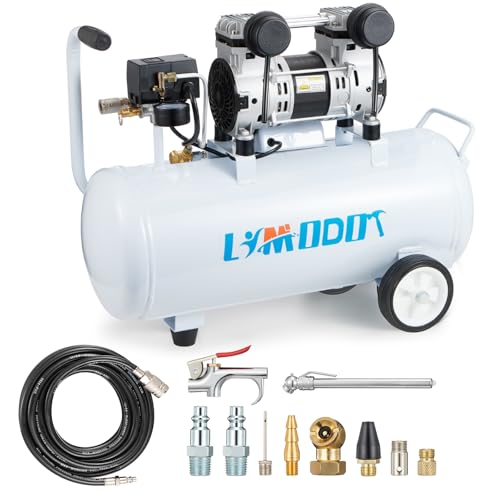
Limodot 8-Gallon Quiet Air Compressor
Limodot pairs an 8-gallon capacity with a quiet 68-decibel motor, keeping noise disruption low during indoor trim or workshop jobs. Delivering 2.8 CFM at 90 PSI alongside a quick 30-second recovery time, it provides steady airflow for DIY pneumatic tools without messy oil maintenance.
Pros
- Low 68 dB output prevents loud workshop disruption
- Fast 30-second pressure recovery keeps projects moving
- Oil-free pump eliminates messy oil changes
- Comprehensive 11-piece accessory kit included out of the box
- Integrated wheels make moving the 8-gallon tank easy
Cons
- 2.8 CFM output limits high-demand continuous tools
- Included PVC hose is stiffer than rubber alternatives
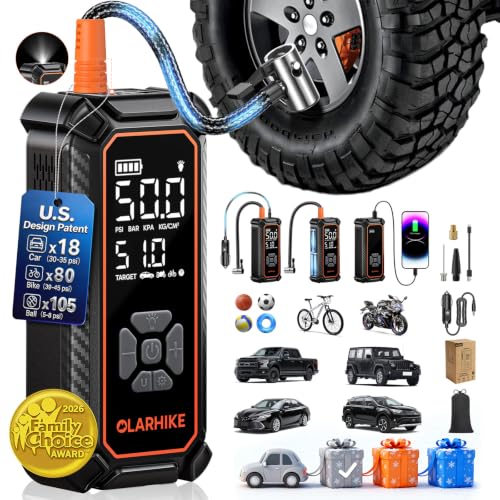
OlarHike Portable Tire Inflator Air Compressor
The OlarHike Portable Tire Inflator combines dual-power versatility via a 12V DC vehicle plug or built-in rechargeable battery with an automatic shut-off digital display. It provides dependable roadside tire top-offs and inflation for passenger cars, crossovers, motorcycles, and bicycles.
Pros
- Dual-power design allows cordless field operation or continuous power through any standard vehicle 12V DC port
- Automatic shut-off technology stops the motor precisely at preset pressure to prevent over-inflation
- Integrated 6000mAh battery reserve doubles as an emergency phone charger and includes an LED work light
- Pocket-sized footprint weighs well under two pounds for convenient transport in center consoles or backpacks
Cons
- Maximum vehicle pressure rating of 51 PSI is not suitable for heavy-duty commercial trucks, RVs, or high-pressure trailer tires
- Compact tankless inflator mechanism cannot power workshop pneumatic tools such as nail guns or air ratchets
- Recharging requires a standard 5V 2A or 5V 3A adapter and is not compatible with high-wattage fast chargers
ECOMAX 6-Gallon 150 PSI Portable Pancake Air
The ECOMAX 6-Gallon 150 PSI Pancake Air Compressor delivers portable, low-maintenance pneumatic power with its 1.5 HP oil-free pump, dual quick-connect couplers, and bundled 10-piece accessory kit. Featuring cold-weather starting support and a flip-up handle, it is an accessible choice for DIYers, trim carpenters, and garage tire maintenance.
Pros
- Comes with a 10-piece accessory kit including an air hose, tire chuck, and blow gun ready out of the box
- Dual quick-connect couplers enable two operators to run pneumatic lines simultaneously
- Oil-free pump design requires zero motor oil maintenance and prevents oil discharge into air lines
- Low-voltage and cold-weather startup capability helps ensure reliable motor turnover in chilly garages
- Flip-up carrying handle and built-in cord bracket simplify transport and tidy storage
Cons
- PVC air hose included in the kit can become stiff and difficult to manage in freezing temperatures
- Not intended for continuous high-demand air tools such as rotary sanders or automotive paint sprayers
- Standard universal motor noise level makes hearing protection advisable during indoor use
Metabo HPT 6-Gallon Pancake Air Compressor Review
The Metabo HPT EC711S is a portable 6-gallon pancake air compressor delivering 2.8 CFM at 90 PSI with a 165 PSI tank ceiling and an operating sound level of 73 dB. With its quick 46-second recovery cycle and dual quick couplers, it is an excellent choice for finish carpenters, punch-list contractors, and DIYers running pneumatic nailers.
Pros
- 73 dB operational sound rating is substantially quieter than standard job-site pancake units
- 165 PSI maximum pressure provides ample air storage with a swift 46-second recovery cycle
- Two 1/4-inch universal quick couplers support multi-tool setups right out of the box
- Sturdy steel roll cage protects gauges and the manifold assembly against knocks and drops
- Oil-free 1.0 HP motor ensures low maintenance and reliable cold-weather motor startup
Cons
- At 38.5 lbs, it is slightly heavier than ultra-compact 1-to-3-gallon trim compressors
- Airflow of 2.8 CFM at 90 PSI is designed for intermittent fastening, not continuous rotary tools or paint sprayers
- Bare-tool configuration means air hoses and pneumatic fastening tools must be purchased separately
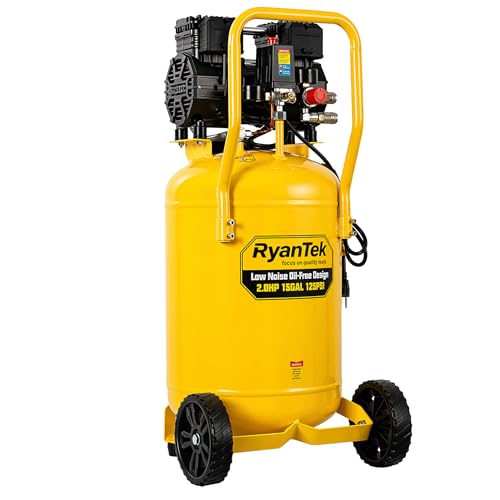
RyanTek 15-Gallon 2HP Air Compressor
Built for garage workshops and indoor tasks, this vertical compressor combines a quiet 66 dBA dual-cylinder motor with a spacious 15-gallon tank. It supplies a dependable 4.5 CFM at 90 PSI for continuous nailing, spraying, and inflation while conserving floor space.
Pros
- Quiet 66 dBA operation suitable for indoor spaces
- Generous 4.5 CFM output at 90 PSI
- Compact vertical tank saves workshop floor space
- Maintenance-free oil-free pump design
- Integrated wheels make rolling transport straightforward
Cons
- Heavy at 68.3 pounds to lift manually
- Maximum pressure caps at 125 PSI
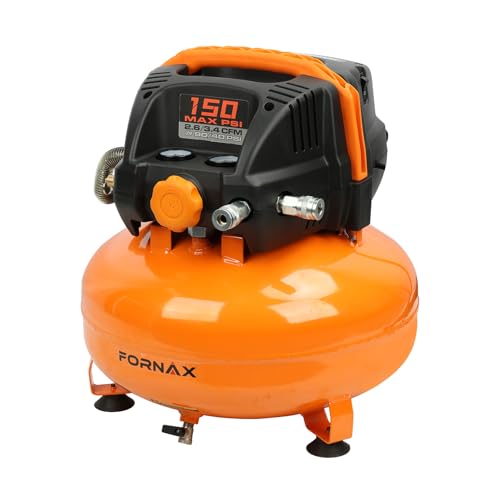
FORNAX 6-Gallon Pancake Air Compressor
The FORNAX 6-Gallon Pancake Air Compressor delivers 2.6 CFM at 90 PSI and up to 150 PSI of maximum pressure, featuring dual couplers and a lightweight 28.8-pound portable footprint. It is a practical pneumatic power source for DIY homeowners, finish carpenters, and garage hobbyists driving nailers or managing tire inflation.
Pros
- Dual quick-connect couplers allow two nailers to operate simultaneously without adding an external splitter manifold
- Generous 6-gallon air tank capacity with a 150 PSI maximum pressure ceiling provides a dependable air reserve
- Lightweight 28.8-pound profile simplifies one-handed carrying up stairs and transport into work vans
- Maintenance-free oil-free pump eliminates oil checks, oil changes, and mess around finished work surfaces
Cons
- Operating sound output rated at 95 dBA is loud and makes hearing protection necessary, especially in closed rooms
- Airflow output of 2.6 CFM at 90 PSI cannot support continuous-demand tools like sanders, grinders, or paint sprayers
- Supplied as a bare-tool compressor without an included air hose, tire inflator chuck, or pneumatic nailers
VELPAX 2.4-Gallon Quiet Air Compressor
Operating at roughly 60 decibels, this portable compressor provides steady air pressure for garage tasks, tire inflation, and trim carpentry without excessive noise. Its oil-free 1.5 HP motor keeps routine upkeep minimal while the integrated handle makes transport between work areas easy.
Pros
- Very quiet operation at roughly 60 dB
- Maintenance-free oil-less pump design
- Compact build with convenient carry handle
- Integrated overload protection and safety release valve
Cons
- Small 2.4-gallon tank limits continuous high-demand tool use
- Modest 115 PSI ceiling restricts heavy industrial applications
CRAFTSMAN 6 Gallon 150 PSI Portable Oil-Free
The CRAFTSMAN 6-Gallon 150 PSI Oil-Free Pancake Air Compressor delivers 2.6 SCFM at 90 PSI via a 1.0 HP low-voltage start motor with factory dual quick couplers. Weighing 30.8 pounds, it provides dependable air delivery for finish carpenters, DIY remodelers, and garage maintenance tasks.
Pros
- Delivers 2.6 SCFM at 90 PSI with a 150 PSI maximum tank ceiling for dependable finish fastening.
- Dual quick couplers allow two pneumatic tools to remain connected at the same time without splitters.
- Oil-free pump design ensures clean air delivery and zero periodic pump oil maintenance.
- Low-voltage start 1.0 HP motor supports reliable startups on standard 120V household outlets.
- Manageable 30.8-pound weight and integrated carry handle provide practical one-person jobsite transport.
Cons
- Air delivery rate of 2.6 SCFM at 90 PSI is not designed for continuous high-demand tools like rotary sanders or paint sprayers.
- Standard oil-free electric motor design generates typical high-pitch operational sound during tank recharge cycles.
- Sold as a bare compressor unit without included air hoses, couplers, or pneumatic nailers.
Understanding Oil-Free Air Compressor Technology and Workshop Applications
Pneumatic power systems rely on rapid air compression to store kinetic energy inside an engineered steel or aluminum vessel. Exploring what is an oil free air compressor requires examining how mechanical engineers eliminate liquid lubricants from the compression chamber without causing catastrophic thermal friction. By shifting from traditional splash-lubricated crankcases to permanently sealed assemblies, these machines redefine portability, clean air delivery, and user maintenance across residential and commercial settings.
The Core Mechanical Operating Principles of Oil-Free Pumps
In a conventional air compressor, a cast-iron piston travels up and down inside an oiled cylinder, relying on oil rings and a splash dipper to keep surfaces slick. In contrast, an oil-free pump utilizes a precision cylinder sleeve lined with low-friction coatings, typically polytetrafluoroethylene (PTFE) or specialized composite polymers. The piston ring itself is fabricated from reinforced Teflon compounds that expand outward under compression stroke pressure to create an airtight seal against the cylinder wall. Because these composite materials possess an exceptionally low coefficient of friction, the pump generates very little abrasive wear during regular cycling.
The supporting rotating assembly also reflects this lubrication-free philosophy through pre-greased, sealed precision ball bearings. The wrist pins and crankshaft bearings are packed at the factory with high-temperature synthetic grease, eliminating any need for an open oil reservoir beneath the piston. Most consumer and jobsite models utilize a single-stage air compressor design that draws atmospheric air through an intake filter and compresses it directly into the storage tank in one stroke. This mechanical layout drastically reduces total unit weight and eliminates the risk of oil leakage during transportation.
Oil-Free Versus Oil-Lubricated Pumps: Mechanical Lifespan and Duty Cycles
Every air compressor architecture involves mechanical engineering trade-offs between continuous durability and operator convenience. Traditional splash-lubricated pumps feature heavy cast-iron cylinders and circulating oil that continuously dissipates intense compression heat away from the piston walls. Because oil-free pumps rely solely on ambient air cooling fans and heat sink fins, their thermal management operates under tighter boundaries. Consequently, oil-free models generally feature intermittent duty cycles, typically around fifty to seventy percent, meaning the pump should rest for a portion of every operating cycle to avoid thermal fatigue.
The operational lifespan of an oil-free pump is primarily determined by the gradual erosion of the PTFE piston ring and cylinder sleeve. While a commercial cast-iron oil-lubricated compressor can run for thousands of hours with regular oil changes, standard oil-free units are engineered for several hundred to a few thousand cumulative operating hours. For DIY homeowners, trim carpenters, and mobile mechanics, this operational window translates to many years of dependable, zero-maintenance service. Understanding these mechanical limits prevents buyers from overworking compact compressors on continuous-draw industrial applications.
Clean Air Delivery and Contamination-Free Pneumatic Applications
One of the most significant advantages of an oil-free system is the purity of the discharged compressed air stream. In oil-lubricated machines, microscopic oil mist invariably bypasses the piston rings during compression, traveling downstream through the discharge line and into connected tools. In sensitive applications like HVLP automotive paint spraying or lacquer finishing, even trace oil aerosol can cause severe cratering, fish-eyes, and finish failure. Oil-free compressors generate an air discharge that is entirely free of petroleum hydrocarbons, protecting delicate surfaces from accidental contamination.
Clean air delivery is equally valuable for fine woodworking, pneumatic nailing, and indoor renovation environments. When using brad nailers, pin nailers, or upholstery staplers on bare hardwood trim, oily exhaust bursts can permanently stain porous timber and ruin expensive millwork. Furthermore, medical, dental, and laboratory environments demand strictly hydrocarbon-free air to maintain sanitary breathing and operating standards. By eliminating oil from the intake-to-discharge pathway, these compressors provide pristine compressed air without requiring costly coalescing oil filters.
Acoustic Engineering: Low-RPM Dual-Piston Pumps Versus High-RPM Motors
Historically, oil-free compressors earned a reputation for deafening noise levels that could easily surpass eighty-five to ninety decibels in an enclosed garage. Older portable pancake designs rely on universal brush-style motors spinning at high speeds above three thousand revolutions per minute to drive a single piston. This rapid reciprocal motion, combined with open intake vents, creates sharp acoustic spikes that cause rapid operator fatigue and disturb household members. Models like the FORNAX pancake compressor operate at approximately ninety-five decibels, illustrating how traditional high-RPM pumps trade acoustic comfort for compact power.
Modern engineering has transformed this dynamic through the introduction of ultra-quiet, low-RPM induction motors paired with twin-cylinder opposed pumps. Operating at roughly seventeen hundred to thirty-four hundred revolutions per minute, these balanced dual pistons distribute compression loads smoothly and feature insulated intake mufflers. Compressors such as the VELPAX unit operate at roughly sixty decibels, while the VEVOR thirteen-gallon and RyanTek fifteen-gallon models register at approximately sixty-six decibels. This dramatic acoustic reduction allows woodworkers and hobbyists to converse comfortably in small basement workshops while the compressor actively pressurizes.
Air Delivery Metrics and Matching CFM to Pneumatic Tools
Evaluating compressed air output requires understanding the relationship between cubic feet per minute (CFM) and operating pressure measured in pounds per square inch (PSI). Pneumatic tools fall into two distinct operational categories: intermittent-demand tools and continuous-demand tools. Intermittent tools like framing nailers, brad nailers, and tire chucks consume brief bursts of air, allowing small portable compressors to maintain sufficient pressure between cycles. For example, the CRAFTSMAN six-gallon pancake unit delivers two point six SCFM at ninety PSI, which readily supports multiple finishing nailers on residential framing jobs.
Continuous-demand air tools present a far greater mechanical challenge for compact oil-free pumps. Devices such as dual-action orbital sanders, pneumatic die grinders, and large HVLP spray guns demand continuous airflow ranging from six to fifteen CFM at ninety PSI. When a tool consumes air faster than the pump can compress it, tank reserve pressure plummets rapidly, causing the tool to stall or sputter mid-pass. Choosing a larger reservoir, such as the RyanTek fifteen-gallon or VEVOR thirteen-gallon units delivering four point five to four point six SCFM at ninety PSI, provides a vital buffer for heavier workshop tasks.
Electrical Demands and Cold-Weather Starting Reliability
Electric air compressors draw substantial electrical current during initial motor startup to overcome mechanical inertia and head pressure. In freezing winter temperatures, oil-lubricated pumps become stiff because their crankcase oil thickens into high-viscosity sludge, forcing the electric motor to pull excessive inrush amperage that frequently trips standard fifteen-amp breakers. Oil-free compressors completely bypass this problem because PTFE piston sleeves and synthetic greased bearings do not congeal in freezing conditions. Models like the ECOMAX pancake unit and Metabo HPT EC711S specifically feature cold-weather starting capabilities that function smoothly in unheated winter job sites.
Understanding line voltage and circuit capacity is equally vital when setting up a garage workshop or remote workstation. Many users discover that running a high-power compressor on a shared household circuit or a long, undersized extension cord induces severe voltage drops that overheat the motor windings. Reviewing small air compressor wattage requirements helps operators configure dedicated electrical lines that prevent unwanted breaker trips. Operating within manufacturer electrical guidelines safeguards internal thermal overload protectors and guarantees that the motor achieves full running speed rapidly.
Routine Maintenance and Tank Moisture Management
While oil-free air compressors eliminate crankcase oil inspections and filter changes, they are not entirely maintenance-free machines. Atmospheric air contains natural humidity that condenses into liquid water inside the storage tank as warm compressed air cools against the steel tank walls. If this moisture is permitted to pool in the bottom of the vessel, it accelerates internal steel oxidation and introduces liquid water droplets directly into pneumatic hoses. Draining the tank at the conclusion of every working session represents the single most important preventative measure an owner can perform.
Tank drain valve design plays an enormous role in determining how easily an operator can purge accumulated condensation. Many budget compressors utilize recessed threaded needle petcocks that become stiff, seize with grit, or require pliers to open. In contrast, premium configurations feature quarter-turn brass ball valves or accessible horizontal drain ports that allow quick, clean moisture evacuation with a flick of the wrist. Regularly checking the ASME safety relief valve ring and keeping air intake filter sponges free of sawdust further preserves system efficiency and ensures safe operating pressures.
Comparing Modern Oil-Free Form Factors for Workshops and Travel
Oil-free compressors are manufactured across several diverse chassis configurations tailored to distinct operational workflows. The pancake form factor, exemplified by models like the CRAFTSMAN six-gallon, Metabo HPT six-gallon, and ECOMAX six-gallon units, provides a low center of gravity and easy carrying handles for active construction jobs. Weighing roughly twenty-eight to thirty-eight pounds, these pancake tanks slip easily into service trucks and withstand rough transport without leaking fluids. Their compact profiles make them the default configuration for trim carpenters and mobile framing crews.
For stationary garage environments and larger workshops, vertical and wheeled horizontal tanks offer expanded storage capacity without occupying excessive floor space. Units such as the Baococo ten-gallon, VEVOR thirteen-gallon, and RyanTek fifteen-gallon compressors incorporate reinforced rubber wheels and sturdy pull handles for rolling between vehicle bays. Meanwhile, ultra-compact handheld units like the OlarHike tire inflator utilize dual-power battery and twelve-volt DC connections, delivering emergency tire inflation right from a vehicle trunk. Matching the mechanical footprint to your physical workshop layout ensures optimal utility without clutter.
Practical Workshop Takeaways and Pressure Verification
Determining whether an oil-free air compressor matches your workshop needs comes down to balancing maintenance freedom against air delivery volume. If your primary tasks involve tire maintenance, finish carpentry, blowing dust, and intermittent automotive repair, an oil-free unit provides unmatched convenience and clean air discharge. You avoid buying specialty compressor oils, checking sight glasses, and worrying about oil spills during vehicle transport. However, if your daily schedule demands continuous rotary sanding or industrial spray coating, verifying your tool CFM requirements against pump capacity remains non-negotiable.
Before placing any new compressor into full service, take the time to verify cut-in and cut-out pressure switch calibration and regulator stability. Allow the machine to build to maximum factory pressure, confirming that the unloader valve releases head pressure cleanly when the motor shuts off. Check all manifold quick-connect couplers with a mild soapy water solution to identify and eliminate hairline pneumatic leaks early. Following these fundamental verification steps ensures your oil-free compressor delivers reliable pneumatic power for years of productive workshop projects.
About the author
Bob Beacham is an experienced tools and workshop writer with deep knowledge of power equipment, mechanical systems, and practical DIY applications. His coverage of air compressors, welding equipment, saws, and workshop tools helps translate technical specifications into useful guidance for homeowners and serious DIYers.