
How to Increase the Cfm of an Air Compressor: Practical Guide for 2026
Learn how to increase the cfm of an air compressor with practical workshop modifications, piping upgrades, and dual-tank setups for October 2026.
 By Bob Beacham
Updated October 7, 2026
By Bob Beacham
Updated October 7, 2026

High-demand pneumatic tools like dual-action sanders, paint sprayers, and die grinders often starve for air when paired with compact workshop compressors. When line pressure plunges during continuous operation, many operators immediately research how to increase the cfm of an air compressor without replacing their existing hardware. While the displacement of an electric air pump is mechanically fixed by cylinder bore and motor speed, specific delivery bottlenecks and air distribution limits can drastically restrict usable volume. Gaining a clear grasp of true volume delivery starts with understanding CFM ratings under standard pressure thresholds like 90 PSI.
In practical workshop setups, addressing restrictions in your air delivery lines can restore significant lost airflow to pneumatic tools. Operators can also expand buffer capacity or pair multiple air units together to meet aggressive tool demands during intense shop cycles. Recognizing whether a system needs lower operating pressure, clean intake filtration, or a secondary storage reservoir prevents motor burnout while protecting delicate pneumatic equipment. Optimizing these pneumatic variables allows home mechanics and woodworkers to extract maximum airflow from their existing compressor configuration.
| Award | Product | ACR Score About ACR ScoreThe ACR Score is our own rating from 0 to 10, based on performance, design and build, ease of use, and value. It reflects independent research and is never influenced by manufacturers, retailers, or affiliate commissions. Learn more › | |
|---|---|---|---|
| Best Overall |
Rhino USA 12V Portable Air Compressor
|
9.1/10 | Buy |
| Best Budget |
 Kohree 12V 7.06 CFM Air Compressor
|
8.9/10 | Buy |
| Best Value |
 ECOMAX 6-Gallon Pancake Air Compressor - 150 PSI
|
8.8/10 | Buy |
| Best Premium |
 ALL-TOP 12V Dual-Cylinder Air Compressor
|
8.8/10 | Buy |
 Campbell Hausfeld 80-Gallon Stationary Air
|
8.8/10 | Buy | |
 CNWZYMX 200 PSI 12V Air Compressor
|
8.6/10 | Buy | |
 METOWARE 12V Offroad Air Compressor
|
8.6/10 | Buy | |
 Air Lift 16060 12V Air Compressor
|
8.6/10 | Buy | |
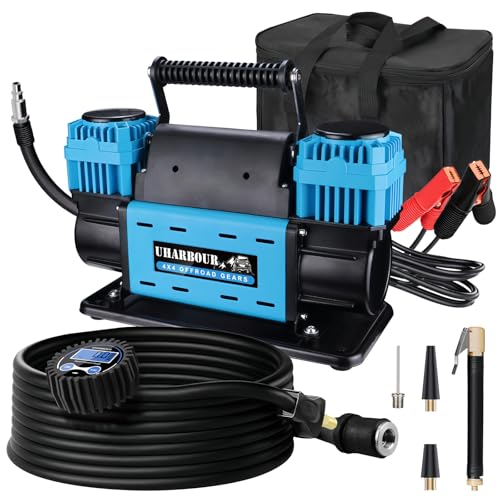 Uharbour 12V 12.35 CFM Air Compressor
|
8.6/10 | Buy | |
 FORNAX 8-Gallon 1HP Quiet Air Compressor
|
8.0/10 | Buy |
Rhino USA 12V Portable Air Compressor
The Rhino USA 12V Portable Air Compressor delivers a manufacturer-rated 10.6 CFM flow rate with digital auto-shutoff functionality and heavy-duty battery clamps. It is an ideal high-output mobile inflation solution for off-roaders, truck owners, and DIY mechanics needing rapid tire pressure management in the field.
Pros
- High manufacturer-rated 10.6 CFM airflow provides rapid inflation for large truck and off-road tires
- Digital auto-shutoff with backlit screen prevents accidental over-inflation
- Cleanable, serviceable intake filters help extend pump service life in dusty trail conditions
- Rubber isolator feet reduce chassis vibration and support permanent vehicle mounting
- Generous 10-foot power leads and 8-foot air hose offer convenient reach around full-size vehicles
Cons
- Requires a direct 12V automotive battery connection and cannot run directly on 120V household wall outlets
- Tankless inflator architecture is not suited for operating continuous air-hungry workshop tools
- High electrical draw requires proper vehicle battery monitoring during multi-tire inflation runs
Kohree 12V 7.06 CFM Air Compressor
Built for trucks, RVs, and off-road rigs, this high-output inflator pumps up to 7.06 CFM and reaches 150 PSI. A heavy metal base reduces operating vibration, while integrated thermal protection safeguards the motor during demanding inflation tasks.
Pros
- High 7.06 CFM airflow inflates large tires quickly
- Heavy-duty metal construction with vibration dampening feet
- Long 26-foot air hose reaches all four tires
- Built-in thermal cut-off prevents motor overheating
- Includes accessory nozzles and durable storage bag
Cons
- Short 6.5-foot power cord limits direct battery reach
- Bulky unit adds substantial weight to gear storage
- Automatic pauses interrupt continuous inflation briefly
ECOMAX 6-Gallon Pancake Air Compressor - 150 PSI
Delivering 2.6 SCFM at 90 PSI from a 6-gallon tank reaching up to 150 PSI, the ECOMAX pancake air compressor balances reliable pneumatic output with a portable 27.6-pound frame. Powered by an oil-free UMC motor engineered for cold-weather starting and equipped with dual quick couplers, it is a practical air supply for trim carpenters, punch-list contractors, and home garage users.
Pros
- Delivers 2.6 SCFM at 90 PSI with a 150 PSI maximum pressure ceiling, well suited for finish carpentry and general garage chores
- Compact 27.6-pound design with a rubberized carry handle allows easy one-handed carrying up stairs and into work vans
- Dual universal quick couplers allow two air lines to connect simultaneously for multi-tool efficiency
- Oil-free UMC motor provides low-maintenance operation with reliable cold-weather and low-voltage starting capability
- Q235b alloy steel tank build and wide rubber feet offer solid jobsite stability
Cons
- Airflow rating of 2.6 SCFM at 90 PSI is not designed for continuous high-consumption air tools like rotary sanders, die grinders, or HVLP sprayers
- Bare-tool configuration does not include pneumatic hoses, tire chucks, or finish nailers in the package
- The manufacturer does not list an official decibel (dBA) sound rating, making standard hearing protection advisable during indoor use
ALL-TOP 12V Dual-Cylinder Air Compressor
The ALL-TOP 12V Dual-Cylinder Air Compressor delivers a manufacturer-rated 12.35 CFM airflow and 150 PSI maximum pressure with an integrated digital LCD auto-stop controller. Powered via direct battery alligator clamps, this heavy-duty portable pump is built for overlanders, off-road enthusiasts, and truck owners needing rapid tire reinflation on remote trails.
Pros
- High rated airflow output of 12.35 CFM (350 L/min) significantly speeds up multi-tire trail reinflation
- Accurate digital auto-stop feature prevents over-inflation without requiring manual gauge checks
- Robust dual-cylinder motor with 221-degree Fahrenheit thermal shutdown and 120A circuit protection
- Anti-vibration metal base can be left portable or permanently bolted into an overland rig
Cons
- Substantial 26.5-pound weight makes it bulkier to stow than compact emergency inflators
- High current draw requires hooking directly to vehicle battery terminals with the engine running
- Normal 2 to 4 pause intervals during the digital inflation cycle may surprise unfamiliar users
Campbell Hausfeld 80-Gallon Stationary Air
Engineered for automotive repair shops and serious home garages, this stationary Campbell Hausfeld unit combines an 80-gallon ASME tank with a 5 HP motor delivering 16.0 CFM at 90 PSI. Its oil-lubricated cast-iron pump runs at a low 950 RPM, making it a dependable choice for continuous paint spraying, sanding, and air tool operation.
Pros
- Substantial 16.0 CFM delivery at 90 PSI easily powers continuous pneumatic tools like sanders and paint sprayers
- Heavy-duty cast-iron two-cylinder pump runs at a low 950 RPM for smoother operation and reduced thermal stress
- ASME-certified 80-gallon vertical tank maximizes air storage while minimizing workshop floor footprint
- Single-phase 208-230V motor includes overload protection and eliminates the need for an external magnetic starter
Cons
- Stationary footprint and substantial 460-pound weight require permanent shop placement and mechanical assistance during unloading
- Requires dedicated 208-230V single-phase electrical wiring and cannot run on standard 120V household outlets
- Maximum operating pressure caps at 140 PSI, which is lower than some two-stage compressors that reach 175 PSI
CNWZYMX 200 PSI 12V Air Compressor
Built for vehicle air suspension and train horn setups, this 12-volt CNWZYMX unit delivers up to 200 PSI using a stainless steel cylinder and braided leader hose. It comes equipped with an oil-water separator and adaptable NPT fittings for complete onboard air integration.
Pros
- High 200 PSI maximum working pressure
- Durable stainless steel cylinder construction
- Includes oil-water separator and NPT adapter
- Integrated mounting bracket simplifies vehicle installation
Cons
- High 23-amp draw requires heavy-duty wiring
- Modest 1.7 CFM output at zero PSI
METOWARE 12V Offroad Air Compressor
The METOWARE 12V Offroad Air Compressor is a heavy-duty dual-cylinder portable inflator delivering an advertised 10.6 CFM airflow rate up to 150 PSI. Designed for 4x4 trucks, RVs, and trail rigs, it provides rapid tire inflation and deflation utility without needing a bulky shop tank.
Pros
- High-volume dual-cylinder pump with an advertised 10.6 CFM output for fast tire air-up times
- Extended 24-foot air hose easily reaches all tires on full-size trucks and RVs
- Durable metal cylinder and gear construction built for trail and vehicle maintenance
- Integrated 3-in-1 tire inflator gauge supports pressure checking, inflating, and trail deflation
- Standard 1/4-inch T quick-connect fitting for convenient accessory hookup
Cons
- Operates strictly on 12V DC power, making it unsuitable for standard 120V household AC outlets without an adapter
- Direct-drive tankless design is intended for inflation tasks rather than operating continuous-demand pneumatic shop tools
- Dual-motor high-CFM configuration generates noticeable heat during extended high-pressure runs
Air Lift 16060 12V Air Compressor
Built for automotive air suspension setups, the Air Lift 16060 delivers onboard pneumatic support in a compact package weighing under two pounds. Its modest footprint makes it an easy fit for drivers seeking a dedicated 12V compressor that can mount into tight vehicle spaces.
Pros
- Lightweight construction under two pounds
- Compact size fits tight underbody spaces
- Standard 12-volt vehicle power compatibility
- Manufactured in the United States
Cons
- Restricted to 12V automotive power sources
- Requires separate air lines and fittings
Uharbour 12V 12.35 CFM Air Compressor
Equipped with dual motors, this heavy-duty compressor delivers a high 12.35 CFM airflow to reinflate off-road tires quickly after trail rides. An integrated digital gauge provides accurate pressure readings, though its 26-pound weight makes transport noticeably hefty.
Pros
- High 12.35 CFM output from dual motors
- Digital gauge provides clear, precise pressure control
- Rugged build designed for harsh trail environments
- Included storage bag keeps gear organized
Cons
- Heavy weight at over 26 pounds to haul
- Bulky dual-motor body requires substantial cargo room
FORNAX 8-Gallon 1HP Quiet Air Compressor
Built for indoor workshops and garage tasks, this 8-gallon unit pairs a quiet 70 dB oil-free motor with rapid 90-second tank recovery. Its wheeled design and 2.2 CFM output make it a solid match for trim nailing, tire inflation, and light pneumatic tools.
Pros
- Quiet 70 dB operation ideal for homes and garages
- Quick 90-second tank recovery time
- Maintenance-free oil-free pump mechanism
- Wheeled cart configuration offers effortless mobility
Cons
- 2.2 CFM output limits continuous high-demand pneumatic tools
- 125 PSI maximum rating falls below heavy commercial standards
Maximizing Airflow: Practical Methods to Improve Air Delivery
Understanding the mechanical boundaries of an air compressor is the first step toward getting more airflow from your workshop setup. Many operators assume that turning a regulator knob or adjusting a pressure switch will automatically force a pump to produce more volume. In reality, compressor air delivery is governed by pump displacement, motor rotational speed, and atmospheric intake density. By looking at true flow restrictions, storage dynamics, and mechanical configurations, you can uncover practical methods to maximize your available airflow without damaging your equipment.
The Physics of Compressor Displacement: What Can and Cannot Be Changed
An air compressor pump functions as a positive displacement machine that moves a fixed volume of ambient air on every stroke. Inside single-stage and two-stage pumps, the cylinder bore diameter and crankshaft stroke determine the total cubic inches of air drawn into the compression chamber. Because the physical dimensions of the cylinder and piston cannot expand, the theoretical air intake per revolution remains constant. Direct-drive units, such as oil-free pancake compressors, run at fixed electric motor speeds that cannot be altered without burning out the motor windings.
Attempting to force an electric motor to spin faster by increasing voltage or altering wiring leads to severe thermal overload. Standard alternating current induction motors operate at fixed synchronous speeds dictated by electrical line frequency, typically around 1,725 RPM or 3,450 RPM. Increasing rotational speed on a pump that was not balanced for high velocity accelerates piston ring wear, overheats valve plates, and risks mechanical seizure. Therefore, pure continuous CFM output cannot simply be dialed up on a self-contained, direct-drive compressor pump.
While pump displacement is physically capped, the volume of air delivered to your pneumatic tools is often significantly lower than the factory pump rating. Frictional resistance, undersized fittings, thermal losses, and intake restrictions frequently rob pneumatic tools of the volume they require. When operators explore practical strategies to boost airflow, the realistic objective is eliminating delivery losses and maximizing pneumatic storage rather than attempting to enlarge pump cylinder capacity.
Lowering Working Pressure to Boost Usable Airflow Volume
Compressor pump delivery increases substantially when operating against lower tank and line pressures. Standard manufacturer ratings demonstrate this principle clearly: a pump produces more volume at 40 PSI than it does at 90 PSI. For instance, the ECOMAX Pancake Air Compressor is rated to deliver 2.6 CFM at 90 PSI, but its delivery jumps to 3.6 CFM at 40 PSI. As tank pressure climbs, backpressure forces the pump pistons to work harder against compressed air, which increases blow-by past the rings and reduces volumetric efficiency.
Operating your air tools at the minimum pressure required for the task immediately frees up higher volume from your compressor. Many pneumatic tools, such as paint sprayers, texture guns, and air dusters, do not require the standard 90 PSI used by heavy impact wrenches. Setting your line regulator to 40 or 50 PSI allows the compressor pump to supply higher continuous volume while running significantly cooler. This operational change minimizes heat buildup and helps the pump maintain peak volumetric output for longer periods.
Many shop operators mistakenly crank their pressure regulators to maximum in a misguided attempt to get more power from their tools. Setting line pressure unnecessarily high increases air consumption per cycle, which drains the storage tank much faster and forces the motor to cycle continuously. Matching line regulation strictly to the operational specifications of each pneumatic tool preserves your air buffer and optimizes delivered flow.
Plumbing a Secondary Receiver Tank for High-Demand Burst Airflow
Plumbing an auxiliary air tank into your pneumatic line is an effective way to run high-CFM tools on a smaller compressor. A secondary receiver tank does not change the continuous delivery rate of the pump, but it functions like a pneumatic capacitor by storing a massive reserve of pressurized air. Tools with intermittent high-volume consumption, like impact wrenches, framing nailers, and plasma cutters, draw heavily from stored volume rather than relying solely on pump output. This setup allows you to complete short, intensive tasks without experiencing immediate pressure drops at the tool inlet.
Connecting an auxiliary tank requires placing a heavy-duty air line between the main compressor discharge port and the secondary tank inlet. Both tanks must be equipped with functional safety relief valves and accessible condensation drains to maintain safe operation. Monitoring how often an air compressor cycles helps confirm that the pump recovers smoothly without running continuously past its rated duty cycle. The primary trade-off of a secondary receiver is that total initial fill time from zero pressure will be longer because the pump must pressurize both vessels.
Once the combined storage capacity reaches full cut-out pressure, the expanded air buffer provides sustained high flow for tools that would otherwise stall a small tank. For example, expanding an 8-gallon reservoir on a portable unit like the FORNAX 8 Gallon Air Compressor with an additional 10-gallon auxiliary vessel more than doubles your burst work capacity. This configuration bridges the gap between small portable convenience and demanding pneumatic tool requirements.
Connecting Two Air Compressors in Parallel to Double CFM Output
Connecting two separate air compressors together in a parallel manifold configuration is the only reliable method to physically double your delivered CFM. By joining the air outlets of two independent compressors into a single distribution manifold, their respective flow rates combine directly. If you link a portable compressor delivering 2.6 CFM at 90 PSI with a secondary unit delivering 3.0 CFM at 90 PSI, your pneumatic line receives an impressive combined flow of 5.6 CFM at 90 PSI. This approach provides enough sustained airflow to operate continuous-demand tools like dual-action sanders and small HVLP spray guns.
Configuring a dual-compressor parallel system requires specific plumbing hardware to prevent backflow and mechanical fighting between units. Each compressor must have a dedicated one-way check valve installed before joining the central tee manifold so air cannot push backward into the other tank. Furthermore, you should adjust the pressure switches so both units share the workload, setting one compressor slightly higher to act as the primary lead while the second unit cuts in when line pressure drops under heavy tool draw.
Electrical circuit management is critical when running two electric air compressors simultaneously in a home garage or workshop. Standard 120-volt household circuits cannot support the simultaneous starting inrush current of two compressor motors on the same branch line. Each compressor must be plugged into a separate, dedicated electrical circuit, such as two distinct 15-amp or 20-amp breakers, to prevent nuisance tripping. Managing electrical distribution carefully ensures that both pumps run reliably without overloading your breaker panel.
Eliminating Airline Restrictions: High-Flow Couplers, Regulators, and Hose Diameter
Severe air delivery bottlenecks frequently occur outside the compressor tank within restrictive hoses, fittings, and regulators. Standard 1/4-inch industrial quick-connect couplers feature narrow internal orifices that choke airflow, causing dramatic dynamic pressure drops during tool operation. Replacing standard fittings with 1/4-inch or 3/8-inch high-flow V-style couplers allows up to double the air volume to pass through the exact same connection point. This straightforward upgrade ensures that the full volume produced by the compressor actually reaches your pneumatic tool.
Air hose internal diameter plays an equally vital role in preserving delivered CFM over standard working distances. A standard 50-foot rubber or polyurethane hose with a 1/4-inch internal diameter creates substantial frictional drag, reducing both line pressure and available volume at the tool trigger. Upgrading to a 3/8-inch or 1/2-inch internal diameter air hose cuts frictional flow resistance dramatically, allowing tools to operate at their intended performance level. Eliminating dynamic pressure loss across your air lines often makes an undersized compressor feel significantly more capable.
Factory-installed pressure regulators on consumer-grade compressors also tend to have restrictive internal passageways that limit maximum flow. Installing a high-flow, balanced-diaphragm pressure regulator on your main workshop manifold eliminates this choke point. When combined with larger supply lines and unrestricted couplers, your pneumatic tools receive unobstructed volume without unnecessary pressure dips.
Restoring Lost CFM Through Pump Maintenance and Intake Optimization
Over time, neglected compressor maintenance leads to significant CFM degradation that makes an otherwise healthy machine struggle. A dirty or clogged air intake filter restricts atmospheric air entering the compression cylinder, starving the pump and reducing volumetric efficiency. Inspecting and replacing foam or paper intake filter elements restores proper intake flow and allows the pistons to draw full air charges on every stroke. In harsh jobsite environments, checking intake filters monthly is essential for maintaining rated factory output.
Internal valve plate wear and reed valve carbonization also create internal leaks that severely decrease effective air delivery. When thin metal reed valves fail to seal completely against the valve plate, compressed air blows back into the intake chamber during the compression stroke. Replacing worn reed valves, head gaskets, and piston rings restores original factory compression pressure and cycle recovery speed. On oil-lubricated pumps, maintaining proper non-detergent compressor oil levels reduces friction and ensures tight piston ring seals.
Accumulated moisture inside the storage tank reduces usable air volume and accelerates internal corrosion that can foul downstream valves. Understanding the implications of leaving compressed air stored in the tank highlights the importance of daily drainage. Purging water daily through bottom tank drain valves preserves full air storage buffer capacity and prevents rust debris from clogging regulator ports.
Altering Motor Pulleys on Belt-Driven Compressors: Feasibility and Limits
On belt-driven stationary air compressors, changing the motor drive pulley diameter provides a mechanical way to alter pump rotational speed. Installing a slightly larger pulley on the electric motor shaft causes the pump flywheel to rotate faster, which increases total intake strokes per minute. This modification theoretically increases delivered CFM because the pump displaces more cubic feet of air in a given period. However, this mechanical adjustment requires careful calculation and carries significant risks if pushed beyond factory design tolerances.
Increasing pump RPM demands substantially more mechanical horsepower from the electric motor, which increases electrical current draw. If the motor lacks sufficient continuous running horsepower, the additional mechanical load will push motor amperage past its full load rating, tripping thermal overload protectors or causing motor burnout. Furthermore, running a cast-iron pump beyond its recommended RPM limit generates excessive heat, thinning the lubricating oil and accelerating bearing wear. Any pulley modification must stay strictly within the pump maximum RPM rating and the motor continuous horsepower limits.
Direct-drive compressors, including compact jobsite units and portable tire inflators like the ALL-TOP 12V Air Compressor or Rhino USA Dual Tire Air Compressor, cannot undergo pulley modifications. These machines feature direct crankshaft connections that operate at fixed motor speeds. For direct-drive platforms, optimizing plumbing, reducing working pressure, and maintaining clean air filters remain the only viable mechanical adjustments.
Matching Tool CFM Requirements: When an Equipment Upgrade Is Required
Despite every workshop optimization, severe mismatches between tool consumption and compressor output ultimately require upgrading your primary hardware. Intermittent pneumatic tools like finish nailers require less than one CFM, making them well suited for portable pancake units. In contrast, continuous air tools like rotary sanders, paint guns, and die grinders consume between 8 and 15 CFM continuously at 90 PSI. A small compressor producing only 2 to 3 CFM cannot keep up with continuous tools regardless of secondary tanks or high-flow couplers.
When continuous air demand outpaces your setup, transitioning to a dedicated stationary workshop machine becomes necessary. Heavy-duty options like the Campbell Hausfeld 80-Gallon Air Compressor deliver 16.0 CFM at 90 PSI powered by a 5 HP motor and a slow-turning cast-iron pump. This substantial air volume powers demanding automotive and commercial tools continuously without pressure starvation or pump overheating. Recognizing the threshold where modifications can no longer bridge the gap prevents wasted time and protects smaller compressors from burnout.
For mobile and off-road applications, specialized high-output 12V compressors provide rapid airflow tailored specifically for high-volume tire inflation. Units like the Kohree 12V Air Compressor delivering 7.06 CFM, or the Uharbour 12V 12.35 CFM Offroad Air Compressor, move massive volumes of air at moderate pressures for large truck and trailer tires. Selecting equipment engineered specifically for high volume ensures reliable operation without pushing light-duty tools beyond their operational limits.
Practical Verification and Safety Precautions Before Modifying Pneumatic Lines
Prioritizing workshop safety is essential whenever modifying compressor plumbing, adding secondary tanks, or joining dual units. Always depressurize all connected air tanks completely by opening drain valves before loosening fittings or installing manifold tees. Never tamper with or adjust factory ASME safety relief valves, as these critical emergency devices prevent catastrophic tank overpressurization if a pressure switch fails. Ensuring that all added components, hoses, and manifold blocks are rated well above the compressor maximum cut-out pressure protects against dangerous equipment ruptures.
After assembling new plumbing or secondary tanks, thoroughly test all connections for microscopic air leaks using a soapy water solution. Even tiny leaks around threaded NPT fittings cause steady volume loss, forcing the compressor to cycle repeatedly and reducing delivered tool pressure. Applying quality PTFE thread sealant or anaerobic pipe paste to all male threads guarantees airtight seals across your manifold. Verifying that pressure switches cut in and cut out at proper factory thresholds confirms that your modified setup functions smoothly.
Maximizing the usable CFM of an air compressor requires a practical combination of eliminating distribution friction, utilizing secondary storage, and matching tool pressure requirements. While the physical displacement of an individual pump cannot be magically expanded, optimizing your air delivery system ensures that every available cubic foot of compressed air powers your tools efficiently. Following systematic maintenance and sensible plumbing practices keeps your pneumatic workshop running at peak performance.
About the author
Bob Beacham is an experienced tools and workshop writer with deep knowledge of power equipment, mechanical systems, and practical DIY applications. His coverage of air compressors, welding equipment, saws, and workshop tools helps translate technical specifications into useful guidance for homeowners and serious DIYers.