
How to Choose Air Compressor Size: A Practical Sizing Guide for 2026
Understanding how to choose air compressor size prevents pressure drops and tool stall. Explore CFM, PSI, and tank volume rules for October 2026.
 By Bob Beacham
Updated October 7, 2026
By Bob Beacham
Updated October 7, 2026

Pneumatic sanders, automotive impact wrenches, and framing nailers quickly stall when an undersized pump fails to maintain adequate airflow under load. Deciding how to choose air compressor size requires balancing continuous air delivery volume against stored pressure reserves rather than simply looking at tank gallon capacity. Many workshop owners mistakenly assume a larger storage tank can compensate for an undersized electric motor and pump assembly. In reality, sustained tool performance depends primarily on CFM delivered at operating pressure, while the physical receiver tank functions as a temporary surge buffer.
Selecting the wrong configuration often leads to tripped household circuit breakers, excessive pump cycling, or frustrating pressure drop mid-cut. If your workshop demands outpace your current tank buffer, adding an auxiliary air tank can provide extra surge volume for short bursts, but continuous tools still rely on true compressor CFM output. By evaluating your highest-consumption pneumatic tool, required duty cycle intervals, and electrical supply capacity, you can establish an accurate sizing profile before investing in hardware. A thoughtful calculation prevents both expensive oversizing and disappointing tool starvation during demanding tasks.
| Award | Product | ACR Score About ACR ScoreThe ACR Score is our own rating from 0 to 10, based on performance, design and build, ease of use, and value. It reflects independent research and is never influenced by manufacturers, retailers, or affiliate commissions. Learn more › | |
|---|---|---|---|
| Best Overall |
ALL-TOP Dual Cylinder 12V Air Compressor
|
9.2/10 | Buy |
| Best Premium |
 Metabo HPT EC28M Quiet Air Compressor
|
9.1/10 | Buy |
| Best Budget |
 SARDVISA 13-Piece Air Blow Gun and Nozzle
|
8.8/10 | Buy |
| Best Value |
 ECOMAX 6-Gallon Pancake Air Compressor - 150 PSI
|
8.8/10 | Buy |
 DEWALT D55146 4.5-Gallon 225-PSI Wheeled
|
8.8/10 | Buy | |
 Air Compressor for Beginners
|
8.6/10 | Buy | |
 Metabo HPT 6-Gallon Pancake Air Compressor Review
|
8.6/10 | Buy | |
 DEWALT DWFP55130 2.5-Gallon 200 PSI Quiet Trim Air
|
8.4/10 | Buy | |
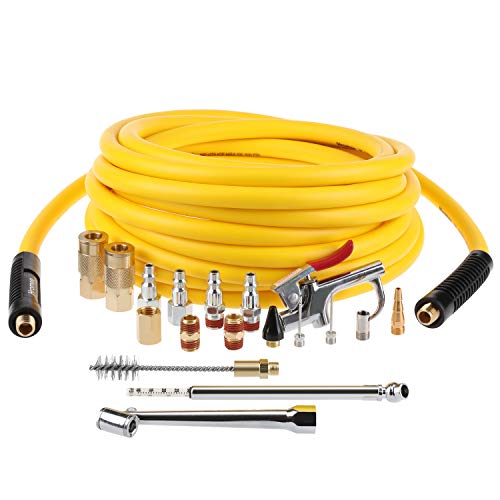 Hromee 19-Piece 25-Foot Air Compressor Kit
|
8.3/10 | Buy | |
 VEVOR 1-Gallon 1HP Portable Air Compressor
|
8.3/10 | Buy |
ALL-TOP Dual Cylinder 12V Air Compressor
Built for rapid tire inflation on large trucks and off-road rigs, this dual-cylinder pump pushes an impressive 12.35 CFM flow rate up to 150 PSI. The rugged metal frame, integrated thermal safeguards, and extended 26-foot hose provide reliable utility for heavy-duty vehicle recovery.
Pros
- High 12.35 CFM output swiftly inflates large tires
- Dual aluminum cylinder construction helps dissipate heat
- Generous 26-foot hose reaches all corners of large vehicles
- Equipped with automatic thermal and over-current safety switches
Cons
- Heftier 24-pound build demands extra carrying effort
- Third-party gauges require built-in over-pressure protection
Metabo HPT EC28M Quiet Air Compressor
Operating at an ultra-quiet 59 dB, the Metabo HPT EC28M 1-gallon oil-free air compressor provides low-noise pneumatic air power in a compact 25.2-pound roll-cage frame. It is an ideal portable match for trim carpenters, punch-list contractors, and residential DIYers needing peaceful indoor fastening.
Pros
- Remarkably quiet 59 dB operation makes it well-suited for occupied residential job sites
- Lightweight 25.2-pound weight and ergonomic rubber grip make carrying up stairs straightforward
- Sturdy steel roll cage provides reliable physical protection around gauges and controls
- Oil-free pump mechanism eliminates pump lubrication maintenance and avoids messy oil leaks
- Universal quick-connect coupler simplifies tool connections across standard pneumatic lines
Cons
- Compact 1-gallon tank capacity is intended for intermittent fastening rather than continuous air tools
- Small air storage volume causes frequent motor cycling during rapid nailing sequences
- Bare-tool configuration does not include an air hose or pneumatic finish nailers
SARDVISA 13-Piece Air Blow Gun and Nozzle
The SARDVISA 13-Piece Air Blow Gun Set delivers multi-purpose workshop cleanup and light inflation capability with an all-metal chrome-plated body and standard 1/4-inch NPT connection. It is an affordable, versatile starter kit for garage DIYers, hobbyists, and woodworkers needing flexible nozzle options at the workbench.
Pros
- All-metal chrome-plated body offers dependable durability compared to cheap molded plastic alternatives
- Comprehensive 13-piece accessory bundle covers machinery cleaning, crevice blowing, and small inflation tasks
- PVC-coated thumb lever provides comfortable control during repetitive workbench blow-offs
- Supplied Teflon tape and thread adapters make immediate out-of-the-box setup straightforward
Cons
- Lacks OSHA-compliant side-relief bypass venting, requiring users to manually regulate compressor line pressure for safety
- Alloy nozzle extensions and thread converters require careful hand alignment to avoid cross-threading
- Thumb-lever actuation can cause hand fatigue during prolonged, continuous blowing compared to full-handle pistol grips
ECOMAX 6-Gallon Pancake Air Compressor - 150 PSI
Delivering 2.6 SCFM at 90 PSI from a 6-gallon tank reaching up to 150 PSI, the ECOMAX pancake air compressor balances reliable pneumatic output with a portable 27.6-pound frame. Powered by an oil-free UMC motor engineered for cold-weather starting and equipped with dual quick couplers, it is a practical air supply for trim carpenters, punch-list contractors, and home garage users.
Pros
- Delivers 2.6 SCFM at 90 PSI with a 150 PSI maximum pressure ceiling, well suited for finish carpentry and general garage chores
- Compact 27.6-pound design with a rubberized carry handle allows easy one-handed carrying up stairs and into work vans
- Dual universal quick couplers allow two air lines to connect simultaneously for multi-tool efficiency
- Oil-free UMC motor provides low-maintenance operation with reliable cold-weather and low-voltage starting capability
- Q235b alloy steel tank build and wide rubber feet offer solid jobsite stability
Cons
- Airflow rating of 2.6 SCFM at 90 PSI is not designed for continuous high-consumption air tools like rotary sanders, die grinders, or HVLP sprayers
- Bare-tool configuration does not include pneumatic hoses, tire chucks, or finish nailers in the package
- The manufacturer does not list an official decibel (dBA) sound rating, making standard hearing protection advisable during indoor use
DEWALT D55146 4.5-Gallon 225-PSI Wheeled
The DEWALT D55146 is a rugged 4.5-gallon portable compressor featuring an oil-free pump and 225-PSI maximum storage pressure for extended air reserve. Built with 10-inch non-flat tires and a protective metal console, it delivers dependable mobility and performance for trim carpenters, remodelers, and garage hobbyists.
Pros
- 225 PSI maximum tank storage provides significantly more usable compressed air than standard lower-pressure portable tanks
- 10-inch non-flat tires make rolling across jobsite debris, thresholds, and gravel paths smooth and dependable
- Protective metal console shields working pressure gauges and air controls against accidental jobsite impacts
- Oil-free pump allows clean transport in truck beds or car trunks without worrying about spilled crankcase oil
Cons
- Substantial 88-pound weight requires noticeable effort when lifting into high truck tailgates or carrying up staircases
- Oil-free pump operation naturally produces elevated sound levels inside small enclosed garages or occupied rooms
- Larger physical footprint takes up more floor space than compact pancake-style compressors
Air Compressor for Beginners
This instructional paperback guide breaks down essential pneumatic principles, explaining the relationship between PSI, CFM, tool compatibility, and receiver tank safety. It serves as an accessible reference for DIY homeowners and hobbyists setting up their first workshop compressor.
Pros
- Demystifies core pneumatic specifications like CFM, PSI, and duty cycle for first-time buyers
- Emphasizes vital maintenance habits like routine tank condensation drainage and moisture management
- Helps prevent costly mistakes when purchasing compressors and matching pneumatic tools
- Compact and lightweight 6 x 9-inch physical reference format suited for workshop bench storage
Cons
- Instructional reference guide only and contains no physical pneumatic tools, fittings, or hardware
- Experienced mechanics and industrial pneumatic technicians may find the foundational material too basic
- Slim 0.29-inch profile reflects a concise introductory overview rather than an exhaustive commercial engineering manual
Metabo HPT 6-Gallon Pancake Air Compressor Review
The Metabo HPT EC711S is a portable 6-gallon pancake air compressor delivering 2.8 CFM at 90 PSI with a 165 PSI tank ceiling and an operating sound level of 73 dB. With its quick 46-second recovery cycle and dual quick couplers, it is an excellent choice for finish carpenters, punch-list contractors, and DIYers running pneumatic nailers.
Pros
- 73 dB operational sound rating is substantially quieter than standard job-site pancake units
- 165 PSI maximum pressure provides ample air storage with a swift 46-second recovery cycle
- Two 1/4-inch universal quick couplers support multi-tool setups right out of the box
- Sturdy steel roll cage protects gauges and the manifold assembly against knocks and drops
- Oil-free 1.0 HP motor ensures low maintenance and reliable cold-weather motor startup
Cons
- At 38.5 lbs, it is slightly heavier than ultra-compact 1-to-3-gallon trim compressors
- Airflow of 2.8 CFM at 90 PSI is designed for intermittent fastening, not continuous rotary tools or paint sprayers
- Bare-tool configuration means air hoses and pneumatic fastening tools must be purchased separately
DEWALT DWFP55130 2.5-Gallon 200 PSI Quiet Trim Air
The DEWALT DWFP55130 delivers a capable 3.0 SCFM at 90 PSI with a 200 max PSI 2.5-gallon tank, running at a quiet 71.5 dBA on an efficient 12-amp motor. It is an ideal pneumatic power source for trim carpenters, punch-list contractors, and DIYers working on residential circuits.
Pros
- Delivers 3.0 SCFM at 90 PSI with a high 200 max PSI ceiling for rapid pressure recovery during sequential fastening
- Quiet 71.5 dBA sound output makes indoor trim carpentry and remodeling far less disruptive to homeowners
- Low 12-amp draw reduces breaker trips when running on shared 15-amp household circuits
- Integrated roll cage and console protect critical components while supporting horizontal or vertical operation
- Dual quick couplers allow two trim carpenters to connect and work off a single compressor
Cons
- Bare-tool configuration means you must supply your own air hoses, couplers, and pneumatic nail guns
- At 36 pounds, it is heavier to haul up flights of stairs than ultra-compact 1-gallon finish compressors
- Air output of 3.0 SCFM is built for intermittent finish fastening and will not support continuous tools like rotary sanders or sprayers
Hromee 19-Piece 25-Foot Air Compressor Kit
This starter bundle equips home workshops with essential inflation, cleaning, and connection attachments centered around a flexible 25-foot hybrid air hose. It offers rust-resistant brass fittings and versatile nozzles suited for everyday pneumatic tasks and basic tire maintenance.
Pros
- Flexible hybrid hose resists kinking and coils easily
- Durable brass couplers resist rust better than steel
- Includes specialized wire brush for bore cleaning
- Rubber tip nozzle protects delicate surfaces from scratches
Cons
- 25-foot hose length limits reach in larger workspaces
- Pencil tire gauge caps at 50 PSI maximum
VEVOR 1-Gallon 1HP Portable Air Compressor
Built for quick tire top-offs and light pneumatic tasks, this compact unit pairs an oil-free 1HP motor with heavy-duty structural steel construction. Integrated thermal protection and a multi-layer intake silencer make it a reliable companion for home workshops.
Pros
- Maintenance-free oil-free motor design
- Sturdy triple-layer coated steel tank
- Automatic safety shut-off for overheating and pressure
- Compact footprint stores easily in tight spaces
Cons
- Small 1-gallon capacity depletes quickly during continuous work
- Relatively heavy at over 30 pounds for its size
- Low 1.5 CFM output limits use with demanding tools
The Engineering and Selection Logic for Air Compressor Sizing
Sizing an air compressor accurately requires matching the volumetric consumption of your tools to the continuous delivery capacity of the pump. Pneumatic efficiency hinges on thermodynamic air delivery under pressure rather than peak horsepower marketing claims. Understanding the relationship between CFM, tank capacity, and operational duty cycles protects equipment from premature burnout. This technical analysis breaks down every critical sizing factor to keep your pneumatic system running reliably.
CFM vs PSI: Decoupling Flow Rate from Air Pressure
Pneumatic tools require two distinct air parameters: pressure measured in PSI and volume measured in CFM. Pressure represents the potential force required to actuate a mechanism, like driving a fastener or unseating a lug nut. Volume represents the mass flow rate of air needed to sustain that motion over continuous cycles. Sizing mistakes occur most frequently when buyers assume high tank pressure can compensate for deficient volumetric flow.
Most pneumatic hand tools operate around a baseline pressure of 90 PSI. A compact 1-gallon unit like the Metabo HPT EC28M delivers around 59 dB of quiet operation for trim tasks, but its smaller pump cannot feed continuous rotary tools. When evaluating specifications, verify certified standard cubic feet per minute (SCFM) delivered at 90 PSI rather than open-air displacement. Free-air ratings drop significantly as working head pressure increases during tool operation.
Operating a tool below its required CFM rating causes immediate pressure drops and sluggish performance. An impact wrench might spin freely without load, yet stall completely when encountering a stubborn fastener. Similarly, HVLP spray guns produce uneven atomization when the pump cannot keep pace with continuous trigger pulls. To ensure stable delivery, select a compressor delivering at least 1.25 to 1.5 times the CFM requirement of your heaviest tool.
Intermittent Tools vs Continuous Demand: The Duty Cycle Divide
Pneumatic applications fall cleanly into intermittent consumption and continuous air draw. Intermittent tools include finish nailers, framing guns, and tire chucks that consume brief air bursts before pausing. These tools allow the storage receiver to absorb momentary deficits while the pump recharges the vessel. A 6-gallon pancake compressor like the Metabo HPT EC711S, delivering 2.8 CFM at 90 PSI, easily handles sequential finish nailing because duty cycle demands remain low.
Continuous tools present a severe challenge for compact compressors. Rotary sanders, die grinders, needle scalers, and blast cabinets consume constant airflow without pause. A standard 6-inch air sander requires between 8 and 12 CFM at 90 PSI during steady sanding passes. If paired with a small 2.6 CFM pancake pump like the ECOMAX 6-gallon unit, the air reserve depletes in under thirty seconds, causing the tool to stall.
Continuous tool operation also pushes small electric pumps past safe duty-cycle limits. Most portable contractor compressors feature intermittent duty ratings around 50 percent run time. Running an oil-free electric pump continuously without cooling intervals overheats the cylinder heads and degrades internal seals. If your daily workflow centers on continuous grinding or sanding, a small portable compressor is fundamentally undersized regardless of tank shape.
The Usable Air Equation: Maximum Tank PSI and Storage Capacity
Tank gallon capacity determines the physical buffer of compressed air available between pump running cycles. A larger receiver tank does not produce more air volume, but it extends runtime before the motor cuts in. For intermittent fastening tasks, a modest tank buffer dampens pressure spikes and smooths out line delivery. When selecting between a 1-gallon hot dog design and a 6-gallon pancake tank, you are choosing cycle frequency rather than airflow capacity.
Maximum tank operating pressure dramatically alters the volume of usable stored air inside a receiver. The DEWALT D55146 stores air up to 225 PSI in a 4.5-gallon tank, creating substantially more usable air reserve than a standard 120 PSI tank of equal volume. Higher storage pressure compresses more air into the same metallic vessel. This high-pressure buffer allows regulated output to remain constant at 90 PSI through extensive firing sequences before the pump restarts.
The DEWALT DWFP55130 trim compressor leverages a 200 PSI maximum limit in a 2.5-gallon reservoir to deliver 3.0 SCFM at 90 PSI. This elevated storage density allows a lightweight 36-pound machine to power multiple trim nailers simultaneously from its dual quick couplers. Higher storage pressures also subject internal check valves and unloader lines to greater mechanical stress. Users must regularly inspect factory relief valves to ensure safe operation when cycling at elevated tank pressures.
Electrical Demands: Running Amperage, Inrush Current, and Breaker Capacity
Compressor motor sizing directly dictates workshop electrical compatibility and circuit reliability. Portable electric compressors generally operate on standard 120-volt alternating current, drawing between 10 and 15 running amps. Units like the DEWALT DWFP55130 feature a low running amp draw of 12 amps, engineered specifically to avoid tripping standard 15-amp branch breakers. Starting an induction motor under head pressure produces a brief inrush current spike that can double running amperage momentarily.
Breaker tripping issues become especially acute during cold-weather startup when cold mechanical tolerances resist motor rotation. Heavy-duty units with high-efficiency motors, like the Metabo HPT EC711S, integrate unloader valves to vent cylinder head pressure before restarting. Undersized extension cords cause dangerous voltage drops that starve electric motors of current, elevating winding heat and tripping thermal overloads. Connecting the compressor directly to a dedicated 20-amp outlet using heavy wiring ensures consistent motor torque without breaker interruptions.
When setting up garage air stations, power continuity and duty cycles require careful management. Questioning whether leaving an air compressor running continuously is safe depends entirely on pressure switch integrity, leak rates, and duty cycle design. Leaving an undersized portable compressor energized overnight invites repeated cycling if minor coupler leaks bleed tank pressure. Sizing your electrical supply correctly protects motor insulation and prevents frustrating workshop interruptions.
Noise Ratings and Pump Architecture: Low-RPM Dual-Piston vs High-RPM Universal Pumps
Operational sound output is a major sizing consideration for residential garages and enclosed workshops. Traditional contractor pancake compressors utilize universal brushed motors spinning at 3,400 RPM, producing harsh noise levels exceeding 80 dBA. By contrast, ultra-quiet designs like the Metabo HPT EC28M operate at a remarkably low 59 dB. This acoustic difference represents a massive reduction in sound intensity, allowing normal conversation while the pump recharges.
Quiet compressors achieve low decibel levels by employing dual-piston pump configurations driven by low-RPM induction motors running around 1,700 RPM. Slower piston speeds generate less mechanical friction, reduced vibration, and lower intake noise. The VEVOR 1-gallon unit operates at 78 dB with a 1 HP oil-free motor spinning at 1,700 RPM, balancing moderate sound levels with 1.5 CFM delivery at 90 PSI. While low-RPM pumps generally deliver modest CFM per pound, their quiet operation suits indoor environments.
Pump lubrication design also impacts long-term durability and air cleanliness. Oil-free pumps utilize self-lubricating PTFE cylinder sleeves that require no periodic oil changes and operate reliably across uneven surfaces. They eliminate oil mist contamination downstream, making them ideal for delicate trim painting and finish nailing. Splash-lubricated cast-iron pumps offer superior heat dissipation and extended commercial lifespan, but their added weight and oil maintenance requirements suit permanent workshop installations.
Recovery Times and Thermal Management in Compact Jobsite Tanks
Recovery time measures how quickly a compressor repressurizes its tank from the cut-in threshold back to the maximum cut-out limit. A fast recovery cycle minimizes operator downtime, allowing tools to regain peak driving force quickly between working sets. The Metabo HPT EC711S features a rapid 46-second recovery cycle, enabling finish carpenters to work with minimal delay. When a pump recovers swiftly, a smaller physical tank performs with the responsiveness of a much bulkier reservoir.
Thermal management determines how well a compressor pump dissipates heat generated during compression. Dual aluminum cylinders, hollow metal protective shells, and integrated cooling fans assist in keeping operating temperatures within safe boundaries. Overheating risks escalate rapidly when compact compressors run in enclosed spaces without adequate ventilation. Automatic thermal cut-off switches and over-current protection mechanisms protect the motor from winding failure if duty cycles are exceeded.
Frequent rapid cycling on undersized units accelerates moisture condensation inside the steel receiver tank. As compressed air cools inside the tank, atmospheric humidity condenses into liquid water along the internal walls. Failing to drain this accumulated water reduces usable tank volume and initiates internal corrosion that can weaken the tank shell. Selecting a compressor with an accessible bottom drain valve promotes daily moisture purging and preserves clean downstream air delivery.
Plumbing, Hose Diameters, and Line Restriction Dynamics
Air compressor sizing calculations are incomplete without considering the flow restrictions introduced by hoses, fittings, and manifolds. A high-output compressor cannot deliver adequate CFM if downstream plumbing introduces excessive dynamic pressure drop. Accessory kits like the Hromee 19-piece set include 3/8-inch hybrid air hoses, which deliver substantially lower friction loss than standard 1/4-inch lines over 25-foot runs. Using larger inner diameter hoses ensures that regulated tank pressure actually reaches the tool trigger without throttling volume.
Fittings and couplers also act as critical pneumatic orifices that can restrict flow to high-demand tools. Standard 1/4-inch industrial couplers handle small finish nailers effortlessly, but high-draw impact guns benefit from high-flow fittings and oversized regulators. When installing permanent air lines or hooking up a stationary air compressor in a large garage, pipe sizing and manifold placement directly dictate delivered volume. Proper line pitch, moisture drop legs, and filter-regulator units maintain clean, unrestricted airflow throughout the distribution network.
Specialized cleaning accessories such as the SARDVISA 13-piece blow gun set utilize threaded 1/4-inch NPT fittings and variable nozzles for targeted cleaning. High-velocity blow guns draw substantial volumetric flow, quickly depleting tanks below 2 gallons if triggered continuously. Equipping your manifold with dual universal couplers, as seen on the ECOMAX and DEWALT models, allows running multiple lines simultaneously. However, operators must confirm that total simultaneous CFM demand does not exceed the continuous output of the pump assembly.
Step-by-Step Formula: Calculating Your True Workshop Air Requirement
Determining your exact compressor size requires an objective audit of all pneumatic tools you plan to operate. Begin by listing every air tool in your workshop alongside its manufacturer-rated CFM consumption at 90 PSI. Identify the tool with the single highest CFM requirement, as this tool sets the baseline continuous output your pump must deliver. If you plan to operate multiple tools concurrently, add their CFM values together to establish total simultaneous demand.
Once you establish your baseline CFM demand, apply a safety multiplier of 1.25 to 1.5 to calculate your target compressor rating. This 25 to 50 percent cushion accounts for hose friction losses, temporary pressure drops, and future pneumatic tool additions. Next, select an appropriate tank size based on the tool duty cycle, choosing 1 to 6 gallons for intermittent nailers or 20 to 60 gallons for continuous rotary tools. Finally, verify that your workshop electrical circuit can supply the necessary running amperage without tripping breakers.
Following this systematic formula ensures your chosen air compressor meets real-world job demands without unnecessary expense or performance shortfalls. Balancing CFM output, storage pressure, and duty cycle limits provides a reliable pneumatic power setup tailored to your specific workshop tasks. Prioritizing certified air delivery over inflated marketing horsepower ratings guarantees dependable operation across years of demanding projects. A properly sized compressor protects your air tools and maximizes workshop productivity every time you pull the trigger.
Matching pump output to pneumatic demand transforms your workshop experience from frustrating tool stalls to smooth, consistent operation. Evaluating certified CFM at 90 PSI, true tank storage density, and electrical branch capacity eliminates guesswork from equipment selection. Whether you require an ultra-quiet 1-gallon trim compressor or a high-pressure jobsite pancake unit, sizing with precision ensures reliable pneumatic performance on every task.
About the author
Bob Beacham is an experienced tools and workshop writer with deep knowledge of power equipment, mechanical systems, and practical DIY applications. His coverage of air compressors, welding equipment, saws, and workshop tools helps translate technical specifications into useful guidance for homeowners and serious DIYers.