
How a 2 Stage Air Compressor Works: Operation and Mechanics Guide for 2026
Understand how a 2 stage air compressor works to generate higher pressures and cooler shop air for demanding pneumatic tools in October 2026.
 By Kenny Koehler
Updated October 8, 2026
By Kenny Koehler
Updated October 8, 2026

Operating continuous pneumatic equipment like rotary sanders, paint sprayers, or heavy automotive impact wrenches requires sustained pressure that ordinary consumer pumps struggle to deliver. Understanding how a 2 stage air compressor works reveals why commercial repair shops and industrial facilities rely on dual-piston compression rather than basic single-stage machines. While standard home garages often utilize oil-free air compressor designs for light trim nailing and tire inflation, demanding trade applications demand higher operating pressures and continuous duty cycles. By dividing the compression workload between two specialized cylinders, a dual-stage setup produces dense, cooler air capable of charging large receiver tanks up to 175 PSI.
The fundamental mechanical advantage lies in thermal efficiency and reduced mechanical strain across the pump components. Compressing atmospheric air generates intense friction and heat, which robs a single piston of volumetric efficiency once storage pressure climbs past 125 PSI. A two-stage system solves this thermodynamic obstacle by cooling the air between strokes, allowing the secondary piston to reach extreme pressures without burning up internal reed valves. Learning the mechanics behind this multi-step compression cycle helps workshop owners size their electrical supply, plan air distribution lines, and choose equipment capable of handling demanding daily pneumatic workloads.
| Award | Product | ACR Score About ACR ScoreThe ACR Score is our own rating from 0 to 10, based on performance, design and build, ease of use, and value. It reflects independent research and is never influenced by manufacturers, retailers, or affiliate commissions. Learn more › | |
|---|---|---|---|
| Best Overall |
DEWALT 60-Gallon Stationary Vertical Air
|
9.2/10 | Buy |
| Best Budget |
 CRAFTSMAN 2-Gallon Portable Air Compressor
|
9.1/10 | Buy |
| Best Premium |
 HPDMC 13HP 30-Gallon Gas Air Compressor
|
9.1/10 | Buy |
| Best Value |
 Campbell Hausfeld 60-Gallon Air Compressor
|
8.9/10 | Buy |
 Campbell Hausfeld 80-Gallon Stationary Air
|
8.8/10 | Buy | |
 NorthStar 2-Stage 24.4 CFM Compressor Pump
|
8.6/10 | Buy | |
 Klutch 20-Gallon Portable Air Compressor
|
8.4/10 | Buy | |
 Ingersoll Rand 2340L5-V 5 HP Air Compressor
|
8.3/10 | Buy | |
 Ingersoll Rand 2475N7.5 7.5 HP 80-Gallon Two-Stage
|
8.1/10 | Buy | |
 VEVOR 2 Gallon 1HP Air Compressor
|
7.8/10 | Buy |
DEWALT 60-Gallon Stationary Vertical Air
The DEWALT DXCM603.COM is a heavy-duty 60-gallon vertical stationary air compressor delivering 14.6 CFM at 90 PSI and 175 max PSI. Driven by a 5 HP 240-volt induction motor on an ASME-certified tank, it provides the sustained air reserve needed for serious auto repair bays and busy woodworking shops.
Pros
- High air delivery rating of 14.6 CFM at 90 PSI powers demanding pneumatic tools with minimal pressure lag
- Generous 60-gallon ASME-certified steel tank provides substantial pressurized air storage up to 175 max PSI
- Vertical stationary footprint conserves floor space in crowded workshops and automotive service bays
- Heavy-duty 5 HP induction motor designed for dependable long-term operation on 240-volt workshop circuits
Cons
- Requires a dedicated 240-volt, 60 Hz AC electrical installation and hardwiring rather than standard 120V household outlets
- Tall 65-inch stationary vertical design is heavy and permanent, making it unsuitable for mobile or jobsite use
- High-pressure single-stage operation creates noticeable acoustic output and heat during extended pump recovery cycles
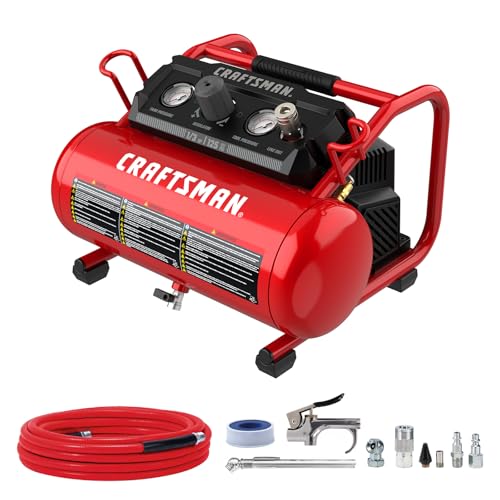
CRAFTSMAN 2-Gallon Portable Air Compressor
This CRAFTSMAN 2-gallon portable compressor package pairs a max 125 PSI oil-free pump with a versatile 10-piece pneumatic accessory kit using standard 1/4-inch NPT fittings. It is a practical, lightweight solution for DIYers and homeowners tackling tire inflation, air dusting, and light fastening.
Pros
- Complete out-of-the-box pneumatic package with air hose, blow gun, tire chuck, and 1/4-inch NPT quick-connect hardware
- Lightweight 19-pound carry weight makes moving between the garage, driveway, and workbench effortless
- Oil-free pump eliminates crankcase oil checks and prevents oil aerosol contamination in downstream air lines
- Dual quick couplings allow quick hookups without needing additional brass splitters
Cons
- Small 2-gallon receiver tank and 1/3 HP motor are limited to light-duty pneumatic tasks rather than continuous air-hungry tools
- The included starter air hose and accessories are entry-level components that high-volume shops may eventually want to upgrade
- Fittings utilize standard 1/4-inch auto profile plugs which require matching couplers if your shop uses alternate pneumatic profiles
HPDMC 13HP 30-Gallon Gas Air Compressor
Engineered for service trucks and remote job sites, this 13-horsepower gas unit delivers a robust 24 CFM at up to 180 PSI. Its two-stage cast iron pump and 30-gallon ASME tank supply continuous, heavy-duty pneumatic power without relying on electrical hookups.
Pros
- High 24 CFM output runs heavy-duty air tools easily
- Durable cast iron pump built for long-term commercial use
- ASME-certified tank meets rigorous safety standards
- Vehicle-mountable frame suits mobile mechanic operations
Cons
- Gasoline engine exhaust restricts operation to outdoor spaces
- Substantial 43-inch footprint requires dedicated vehicle space
- Gas engine demands ongoing fuel and oil maintenance
Campbell Hausfeld 60-Gallon Air Compressor
Built for demanding garage and workshop tasks, this stationary compressor combines a 3.7 HP motor with a two-stage cast-iron pump reaching 175 PSI. It provides steady airflow to support high-demand air tools like sprayers, grinders, and sanders.
Pros
- High 175 PSI maximum output pressure
- Durable cast-iron pump rated for longevity
- Large 60-gallon capacity supports sustained pneumatic tool use
- Vertical tank design saves workshop floor space
Cons
- Requires a dedicated 230V to 240V electrical connection
- Heavy 255-pound stationary build is difficult to move
Campbell Hausfeld 80-Gallon Stationary Air
Engineered for automotive repair shops and serious home garages, this stationary Campbell Hausfeld unit combines an 80-gallon ASME tank with a 5 HP motor delivering 16.0 CFM at 90 PSI. Its oil-lubricated cast-iron pump runs at a low 950 RPM, making it a dependable choice for continuous paint spraying, sanding, and air tool operation.
Pros
- Substantial 16.0 CFM delivery at 90 PSI easily powers continuous pneumatic tools like sanders and paint sprayers
- Heavy-duty cast-iron two-cylinder pump runs at a low 950 RPM for smoother operation and reduced thermal stress
- ASME-certified 80-gallon vertical tank maximizes air storage while minimizing workshop floor footprint
- Single-phase 208-230V motor includes overload protection and eliminates the need for an external magnetic starter
Cons
- Stationary footprint and substantial 460-pound weight require permanent shop placement and mechanical assistance during unloading
- Requires dedicated 208-230V single-phase electrical wiring and cannot run on standard 120V household outlets
- Maximum operating pressure caps at 140 PSI, which is lower than some two-stage compressors that reach 175 PSI
NorthStar 2-Stage 24.4 CFM Compressor Pump
Built with full cast iron construction and Swedish steel valves, this NorthStar two-stage pump delivers 24.4 CFM at 90 PSI for demanding pneumatic setups. Its low-RPM operation and V-style cylinder layout prioritize cooling and mechanical durability during heavy use.
Pros
- High airflow rating of 24.4 CFM at 90 PSI
- Heavy-duty FC35 cast iron construction
- Durable Swedish steel floating valve design
- V-style cylinders promote effective heat dissipation
- Low-RPM operation minimizes wear and running temperatures
Cons
- Heavy 135-pound weight complicates mounting and handling
- Substantial 21-inch cubic dimensions require ample space
Klutch 20-Gallon Portable Air Compressor
Featuring a 2.0 HP 120V motor and a 20-gallon tank, the Klutch portable air compressor delivers a rated 4.2 SCFM at 90 PSI for versatile workshop air. Its oil-free pump and wheeled design make it a dependable choice for garage mechanics, woodworkers, and serious DIYers needing steady air storage.
Pros
- Generous 20-gallon air storage capacity provides a substantial buffer for intermittent shop tools
- Delivers a listed 4.2 SCFM at 90 PSI, outperforming smaller pancake compressors for workshop chores
- Oil-free pump design eliminates messy oil changes and allows clean, upright transport
- Rugged rubber wheels and built-in ergonomic handle make moving the 90-pound frame manageable
- Integrated thermal overload protection helps prevent motor burnout during demanding cycles
Cons
- Substantial 90-pound weight makes lifting into truck beds or carrying up stairs difficult without assistance
- Oil-free motor configurations generally produce noticeable operating noise compared to low-RPM lubricated units
- At 4.2 SCFM at 90 PSI, high-draw continuous air tools like sanders or grinders will require recovery pauses
Ingersoll Rand 2340L5-V 5 HP Air Compressor
Built for demanding workshop environments, this two-stage compressor provides continuous duty operation through an all-cast-iron design. Its 60-gallon vertical configuration helps conserve valuable floor space while reliably sustaining high-pressure air applications.
Pros
- Durable all-cast-iron construction
- Rated for 100% continuous duty
- Vertical tank configuration saves floor space
- Individually cast cylinders ease maintenance
Cons
- Extremely heavy at 430 pounds
- Requires dedicated 230-volt single-phase power
- Tall 69-inch profile requires significant overhead clearance
Ingersoll Rand 2475N7.5 7.5 HP 80-Gallon Two-Stage
The Ingersoll Rand 2475N7.5 is an industrial-grade 7.5 HP two-stage stationary air compressor pairing an 80-gallon ASME receiver tank with a rugged cast-iron pump rated for 100% continuous duty at up to 175 psig. It provides dependable, high-capacity air storage for professional auto mechanics, commercial garages, and demanding fabrication shops.
Pros
- Durable solid cast-iron two-stage pump engineered for over 15,000 hours of heavy-duty shop service
- True 100% continuous duty rating supports non-stop production in multi-bay automotive and fabrication environments
- Spacious 80-gallon ASME-certified vertical receiver tank stores ample air volume at up to 175 psig
- Extended 2,000-hour oil service intervals when utilizing All Season Select synthetic lubricant
- Individual cylinder casting and one-piece connecting rod simplify preventative maintenance and component access
Cons
- Substantial 611-pound dry weight requires dedicated floor anchoring, mechanical lifting gear for positioning, and a permanent shop footprint
- Demands high-power dedicated electrical service and professional stationary hardwiring rather than standard outlet convenience
- Extended two-year pump warranty coverage requires the separate purchase of the official lubricant start-up kit
VEVOR 2 Gallon 1HP Air Compressor
Built for DIYers tackling tire inflation and light pneumatic work, this compact unit delivers 2.1 CFM at 90 PSI with a maintenance-free oil-free pump. Its sturdy steel tank and integrated safety shut-offs offer dependable performance for home garages.
Pros
- Maintenance-free oil-free pump design
- Durable rust-resistant three-layer steel tank
- Reliable automatic overheating and overpressure shut-off
- Adequate air delivery for light pneumatic tools
Cons
- Small two-gallon tank limits continuous high-demand tool use
- Produces 81 dB of operational noise
- Relatively heavy at 33 pounds for quick carrying
The Mechanics, Airflow Dynamics, and Workshop Performance of Two-Stage Compression
A two-stage air compressor does not simply use two identical pistons running side by side to double output volume. Instead, it utilizes two distinct compression chambers operating in series, with each cylinder performing a specialized mechanical role. Understanding this sequential compression process clarifies why heavy workshops rely on two-stage machines for high-pressure operations. The entire mechanism centers on dividing mechanical compression into manageable steps to mitigate thermal expansion and air density loss.
The Fundamental Thermodynamics of Two-Stage Compression
When atmospheric air is compressed inside a cylinder, basic thermodynamic laws dictate that temperature rises dramatically alongside pressure. In a single-stage pump, forcing atmospheric air directly to high pressures generates extreme friction and thermal heat that degrades volumetric efficiency. As the air heats up, it expands rapidly, meaning the piston expends excessive energy fighting backpressure rather than packing dense air molecules into the receiver tank. By dividing the process into two stages, the pump manages thermal buildup effectively and achieves far greater efficiency.
The first stage piston handles initial volume reduction by compressing ambient intake air to an intermediate pressure, typically between 40 and 90 PSI. Because this initial stroke operates across a moderate pressure differential, cylinder head temperatures remain within manageable operating limits. The partially pressurized air is then transferred out of the first cylinder before excessive heat can saturate the pump casting. This thermodynamic relief preserves valve plates, reduces oil vaporization in the crankcase, and allows the secondary stage to compress a much denser charge of air.
The Airflow Path: From Intake Filter to Storage Receiver
The complete airflow journey begins at the intake air filter, where atmospheric air is drawn through pleated paper or foam media to capture ambient shop dust. As the low-pressure piston descends on its intake stroke, atmospheric pressure pushes open the flexible intake reed valves or Swedish steel flappers. The ascending piston then compresses this air volume inside the large-diameter low-pressure bore until internal cylinder pressure overcomes the intermediate discharge valve. Once discharged, the air enters an external copper or aluminum transfer tube designed to route the airflow across the pump assembly.
This intermediate air charge travels directly into the high-pressure cylinder, which features a noticeably smaller bore diameter. Because the incoming air is already pre-compressed, the smaller secondary piston does not need a massive volume capacity to handle the mass of air delivered by the primary stage. On the compression stroke, the high-pressure piston forces this dense air charge up to the pump cut-off threshold, commonly 175 PSI. The air exits through heavy-duty discharge valves, passes through a one-way check valve at the tank bung, and finally settles into the heavy steel receiver.
Why the Finned Intercooler Tube Is Critical to Pump Survival
Positioned directly between the primary and secondary cylinder heads sits the intercooler tube, one of the most recognizable components on a two-stage pump. This metal transfer line features closely spaced external cooling fins engineered to dissipate radiant heat into the surrounding ambient air. As the flywheel spins, its integrated fan blades blow a continuous stream of forced air across these intercooler fins. This airflow rapidly drops the temperature of the intermediate air before it ever enters the second cylinder.
Cooling the air between stages provides immense mechanical and physical benefits for the secondary compression stroke. Cooler air is significantly denser, meaning the smaller second-stage piston can pack a higher mass of air into the high-pressure chamber with every stroke. Without this intercooling step, the second piston would ingest superheated, expanded air, causing cylinder head temperatures to spike past safe operating limits. Extreme thermal saturation would quickly scorch reed valves, break down cylinder lubrication films, and cause premature pump seizure.
Mechanical Differences Between Single-Stage and Two-Stage Pumps
Many buyers confuse twin-cylinder single-stage compressors with true two-stage systems because both designs feature two prominent cylinder heads on top of the crankcase. In a twin-cylinder single-stage compressor, such as many common workshop models, both pistons share identical bore diameters and draw ambient air simultaneously. Both pistons discharge air directly into the receiver tank at identical pressures, maxing out around 135 to 150 PSI. In contrast, a two-stage pump always pairs a larger primary cylinder with a smaller secondary high-pressure cylinder.
Another major mechanical distinction involves maximum operating pressure thresholds and sustained air delivery. While single-stage units experience sharp CFM drops as tank pressures climb past 100 PSI, two-stage pumps maintain steady air delivery up to 175 PSI. The Campbell Hausfeld 60-gallon two-stage model illustrates this capability by sustaining 6.9 SCFM even at 175 PSI. This higher tank pressure creates a deep reservoir of stored energy, allowing smaller physical tanks to store substantially more usable air before requiring the motor to restart.
Crankcase Construction, Splash Lubrication, and Thermal Management
Stationary two-stage pumps are engineered for demanding industrial duty, which requires robust cast-iron crankcases and durable splash-lubrication systems. Pumps like the NorthStar cast-iron pump head utilize solid FC35 grade cast iron for cylinder sleeves and pump heads to withstand structural stress. Inside the crankcase, dippers attached to the bottom of the connecting rods slice into the oil reservoir, splashing an atomized mist across the crankshaft bearings, wrist pins, and cylinder walls. Maintaining clean, proper air compressor pump oil inside the crankcase prevents catastrophic friction wear and protects precision bearing surfaces.
Slower operational speeds represent another fundamental design principle of heavy two-stage cast-iron pumps. While direct-drive oil-free consumer compressors spin high-speed universal motors at 3,400 RPM, commercial two-stage belt-driven pumps generally operate at conservative speeds between 800 and 1,000 RPM. Slower rotational speeds significantly reduce vibration, lower operating noise levels, and allow cooling fans to keep metal castings at modest temperatures. Units like the Ingersoll Rand Type 30 series take advantage of this low-RPM stability to achieve full 100 percent continuous duty ratings without overheating.
Electrical Demands, Motor Horsepower, and Continuous Duty Cycles
Driving a heavy two-stage pump against 175 PSI of internal head pressure demands serious electrical motor torque. Most stationary workshop two-stage systems require heavy single-phase or three-phase electric motors rated from 5 to 7.5 running horsepower. Models such as the Ingersoll Rand 2475N7.5 require dedicated 230-volt circuits capable of supplying sustained running amperage without tripping protective breakers. The immense starting torque required to move large cast-iron pistons from a dead stop also creates high electrical inrush current, requiring dedicated magnetic starters on larger motors.
Commercial applications that lack stationary electric service often rely on gas-powered drive systems instead. The HPDMC 13HP gas-powered unit utilizes an electric-start gasoline engine to spin its multi-cylinder pump, delivering 24 CFM at up to 180 PSI for remote service trucks. Gasoline engines eliminate the risk of voltage drops associated with long extension cords on construction sites or agricultural settings. Whether driven by industrial electric motors or commercial gas engines, two-stage systems provide the sustained duty cycle needed for relentless daily operation.
Matching Tool Air Consumption to Pressure and Storage Capacity
Operating high-draw pneumatic tools reveals the true practical advantages of two-stage compression over standard workshop units. Continuous-use tools like dual-action rotary sanders, blast cabinets, and HVLP paint sprayers consume massive volumes of air at constant pressure. A single-stage compressor delivering air at 125 PSI often suffers rapid line pressure drops when multiple tools cycle simultaneously, forcing workers to pause until pressure recovers. In contrast, storing air at 175 PSI provides a massive pressure buffer above the standard 90 PSI regulator setting used by most tools.
Delivering this stored energy effectively requires attention to delivery plumbing and line restriction. After regulating stored tank pressure down to the tool operating rating, connecting air compressor hoses properly with high-flow couplings ensures that line friction does not starve sensitive pneumatic motors. A two-stage system paired with an 80-gallon ASME tank gives operators plenty of reserve air, allowing tools to maintain peak torque even during lengthy grinding or painting sessions. When air demand finally triggers the cut-in pressure switch, the two-stage pump replenishes the tank quickly without struggling against backpressure.
Moisture Condensation and Long-Term Maintenance in High-Pressure Systems
Compressing air to 175 PSI squeezes tremendous amounts of ambient atmospheric humidity out of suspension, causing heavy water condensation inside the tank. Because two-stage units handle large volumes of air daily, water accumulation in the bottom of the receiver happens far more rapidly than in small portable inflators. Neglecting this moisture can lead to aggressive internal rust, scale buildup, and water spraying through downstream hoses directly into expensive pneumatic tools. Installing an accessible quarter-turn brass ball valve at the base of the tank makes daily moisture drainage quick and reliable.
Routine pump maintenance also involves inspecting air intake filters, checking oil sight glasses, and testing safety relief valves. Finned intercooler tubes and cylinder heads should be blown clean with compressed air regularly to remove insulating dust blankets that trap heat. Operators should also inspect pump belt tension periodically to prevent belt slip against the heavy flywheel under full compression load. Following manufacturer-recommended oil change schedules with non-detergent synthetic lubricants keeps Swedish steel valves free from carbon deposits that cause pressure leaks.
Diagnosing Common Two-Stage Operational and Pressure Symptoms
When a two-stage air compressor begins to lose performance, specific mechanical symptoms point directly to the underlying cause. A frequent indicator of primary stage trouble is the safety relief valve on the intercooler tube popping open during operation. If the secondary cylinder intake valves become stuck, broken, or carbonized, intermediate air cannot enter the high-pressure bore, causing pressure in the transfer tube to spike until the safety valve blows. Conversely, if the intercooler tube shows unusually low pressure or remains cool to the touch, the primary stage reed valves or piston rings are likely worn out.
Another common operational complaint involves the compressor running continuously without reaching its factory cut-out pressure of 175 PSI. This issue often stems from dirty intake filters restricting airflow, cracked head gaskets, or worn high-pressure piston rings allowing blow-by into the crankcase. If air hisses continuously from the pressure switch unloader valve after the motor shuts off, the tank check valve is stuck open and allowing stored tank pressure to bleed backward into the pump head. Safely depressurizing the receiver before removing and cleaning the brass check valve normally resolves this unloader leak.
Selecting and operating a two-stage air compressor comes down to understanding your workshop air volume and pressure requirements. By utilizing a staged compression cycle, intercooled cooling lines, and heavy cast-iron components, these machines supply dependable high-pressure air that single-stage units cannot match. Investing in proper electrical supply wiring, maintaining synthetic oil levels, and establishing a disciplined daily tank draining routine ensures your two-stage system provides decades of reliable workshop power.
About the author
Kenny Koehler is a power-tool specialist with more than a decade of hands-on evaluation experience and a science-based approach to product testing. His expertise in repeatable testing, tool performance, impact wrenches, and professional equipment brings a practical, data-focused perspective to compressor and pneumatic-tool comparisons.