
Do Portable Air Compressors Work for Car Tires? A Practical Guide
Do portable air compressors work for car tires? Learn how power, pressure settings, duty limits, and tire size affect top-offs and roadside use for November 2026.
 By Clint DeBoer
Updated November 21, 2026


A tire that’s a few pounds low can affect handling and wear, while driving to a service station may not be convenient. A compact inflator can make routine pressure checks and small top-offs easier, but a pump’s maximum PSI alone doesn’t tell you how quickly or reliably it will inflate a tire. The power source, hose connection, operating limits, and the size and condition of the tire all matter.
So, do portable air compressors work for car tires? Yes, many portable tire inflators are designed for passenger-car tires, though they’re better suited to maintenance and occasional use than repeated inflation of large, fully flat tires. The products listed below range from compact cordless units to 12V models powered by a vehicle outlet or battery clamps. Their descriptions include pressure limits, controls, and example inflation claims, but don’t provide a common independent test standard for comparing performance.
Check the vehicle’s recommended cold tire pressure on its door-jamb label or owner’s manual, rather than treating the maximum pressure printed on the tire sidewall as the target. A compressor with an adjustable preset and auto shut-off can make the task simpler, but the reading should still be checked carefully. For a broader look at vehicle-mounted air systems, see our guide to installing an air compressor in a car.
| Award | Product | ACR Score About ACR ScoreThe ACR Score is our own rating from 0 to 10, based on performance, design and build, ease of use, and value. It reflects independent research and is never influenced by manufacturers, retailers, or affiliate commissions. Learn more › | |
|---|---|---|---|
| Best Overall |
CRAFTSMAN 12V Portable Tire Inflator with
|
9.2/10 | Buy |
| Best Premium |
 KANWITY 160 PSI Portable Tire Inflator |
8.9/10 | Buy |
| Best Budget |
 OlarHike Portable Tire Inflator Air Compressor |
8.8/10 | Buy |
 GSPSCN 12V Portable Tire Inflator |
8.8/10 | Buy | |
 Inzeetor 150 PSI Portable Tire Inflator 12V DC |
8.6/10 | Buy | |
| Best Value |
 FORTEM Model L 150 PSI Tire Inflator |
8.4/10 | Buy |
 UUP 150 PSI Dual Cylinder Air Compressor |
8.3/10 | Buy | |
 Airmoto 120 PSI Portable Tire Inflator |
8.3/10 | Buy | |
 AstroAI Portable Tire Inflator Air Compressor |
8.1/10 | Buy | |
 AstroAI L7 Cordless Tire Inflator Portable Air |
8.0/10 | Buy |
CRAFTSMAN 12V Portable Tire Inflator with
The CRAFTSMAN 12V Portable Tire Inflator is an ultra-compact 1.9-pound roadside unit delivering up to 150 PSI with digital auto shut-off and built-in cord storage. Powered via a standard 12V car accessory plug, it offers fast tire top-offs and dependable emergency inflation without crowding trunk space.
Pros
- Weighs only 1.9 pounds for effortless glove box, under-seat, or trunk storage during road trips
- Digital auto shut-off prevents accidental over-inflation without requiring constant manual gauge monitoring
- Bright three-mode LED light provides critical illumination during nighttime roadside emergencies
- Comes fully equipped with multi-valve adapters, a replacement fuse, and a tailored carry pouch
Cons
- Requires a 12V DC vehicle accessory socket and does not include a 120V AC household outlet adapter
- Compact tankless pump is built strictly for tire inflation and cannot drive pneumatic nailers or air tools
- The 2.17-foot air hose length means the compressor must sit on the ground adjacent to the wheel valve stem
KANWITY 160 PSI Portable Tire Inflator
Delivering up to 160 PSI using either an internal 8000 mAh battery or 12V car power, this compact compressor is built for quick roadside tire top-offs. Its multi-mode digital interface, integrated emergency light, and mobile charging capability make it a practical tool for glove-box storage.
Pros
- Dual battery and 12V DC car power options
- Fast 30L/min inflation with auto shut-off
- Accurate digital gauge with four pressure units
- Includes emergency light and USB power bank
Cons
- Lacks support for standard household AC wall outlets
- Relatively heavy for a handheld tool at nearly 1.9 pounds
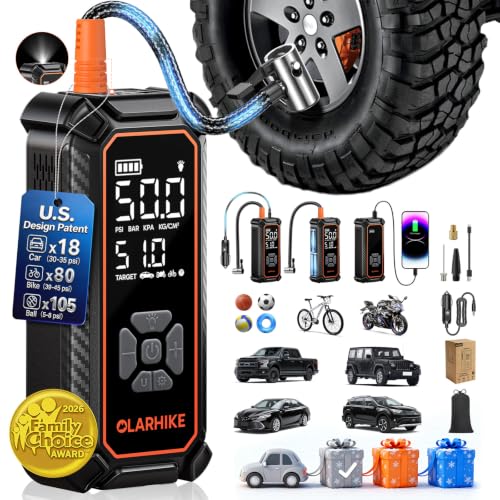
OlarHike Portable Tire Inflator Air Compressor
The OlarHike Portable Tire Inflator combines dual-power versatility via a 12V DC vehicle plug or built-in rechargeable battery with an automatic shut-off digital display. It provides dependable roadside tire top-offs and inflation for passenger cars, crossovers, motorcycles, and bicycles.
Pros
- Dual-power design allows cordless field operation or continuous power through any standard vehicle 12V DC port
- Automatic shut-off technology stops the motor precisely at preset pressure to prevent over-inflation
- Integrated 6000mAh battery reserve doubles as an emergency phone charger and includes an LED work light
- Pocket-sized footprint weighs well under two pounds for convenient transport in center consoles or backpacks
Cons
- Maximum vehicle pressure rating of 51 PSI is not suitable for heavy-duty commercial trucks, RVs, or high-pressure trailer tires
- Compact tankless inflator mechanism cannot power workshop pneumatic tools such as nail guns or air ratchets
- Recharging requires a standard 5V 2A or 5V 3A adapter and is not compatible with high-wattage fast chargers
GSPSCN 12V Portable Tire Inflator
The GSPSCN 12V Heavy Duty Tire Inflator delivers a robust 70 L/min airflow with its direct-drive dual-cylinder metal pump and 150 PSI maximum pressure rating. Built for pickup trucks, SUVs, and trailer owners, it operates at a manageable 70 dB and includes battery clamps for reliable 12V direct connection.
Pros
- Fast 70 L/min air volume output powered by a dual-cylinder direct-drive metal pump mechanism
- Generous 23-foot total working reach across the 11.5-foot 12V power cord and 11.5-foot air hose
- Direct battery clamps deliver dependable 12V DC power without risking internal vehicle fuse blowouts
- Remarkably manageable 70 dB sound level compared to standard high-pitch emergency tire pumps
Cons
- Requires direct 12V car battery terminal connection, which necessitates opening the vehicle hood
- Lacks an integrated air storage tank, so it is strictly intended for direct inflation rather than air tools
- No built-in digital automatic shutoff target pressure stop, requiring manual gauge monitoring
Inzeetor 150 PSI Portable Tire Inflator 12V DC
The Inzeetor 150 PSI Portable Tire Inflator is a lightweight 12V DC air compressor featuring digital auto shut-off and a durable zinc-alloy motor. Designed for rapid vehicle tire top-offs and sports gear, it offers dependable roadside utility for drivers and garage DIYers.
Pros
- Automatic digital shut-off eliminates manual monitoring and over-inflation risks
- Zinc-alloy motor allows continuous top-offs across four passenger tires without mandatory cooling breaks
- Weighs less than two pounds, making it effortless to stash in a trunk emergency kit
- Low-vibration chassis prevents the compressor from skittering across pavement during operation
- Comes equipped with versatile Presta and sports ball adapters alongside the standard Schrader chuck
Cons
- Requires a 12V DC vehicle cigarette lighter outlet and does not include a 120V AC wall plug
- The 1.97-foot air hose means the unit must sit on the ground or be held near the valve stem
- Engineered strictly for tire and recreation inflation rather than driving pneumatic workshop tools
FORTEM Model L 150 PSI Tire Inflator
Equipped for dual-voltage use, this inflator runs on both 12V car sockets and 110V household outlets. It reaches up to 150 PSI with automatic shut-off, making it a versatile option for vehicle tires and household inflatables.
Pros
- Operates on both AC and DC power sources
- Automatic shut-off stops inflation at target pressure
- Long 14-foot power cord stores internally
- Integrated LED light aids roadside visibility
- Includes three nozzle adapters and carrying case
Cons
- Plastic body construction rather than metal housing
- Requires corded power with no internal battery option
UUP 150 PSI Dual Cylinder Air Compressor
Built with dual cylinders and a 70L/min flow rate, this portable 12V inflator delivers fast tire fills for trucks, SUVs, and outdoor inflatables. Its integrated LED light and included battery clamps make roadside top-offs straightforward.
Pros
- High 70L/min airflow for rapid inflation
- Capable of reaching up to 150 PSI
- Built-in emergency LED work light
- Includes comprehensive adapter kit and storage bag
Cons
- Weighs over 6.6 pounds
- Requires direct car battery connection with clamps
Airmoto 120 PSI Portable Tire Inflator
Weighing just 1.2 pounds, this compact cordless compressor delivers up to 120 PSI with automatic shutoff for routine top-offs on cars, bikes, and sports gear. Its pocket-sized form factor stores neatly in a glove box, serving as a convenient roadside backup.
Pros
- Extremely compact and lightweight design
- Auto shut-off prevents accidental over-inflation
- Clear digital LCD display with real-time pressure reading
- Integrated LED light aids night roadside repairs
- Internal hose storage keeps accessories organized
Cons
- Not suitable for heavy-load tires or large inflatables
- Cold temperatures and large tires drain battery quickly
- Requires frequent recharging before heavy usage
AstroAI Portable Tire Inflator Air Compressor
The AstroAI Dual Power Tire Inflator combines a 12V DC vehicle plug and 120V AC household cord, delivering up to 150 PSI for car tires and a 350 L/min high-volume mode for rafts and mattresses. It is a dependable, compact choice for garage mechanics, road-trippers, and homeowners wanting versatile inflation without needing a bulky air tank.
Pros
- Dual 12V DC and 120V AC power cords offer genuine versatility for garage benches, driveways, and roadside emergencies
- Two dedicated inflation modes handle high-pressure tires up to 150 PSI as well as high-volume camping gear at 350 L/min
- Digital auto-shutoff stops pumping once target pressure is reached, preventing accidental over-inflation
- Integrated cord and air hose storage compartments maintain a clean, compact footprint in vehicle trunks
- Dual metal motor build provides reliable output with up to 15 minutes of continuous run time per cycle
Cons
- Not designed to support heavy-duty commercial truck tires or high-volume commercial vehicle applications
- Requires a mandatory 10-minute cooling rest after 15 minutes of continuous high-pressure pumping
- Tankless electric inflator design cannot drive pneumatic air tools such as brad nailers or impact wrenches
AstroAI L7 Cordless Tire Inflator Portable Air
The AstroAI L7 is a lightweight, handheld cordless air compressor delivering up to 150 PSI with an integrated 4000mAh rechargeable battery and precise auto-shutoff. It provides dependable, pocket-sized inflation performance for motorists, cyclists, and DIYers needing quick roadside tire top-offs.
Pros
- Weighs only 0.96 pounds for effortless storage in vehicle consoles, toolbags, or cycling packs
- High-speed digital sensor samples tire pressure at 200 times per second to prevent over-inflation
- Internal 4000mAh battery provides cordless freedom without tangling 12V cigarette lighter cords
- Versatile secondary utility as an emergency LED flashlight and portable USB power bank
Cons
- Not intended for heavy-duty truck tires or commercial tires larger than 25 inches in diameter
- Duty cycle requires allowing the unit to cool for 10 minutes after 15 minutes of continuous run time
- Tankless micro-compressor design cannot power workshop pneumatic air tools
How portable inflators handle car tires
Yes, a portable tire inflator can work for an ordinary passenger-car tire if its instructions cover that use and the pump is connected to a compatible valve. The models in this guide include products specifically described for car tires, with features such as digital pressure displays, preset target pressure, and automatic shut-off. Those controls help manage a top-off, but they don’t remove the need to use the vehicle’s recommended pressure and follow the inflator’s operating directions.
Portable tire inflators are not all the same as tank-style shop compressors. Most products here are compact direct-inflation pumps: they connect a hose to the tire valve and add air without first filling a storage tank. Their usefulness for tire maintenance depends on the pump’s stated limits, power arrangement, and the job at hand, not on the gallon capacity or pneumatic-tool airflow ratings used to assess workshop compressors.
That distinction matters because a tire inflator’s maximum pressure is not a speed rating. A claim such as 150 or 160 PSI indicates a stated pressure ceiling, not a promise that the unit will inflate every tire quickly or perform indefinitely. Tire size, starting pressure, ambient conditions, battery charge, and the manufacturer’s recommended operating interval can all affect the task.
Set the vehicle’s pressure, not the pump’s maximum
Find the recommended cold pressure in the vehicle owner’s manual or on the label inside the driver’s door area. Front and rear targets can differ, and some vehicles specify different pressures for particular loads. Do not use the tire sidewall’s maximum pressure as the routine inflation target; that marking serves a different purpose.
Use the inflator’s pressure-unit setting to match the target, typically PSI, and enter the specified value if the model offers a custom preset. A preset and auto shut-off can reduce the chance of continuing to pump past the selected target, but the feature depends on the device’s sensor and correct operation. Check the result with a reliable gauge if the reading seems inconsistent or the vehicle’s tire-pressure monitoring system continues to warn.
Measure pressure when the tires are cold for the most useful comparison with the vehicle placard. Driving heats the tires and can raise the displayed pressure, so lowering a warm tire to the cold target can leave it underinflated after it cools. If you have to check a tire that has already been driven, account for that condition by following the vehicle manufacturer’s advice rather than guessing at a correction.
Choose power for the situation
A 12V corded inflator draws power from the vehicle’s accessory outlet, so it can be useful when a rechargeable unit hasn’t been charged. The CRAFTSMAN Portable 12V Tire Inflator with lists a 10-foot power cord, digital display, several pressure units, and automatic shut-off. The FORTEM Tire Inflator Portable Air Compressor is also described as working from a 12V vehicle outlet, with a separate household-power adapter listed in its product information.
Cordless inflators trade a cable connection for an internal rechargeable battery. The Airmoto Tire Inflator Portable Air Compressor lists a 2,000 mAh battery and a 120 PSI maximum, while the AstroAI L7 Tire Inflator Portable Air lists a 4,000 mAh battery and a 150 PSI maximum. These figures describe different models and shouldn’t be treated as directly comparable runtime ratings, since the products do not provide a shared test method or identical use conditions.
Dual-power designs can offer another option. The KANWITY Tire Inflator Portable Air Compressor 160 lists both a built-in battery and a 12V DC car-power connection. The OlarHike Tire Inflator Portable Air description also lists rechargeable and vehicle-outlet operation, and specifies a 51 PSI limit for car and pickup tires. That restriction makes checking the exact product instructions especially important before using it on a vehicle with a different requirement.
For cordless use, charge the device before a trip and consider temperature effects noted by the manufacturer. Cold weather can reduce battery performance, and repeated inflation can use more charge than a quick single-tire top-off. If the device allows vehicle-outlet operation, that connection may provide an alternative, but confirm that the cable and power source are intended for the job.
Read pressure and inflation claims in context
Several product descriptions provide example inflation times or pressure increases for a specified tire size. For instance, the CRAFTSMAN listing describes a 195/65 R15 tire going from 30 to 36 PSI in under a minute, while the AstroAI L7 listing gives an example for the same size and pressure change in about 1.5 minutes. These are manufacturer-provided claims, not a standardized side-by-side comparison, so treat them as indicative rather than guaranteed results.
The GSPSCN 12V Heavy Duty Tire Inflator Metal and UUP Portable 12V Air Compressor use a different format from glove-box-sized cordless pumps. Both descriptions list dual cylinders, a 150 PSI maximum, and battery clamps; the GSPSCN description also lists an 11.5-foot air hose and an 11.5-foot power cord. This setup may suit buyers who value a longer reach or a direct battery connection, but the extra listed capability doesn’t establish that every vehicle, tire size, or duty cycle is suitable.
Look for explicit limits as well as maximum pressure. The OlarHike description says it is not intended for heavy-duty pickup trucks or RVs, and the AstroAI L7 listing excludes heavy-duty truck tires and tires larger than 25 inches. A product that works for a passenger-car tire may not be suitable for a large truck or recreational vehicle tire, even if its pressure display appears to cover the target.
Airmoto’s description also cautions against large-volume uses and heavy-load tires. That’s a useful reminder that compact size and a high pressure ceiling do not necessarily indicate high air volume or continuous-duty operation. Confirm that the intended tire type is included in the manufacturer’s stated applications.
Inflate carefully and stop for warning signs
Park safely away from traffic, set the parking brake, and keep the inflator and hose clear of moving parts. Follow the manual for connecting the power supply and attaching the hose to the valve stem. A secure connection helps limit air loss at the fitting and makes it easier to read the pressure correctly.
Set the desired pressure before starting if the inflator supports a preset, then monitor the unit rather than leaving it unattended. Stop if the hose or pump becomes unusually hot, the unit signals an error, or the operating instructions call for a cooling interval. Some listed models specify rest periods after extended use; observe the directions for the exact model instead of assuming all compact inflators share the same duty limit.
Do not keep adding air to a tire that has a visible cut, bulge, exposed cord, damaged valve, or a rapid pressure loss. A portable inflator can add air, but it cannot repair structural tire damage or make an unsafe tire roadworthy. Seek professional tire service when damage or continuing air loss is present.
For a flat tire, distinguish a slow leak from a puncture or other failure. If the tire will not hold pressure, the compressor’s ability to reach a stated maximum does not solve the underlying problem. Use the vehicle’s roadside assistance or spare-tire procedure as appropriate, and avoid driving on a tire that is visibly damaged or substantially underinflated.
Keep the inflator ready for the next top-off
Store the unit with its hose, adapter, and power cable organized so they’re easy to find, and recharge a battery model according to its manual. Inspect the hose and connector for damage before use. Keep dirt out of the valve connection, since debris can interfere with the seal or enter the valve.
For a corded model, check that the vehicle outlet and supplied cable are in suitable condition and follow the product’s power instructions. Do not assume that a household AC adapter is included simply because another model offers one. The product data distinguishes among 12V-only, cordless, and dual-power designs, so verify what comes in the box and what power sources the exact model supports.
Portable tire inflators are also distinct from larger onboard systems designed around vehicle air storage or off-road accessories. If you’re comparing a compact maintenance pump with a vehicle-mounted setup, our overview of onboard air compressor systems can help clarify that difference. A small inflator may be easier to store, while a more involved system serves a different installation and use case.
For ordinary pressure checks and modest top-offs, a correctly rated portable inflator is a practical tool to keep in a vehicle. Match its stated tire compatibility and power source to your needs, use the pressure listed by the vehicle maker, and observe the model’s operating limits. If the tire is damaged, loses air quickly, or falls outside the inflator’s stated applications, stop and use an appropriate repair or roadside service instead.
About the author
Clint DeBoer is an experienced tool-industry specialist with decades of involvement in technical media, hands-on product evaluation, and testing methodology. His focus on performance, practical usability, and data-driven comparisons makes his expertise highly relevant to professional air compressors, pneumatic tools, and workshop equipment.