
How to Install an Air Compressor in a Car: A Practical Guide
How to install an air compressor in a car starts with choosing a safe mounting point and matching the compressor to its power source. Updated for November 2026.
 By Clint DeBoer
Updated November 10, 2026


A flat tire can turn a routine drive into a roadside problem, but a portable inflator and a permanently installed compressor are different setups. If you’re researching how to install an air compressor in a car, first decide whether you need a compact tire inflator stored in the trunk or a heavier compressor connected to the vehicle’s electrical system. The products listed below include cordless inflators, 12V models, and a 12V compressor with an air tank, so their installation and operating requirements aren’t interchangeable.
For most passenger-car owners, a portable unit needs no permanent mounting: store it securely, follow its power instructions, and connect its hose when needed. A hardwired or tank-equipped setup involves additional decisions about mounting, wiring, airflow, heat, and safe pressure handling. Check the vehicle and compressor manuals before making changes, and don’t modify factory pressure controls or safety devices. For a different vehicle-focused application, our guide to inflating large off-road tires explains why tire size and compressor capability matter together.
Top Products
| Award | Product | ACR Score About ACR ScoreThe ACR Score is our own rating from 0 to 10, based on performance, design and build, ease of use, and value. It reflects independent research and is never influenced by manufacturers, retailers, or affiliate commissions. Learn more › | |
|---|---|---|---|
| Best Overall |
Topwest Cordless Tire Inflator Portable Air
|
9.1/10 | Buy |
| Best Premium |
 VEVOR 12V Air Compressor with 6L Tank |
8.8/10 | Buy |
 WE LOVE TO DRIVE Dual Cylinder Tire Inflator |
8.6/10 | Buy | |
| Best Budget |
 Lamicall Portable Car Tire Inflator Air Compressor |
8.4/10 | Buy |
| Best Value |
 PASLDA Eco 150 PSI Portable Tire Inflator Air |
8.4/10 | Buy |
 VIAIR 88P 12V Portable Air Compressor |
8.4/10 | Buy | |
 AstroAI 150 PSI Tire Inflator Portable Air |
8.1/10 | Buy | |
 Tire Inflator Portable Air Compressor |
8.1/10 | Buy | |
 Portable Tire Inflator Air Compressor 150 PSI |
8.0/10 | Buy | |
 WE LOVE TO DRIVE 150 PSI Cordless Tire Inflator |
8.0/10 | Buy |
VEVOR 12V Air Compressor with 6L Tank
Built for off-road rigs and heavy vehicles, this setup pairs a high-output 6.35 CFM compressor with a 6-liter tank for steady, pulsation-free airflow. The digital trigger gauge and generous 26-foot hose streamline tire maintenance without requiring constant trips back to the power switch.
Pros
- High 6.35 CFM airflow for rapid tire inflation
- Dedicated 6-liter tank eliminates air pulsation
- Long 26-foot rubber hose reaches around larger vehicles
- Trigger-operated digital gauge simplifies pressure adjustments
- Built-in thermal protection prevents motor overload
Cons
- Heavy package weighing over 28 pounds
- Relatively short 6.5-foot power cord
- Large footprint takes up noticeable cargo space
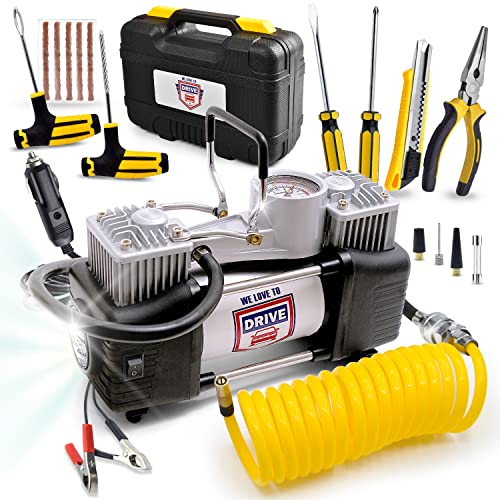
WE LOVE TO DRIVE Dual Cylinder Tire Inflator
Combining a dual cylinder 12V compressor with a complete plug and patch kit, this roadside set delivers up to 150 PSI for car, truck, and recreation tires. It serves as a comprehensive trunk solution for drivers who want both rapid inflation and immediate flat repair tools on road trips.
Pros
- Dual cylinder mechanism delivers high-pressure 150 PSI output
- Bundles essential flat tire repair plugs and patch tools
- Integrated gauge enables straightforward pressure monitoring
- Versatile application for trucks, SUVs, and recreational gear
Cons
- Relatively hefty carry weight at over eight pounds
- Tethered to a 12V DC vehicle power source
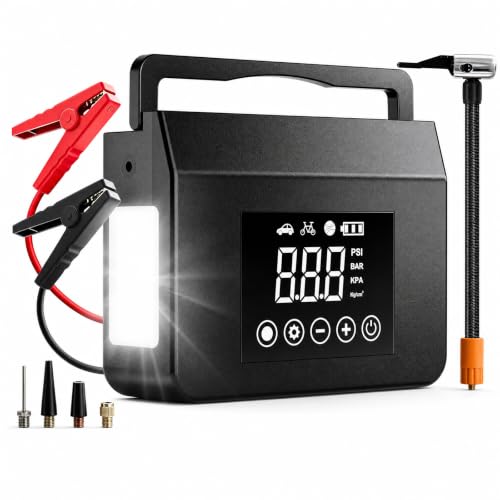
PASLDA Eco 150 PSI Portable Tire Inflator Air
This 2.6 lb cordless multi-function air compressor provides up to 150 PSI and 25 L/min airflow alongside a 4000A jump starter, real-time digital pressure readout, and auto-stop shutoff. It is an ideal emergency trunk tool for commuters, DIY drivers, off-road enthusiasts, and garage mechanics needing reliable mobile tire maintenance.
Pros
- Compact 2.6 lb all-in-one chassis combines high-pressure mobile tire inflation with a 4000A emergency engine jump starter
- Cordless 29.6 Wh battery design allows quick roadside tire top-offs without wrestling long power cords or requiring vehicle battery hookups
- Digital display with auto-shutoff protects tires, bicycle tubes, and sports equipment from accidental overpressurization
- Comprehensive built-in electrical protections prevent sparks, short circuits, reverse polarity, and motor overheating
Cons
- Tankless mobile inflator design does not provide the sustained CFM output required to operate pneumatic workshop tools
- Continuous inflation runtime is limited to approximately six minutes before requiring a motor cool-down period
- Lacks an AC wall outlet adapter for direct corded household plug-in operation without recharging the battery
VIAIR 88P 12V Portable Air Compressor
Designed for passenger cars and light trucks with tires up to 33 inches, the VIAIR 88P delivers dependable 120 PSI output directly from a vehicle battery. Its generous 26-foot total reach, built-in gauge, and integrated work light make it a practical emergency companion for road trips and camping.
Pros
- Solid 1.47 CFM flow rate provides brisk inflation
- Generous 26-foot reach easily accesses all four tires
- Built-in LED work light aids dark roadside repairs
- Compact body weighs under five pounds for convenient storage
Cons
- Requires direct battery connection instead of standard 12V outlet
- Limited to a 25-minute duty cycle before cooling
- Not designed for tires larger than 33 inches
WE LOVE TO DRIVE 150 PSI Cordless Tire Inflator
This portable inflator delivers up to 150 PSI with an integrated 6,000 mAh battery that doubles as a device power bank. Equipped with digital pressure presets, auto shut-off, and a three-mode emergency light, it serves as a dependable roadside safety companion.
Pros
- Cordless operation with a 6,000 mAh rechargeable battery
- Dual power options via battery or 12V DC adapter
- Automatic shut-off prevents over-inflation
- Multi-mode LED light aids nighttime emergencies
Cons
- Weighs 1.76 pounds, adding bulk to glove compartments
- Requires recharging to maintain cordless standby capability
Installing a Car Air Compressor Safely
The safest approach depends on what “install” means in your case. A portable tire inflator is usually set up for use, not permanently installed: it stays secured in the vehicle and connects to a tire and an approved power source when required. A compressor with a tank or a fixed air line is a more involved vehicle modification that requires appropriate mounting, electrical protection, and a clear understanding of the manufacturer’s limits. Don’t treat a small cordless inflator as if it were a hardwired onboard air system.
Choose between a stored inflator and a fixed system
For ordinary tire top-ups and roadside preparedness, portability is often the simpler answer. The Topwest model is listed with a rechargeable battery and a 12V vehicle-outlet cable, while the AstroAI L7 Mini and Lamicall inflator are described as cordless rechargeable units. The Big Star Trading model uses a 12V DC plug and a 10-foot power cord. These designs are intended to be connected for use rather than mounted as permanent vehicle equipment.
A fixed system may make sense when a vehicle needs an accessible air outlet or a tank-based setup for a particular use. The VEVOR product is described as a 12V compressor with a 6-liter tank, while the VIAIR 88P is a portable compressor kit that connects to the battery with alligator clamps. Those descriptions do not establish that either unit is designed for permanent mounting in every car. Confirm the installation method, operating limits, and vehicle compatibility in the actual manuals before planning a fixed installation.
Think through how the compressor will be used before selecting its location. A trunk inflator should remain accessible without shifting cargo, and a permanently mounted unit needs enough clearance for its controls, hose connections, ventilation, and any manufacturer-specified service access. Avoid locations where luggage can strike the device, where water can collect, or where hot components or moving vehicle parts could contact wiring or hoses. If a location does not meet the compressor maker’s installation instructions, choose another location rather than improvising a bracket or enclosure.
Check the power connection before mounting anything
Read the compressor label and manual to identify its required supply, connection method, and any restrictions on operating time. A 12V cigarette-lighter-style plug and battery clamps are different ways of supplying power; one should not be substituted for the other unless the manufacturer permits it. The VIAIR 88P listing describes direct battery-clamp operation, and the Big Star Trading unit is listed with a 12V DC plug. Neither detail alone tells you whether another vehicle outlet or circuit can safely supply a different compressor.
Do not assume a vehicle accessory socket can run every 12V compressor. The socket’s fuse, wiring, and rated capacity must suit the device, and the compressor instructions take priority. If the manual calls for battery clamps, use the specified connection rather than adapting the plug or bypassing a fuse. For permanent wiring, have a qualified automotive technician select and install the circuit protection and wiring to match the compressor and vehicle; do not guess at wire size or connect directly to a battery without the required protection.
Battery-powered models avoid a live vehicle connection during inflation, but they still need charging and storage according to their instructions. Product information lists a removable rechargeable battery for the Topwest unit and rechargeable batteries for several other inflators. Check the charge before relying on one during a trip, and observe any temperature or charging guidance supplied with the product. Keep charging cables and adapters secured so they don’t interfere with pedals, seats, or other vehicle controls.
Mounting a fixed compressor and routing its hose
For a compressor approved for a fixed vehicle installation, use only a mounting surface and hardware that the manufacturer specifies or permits. The mounting must hold the unit securely under normal vehicle movement without obstructing seat belts, airbags, access panels, or routine service points. Don’t drill into an area until you have confirmed what lies behind it, including fuel lines, wiring, and other vehicle components. If you can’t verify a safe mounting point, stop and ask an automotive installer to inspect the proposed location.
Route the air hose away from exhaust components, sharp edges, suspension travel, and pinch points. Leave enough slack for the parts that move, but secure excess hose so it cannot snag or strike a hot surface. Use fittings and hose rated for the compressor’s stated maximum pressure, and keep the hose path free of kinks that can restrict airflow. Never use a damaged or unmarked hose simply because its fittings appear to connect.
Air tanks add stored pressure and require more careful placement than a small inflator. Secure the tank as its manufacturer directs, keep access to its drain and fittings, and don’t enclose it in a way that blocks required cooling or inspection. The VEVOR listing specifies a 6-liter tank and a maximum pressure of 150 PSI, but that does not establish a safe mounting method for a particular vehicle. Follow the tank and compressor documentation, including instructions for draining, servicing, transport, and pressure limits.
Use a portable inflator without permanent vehicle changes
A portable unit typically needs a clear, stable place beside the tire, with the vehicle parked safely and the compressor kept out of traffic. Connect its hose to the tire valve and its power source as instructed, then use the compressor’s gauge or a separate reliable tire-pressure gauge to compare the reading with the vehicle’s recommended cold-tire pressure. The correct target is found on the vehicle’s tire-information label or in its owner’s manual, not by using the tire’s maximum sidewall pressure as the normal target. If the manufacturer supplies preset modes or automatic shutoff, learn their controls before an emergency.
Some products include a digital gauge and automatic shutoff, such as the Topwest, Lamicall, AstroAI, and Big Star Trading listings. These features can simplify routine inflation, but the listing does not remove the need to set the correct target or verify pressure. Make sure the selected unit is appropriate for the tire and the intended inflation task. A compact inflator intended for tire top-ups should not be treated as an air source for continuous-duty pneumatic tools or as proof that a vehicle’s tire damage is safe to drive on.
Clamping a compressor directly to a vehicle battery requires careful adherence to the supplied instructions. Keep the compressor switched off while making the connection if the manual directs that sequence, and keep clamps clear of one another and of unintended contact points. Start or stop the vehicle only as the compressor maker specifies. If a cable, clamp, plug, or outlet becomes unusually hot, or if a fuse repeatedly opens, stop using the system and have the cause checked instead of installing a larger fuse or bypassing protection.
Verify operation and watch for installation problems
After a permitted fixed installation, inspect the mounting and cable routing before powering the compressor. Check that connectors are fully seated, hoses are not rubbing against moving or hot parts, and controls remain reachable. For a tank-equipped setup, use only the pressure range and operating sequence specified by its maker. Don’t alter the pressure switch, safety relief valve, or thermal protection to make the system run longer or build more pressure.
Operate the compressor according to its duty and cooling instructions, and allow cooling pauses where required. A portable pump can become hot during inflation, and product descriptions vary in their stated operating limits and protective features. Don’t infer a continuous-duty rating from a maximum PSI figure or from a claim about fast inflation. Stop if the unit overheats, behaves abnormally, or triggers a vehicle electrical fault, then consult the manual or a qualified service provider.
Listen and look for signs that the installation needs attention: a loose mount, a damaged cable, a persistent air leak, or a pressure reading that does not behave as expected. For a tank system, use the manufacturer’s leak-check and inspection guidance, and never operate a damaged pressure vessel. Depressurize the tank completely before servicing or transporting it, following the manual’s procedure. Wear suitable eye protection around pressurized air equipment, and keep hands and face away from fittings while the system is under pressure.
If a fuse opens or the motor stops, don’t repeatedly reset or replace protection without identifying the cause. The load may exceed what the selected outlet or circuit is intended to supply, or the compressor may have reached a thermal limit. Check the product manual for the correct troubleshooting steps and the vehicle manual for outlet restrictions. Persistent electrical faults, damaged wiring, pressure leaks, or uncertain tank installation are reasons to stop and get qualified help.
Choose a product that fits the intended installation
Product descriptions show meaningful differences in power source and intended convenience. The Topwest model offers battery and 12V outlet options, while the VIAIR 88P listing describes a battery-clamp connection and a 16-foot air hose. The VEVOR package includes a tank, a digital inflator, and a 26-foot air hose, which may be useful for reaching around a vehicle but also introduces stored-pressure equipment. These features help distinguish portable use from a more involved onboard setup; they do not replace checking the complete installation instructions.
For a compact trunk kit, compare the power method, hose reach, pressure display, accessories, and storage needs. For example, the Big Star Trading listing specifies a 10-foot cord and a 12V plug, while the VIAIR 88P listing specifies battery clamps and a carry bag. Cordless choices avoid a power lead during inflation, but require maintaining battery charge. Consider which connection you can use reliably in your vehicle and whether the product’s stated use and operating limits match your tire needs.
Maximum PSI is not the only useful specification. A compressor’s airflow and operating limits affect how it handles a task, while tank capacity determines the amount of stored air available before the pump must replenish it. The supplied products do not all provide comparable airflow data, so avoid ranking them by unsupported speed claims. For occasional car-tire top-ups, a compact inflator may be more convenient than a tank system; for a fixed installation, confirm that the compressor is specifically suitable for the vehicle application and intended workload.
Do not choose an onboard compressor for impact wrenches, grinders, or paint sprayers based only on a tire-inflator listing. Pneumatic tools often need a stated airflow at a specified pressure, and the product data supplied here does not establish that these inflators can sustain those demands. If a project depends on air tools, compare the tool’s required CFM with a compressor’s delivered CFM at the operating pressure, then account for duty cycle and hose losses. A guide to medium air compressors offers related context for readers considering workshop-style equipment rather than a trunk tire pump.
Maintenance and safe storage in a vehicle
Keep a portable inflator clean and secured, and store its cable, hose, and adapters as the instructions recommend. Protect rechargeable units from storage conditions the manufacturer warns against, and recharge them at the recommended interval. Inspect the hose and connector before use; cracks, loose fittings, or damaged insulation are reasons not to operate the unit. Don’t leave loose equipment where it can become a hazard during sudden braking.
A tank-equipped compressor needs additional care because water can collect inside a pressurized tank as air cools. Follow the manufacturer’s drain instructions and perform maintenance only after fully depressurizing the equipment as directed. Keep the drain accessible rather than burying it behind a bracket or trim panel. Never drill a tank, weld on it, or continue using it if corrosion or damage raises concern.
Check the pressure gauge against a separate tire gauge periodically if accuracy matters, and follow the vehicle maker’s tire-pressure guidance. Inspect electrical connections and mounting hardware at the intervals specified by the compressor and vehicle manufacturers, especially after service or a change to the installation. A portable inflator that is used occasionally still needs a charged battery or a functioning power connection when an emergency occurs. For fixed systems, a qualified installer can confirm that the vehicle’s wiring, mounting, and pressure equipment remain appropriate.
The practical choice is simple: use a portable inflator when the goal is tire inflation without permanent vehicle changes, and consider a fixed system only when the compressor is intended for that installation and its electrical and mounting requirements can be met safely. Match the connection method to the product instructions, keep pressure and temperature limits intact, and verify the tire pressure against the vehicle’s recommendation. If any part of a hardwired or tank-based installation is uncertain, pause and consult the manufacturer or a qualified automotive technician rather than improvising.
About the author
Clint DeBoer is an experienced tool-industry specialist with decades of involvement in technical media, hands-on product evaluation, and testing methodology. His focus on performance, practical usability, and data-driven comparisons makes his expertise highly relevant to professional air compressors, pneumatic tools, and workshop equipment.