
How Do You Use a Portable Air Compressor in a Car: Guide
How do you use a portable air compressor in a car? Learn safe tire inflation steps, pressure checks, power options, and product details for November 2026.
 By Clint DeBoer
Updated November 24, 2026


A tire that looks low can be difficult to judge by sight, and driving on it without checking pressure may affect handling and tire wear. A portable inflator lets you measure and add air where the car is parked, provided you follow the vehicle’s recommended tire pressure and the pump’s instructions. If you’re asking how do you use a portable air compressor in a car, the core process is simple: check the tire cold when practical, connect the inflator securely, set the correct target, and monitor the result. The details that matter most are the compressor’s power source, the valve connection, and whether its limits suit your tire.
Small car inflators in the supplied options include cordless models and pumps powered by a 12V vehicle outlet, while one option supports both a vehicle outlet and a household outlet. Digital gauges and automatic shutoff can make routine top-ups easier, but they don’t replace checking the vehicle placard or owner’s manual. Use the recommended pressure for your vehicle, not the maximum pressure molded on the tire sidewall. For broader equipment context, see our AC and DC portable compressor guide and overview of portable compressors for different tasks.
| Award | Product | ACR Score About ACR ScoreThe ACR Score is our own rating from 0 to 10, based on performance, design and build, ease of use, and value. It reflects independent research and is never influenced by manufacturers, retailers, or affiliate commissions. Learn more › | |
|---|---|---|---|
| Best Overall |
DEWALT Cordless Tire Inflator Portable Air
|
9.1/10 | Buy |
| Best Premium |
 KANWITY 160 PSI Portable Tire Inflator |
8.9/10 | Buy |
| Best Budget |
 Inzeetor 150 PSI Portable Tire Inflator 12V DC |
8.6/10 | Buy |
| Best Value |
 AstroAI AIRUN H 12V DC Portable Air Compressor |
8.4/10 | Buy |
 CARSUN Dual Power AC/DC Portable Tire Inflator |
8.3/10 | Buy | |
 Airmoto 120 PSI Portable Tire Inflator |
8.3/10 | Buy | |
 AstroAI L7 Cordless Tire Inflator Portable Air |
8.0/10 | Buy | |
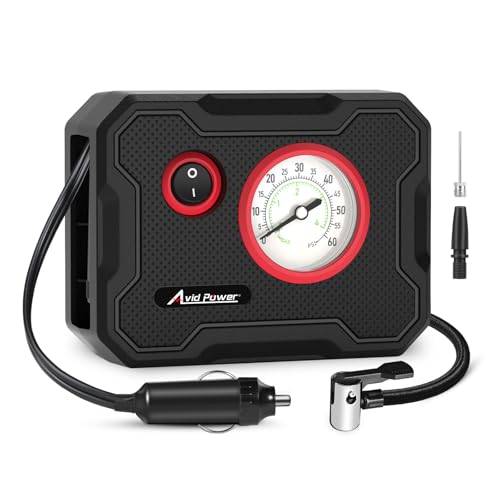 AVID POWER 12V Portable Tire Inflator |
7.8/10 | Buy | |
 ROCGORLD R8 12V Portable Tire Inflator |
7.8/10 | Buy |
DEWALT Cordless Tire Inflator Portable Air
This compact DEWALT portable tire inflator delivers up to 150 PSI with smart auto shut-off, powered by an internal rechargeable battery or an included 10-foot 12V car plug. It provides an efficient, pocket-sized solution for vehicle owners, cyclists, and DIYers wanting rapid roadside top-offs without hauling a bulky tank compressor.
Pros
- True cordless freedom with an internal rechargeable battery plus a 10-foot 12V DC vehicle plug backup
- Accurate digital pressure gauge with 5 smart presets and automatic shut-off to eliminate overinflation
- Ultra-compact handheld design weighing just 0.63 kg for easy storage in glove boxes or saddlebags
- Integrated LED work light and emergency USB power bank functionality for travel safety
- Generous accessory bundle backed by a 3-year limited warranty
Cons
- Engineered exclusively for high-pressure inflation rather than operating pneumatic air tools or nailers
- Does not include a 120V AC residential wall outlet power adapter
- Compact tankless pump requires periodic cooling breaks during heavy multi-tire inflation runs
KANWITY 160 PSI Portable Tire Inflator
Delivering up to 160 PSI using either an internal 8000 mAh battery or 12V car power, this compact compressor is built for quick roadside tire top-offs. Its multi-mode digital interface, integrated emergency light, and mobile charging capability make it a practical tool for glove-box storage.
Pros
- Dual battery and 12V DC car power options
- Fast 30L/min inflation with auto shut-off
- Accurate digital gauge with four pressure units
- Includes emergency light and USB power bank
Cons
- Lacks support for standard household AC wall outlets
- Relatively heavy for a handheld tool at nearly 1.9 pounds
Inzeetor 150 PSI Portable Tire Inflator 12V DC
The Inzeetor 150 PSI Portable Tire Inflator is a lightweight 12V DC air compressor featuring digital auto shut-off and a durable zinc-alloy motor. Designed for rapid vehicle tire top-offs and sports gear, it offers dependable roadside utility for drivers and garage DIYers.
Pros
- Automatic digital shut-off eliminates manual monitoring and over-inflation risks
- Zinc-alloy motor allows continuous top-offs across four passenger tires without mandatory cooling breaks
- Weighs less than two pounds, making it effortless to stash in a trunk emergency kit
- Low-vibration chassis prevents the compressor from skittering across pavement during operation
- Comes equipped with versatile Presta and sports ball adapters alongside the standard Schrader chuck
Cons
- Requires a 12V DC vehicle cigarette lighter outlet and does not include a 120V AC wall plug
- The 1.97-foot air hose means the unit must sit on the ground or be held near the valve stem
- Engineered strictly for tire and recreation inflation rather than driving pneumatic workshop tools
AstroAI AIRUN H 12V DC Portable Air Compressor
The AstroAI AIRUN H is a compact 12V DC tire inflator delivering up to 35 L/min airflow with automatic shut-off and digital pressure presets. It is an ideal portable emergency compressor for drivers, commuters, and garage hobbyists seeking fast tire top-offs.
Pros
- Automatic shut-off stops pumping reliably once target PSI is reached
- High-airflow 120W motor provides rapid top-offs for daily driver tires
- Long 9.84-foot power cord reaches all passenger vehicle wheels with ease
- Bright built-in LED flashlight and backlit display assist during night repairs
- Lightweight 2.2-pound form factor stores neatly in glove boxes and trunks
Cons
- Requires a 12V DC vehicle outlet and does not include a 120V AC household plug
- Mandates a 10-minute cool-down interval after 15 minutes of continuous operation
- Not intended for high-volume inflatables like large pool floats or air mattresses
CARSUN Dual Power AC/DC Portable Tire Inflator
The CARSUN Dual Power Tire Inflator delivers up to 150 PSI of high-pressure air running from either a 110V household outlet or a 12V vehicle socket. With digital pressure presets, automatic shutoff, and a lightweight 2.1-pound frame, it is an ideal maintenance pump for passenger vehicles, bicycles, and household inflatables.
Pros
- Versatile dual-voltage operation works seamlessly in the home garage or on the road without requiring an external converter
- Accurate auto-shutoff mechanism protects tires from accidental over-pressurization during routine top-offs
- Compact 2.1-pound build packs away easily in car trunks, under vehicle seats, or on garage shelving
- Clear digital display allows fast switching across four standard pressure measurement units
Cons
- Requires a mandatory 10-minute cooldown period after every 15 minutes of continuous operation
- Manufacturer explicitly states it does not support heavy truck tires, tractor tires, or stand-up paddleboards (SUP)
- Tankless inflator design cannot run standard workshop pneumatic air tools like brad nailers or paint sprayers
Airmoto 120 PSI Portable Tire Inflator
Weighing just 1.2 pounds, this compact cordless compressor delivers up to 120 PSI with automatic shutoff for routine top-offs on cars, bikes, and sports gear. Its pocket-sized form factor stores neatly in a glove box, serving as a convenient roadside backup.
Pros
- Extremely compact and lightweight design
- Auto shut-off prevents accidental over-inflation
- Clear digital LCD display with real-time pressure reading
- Integrated LED light aids night roadside repairs
- Internal hose storage keeps accessories organized
Cons
- Not suitable for heavy-load tires or large inflatables
- Cold temperatures and large tires drain battery quickly
- Requires frequent recharging before heavy usage
AstroAI L7 Cordless Tire Inflator Portable Air
The AstroAI L7 is a lightweight, handheld cordless air compressor delivering up to 150 PSI with an integrated 4000mAh rechargeable battery and precise auto-shutoff. It provides dependable, pocket-sized inflation performance for motorists, cyclists, and DIYers needing quick roadside tire top-offs.
Pros
- Weighs only 0.96 pounds for effortless storage in vehicle consoles, toolbags, or cycling packs
- High-speed digital sensor samples tire pressure at 200 times per second to prevent over-inflation
- Internal 4000mAh battery provides cordless freedom without tangling 12V cigarette lighter cords
- Versatile secondary utility as an emergency LED flashlight and portable USB power bank
Cons
- Not intended for heavy-duty truck tires or commercial tires larger than 25 inches in diameter
- Duty cycle requires allowing the unit to cool for 10 minutes after 15 minutes of continuous run time
- Tankless micro-compressor design cannot power workshop pneumatic air tools
AVID POWER 12V Portable Tire Inflator
Weighing just 0.8 pounds, this pocket-sized 12-volt compressor stows neatly in a glove box for roadside emergencies. It handles routine pressure top-offs on standard cars, though its modest flow rate is geared strictly toward smaller passenger tires.
Pros
- Extremely lightweight at only 0.8 pounds
- Compact body stores cords and adapters neatly
- Quick-connect locking lever simplifies valve attachment
- Long 9.5-foot total reach reaches every tire
Cons
- Not suitable for tires exceeding 225/60R17V
- Relatively slow output at 0.6 CFM
- Automotive pressure capped at 50 PSI
ROCGORLD R8 12V Portable Tire Inflator
The ROCGORLD R8 is an ultra-compact 12V DC mobile tire inflator delivering up to 40 L/Min airflow and 150 PSI with an intuitive dual digital display and automatic shutoff. It is an exceptional, budget-friendly roadside emergency tool for everyday drivers, commuters, and cyclists who need quick, dependable tire top-offs.
Pros
- Fast 40L/Min rated cylinder tops off passenger car and EV tires in just 1 to 1.5 minutes
- Clear dual digital readout displays target PSI and actual tire pressure simultaneously
- Automatic shutoff with memory function prevents tire over-inflation and simplifies monthly checks
- Featherweight 2.16-pound design with included storage bag fits easily in any trunk emergency kit
- Backed by a two-year manufacturer warranty with included Presta and sports ball adapters
Cons
- Operates strictly on 12V DC vehicle power and cannot plug directly into standard 120V AC household wall outlets
- Does not include an internal rechargeable battery, requiring an active 12V vehicle connection for power
- Short 2-foot air hose requires resting the compressor on the ground or holding it close to the tire stem
How to Inflate a Car Tire with a Portable Compressor
Using a car inflator safely means treating it as a tire-maintenance tool, not as a substitute for diagnosing a damaged tire. Confirm the required pressure, prepare the pump and power source, attach the hose, and inflate in controlled steps. Then verify the pressure with the inflator’s gauge or a separate tire gauge. If a tire is visibly damaged, losing air rapidly, or won’t hold pressure, stop and arrange a proper inspection rather than relying on repeated top-ups.
Find the correct pressure before connecting the pump
Look for the vehicle manufacturer’s recommended cold tire pressure on the driver-side door placard or in the owner’s manual. Front and rear tires may have different recommendations, and the spare may have a separate specification. Don’t use the tire sidewall’s maximum pressure as the everyday target; it describes a tire limit rather than the vehicle’s normal inflation instruction.
Pressure readings rise as tires warm from driving, so checking before a trip or after the car has been parked for several hours gives a more useful baseline. If you’ve just driven, the reading can still help identify a seriously low tire, but don’t release air from a warm tire merely to reach the cold specification. Recheck it when cold and follow the vehicle maker’s guidance.
Choose a pressure unit that matches the vehicle recommendation, usually PSI, and confirm the display is not set to BAR or kPa. Several supplied inflators list multiple units and presets for cars, motorcycles, bikes, or balls. Those presets are convenience features, not a reason to skip checking the actual vehicle specification.
Prepare the inflator and its power source
Read the pump’s instructions before use and check its stated pressure and tire-size limits. The supplied options illustrate meaningful differences: the DEWALT model lists a built-in rechargeable battery and a 12V car accessory plug, the Airmoto is cordless with a rechargeable battery, and the AstroAI AIRUN H is listed as a 12V DC unit. The CARSUN model lists both 110V or 120V household power and a 12V vehicle connection.
Charge a cordless inflator before storing it for travel, especially if it has been sitting unused. Cold conditions can reduce battery efficiency, as the Airmoto product information notes, so a low battery may be a poor surprise at the roadside. A 12V corded model avoids reliance on an internal battery, but it needs a suitable vehicle accessory outlet and enough cord reach to connect to each tire.
Park on a stable, safe surface away from moving traffic whenever possible, set the parking brake, and switch the vehicle off unless the pump instructions require a different arrangement. Keep the hose and cord clear of hot, sharp, or moving parts. If you cannot work safely beside the vehicle, move to a safer location or contact roadside assistance.
Check that the hose, connector, power cord, and housing are intact. A damaged cable, loose valve connector, or cracked hose can interrupt inflation or create a hazard. Use only the supplied or specified power connection, and don’t modify plugs, fuses, or wiring to make an incompatible pump operate.
Connect the hose and set a pressure target
Remove the valve cap and keep it somewhere clean. Attach the inflator’s hose to the tire’s Schrader valve, which is the standard valve type used on most car tires, following the connector instructions. A secure connection matters: air escaping around the valve can make the gauge reading unreliable and waste time.
Some models use a threaded connector, while others have a lever or quick-connect style arrangement. For example, the AVID POWER description specifies a quick-connect hose, while other product listings describe an attached air hose without providing the same connection detail. Use the instructions for the specific unit instead of forcing a connector or assuming every pump attaches in the same way.
Switch on the inflator and select PSI if needed. Enter the vehicle’s recommended cold pressure with the controls, checking the display before starting. Models that list automatic shutoff, including the AstroAI AIRUN H, Airmoto, and ROCGORLD R8, are designed to stop at a selected target, but the user still needs to set that target correctly and confirm the final reading.
If the inflator has presets, make sure the selected mode corresponds to a car and that its displayed pressure agrees with the vehicle placard. A preset may provide a starting point, but the recommended pressure varies by vehicle and tire position. Custom pressure entry is the more direct choice when the correct target differs from the preset.
Inflate in a controlled way and verify the result
Start the pump only after the hose is attached and the target has been checked. Watch the display as pressure rises, and stay with the unit while it runs. Automatic shutoff can reduce the chance of overshooting, but it doesn’t make unattended operation a good idea.
Portable inflators can become warm during use. Respect the manufacturer’s stated operating and cooling instructions rather than running the pump beyond its limits. The AstroAI AIRUN H listing specifies automatic shutoff after 15 minutes of continuous use and recommends a 10-minute cooldown before resuming; the CARSUN description likewise says to cool the pump after each 15 minutes of use. Those directions apply to those products, not automatically to every inflator.
When the pump stops, check the pressure again. If you use a separate gauge, disconnect the inflator carefully and measure promptly, because a small amount of air may escape during removal. Add air in short intervals if needed, then recheck. If pressure appears inconsistent, reseat the connector and take another reading rather than assuming the first display was definitive.
Replace the valve cap after confirming the reading. Repeat the process for the other tires, using each tire’s specified target. A pump’s advertised maximum PSI is not the pressure to use in the tire; it describes the inflator’s stated capability. The recommended vehicle pressure remains the target, and the tire’s limits must be respected.
What the listed models reveal about power and features
For drivers who want a choice of power sources, the DEWALT Tire Inflator, Portable Air Compressor lists both battery operation and a 12V vehicle plug. The product details also list a digital gauge, presets, automatic shutoff, an LED light, and a maximum pressure of 150 PSI. That combination may suit someone who wants cordless convenience but also wants a vehicle-power option; the available information does not establish how many tires a battery will inflate in every condition.
The KANWITY Tire Inflator Portable Air Compressor 160 lists an 8000 mAh battery, 12V DC support, a digital display, several modes, and a 160 PSI maximum. Its description gives a tire inflation example, but that example depends on the stated tire and pressure change, so it should not be treated as a guarantee for other tire sizes or starting pressures. Buyers should also review the unit’s charging and cooling instructions before relying on it as an emergency tool.
The AstroAI AIRUN H is a corded 12V choice with a listed 9.8-foot cord, digital preset controls, automatic shutoff, and a work light. The AVID POWER 12V model lists a 9.2-foot power cord, a 0.3-foot hose, and limits that exclude vehicle tires larger than its stated size guidance or needing more than 50 PSI. That makes checking the product’s application restrictions especially important before purchase.
For a household outlet as well as vehicle power, the CARSUN AC/DC Tire Inflator Portable Air lists both connections. Its description says it is not intended for truck or tractor tires, which is a useful boundary for shoppers. The ROCGORLD R8 is a 12V DC model, not a battery-powered unit and not one that plugs directly into a household AC outlet, according to its product information.
The Airmoto and AstroAI L7 are listed as cordless rechargeable options. The Airmoto product information cautions that it isn’t designed for heavy-load tires or large-volume uses, and the AstroAI L7 description excludes heavy-duty truck tires. A higher maximum PSI by itself doesn’t establish that an inflator is suitable for every tire or for repeated, prolonged operation.
Inflation-time claims in product descriptions depend on the tire size and the pressure change described. Actual results can vary with starting pressure, tire size, temperature, battery condition, and the pump’s operating limits. Use those figures as product-specific examples, not as a promise that every flat tire will inflate in the same time.
Recognize when a top-up is not enough
A portable pump is useful for routine pressure correction, but it cannot repair a puncture or determine whether a tire is structurally safe. A tire that repeatedly loses pressure may have a puncture, a valve problem, a damaged wheel, or another leak. Don’t keep driving on a visibly damaged tire or one that cannot hold the correct pressure.
If the inflator runs but pressure barely changes, check the hose connection, the power supply, and whether the pump is being used within its listed limits. A poor seal at the valve can imitate a weak pump. If the connection is sound and the unit still cannot inflate the tire, stop and consult the product instructions or seek roadside help.
Some inflators include a deflate feature, but use it only as directed and make small adjustments while checking pressure. Releasing too much air creates extra work and may leave the tire below specification. If the pressure reading seems implausible or differs substantially between gauges, use a reliable tire gauge and have the tire checked if the discrepancy remains.
Repeated inflation can also point to a slow leak that needs professional attention. A tire that loses pressure again soon after being topped up should not be treated as normal maintenance. Arrange an inspection rather than depending on the compressor to compensate indefinitely.
Choose a pump for your actual vehicle use
For occasional passenger-car top-ups, the practical questions are whether the pump’s power source is available, its hose and cord can reach the tires, and its pressure and application limits fit the vehicle. A cordless design avoids a power cord at the tire but relies on a charged battery. A 12V corded design draws from the vehicle outlet and needs adequate reach; a dual-power model adds a household outlet option where one is available.
Display readability and automatic shutoff can make the process easier, particularly in low light or for drivers who don’t want to watch a basic gauge continuously. Presets are convenient only when their target is checked against the car’s specification. A built-in light may help illuminate the valve area, but it does not replace safe roadside positioning or visibility precautions.
Portability also involves storage and readiness. Keep the hose, adapters, and power cable together, and confirm that the pump is charged or that its vehicle plug and fuse are intact before a trip. Product listings describe accessories such as storage bags, adapters, spare fuses, and lights, but included items differ by model.
Don’t select a pump only because its maximum PSI number is high. Check the stated tire applications, power arrangements, continuous-use restrictions, and cooling requirements. For more context on equipment intended for vehicle and household power, our portable compressor options with tanks cover a different class of equipment, while the portable compressor detailing guide addresses air tools rather than simple tire top-ups.
Finish with a pressure check, not an assumption
Once all tires are checked, compare each reading with the vehicle’s specified pressure and note any tire that needed an unusual amount of air. Recheck a tire that seems to lose pressure, and arrange inspection for damage or persistent leakage. Return the inflator to storage only after it has cooled as directed and its hose and power cable are safely put away.
The straightforward routine is to confirm the target, connect the correct power source, secure the hose, set the pressure, supervise inflation, and verify the final reading. Product features can simplify those steps, but they don’t override vehicle pressure guidance or the pump’s limitations. If the tire will not hold air or appears damaged, treat that as a repair issue rather than an inflator problem.
About the author
Clint DeBoer is an experienced tool-industry specialist with decades of involvement in technical media, hands-on product evaluation, and testing methodology. His focus on performance, practical usability, and data-driven comparisons makes his expertise highly relevant to professional air compressors, pneumatic tools, and workshop equipment.