
Do Portable Air Compressors Need to Be Plugged?
Do portable air compressors need to be plugged? Compare corded, cordless, and vehicle-powered options for practical inflation and shop use in November 2026.
 By Tom Scalisi
Updated November 20, 2026


A low tire or a job away from an outlet can make the compressor’s power source the first thing you notice. The short answer to do portable air compressors need to be plugged is no: portable models may run from household AC power, a vehicle’s 12V outlet or battery, or a built-in rechargeable battery. The exact answer depends on the compressor, since a compact tire inflator and a tank-style shop compressor have different power needs and intended jobs.
Product descriptions show that power options vary considerably. For example, the DEWALT tire inflator listed here supports a built-in rechargeable battery and a 12V car accessory plug, while the CARSUN AC/DC inflators can use a wall outlet or a vehicle outlet. A VIAIR 88P uses battery clamps, and the CRAFTSMAN model is a tank compressor intended for workshop and jobsite tasks. If you’re considering a vehicle-based setup, our on-board air compressor guide offers related context. For a broader look at workshop equipment, see our air compressor options for furniture work.
| Award | Product | ACR Score About ACR ScoreThe ACR Score is our own rating from 0 to 10, based on performance, design and build, ease of use, and value. It reflects independent research and is never influenced by manufacturers, retailers, or affiliate commissions. Learn more › | |
|---|---|---|---|
| Best Overall |
DEWALT Cordless Tire Inflator Portable Air
|
9.1/10 | Buy |
| Best Premium |
 CRAFTSMAN 2-Gallon Portable Air Compressor |
9.1/10 | Buy |
| Best Value |
 KANWITY 160 PSI Portable Tire Inflator |
8.9/10 | Buy |
| Best Budget |
 CARSUN AC/DC Portable Tire Inflator |
8.8/10 | Buy |
 AstroAI AIRUN H 12V DC Portable Air Compressor |
8.4/10 | Buy | |
 VIAIR 88P 12V Portable Air Compressor |
8.4/10 | Buy | |
 AIRSURE 150 PSI Portable Tire Inflator |
8.3/10 | Buy | |
 CARSUN Dual Power AC/DC Portable Tire Inflator |
8.3/10 | Buy | |
 Airmoto 120 PSI Portable Tire Inflator |
8.3/10 | Buy | |
 AstroAI L7 Cordless Tire Inflator Portable Air |
8.0/10 | Buy |
DEWALT Cordless Tire Inflator Portable Air
This compact DEWALT portable tire inflator delivers up to 150 PSI with smart auto shut-off, powered by an internal rechargeable battery or an included 10-foot 12V car plug. It provides an efficient, pocket-sized solution for vehicle owners, cyclists, and DIYers wanting rapid roadside top-offs without hauling a bulky tank compressor.
Pros
- True cordless freedom with an internal rechargeable battery plus a 10-foot 12V DC vehicle plug backup
- Accurate digital pressure gauge with 5 smart presets and automatic shut-off to eliminate overinflation
- Ultra-compact handheld design weighing just 0.63 kg for easy storage in glove boxes or saddlebags
- Integrated LED work light and emergency USB power bank functionality for travel safety
- Generous accessory bundle backed by a 3-year limited warranty
Cons
- Engineered exclusively for high-pressure inflation rather than operating pneumatic air tools or nailers
- Does not include a 120V AC residential wall outlet power adapter
- Compact tankless pump requires periodic cooling breaks during heavy multi-tire inflation runs
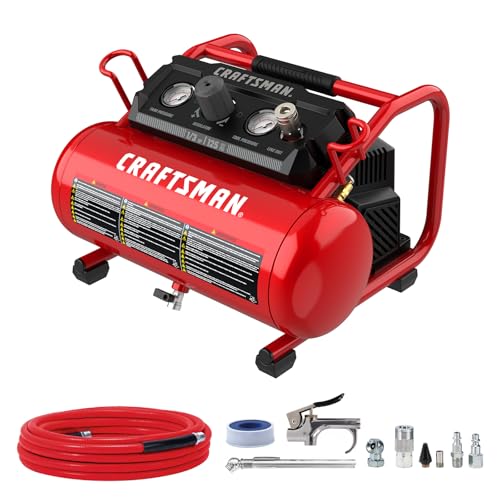
CRAFTSMAN 2-Gallon Portable Air Compressor
This CRAFTSMAN 2-gallon portable compressor package pairs a max 125 PSI oil-free pump with a versatile 10-piece pneumatic accessory kit using standard 1/4-inch NPT fittings. It is a practical, lightweight solution for DIYers and homeowners tackling tire inflation, air dusting, and light fastening.
Pros
- Complete out-of-the-box pneumatic package with air hose, blow gun, tire chuck, and 1/4-inch NPT quick-connect hardware
- Lightweight 19-pound carry weight makes moving between the garage, driveway, and workbench effortless
- Oil-free pump eliminates crankcase oil checks and prevents oil aerosol contamination in downstream air lines
- Dual quick couplings allow quick hookups without needing additional brass splitters
Cons
- Small 2-gallon receiver tank and 1/3 HP motor are limited to light-duty pneumatic tasks rather than continuous air-hungry tools
- The included starter air hose and accessories are entry-level components that high-volume shops may eventually want to upgrade
- Fittings utilize standard 1/4-inch auto profile plugs which require matching couplers if your shop uses alternate pneumatic profiles
KANWITY 160 PSI Portable Tire Inflator
Delivering up to 160 PSI using either an internal 8000 mAh battery or 12V car power, this compact compressor is built for quick roadside tire top-offs. Its multi-mode digital interface, integrated emergency light, and mobile charging capability make it a practical tool for glove-box storage.
Pros
- Dual battery and 12V DC car power options
- Fast 30L/min inflation with auto shut-off
- Accurate digital gauge with four pressure units
- Includes emergency light and USB power bank
Cons
- Lacks support for standard household AC wall outlets
- Relatively heavy for a handheld tool at nearly 1.9 pounds
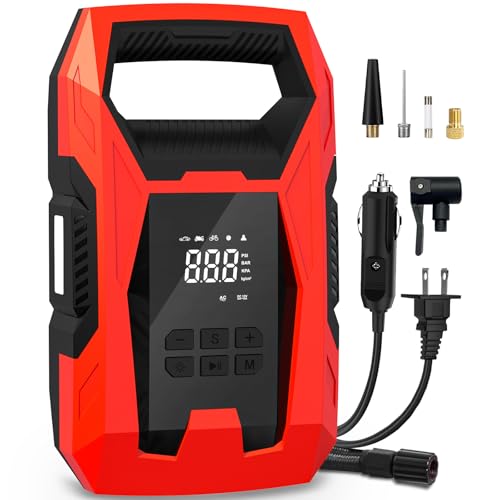
CARSUN AC/DC Portable Tire Inflator
Equipped with dual power inputs for 110V household outlets and 12V car sockets, this portable compressor delivers up to 150 PSI with auto-shutoff presets. It is a practical solution for drivers, cyclists, and households needing dependable inflation for standard vehicle tires and sports gear.
Pros
- Dual 110V AC and 12V DC power compatibility
- Automatic shutoff with memory preset function
- Clear backlit screen visible in direct sunlight
- Integrated LED light for nighttime emergencies
- Includes multiple adapters and dedicated carrying bag
Cons
- Not compatible with truck, tractor, or SUP board tires
- Requires 10-minute cooldown after 15 minutes of use
AstroAI AIRUN H 12V DC Portable Air Compressor
The AstroAI AIRUN H is a compact 12V DC tire inflator delivering up to 35 L/min airflow with automatic shut-off and digital pressure presets. It is an ideal portable emergency compressor for drivers, commuters, and garage hobbyists seeking fast tire top-offs.
Pros
- Automatic shut-off stops pumping reliably once target PSI is reached
- High-airflow 120W motor provides rapid top-offs for daily driver tires
- Long 9.84-foot power cord reaches all passenger vehicle wheels with ease
- Bright built-in LED flashlight and backlit display assist during night repairs
- Lightweight 2.2-pound form factor stores neatly in glove boxes and trunks
Cons
- Requires a 12V DC vehicle outlet and does not include a 120V AC household plug
- Mandates a 10-minute cool-down interval after 15 minutes of continuous operation
- Not intended for high-volume inflatables like large pool floats or air mattresses
VIAIR 88P 12V Portable Air Compressor
Designed for passenger cars and light trucks with tires up to 33 inches, the VIAIR 88P delivers dependable 120 PSI output directly from a vehicle battery. Its generous 26-foot total reach, built-in gauge, and integrated work light make it a practical emergency companion for road trips and camping.
Pros
- Solid 1.47 CFM flow rate provides brisk inflation
- Generous 26-foot reach easily accesses all four tires
- Built-in LED work light aids dark roadside repairs
- Compact body weighs under five pounds for convenient storage
Cons
- Requires direct battery connection instead of standard 12V outlet
- Limited to a 25-minute duty cycle before cooling
- Not designed for tires larger than 33 inches
AIRSURE 150 PSI Portable Tire Inflator
Measuring just over five inches tall, this compact inflator delivers up to 150 PSI with automatic shut-off and multiple preset modes. It also functions as a travel emergency tool, offering an integrated LED work light and a USB charging port for phones.
Pros
- Compact pocket-sized dimensions for easy storage
- Doubles as a backup USB power bank
- Clear digital display with four pressure units
- Built-in LED light aids nighttime use
- Auto shut-off prevents accidental over-inflation
Cons
- Requires short bursts when inflating smaller items
- Pressure reading has a tolerance of 1 PSI
- Sensor may occasionally need manual zero resets
CARSUN Dual Power AC/DC Portable Tire Inflator
The CARSUN Dual Power Tire Inflator delivers up to 150 PSI of high-pressure air running from either a 110V household outlet or a 12V vehicle socket. With digital pressure presets, automatic shutoff, and a lightweight 2.1-pound frame, it is an ideal maintenance pump for passenger vehicles, bicycles, and household inflatables.
Pros
- Versatile dual-voltage operation works seamlessly in the home garage or on the road without requiring an external converter
- Accurate auto-shutoff mechanism protects tires from accidental over-pressurization during routine top-offs
- Compact 2.1-pound build packs away easily in car trunks, under vehicle seats, or on garage shelving
- Clear digital display allows fast switching across four standard pressure measurement units
Cons
- Requires a mandatory 10-minute cooldown period after every 15 minutes of continuous operation
- Manufacturer explicitly states it does not support heavy truck tires, tractor tires, or stand-up paddleboards (SUP)
- Tankless inflator design cannot run standard workshop pneumatic air tools like brad nailers or paint sprayers
Airmoto 120 PSI Portable Tire Inflator
Weighing just 1.2 pounds, this compact cordless compressor delivers up to 120 PSI with automatic shutoff for routine top-offs on cars, bikes, and sports gear. Its pocket-sized form factor stores neatly in a glove box, serving as a convenient roadside backup.
Pros
- Extremely compact and lightweight design
- Auto shut-off prevents accidental over-inflation
- Clear digital LCD display with real-time pressure reading
- Integrated LED light aids night roadside repairs
- Internal hose storage keeps accessories organized
Cons
- Not suitable for heavy-load tires or large inflatables
- Cold temperatures and large tires drain battery quickly
- Requires frequent recharging before heavy usage
AstroAI L7 Cordless Tire Inflator Portable Air
The AstroAI L7 is a lightweight, handheld cordless air compressor delivering up to 150 PSI with an integrated 4000mAh rechargeable battery and precise auto-shutoff. It provides dependable, pocket-sized inflation performance for motorists, cyclists, and DIYers needing quick roadside tire top-offs.
Pros
- Weighs only 0.96 pounds for effortless storage in vehicle consoles, toolbags, or cycling packs
- High-speed digital sensor samples tire pressure at 200 times per second to prevent over-inflation
- Internal 4000mAh battery provides cordless freedom without tangling 12V cigarette lighter cords
- Versatile secondary utility as an emergency LED flashlight and portable USB power bank
Cons
- Not intended for heavy-duty truck tires or commercial tires larger than 25 inches in diameter
- Duty cycle requires allowing the unit to cool for 10 minutes after 15 minutes of continuous run time
- Tankless micro-compressor design cannot power workshop pneumatic air tools
How Portable Compressor Power Sources Work
Portable air compressors do not all need to be plugged into a wall outlet. Some connect to a vehicle’s 12V electrical system, some contain a rechargeable battery, and some offer more than one way to receive power. A tank-style compressor commonly uses household AC power, but its actual power source and electrical requirements depend on the specific model. Check the product manual and nameplate rather than assuming that every portable compressor can run from the same outlet or battery.
Household AC power for tank compressors
A plug-in tank compressor draws electricity through a cord and uses a motor to compress and store air. The tank lets the motor build a reserve, but the unit still needs a suitable electrical supply to run and replenish that air. The CRAFTSMAN model listed here is a 2-gallon, 1/3 HP tank compressor with a maximum pressure of 125 PSI. Its supplied information describes uses such as automotive work, carpentry, fastening, and bolting, but it does not provide an SCFM delivery rating or amperage figure.
That missing airflow and electrical information matters if you’re matching a compressor to a particular pneumatic tool or circuit. A tool’s required airflow, commonly listed in SCFM at a stated pressure, is not the same as a compressor’s maximum PSI or tank size. Consult the compressor and tool manuals for those figures, along with the motor’s power requirements. Do not infer that a small tank compressor can sustain a high-demand tool just because its maximum pressure looks adequate.
A household outlet may be convenient in a garage or workshop, but convenience is not a substitute for checking the circuit. Follow the manufacturer’s electrical instructions, including any guidance about circuit capacity, grounding, and extension cords. Avoid relying on a long, light-duty extension cord if the manual does not permit it, because voltage drop can interfere with motor operation. If the compressor repeatedly trips a breaker or struggles to start, stop and investigate the electrical supply instead of repeatedly resetting the breaker.
12V vehicle power for roadside inflation
Many compact tire inflators are designed to connect to a vehicle’s 12V accessory outlet. The AstroAI AIRUN H, for example, is listed as a 12V DC inflator with a 9.8-foot cord, digital pressure display, and automatic shutoff at a selected target. A corded unit like this needs a compatible vehicle power connection while operating, so it is not cordless merely because it is small enough to store in a trunk.
Some 12V compressors use battery clamps instead of an accessory plug. The VIAIR 88P product information says to connect its clamps directly to the vehicle battery, start the engine, attach the hose, and operate the compressor with its switch. This arrangement differs from plugging a tire inflator into the cabin outlet, so follow the supplied instructions for the particular unit. A battery-clamp compressor is not a household plug-in model, even though it still depends on an electrical power source.
Vehicle power can make sense when you need to adjust tire pressure away from a building, but a compressor’s pressure rating alone does not establish suitability for every tire or inflation task. The VIAIR 88P is listed at up to 120 PSI, and its description identifies vehicle tires and compatible inflatables as intended uses. Check the compressor’s specifications, duty-cycle instructions, and the tire or equipment manufacturer’s pressure guidance before operating it. Never exceed the pressure limit specified for the tire or inflatable.
Rechargeable batteries and dual-power inflators
A battery-powered inflator can operate without a live outlet or a connected vehicle cord once its internal battery is charged. The Airmoto is described as a cordless inflator with a rechargeable 2,000 mAh battery, an LCD, and automatic shutoff. Its manufacturer notes that battery performance depends on conditions such as tire size, pressure, temperature, and charging state. That means cordless convenience should not be mistaken for unlimited runtime or suitability for large-volume inflation.
Other models combine battery operation with a backup power connection. The DEWALT inflator’s listed power options include a built-in rechargeable battery, USB charging, and a 12V car accessory plug. The KANWITY inflator is described as having an 8,000 mAh battery and 12V DC support. These examples illustrate why the word portable does not tell you whether a particular unit must be plugged in, or whether it can fall back to vehicle power after its battery runs low.
Before buying a battery model, confirm how it charges, what power sources it accepts during operation, and whether a battery or charger is included. The AstroAI L7 product information lists a built-in 4,000 mAh battery and USB-C charging, along with USB input and output. The supplied description does not establish compatibility with a separate cordless tool battery platform, so do not assume that a pack from another brand or tool system will work. A built-in battery inflator is also a different category from a tank compressor powered by a removable jobsite battery.
AC/DC models bridge home and car use
A dual-power inflator can be useful if you want one device for a garage and a vehicle. Both CARSUN products in the supplied information are described as accepting a 110V or 120V wall connection and a 12V vehicle accessory connection. They also list a digital display, preset modes, and automatic shutoff. That combination can remove the need to choose a wall-powered-only or car-powered-only inflator, as long as the intended task is within the unit’s stated limits.
Power flexibility does not make these compact inflators substitutes for every shop compressor. The CARSUN descriptions specifically exclude truck and tractor tires, and one also warns against use with SUP paddleboards. Those limitations matter more than a high maximum PSI figure when evaluating fit for a task. A device may generate a high pressure but still lack the airflow, operating duration, or capacity needed for a large-volume job.
Check the supplied cord and adapters before use, and connect only to the power source identified by the manufacturer. Keep the unit’s ventilation clear and observe any stated cooling periods. The CARSUN information recommends a rest period after a specified interval of operation. Respect those limits rather than leaving a compact inflator running continuously to finish a demanding task.
Power source is separate from pressure and airflow
It is easy to focus on whether a compressor plugs in and overlook what its air output can actually do. Maximum PSI describes a pressure limit, not the volume of air delivered to a tool. Tank capacity describes stored air, not how quickly the pump can replace it. For pneumatic tools, compare the tool’s stated air consumption with the compressor’s delivered airflow at the relevant pressure, if that information is available.
Intermittent tools, such as some nailers, generally use air in short bursts, while equipment such as sanders and sprayers may draw air continuously. A compressor that can reach a tool’s operating pressure may still fail to keep up with a continuous demand. The product information provided for the CRAFTSMAN tank compressor does not state its SCFM output, and the tire inflators are presented chiefly for inflation rather than sustained pneumatic-tool operation. Don’t assume tool compatibility without checking the manufacturer’s airflow specifications.
Likewise, a built-in battery inflator may be suitable for routine tire top-offs without being intended for air tools, large tires, or high-volume inflatables. The Airmoto description specifically excludes large-volume uses such as air mattresses, paddleboards, and heavy-load tires requiring a small compressor. A compact pump’s portability can be a strong advantage for its intended tasks, but it is not evidence of a large air reserve or continuous-duty capability. Match the equipment to the job before relying on it.
Choosing the right connection for the job
For quick tire checks at home, a wall-powered or rechargeable inflator may be convenient. For roadside use, a 12V accessory-powered model, battery-clamp compressor, or charged cordless inflator avoids the need for a household outlet. If you want to use the same tire inflator in a garage and car, an AC/DC design offers both listed connections. A tank compressor is the more relevant form when the task involves workshop air tools, but its airflow and electrical requirements still need to match the work.
Think about how the power source affects storage and readiness. A battery-powered device needs to be recharged and stored with enough charge for the next use, while a corded vehicle inflator needs its cable and adapters available. A compressor that uses battery clamps calls for access to the battery and safe connection according to its manual. An AC/DC unit needs both its wall and vehicle leads kept in usable condition.
Portability also has practical limits. A compact inflator can fit in a vehicle, while a tank compressor occupies more room and requires a suitable place to operate. The CRAFTSMAN compressor is listed at 19 pounds and includes a reinforced handle, but the supplied details do not specify its electrical draw or extension-cord requirements. For tank compressors, consult the complete manual before transport, operation, or maintenance, and do not move a pressurized unit in a way the manufacturer prohibits.
Safe operation and useful checks
Start by identifying the exact model and reading its manual. Confirm the allowed input voltage, connection type, fuse requirements, pressure limit, and any maximum operating time or cooling interval. Inspect cords, clamps, plugs, hoses, and adapters for visible damage before use. If a connection is loose or damaged, do not improvise a repair while the compressor is energized.
Set an inflator’s target using the pressure recommended for the vehicle or item, rather than relying on a generic preset. The tire pressure information on the vehicle placard or in its manual is the appropriate reference for routine tire inflation, not the maximum pressure printed on the tire sidewall. Monitor the display and hose connection, and stop if the unit behaves abnormally, overheats, or reaches a stated operating limit. Automatic shutoff is useful, but it does not replace checking the final pressure.
Tank compressors need different care from small tire inflators. Follow the manual’s instructions for draining condensation, storage, and maintenance, and depressurize the tank as directed before maintenance or transport. Never modify a pressure switch or safety relief device, and never exceed the compressor’s rated pressure. For any powered compressor, disconnect the power source before servicing it; remove a battery pack where applicable.
Use appropriate eye protection around compressed air and pneumatic equipment, and follow the manufacturer’s safety directions. Do not point compressed air at people or use it to clean skin or clothing. Keep children and bystanders away from operating equipment, especially where hoses or power cords could create a trip hazard. If a unit repeatedly trips a breaker, overheats, leaks, or fails to reach its expected pressure, discontinue use and consult the manual or manufacturer for service guidance.
Make the decision by task, not by label
The term portable covers several different products, so compare the power source and intended task rather than relying on the label. A rechargeable inflator offers cordless operation after charging; a 12V model needs a vehicle connection; an AC/DC unit can use either listed source; and a tank compressor may need a household outlet. These are not interchangeable power arrangements, even though all can be moved from place to place.
For tire inflation, check pressure limits, connection options, hose reach, battery charging, and any cooling guidance. For workshop tools, prioritize documented airflow at the required pressure, tank capacity, and electrical requirements. If those specifications are missing, ask the manufacturer or choose a product whose published details address the job. A maximum PSI figure alone cannot establish that the compressor will keep up with a pneumatic tool.
So, portable air compressors do not universally need to be plugged into a wall. Some need a vehicle connection, some run on a charged internal battery, and some offer multiple power choices. Identify the intended use, verify the exact input and performance limits, and keep the compressor within the manufacturer’s operating instructions before putting it to work.
Vehicle-based air setups and installation context
Some drivers want an air source that stays with the vehicle rather than a portable unit carried in and out of the trunk. That is a different decision from choosing a cordless tire inflator: a mounted system may be arranged around vehicle storage, wiring, and the intended inflation tasks. The products listed here include portable options, but they do not provide enough information to recommend a particular permanent installation or claim compatibility with a specific vehicle.
If you’re comparing a portable compressor with an installed setup, our guide to in-car compressor installation provides related information. Read the installation requirements for the exact equipment before making changes to a vehicle. Electrical routing, mounting, and air-line choices should follow the product maker’s instructions and applicable vehicle guidance, rather than assumptions based on another compressor.
For occasional inflation, carrying a self-contained unit may be simpler than adding fixed equipment. For repeated use, a vehicle-based arrangement may merit further research, but the power source, airflow, pressure rating, and duty-cycle limits still determine whether it suits the work. In either case, choose equipment from documented specifications and avoid treating portability as proof that a compressor can supply every tool or tire.
About the author
Tom Scalisi brings more than two decades of experience in construction, building maintenance, contracting, and hands-on tool use. His practical understanding of power tools, automotive work, repairs, and jobsite equipment helps readers evaluate compressors based on real workloads rather than specifications alone.