
Are Portable Air Compressors Worth It? A Practical Guide
Are portable air compressors worth it for tire care and pneumatic tools? Compare useful capacity, power, and limits for November 2026.
 By Tony Carrick
Updated November 23, 2026


A compact inflator can save a trip to a service station, while a small tank compressor can power tools that would be impractical to run from a hand pump. But these machines aren’t interchangeable, and the answer to are portable air compressors worth it depends on what you expect one to do. A cordless tire inflator is built around portability and occasional inflation; a pancake compressor stores more air for tools, but still has limits on sustained airflow.
Think about the jobs you actually do, how often you do them, and whether you’re willing to manage a power cord, battery, or vehicle connection. The available options include small cordless tire pumps, 12V battery-clamp inflators, and electric tank compressors, so the right purchase depends on matching the format to the task. For a workshop decision involving air demand, our compressor options for furniture projects offer another useful point of comparison. If your work involves abrasive blasting, the airflow demands of home sandblasting illustrate why a small portable unit may not be enough.
| Award | Product | ACR Score About ACR ScoreThe ACR Score is our own rating from 0 to 10, based on performance, design and build, ease of use, and value. It reflects independent research and is never influenced by manufacturers, retailers, or affiliate commissions. Learn more › | |
|---|---|---|---|
| Best Overall |
WELLBALLER 20V Cordless Tire Inflator 150 PSI
|
9.1/10 | Buy |
| Best Premium |
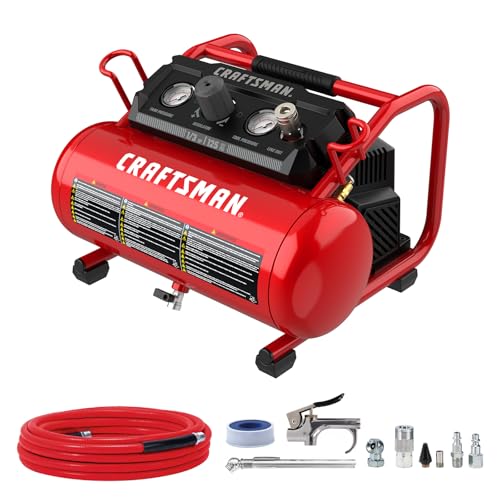 CRAFTSMAN 2-Gallon Portable Air Compressor |
9.1/10 | Buy |
| Best Budget |
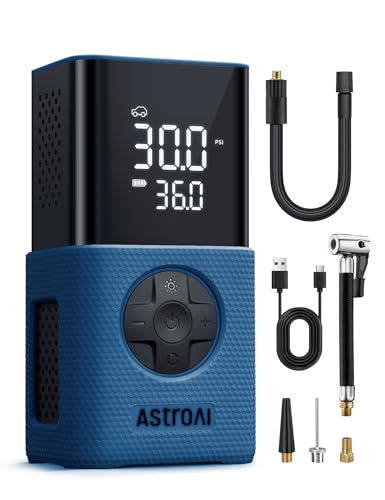 AstroAI L7S 150 PSI Cordless Tire Inflator |
8.9/10 | Buy |
 Elccyu Cordless Tire Inflator Portable Air |
8.9/10 | Buy | |
| Best Value |
 GSPSCN 12V Portable Tire Inflator |
8.8/10 | Buy |
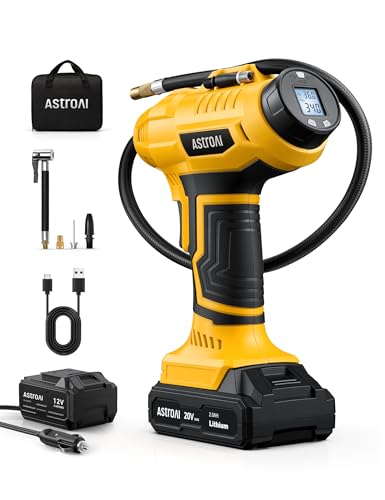 AstroAI Cordless Tire Inflator 160 PSI |
8.8/10 | Buy | |
 ECOMAX 6-Gallon 150 PSI Portable Pancake Air |
8.8/10 | Buy | |
 VIAIR 88P 12V Portable Air Compressor |
8.4/10 | Buy | |
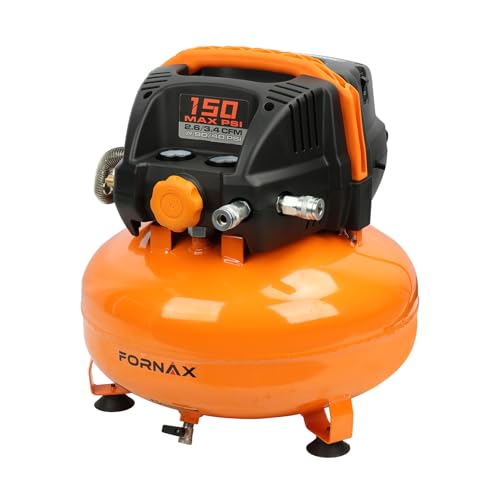 FORNAX 6-Gallon Pancake Air Compressor |
8.4/10 | Buy | |
 AIRSURE 150 PSI Portable Tire Inflator |
8.3/10 | Buy |
WELLBALLER 20V Cordless Tire Inflator 150 PSI
WELLBALLER equips this handheld inflator with a 25mm cylinder delivering 30L/min airflow up to 150 PSI. Fast USB-C recharging and intelligent auto shut-off make it a dependable companion for car tires, bicycles, and emergency roadside top-offs.
Pros
- Fast 30L/min airflow reaches up to 150 PSI
- Rapid one-hour USB-C fast charging
- Automatic shut-off prevents accidental over-inflation
- Multi-mode LED light aids nighttime roadside use
Cons
- 2000mAh battery capacity limits extended heavy use
- Lacks a 12V car socket power backup
CRAFTSMAN 2-Gallon Portable Air Compressor
This CRAFTSMAN 2-gallon portable compressor package pairs a max 125 PSI oil-free pump with a versatile 10-piece pneumatic accessory kit using standard 1/4-inch NPT fittings. It is a practical, lightweight solution for DIYers and homeowners tackling tire inflation, air dusting, and light fastening.
Pros
- Complete out-of-the-box pneumatic package with air hose, blow gun, tire chuck, and 1/4-inch NPT quick-connect hardware
- Lightweight 19-pound carry weight makes moving between the garage, driveway, and workbench effortless
- Oil-free pump eliminates crankcase oil checks and prevents oil aerosol contamination in downstream air lines
- Dual quick couplings allow quick hookups without needing additional brass splitters
Cons
- Small 2-gallon receiver tank and 1/3 HP motor are limited to light-duty pneumatic tasks rather than continuous air-hungry tools
- The included starter air hose and accessories are entry-level components that high-volume shops may eventually want to upgrade
- Fittings utilize standard 1/4-inch auto profile plugs which require matching couplers if your shop uses alternate pneumatic profiles
AstroAI L7S 150 PSI Cordless Tire Inflator
Weighing barely a pound, the AstroAI L7S delivers portable inflation up to 150 PSI alongside a shock-absorbing silicone sleeve and power bank utility. Five smart presets and automatic shut-off make it a practical roadside companion for passenger cars, bicycles, and sports gear.
Pros
- Pocketable design weighing just 1.01 pounds
- Protective silicone sleeve dampens vibration and drops
- Hands-free operation with automatic shut-off
- Built-in power bank charges mobile devices
- Clear digital display with five smart presets
Cons
- Incompatible with heavy-duty truck and RV tires
- Not suitable for off-road vehicle tires or trailers
Elccyu Cordless Tire Inflator Portable Air
The Elccyu Cordless Tire Inflator delivers up to 160 PSI and 40 L/min airflow with a compact 22-cylinder turbo motor, making it a dependable emergency solution for passenger cars, motorcycles, and bicycles. With smart auto shut-off, a digital LCD display, and a lightweight one-pound frame, it is a practical pick for drivers and DIYers wanting hassle-free cordless inflation.
Pros
- Fast 160 PSI and 40 L/min airflow quickly tops off passenger car, SUV, motorcycle, and bicycle tires
- Smart digital auto shut-off eliminates the risk of accidental over-inflation
- Ultra-compact one-pound profile stores easily in a glove compartment, door pocket, or backpack
- Built-in multi-mode LED flashlight with SOS and strobe adds practical safety during nighttime roadside stops
Cons
- Not engineered for heavy-duty high-volume applications such as RVs, trailers, or commercial dual-wheel trucks
- Does not include an AC wall adapter block, requiring a standard USB-A power source for recharging
- Tankless mobile design is dedicated to tire and ball inflation rather than powering pneumatic workshop air tools
GSPSCN 12V Portable Tire Inflator
The GSPSCN 12V Heavy Duty Tire Inflator delivers a robust 70 L/min airflow with its direct-drive dual-cylinder metal pump and 150 PSI maximum pressure rating. Built for pickup trucks, SUVs, and trailer owners, it operates at a manageable 70 dB and includes battery clamps for reliable 12V direct connection.
Pros
- Fast 70 L/min air volume output powered by a dual-cylinder direct-drive metal pump mechanism
- Generous 23-foot total working reach across the 11.5-foot 12V power cord and 11.5-foot air hose
- Direct battery clamps deliver dependable 12V DC power without risking internal vehicle fuse blowouts
- Remarkably manageable 70 dB sound level compared to standard high-pitch emergency tire pumps
Cons
- Requires direct 12V car battery terminal connection, which necessitates opening the vehicle hood
- Lacks an integrated air storage tank, so it is strictly intended for direct inflation rather than air tools
- No built-in digital automatic shutoff target pressure stop, requiring manual gauge monitoring
AstroAI Cordless Tire Inflator 160 PSI
The AstroAI Cordless Tire Inflator is a compact 160 PSI handheld air compressor featuring dual power via a 20V rechargeable battery and a 12V DC car adapter. Delivering digital auto shut-off and up to 20 minutes of continuous runtime, it is an ideal emergency tool for garage mechanics, commuters, and road-trippers.
Pros
- Dual-power versatility allows cordless battery operation at home or 12V DC vehicle plug-in on the road
- Reaches up to 160 PSI with automatic shut-off to prevent accidental tire over-pressurization
- Compact 2.54-pound footprint provides effortless trunk or glove-box storage for emergency readiness
- Backlit digital LCD screen provides clear readouts in PSI, BAR, and KPA units
- Integrated front LED light illuminates tire valve stems during dark roadside emergencies
Cons
- Includes a USB-C charging cable but requires an external USB power block to recharge the battery
- Designed specifically for tire and sports inflation rather than driving pneumatic workshop air tools
- Continuous runtime is limited to 20 minutes before requiring a cool-down pause
ECOMAX 6-Gallon 150 PSI Portable Pancake Air
The ECOMAX 6-Gallon 150 PSI Pancake Air Compressor delivers portable, low-maintenance pneumatic power with its 1.5 HP oil-free pump, dual quick-connect couplers, and bundled 10-piece accessory kit. Featuring cold-weather starting support and a flip-up handle, it is an accessible choice for DIYers, trim carpenters, and garage tire maintenance.
Pros
- Comes with a 10-piece accessory kit including an air hose, tire chuck, and blow gun ready out of the box
- Dual quick-connect couplers enable two operators to run pneumatic lines simultaneously
- Oil-free pump design requires zero motor oil maintenance and prevents oil discharge into air lines
- Low-voltage and cold-weather startup capability helps ensure reliable motor turnover in chilly garages
- Flip-up carrying handle and built-in cord bracket simplify transport and tidy storage
Cons
- PVC air hose included in the kit can become stiff and difficult to manage in freezing temperatures
- Not intended for continuous high-demand air tools such as rotary sanders or automotive paint sprayers
- Standard universal motor noise level makes hearing protection advisable during indoor use
VIAIR 88P 12V Portable Air Compressor
Designed for passenger cars and light trucks with tires up to 33 inches, the VIAIR 88P delivers dependable 120 PSI output directly from a vehicle battery. Its generous 26-foot total reach, built-in gauge, and integrated work light make it a practical emergency companion for road trips and camping.
Pros
- Solid 1.47 CFM flow rate provides brisk inflation
- Generous 26-foot reach easily accesses all four tires
- Built-in LED work light aids dark roadside repairs
- Compact body weighs under five pounds for convenient storage
Cons
- Requires direct battery connection instead of standard 12V outlet
- Limited to a 25-minute duty cycle before cooling
- Not designed for tires larger than 33 inches
FORNAX 6-Gallon Pancake Air Compressor
The FORNAX 6-Gallon Pancake Air Compressor delivers 2.6 CFM at 90 PSI and up to 150 PSI of maximum pressure, featuring dual couplers and a lightweight 28.8-pound portable footprint. It is a practical pneumatic power source for DIY homeowners, finish carpenters, and garage hobbyists driving nailers or managing tire inflation.
Pros
- Dual quick-connect couplers allow two nailers to operate simultaneously without adding an external splitter manifold
- Generous 6-gallon air tank capacity with a 150 PSI maximum pressure ceiling provides a dependable air reserve
- Lightweight 28.8-pound profile simplifies one-handed carrying up stairs and transport into work vans
- Maintenance-free oil-free pump eliminates oil checks, oil changes, and mess around finished work surfaces
Cons
- Operating sound output rated at 95 dBA is loud and makes hearing protection necessary, especially in closed rooms
- Airflow output of 2.6 CFM at 90 PSI cannot support continuous-demand tools like sanders, grinders, or paint sprayers
- Supplied as a bare-tool compressor without an included air hose, tire inflator chuck, or pneumatic nailers
AIRSURE 150 PSI Portable Tire Inflator
Measuring just over five inches tall, this compact inflator delivers up to 150 PSI with automatic shut-off and multiple preset modes. It also functions as a travel emergency tool, offering an integrated LED work light and a USB charging port for phones.
Pros
- Compact pocket-sized dimensions for easy storage
- Doubles as a backup USB power bank
- Clear digital display with four pressure units
- Built-in LED light aids nighttime use
- Auto shut-off prevents accidental over-inflation
Cons
- Requires short bursts when inflating smaller items
- Pressure reading has a tolerance of 1 PSI
- Sensor may occasionally need manual zero resets
Are Portable Air Compressors Worth It for Your Jobs?
Yes, a portable air compressor can be worth owning if its power source, airflow, and storage capacity match the work you need done. For topping up passenger-car tires, inflating sports equipment, or running an intermittent-use nailer, a compact model can offer convenient access to compressed air. It is a less convincing purchase if you expect a small tank or cordless inflator to power air-hungry tools continuously. The useful question isn’t simply how much pressure a compressor advertises, but whether it can supply enough air for your particular task.
Separate tire inflators from tank compressors
A portable tire inflator is a focused tool for adding air to tires and other compatible inflatables. It generally connects directly to a tire valve and may include a digital pressure display, preset pressure, auto shutoff, light, or accessory nozzles. The listed cordless options include models with maximum pressure ratings of 150 or 160 PSI, but a maximum-pressure figure doesn’t mean the pump is suitable for every tire or built for prolonged operation. Follow the product instructions and the vehicle or tire maker’s recommended pressure, not the maximum printed on the inflator listing.
A tank compressor stores compressed air in a vessel, then supplies it through a regulator and hose. Tank size gives the pump a reserve to draw from, but doesn’t tell you how much air the pump can continuously deliver. The CRAFTSMAN option is listed with a 2-gallon tank and 125 PSI maximum; the ECOMAX and FORNAX models are 6-gallon pancake compressors with 150 PSI maximum ratings. Those figures help describe storage and pressure limits, but neither establishes that a compressor can sustain every pneumatic tool.
This distinction matters when comparing listings. A 150 PSI inflator might reach a high pressure in a small hose, yet still be intended for tire maintenance rather than operating a nailer. A tank compressor may run a compatible tool from stored air, but the pump has to replenish that reserve as the tool consumes it. A buyer can therefore get good value from a small machine for a narrow set of tasks without treating it as a miniature shop compressor.
Airflow matters more than the headline PSI for tools
Pressure and airflow answer different questions. PSI describes pressure, while a tool’s air demand is commonly stated in CFM or SCFM at a specified pressure. The compressor needs to provide adequate delivered airflow at the pressure the tool requires, with enough recovery capacity for the pace of work. A maximum PSI rating alone cannot confirm that match, and the product data supplied here does not provide delivered CFM at 90 PSI for the listed tank compressors.
Intermittent tools, such as many brad nailers and staplers, use short bursts of air rather than drawing continuously. That pattern can make a small tank compressor useful for trim tasks, though the exact tool requirements and the pace of firing still matter. If pressure falls before the pump catches up, fast work may require pauses for recovery. Read the tool’s air-consumption requirements and compare them with the compressor’s published delivery rating before assuming the combination will work.
Continuous-demand tools create a tougher test. Orbital sanders, grinders, and many spray guns can consume air steadily, so a small tank may empty quickly and leave the pump running or the tool short of air. Even a tank that reaches a high cutoff pressure cannot make up for inadequate pump output over time. A small portable compressor may handle occasional touch-up or brief tool use if specifications align, but don’t buy one on the assumption that it will run a continuous-use tool without interruption.
The FORNAX listing reports air-consumption figures of 2.6 CFM at 90 PSI and 3.4 CFM at 40 PSI. Those are presented as compressor air-consumption specifications, so check the manufacturer’s technical information to determine exactly how they relate to delivered output before comparing them with a tool’s SCFM requirement. The ECOMAX description mentions 3 cubic inches of air at 90 PSI, a unit that is not directly interchangeable with a CFM rating. Clarifying units and delivery ratings is more useful than trying to rank models by their maximum PSI.
For air-tool projects, write down the tool’s required pressure and air consumption, including whether its rating assumes intermittent or sustained use. Then verify that the compressor publishes a comparable delivery figure at the same pressure. If a listing lacks that information, treat compatibility as uncertain rather than filling in the gap with a guess. A guide to installing an air compressor in a vehicle may also help distinguish a vehicle-mounted setup from a portable unit carried for occasional tire inflation.
Choose power around where the compressor will work
Cordless inflators make sense when you want a compact emergency pump without setting up an air hose or finding a wall outlet. The WELLBALLER listing describes a 20V battery, while the AstroAI L7S lists a built-in battery and USB-C input/output. The AstroAI cordless model in the product set is described as supporting both a rechargeable battery and a 12V DC vehicle power adapter. Battery capacity, runtime, and charging arrangements vary, so check what is included and keep the unit charged if you plan to rely on it away from home.
Battery-powered inflators trade cord-free convenience for dependence on stored electrical charge. The product descriptions make different runtime claims, but those claims shouldn’t be treated as a guarantee for every tire size, starting pressure, temperature, or battery condition. Some models may also have limits on continuous operating time. Check the manual for rest periods and intended use, and avoid assuming that a compact cordless inflator is appropriate for heavy truck, trailer, RV, or off-road tire work unless the manufacturer specifically supports that application.
A 12V clamp-style compressor uses a vehicle battery connection rather than a small built-in battery. The VIAIR 88P listing specifies battery clamps, a 120 PSI maximum working pressure, a 25-minute duty cycle at 30 PSI, and suitability for tires up to 33 inches. These details make its intended tire-inflation use clearer than a bare maximum-PSI number. Still, observe its stated duty cycle and vehicle operating instructions, and don’t assume that its specifications cover every RV or trailer tire.
Electric tank compressors are better suited to a garage or a job where mains power is available. The listed CRAFTSMAN 2-gallon compressor weighs 19 pounds and includes an accessory kit; the 6-gallon ECOMAX is listed at 34.17 pounds, while the FORNAX listing gives 28.8 pounds. Those weights signal a real portability tradeoff: more tank capacity can mean a heavier unit to lift, even if a handle makes it easier to move. None of those listed weights establishes how convenient a compressor will be on stairs or in a packed vehicle, so consider the route and storage space as well as the tank.
Think about noise, maintenance, and transport
Noise can affect whether a compressor is comfortable to use inside a garage or near an occupied home. The FORNAX description lists an operating noise level of 95 dB(A), which is a specific product claim worth considering, but no comparable noise figures are supplied for the other tank compressors or inflators here. Don’t assume that every compact unit is quiet. For loud equipment, use appropriate hearing protection and follow the operating instructions, especially during longer tasks.
The CRAFTSMAN, ECOMAX, and FORNAX tank compressors are described as having oil-free pumps. That can reduce routine pump-oil maintenance and may be convenient if the compressor travels between a garage and a work area. Oil-free does not mean maintenance-free in every respect: users still need to consult the manual about tank drainage, cleaning, and storage. The provided descriptions do not establish pump life or make a fair comparison with oil-lubricated models, so those claims should not be inferred.
Small cordless inflators are easy to store in a vehicle, but they are limited by battery charge and their intended workload. A compact tank compressor is more capable of supplying air through a hose, but its size and weight take up more storage space. The CRAFTSMAN listing includes a reinforced handle and accessory kit, while the ECOMAX description lists a flip-up handle and cord-storage bracket. Those features can make transport and organization easier, but they don’t change the compressor’s actual air-delivery capacity.
Tank compressors also collect moisture as compressed air cools. Drain condensation according to the manufacturer’s instructions, particularly after use, to reduce the chance of water remaining in the tank. Before maintenance or transport, follow the manual’s depressurization guidance and disconnect the power source; remove a battery pack where applicable. Never try to repair a damaged pressure vessel yourself, and have a questionable tank assessed through the manufacturer or an appropriate service provider.
Make the purchase decision by task, not by one number
A tire-only use case generally favors a dedicated inflator that fits the intended tires and power arrangement. A glove-box-sized cordless unit may be convenient for routine top-ups, while a clamp-powered 12V model may suit a buyer who wants a vehicle connection and a longer hose. The VIAIR 88P’s listed duty cycle and tire-size guidance are more useful for evaluating that role than its maximum PSI on its own. Match any tire work to the vehicle or tire maker’s pressure recommendation and the compressor’s stated limits.
A workshop buyer who needs air for occasional trim work should pay particular attention to delivered airflow, regulator range, couplers, tank capacity, and the nailer’s requirements. The CRAFTSMAN 2-gallon model includes two quick couplings and a 125 PSI maximum, while the FORNAX 6-gallon model lists two couplers and 150 PSI maximum. Dual couplers can make connecting equipment convenient, but they don’t increase the pump’s total airflow. If two tools draw air at once, their combined demand still has to be supported by the compressor.
Buyers planning to spray paint or sand should be more cautious than someone inflating tires or firing a nailer now and then. These sustained tasks depend on compressor output over time, not simply the amount of air temporarily stored in a tank. Look for a published delivered CFM or SCFM rating at the tool’s operating pressure, a suitable duty-cycle specification, and clear guidance about the intended use. If those details are missing, a larger tank or higher maximum PSI by itself is not enough evidence to justify the purchase.
Accessories can affect day-to-day convenience, but they don’t fix a capacity mismatch. The CRAFTSMAN package lists a hose, tire-pressure gauge, blow gun, and inflation fittings; the ECOMAX package lists a 25-foot PVC hose and inflation accessories. Check that included connectors suit the equipment you plan to use, and follow the compressor and hose manufacturers’ pressure limits. Wear eye protection when using compressed air, and use air only for applications allowed by the equipment instructions.
Electrical setup matters for a mains-powered tank compressor, but the supplied product details don’t give starting-current measurements or specific extension-cord requirements. Use a properly grounded outlet and follow the manual for power supply and cord selection instead of assuming a household circuit or long cord is suitable. Stop using equipment that trips a breaker repeatedly, overheats, or behaves abnormally until the cause is addressed. Avoid bypassing electrical protections or modifying pressure controls.
Overall, portable compressors are worth considering when portability solves a regular problem and the machine is specified for the work. A tire inflator is a practical emergency and maintenance tool; a small tank compressor can add intermittent pneumatic-tool capability when its delivered airflow matches the tool. Continuous air use, large tires, long work sessions, or strict noise needs call for closer specification checks, and may justify a different class of equipment. Buy for the job you can verify from the published requirements, not for a headline PSI figure alone.
About the author
Tony Carrick is an experienced product researcher and writer specializing in tools, home improvement, automotive maintenance, and consumer equipment. With extensive experience reviewing tools and tackling hands-on renovation projects, he brings a buyer-focused perspective to compressor performance, usability, and overall value.