
What Is a Good Psi for a Portable Air Compressor? A Practical Guide
What is a good psi for a portable air compressor depends on the tire or tool, not the pump's maximum rating. Compare key settings for November 2026.
 By Glenda Taylor
Updated November 23, 2026


A compressor’s maximum PSI can look impressive, but that number alone doesn’t tell you whether it’s right for a tire or pneumatic tool. What is a good psi for a portable air compressor depends on the equipment being inflated or operated, the pressure it requires, and the compressor’s ability to deliver air at that pressure. A tire’s recommended pressure, for example, is not the same as a compressor’s maximum pressure rating.
For vehicle tires, follow the pressure listed on the vehicle’s tire-information placard or in its owner’s manual, and check pressure when the tires are cold. For pneumatic tools, start with the tool manufacturer’s specified operating pressure, often stated around 90 PSI, then check the tool’s air-consumption requirement. Maximum PSI, delivered airflow, tank capacity, and the regulator setting each describe a different part of the system. If you’re considering an in-vehicle setup, our guide to installing an air compressor in a car covers a related planning question.
Product Shortcode
| Award | Product | ACR Score About ACR ScoreThe ACR Score is our own rating from 0 to 10, based on performance, design and build, ease of use, and value. It reflects independent research and is never influenced by manufacturers, retailers, or affiliate commissions. Learn more › | |
|---|---|---|---|
| Best Overall |
CRAFTSMAN 12V Portable Tire Inflator with
|
9.2/10 | Buy |
| Best Budget |
 AstroAI H2 Pro Cordless Tire Inflator 150 PSI |
9.2/10 | Buy |
| Best Value |
 DEWALT Cordless Tire Inflator Portable Air |
9.1/10 | Buy |
| Best Premium |
 CRAFTSMAN 2-Gallon Portable Air Compressor |
9.1/10 | Buy |
 KANWITY 160 PSI Portable Tire Inflator |
8.9/10 | Buy | |
 ECOMAX 6-Gallon 150 PSI Portable Pancake Air |
8.8/10 | Buy | |
 Inzeetor 150 PSI Portable Tire Inflator 12V DC |
8.6/10 | Buy | |
 AstroAI AIRUN H 12V DC Portable Air Compressor |
8.4/10 | Buy | |
 FORNAX 6-Gallon Pancake Air Compressor |
8.4/10 | Buy | |
 Airmoto 120 PSI Portable Tire Inflator |
8.3/10 | Buy |
CRAFTSMAN 12V Portable Tire Inflator with
The CRAFTSMAN 12V Portable Tire Inflator is an ultra-compact 1.9-pound roadside unit delivering up to 150 PSI with digital auto shut-off and built-in cord storage. Powered via a standard 12V car accessory plug, it offers fast tire top-offs and dependable emergency inflation without crowding trunk space.
Pros
- Weighs only 1.9 pounds for effortless glove box, under-seat, or trunk storage during road trips
- Digital auto shut-off prevents accidental over-inflation without requiring constant manual gauge monitoring
- Bright three-mode LED light provides critical illumination during nighttime roadside emergencies
- Comes fully equipped with multi-valve adapters, a replacement fuse, and a tailored carry pouch
Cons
- Requires a 12V DC vehicle accessory socket and does not include a 120V AC household outlet adapter
- Compact tankless pump is built strictly for tire inflation and cannot drive pneumatic nailers or air tools
- The 2.17-foot air hose length means the compressor must sit on the ground adjacent to the wheel valve stem
AstroAI H2 Pro Cordless Tire Inflator 150 PSI
The AstroAI H2 Pro is a versatile dual-power portable tire inflator delivering up to 150 PSI via an internal rechargeable lithium battery or 12V DC vehicle plug. Featuring digital auto shut-off, accurate dual pressure displays, and onboard accessory storage, it is an ideal roadside emergency and garage solution for vehicle owners and cyclists.
Pros
- Dual power supply provides cordless convenience with a 12V DC vehicle fallback for roadside emergencies.
- Automatic shut-off and dual digital display prevent overinflation and eliminate manual pressure monitoring.
- ToughUltra internal components improve mechanical durability compared to standard plastic gear assemblies.
- Integrated nozzle storage compartment keeps bicycle adapters and ball needles organized inside the unit.
Cons
- Tankless high-pressure inflator design is not compatible with pneumatic workshop air tools like nailers or impact wrenches.
- Cordless runtime is limited to approximately 18 minutes before requiring a recharge or switching to the 12V DC vehicle cord.
- Direct-drive high-pressure pump requires cool-down pauses during continuous multi-tire inflation tasks.
DEWALT Cordless Tire Inflator Portable Air
This compact DEWALT portable tire inflator delivers up to 150 PSI with smart auto shut-off, powered by an internal rechargeable battery or an included 10-foot 12V car plug. It provides an efficient, pocket-sized solution for vehicle owners, cyclists, and DIYers wanting rapid roadside top-offs without hauling a bulky tank compressor.
Pros
- True cordless freedom with an internal rechargeable battery plus a 10-foot 12V DC vehicle plug backup
- Accurate digital pressure gauge with 5 smart presets and automatic shut-off to eliminate overinflation
- Ultra-compact handheld design weighing just 0.63 kg for easy storage in glove boxes or saddlebags
- Integrated LED work light and emergency USB power bank functionality for travel safety
- Generous accessory bundle backed by a 3-year limited warranty
Cons
- Engineered exclusively for high-pressure inflation rather than operating pneumatic air tools or nailers
- Does not include a 120V AC residential wall outlet power adapter
- Compact tankless pump requires periodic cooling breaks during heavy multi-tire inflation runs
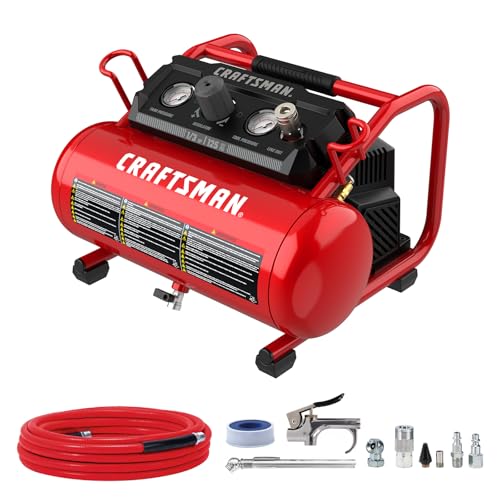
CRAFTSMAN 2-Gallon Portable Air Compressor
This CRAFTSMAN 2-gallon portable compressor package pairs a max 125 PSI oil-free pump with a versatile 10-piece pneumatic accessory kit using standard 1/4-inch NPT fittings. It is a practical, lightweight solution for DIYers and homeowners tackling tire inflation, air dusting, and light fastening.
Pros
- Complete out-of-the-box pneumatic package with air hose, blow gun, tire chuck, and 1/4-inch NPT quick-connect hardware
- Lightweight 19-pound carry weight makes moving between the garage, driveway, and workbench effortless
- Oil-free pump eliminates crankcase oil checks and prevents oil aerosol contamination in downstream air lines
- Dual quick couplings allow quick hookups without needing additional brass splitters
Cons
- Small 2-gallon receiver tank and 1/3 HP motor are limited to light-duty pneumatic tasks rather than continuous air-hungry tools
- The included starter air hose and accessories are entry-level components that high-volume shops may eventually want to upgrade
- Fittings utilize standard 1/4-inch auto profile plugs which require matching couplers if your shop uses alternate pneumatic profiles
KANWITY 160 PSI Portable Tire Inflator
Delivering up to 160 PSI using either an internal 8000 mAh battery or 12V car power, this compact compressor is built for quick roadside tire top-offs. Its multi-mode digital interface, integrated emergency light, and mobile charging capability make it a practical tool for glove-box storage.
Pros
- Dual battery and 12V DC car power options
- Fast 30L/min inflation with auto shut-off
- Accurate digital gauge with four pressure units
- Includes emergency light and USB power bank
Cons
- Lacks support for standard household AC wall outlets
- Relatively heavy for a handheld tool at nearly 1.9 pounds
ECOMAX 6-Gallon 150 PSI Portable Pancake Air
The ECOMAX 6-Gallon 150 PSI Pancake Air Compressor delivers portable, low-maintenance pneumatic power with its 1.5 HP oil-free pump, dual quick-connect couplers, and bundled 10-piece accessory kit. Featuring cold-weather starting support and a flip-up handle, it is an accessible choice for DIYers, trim carpenters, and garage tire maintenance.
Pros
- Comes with a 10-piece accessory kit including an air hose, tire chuck, and blow gun ready out of the box
- Dual quick-connect couplers enable two operators to run pneumatic lines simultaneously
- Oil-free pump design requires zero motor oil maintenance and prevents oil discharge into air lines
- Low-voltage and cold-weather startup capability helps ensure reliable motor turnover in chilly garages
- Flip-up carrying handle and built-in cord bracket simplify transport and tidy storage
Cons
- PVC air hose included in the kit can become stiff and difficult to manage in freezing temperatures
- Not intended for continuous high-demand air tools such as rotary sanders or automotive paint sprayers
- Standard universal motor noise level makes hearing protection advisable during indoor use
Inzeetor 150 PSI Portable Tire Inflator 12V DC
The Inzeetor 150 PSI Portable Tire Inflator is a lightweight 12V DC air compressor featuring digital auto shut-off and a durable zinc-alloy motor. Designed for rapid vehicle tire top-offs and sports gear, it offers dependable roadside utility for drivers and garage DIYers.
Pros
- Automatic digital shut-off eliminates manual monitoring and over-inflation risks
- Zinc-alloy motor allows continuous top-offs across four passenger tires without mandatory cooling breaks
- Weighs less than two pounds, making it effortless to stash in a trunk emergency kit
- Low-vibration chassis prevents the compressor from skittering across pavement during operation
- Comes equipped with versatile Presta and sports ball adapters alongside the standard Schrader chuck
Cons
- Requires a 12V DC vehicle cigarette lighter outlet and does not include a 120V AC wall plug
- The 1.97-foot air hose means the unit must sit on the ground or be held near the valve stem
- Engineered strictly for tire and recreation inflation rather than driving pneumatic workshop tools
AstroAI AIRUN H 12V DC Portable Air Compressor
The AstroAI AIRUN H is a compact 12V DC tire inflator delivering up to 35 L/min airflow with automatic shut-off and digital pressure presets. It is an ideal portable emergency compressor for drivers, commuters, and garage hobbyists seeking fast tire top-offs.
Pros
- Automatic shut-off stops pumping reliably once target PSI is reached
- High-airflow 120W motor provides rapid top-offs for daily driver tires
- Long 9.84-foot power cord reaches all passenger vehicle wheels with ease
- Bright built-in LED flashlight and backlit display assist during night repairs
- Lightweight 2.2-pound form factor stores neatly in glove boxes and trunks
Cons
- Requires a 12V DC vehicle outlet and does not include a 120V AC household plug
- Mandates a 10-minute cool-down interval after 15 minutes of continuous operation
- Not intended for high-volume inflatables like large pool floats or air mattresses
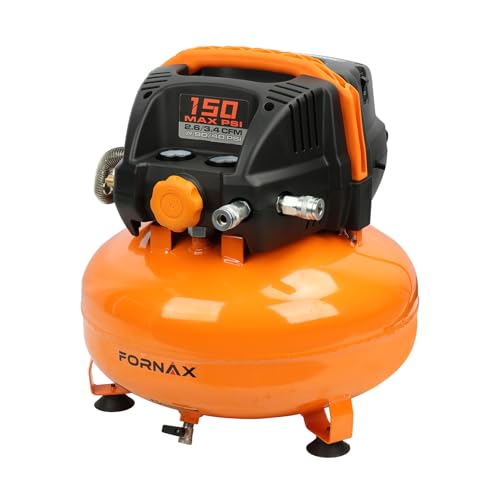
FORNAX 6-Gallon Pancake Air Compressor
The FORNAX 6-Gallon Pancake Air Compressor delivers 2.6 CFM at 90 PSI and up to 150 PSI of maximum pressure, featuring dual couplers and a lightweight 28.8-pound portable footprint. It is a practical pneumatic power source for DIY homeowners, finish carpenters, and garage hobbyists driving nailers or managing tire inflation.
Pros
- Dual quick-connect couplers allow two nailers to operate simultaneously without adding an external splitter manifold
- Generous 6-gallon air tank capacity with a 150 PSI maximum pressure ceiling provides a dependable air reserve
- Lightweight 28.8-pound profile simplifies one-handed carrying up stairs and transport into work vans
- Maintenance-free oil-free pump eliminates oil checks, oil changes, and mess around finished work surfaces
Cons
- Operating sound output rated at 95 dBA is loud and makes hearing protection necessary, especially in closed rooms
- Airflow output of 2.6 CFM at 90 PSI cannot support continuous-demand tools like sanders, grinders, or paint sprayers
- Supplied as a bare-tool compressor without an included air hose, tire inflator chuck, or pneumatic nailers
Airmoto 120 PSI Portable Tire Inflator
Weighing just 1.2 pounds, this compact cordless compressor delivers up to 120 PSI with automatic shutoff for routine top-offs on cars, bikes, and sports gear. Its pocket-sized form factor stores neatly in a glove box, serving as a convenient roadside backup.
Pros
- Extremely compact and lightweight design
- Auto shut-off prevents accidental over-inflation
- Clear digital LCD display with real-time pressure reading
- Integrated LED light aids night roadside repairs
- Internal hose storage keeps accessories organized
Cons
- Not suitable for heavy-load tires or large inflatables
- Cold temperatures and large tires drain battery quickly
- Requires frequent recharging before heavy usage
How to Choose and Set the Right PSI
A good PSI setting is the value specified for the tire or tool being used. It is not automatically the compressor’s maximum PSI, and a higher setting does not make a task safer or faster by itself. Set the regulator or inflator target to the equipment’s stated requirement, and stay within the pressure limits printed on the equipment.
Start with the item being inflated or operated
For a car, SUV, motorcycle, or bicycle tire, use the recommended cold inflation pressure from the vehicle or tire manufacturer. Vehicle placards commonly appear on the driver-side door area, but the owner’s manual is another source. Do not substitute the maximum pressure molded on the tire sidewall for the vehicle’s recommended pressure. The sidewall marking describes a tire limit, not necessarily the pressure the vehicle calls for in everyday use.
For a pneumatic nailer, stapler, or other air tool, check its manual or specification label for the required operating pressure and air consumption. Many tools are specified near 90 PSI, but that is not a universal setting. Some tools have a stated operating range, and fastener depth or tool function can change if the pressure is outside that range. Use the tool maker’s instructions rather than guessing from the compressor’s tank gauge.
Small inflatables have their own requirements, too. A ball needle, Presta adapter, or general-purpose nozzle changes how air connects, but it does not determine the correct pressure. The item’s label or manufacturer guidance should supply that target. If the target is unknown, avoid treating the maximum PSI printed on the compressor as a safe inflation value.
Maximum PSI is not the working pressure
Maximum PSI is the highest pressure the compressor is designed to reach in its tank or inflator system. It describes a pressure ceiling, not the recommended setting for every connected item. A portable inflator rated to 150 PSI, for example, is not telling you to inflate a passenger-car tire to 150 PSI. The correct tire pressure still comes from the vehicle’s recommendation.
A regulator controls pressure supplied downstream on many tank compressors. The tank gauge and regulated outlet gauge may show different readings because the regulator reduces the pressure delivered to a tool. A tire inflator with a digital preset may instead let the user select a target and stop automatically when it reaches that value. In either case, confirm the display or gauge is set to the correct unit and target before starting.
Products in the supplied list illustrate why maximum PSI should be interpreted carefully. The CRAFTSMAN 2-gallon compressor is listed at a maximum of 125 PSI, while the ECOMAX and FORNAX pancake compressors are listed at 150 PSI. Those ratings describe the compressors, not the required pressure for a particular tire or tool. A higher maximum can provide more pressure headroom, but it does not establish how much air the pump can deliver at a working pressure.
For tires, use the vehicle’s cold-pressure recommendation
Tire pressure changes with temperature and use. To make a useful comparison with the vehicle’s stated recommendation, check tires before driving or after they have been parked long enough to cool. A warm tire can show a different reading after road use, so do not release air simply to force a warm reading down to the cold specification. Follow the vehicle or tire maker’s guidance if you’re unsure how to handle a reading.
Set the inflator to the target pressure and attach its hose securely to the valve. If the inflator offers automatic shutoff, that feature can stop the pump at the preset target, but the target still needs to be correct. Recheck the tire with a suitable gauge if the inflator’s display is difficult to read or the connection may have leaked air during attachment. Correct a loose connection before relying on the reading.
The AstroAI H2 Pro, CRAFTSMAN 12V inflator, DEWALT inflator, and KANWITY model are listed with digital displays and automatic shutoff features. The product descriptions state maximum pressures of 150 PSI for the first three and 160 PSI for KANWITY. Those specifications may help a buyer compare device capabilities, but they do not replace a tire’s recommended pressure. Check the particular model’s instructions for power, operating limits, and cooling guidance.
Tool PSI and airflow must both match
Pressure is only one part of pneumatic-tool compatibility. A tool needs enough pressure at its inlet, but it also consumes a volume of air over time, usually described as CFM or SCFM at a stated pressure. The supplied data lists a maximum PSI and, for some compressors, an airflow figure at a specific pressure. For example, the FORNAX listing states 2.6 CFM at 90 PSI and 3.4 CFM at 40 PSI; those are distinct operating points, not interchangeable numbers.
A brad nailer or stapler typically uses air in short bursts, so the tank can provide a temporary reserve between pump cycles. A continuous-use tool such as a sander or paint sprayer draws air for longer periods. A compressor may reach the right pressure yet struggle to keep up with a tool that consumes more air than the pump can deliver. Check the tool’s required CFM at its specified pressure against the compressor’s delivered-air rating, not its maximum PSI alone.
The ECOMAX listing describes a 6-gallon tank and reports 3 cubic inches of air when pressure is 90 PSI. That wording is not an SCFM rating, so it should not be used as a direct substitute for a tool’s CFM requirement. The supplied CRAFTSMAN 2-gallon listing gives a maximum PSI but no delivered CFM figure. Where a reliable airflow rating is missing, avoid assuming that a tank size or maximum pressure proves the compressor can sustain a particular tool.
Tank capacity and pump output answer different questions. A larger tank stores more compressed air, which can help buffer short bursts, while pump delivery determines how quickly the system replenishes air during use. Neither tank gallons nor maximum PSI alone establishes a continuous run time. For a tool used repeatedly or continuously, prioritize a verified airflow rating at the required pressure and follow the compressor’s duty-cycle instructions.
Regulator settings, gauges, and pressure drop
On a tank compressor, set the outlet regulator to the tool maker’s specified pressure while the system is operating as directed. A static gauge reading with no air moving may not describe the pressure the tool receives during use. Pressure can fall across hoses, couplers, or other restrictions when air is flowing, especially if the setup cannot supply the tool’s demand. If performance changes during repeated use, check both the regulator setting and the compressor’s airflow capability rather than simply turning the pressure higher.
Use fittings that match the tool, hose, and compressor connections, and make sure they are seated securely. A leaking connection wastes air and can make the pump cycle more often, while an unsuitable fitting may restrict flow. The CRAFTSMAN 2-gallon unit is listed with two quick couplings, and the FORNAX pancake compressor is also described as having two couplers. Multiple outlets can make connection convenient, but they do not establish that the pump can support two high-demand tools at once.
Do not raise a factory pressure-switch cutoff or exceed the compressor’s rated maximum to compensate for a tool that stalls. Those actions can create a pressure-vessel hazard and do not solve inadequate airflow. If the tool requires more CFM than the compressor supplies, choose equipment with a suitable verified output or use the tool intermittently within the manufacturers’ limits. Wear eye protection when working with compressed air and follow the compressor and tool safety instructions.
Portable inflators are not tank compressors
Compact cordless and 12V inflators are designed for jobs such as topping off tires and inflating smaller items. Their maximum pressure ratings do not mean they behave like a 2- or 6-gallon shop compressor. The AstroAI AIRUN H, for example, is a 12V DC inflator listed at up to 150 PSI, with a manufacturer-stated 15-minute continuous-use shutoff and a recommended 10-minute cool-down before resuming. Follow that specific operating guidance rather than extrapolating it to other models.
Battery-powered models also depend on charge, temperature, tire size, and the amount of pressure being added. The Airmoto is listed at up to 120 PSI and has a rechargeable battery, while the AstroAI H2 Pro is described as having both a rechargeable battery and 12V DC power. The KANWITY listing describes an 8000 mAh battery and 12V DC support. These details help distinguish power options, but the supplied information does not establish a universal number of tires or a runtime that applies in every condition.
High-volume inflatables and sustained pneumatic-tool work are different jobs from topping off a tire. The Airmoto description specifically cautions that it is not designed for large-volume uses such as air mattresses, paddle boards, or heavy-load tires requiring a small compressor. Other products may have their own limitations, so check each manufacturer’s directions. For off-road or RV applications, compare the tire’s required pressure with the inflator’s rating and operating guidance, and do not assume that a high PSI rating guarantees suitable airflow or continuous-duty capability.
Readers comparing vehicle-mounted systems for tire work can also see our overview of onboard compressor setups. That subject is related, but it does not change the pressure rule: the vehicle or tire maker sets the target, while the compressor’s specifications determine whether it can supply air for the job. Distinguish pressure capability from airflow and duty cycle before choosing equipment.
Use pressure ratings without ignoring safe operation
Every connected component has limits, including the compressor, hose, fittings, gauge, and tool. Follow the lowest applicable manufacturer limit and never exceed the compressor’s maximum rated pressure. A pressure regulator is not a reason to ignore the vessel rating, and a digital preset is only useful when the selected value is appropriate for the item being inflated.
For tank compressors, drain condensation according to the manufacturer’s instructions, particularly after use, because water can collect inside the tank. Disconnect power or remove a battery pack before maintenance, and depressurize the tank fully before transporting or servicing it as directed by the manual. Do not modify the pressure switch, relief valve, or tank. If a tank shows significant corrosion, damage, or an unexplained pressure problem, stop using it and seek qualified service or replacement guidance.
The practical answer is to set pressure from the tire or tool specification, not from the compressor’s maximum rating. For pneumatic tools, confirm both operating PSI and required airflow; for tires, use the vehicle’s cold-pressure recommendation. Then select a compressor whose documented output and operating limits suit the task, and follow its instructions for connection, cooling, and maintenance.
About the author
Glenda Taylor has extensive experience in residential construction, remodeling, home improvement, and tool use. Her practical approach to equipment evaluation focuses on usability, performance, safety, and value—helping DIYers and workshop users make better-informed decisions about compressors and related tools.