
Can a portable air compressor fill a tires? A Practical Guide
Can a portable air compressor fill a tires? Learn how pressure, power, and duty cycle affect tire inflation, with practical guidance for November 2026.
 By Kenny Koehler
Updated November 19, 2026


A tire that’s a few pounds low doesn’t always require a trip to a service station. A portable inflator can top up many passenger-car tires, but the right choice depends on its power source, hose reach, pressure controls, and intended workload. The question can a portable air compressor fill a tires is best answered by separating compact tire inflators from larger compressors made to run pneumatic tools.
For ordinary tire maintenance, look for a unit designed for vehicle tires, a readable pressure display, and an automatic shutoff if you want the pump to stop at a chosen setting. A portable inflator isn’t automatically suitable for every truck, trailer, or RV tire, and its maximum PSI alone doesn’t tell you how quickly or repeatedly it can inflate. The products below include corded, cordless, and dual-power designs, so check the manufacturer’s stated limits and operating instructions before buying. For a different vehicle-air setup, see our on-board air compressor options.
Portable Tire Inflators
| Award | Product | ACR Score About ACR ScoreThe ACR Score is our own rating from 0 to 10, based on performance, design and build, ease of use, and value. It reflects independent research and is never influenced by manufacturers, retailers, or affiliate commissions. Learn more › | |
|---|---|---|---|
| Best Overall |
Slime 40088 Portable 12V Tire Inflator
|
9.1/10 | Buy |
| Best Premium |
 DEWALT Cordless Tire Inflator Portable Air |
9.1/10 | Buy |
| Best Value |
 Ipflin 160 PSI Portable Tire Inflator and Air |
8.9/10 | Buy |
 GSPSCN 12V Portable Tire Inflator |
8.8/10 | Buy | |
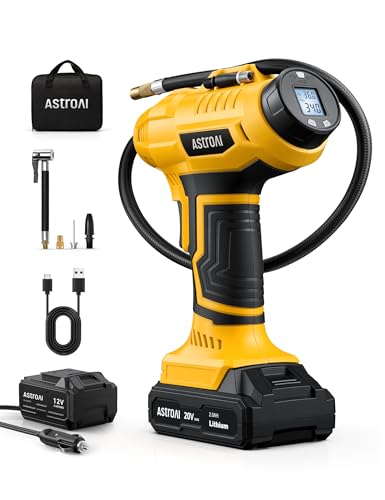 AstroAI Cordless Tire Inflator 160 PSI |
8.8/10 | Buy | |
| Best Budget |
 Inzeetor 150 PSI Portable Tire Inflator 12V DC |
8.6/10 | Buy |
 AIRSURE 150 PSI Portable Tire Inflator |
8.3/10 | Buy | |
 CARSUN Dual Power AC/DC Portable Tire Inflator |
8.3/10 | Buy | |
 Airmoto 120 PSI Portable Tire Inflator |
8.3/10 | Buy | |
 AstroAI Portable Tire Inflator Air Compressor |
8.1/10 | Buy |
Slime 40088 Portable 12V Tire Inflator
The Slime 40088 is a compact 12V portable tire inflator featuring Inflate Right automatic shut-off, an easy-to-read digital 99 PSI display, and emergency tubeless tire repair tools. It provides garage DIYers, commuters, and mobile equipment owners with a dependable roadside and driveway tire maintenance solution.
Pros
- Automatic shut-off helps prevent accidental tire over-pressurization during inflation cycles
- Clear digital pressure gauge reads up to 99 PSI for straightforward pressure setting
- Built-in LED work light enhances visibility around valve stems in dark roadside conditions
- Compact footprint makes it easy to store in a vehicle trunk, utility box, or garage shelf
- Includes heavy-duty emergency plug tools and tire repair strings for tubeless punctures
Cons
- Operates on 12V vehicle power, requiring a vehicle accessory socket rather than a standard 120V garage wall outlet
- Listed 6-minute inflation time is intended for routine passenger tire top-offs rather than high-volume continuous shop air
- Emergency tire repair plugs are suitable only for temporary punctures to reach a dedicated service facility
DEWALT Cordless Tire Inflator Portable Air
This compact DEWALT portable tire inflator delivers up to 150 PSI with smart auto shut-off, powered by an internal rechargeable battery or an included 10-foot 12V car plug. It provides an efficient, pocket-sized solution for vehicle owners, cyclists, and DIYers wanting rapid roadside top-offs without hauling a bulky tank compressor.
Pros
- True cordless freedom with an internal rechargeable battery plus a 10-foot 12V DC vehicle plug backup
- Accurate digital pressure gauge with 5 smart presets and automatic shut-off to eliminate overinflation
- Ultra-compact handheld design weighing just 0.63 kg for easy storage in glove boxes or saddlebags
- Integrated LED work light and emergency USB power bank functionality for travel safety
- Generous accessory bundle backed by a 3-year limited warranty
Cons
- Engineered exclusively for high-pressure inflation rather than operating pneumatic air tools or nailers
- Does not include a 120V AC residential wall outlet power adapter
- Compact tankless pump requires periodic cooling breaks during heavy multi-tire inflation runs
Ipflin 160 PSI Portable Tire Inflator and Air
The Ipflin portable air compressor provides up to 160 PSI and 30 L/min airflow with a built-in 9600mAh battery and 12V DC vehicle backup. It is an ideal emergency inflator for motorists, garage DIYers, and cyclists who need quick tire pressure adjustments without hauling a heavy air tank.
Pros
- True dual-power flexibility allows cordless battery operation or direct 12V DC automotive corded power during roadside emergencies
- High 160 PSI maximum pressure rating handles high-pressure bike tires, trailer tires, and passenger vehicle inflation
- Automatic shutoff system prevents over-inflation by stopping airflow as soon as the preset pressure target is reached
- Built-in 9600mAh battery eliminates the need for separate external power tool batteries or standalone chargers
Cons
- High-pressure tire inflator design is strictly intended for inflation and cannot operate pneumatic tools like brad nailers or air ratchets
- Cordless lithium-ion battery requires periodic top-off charging during storage to maintain emergency readiness
- Continuous inflation runtime is capped at 30 minutes before requiring a short cool-down period
GSPSCN 12V Portable Tire Inflator
The GSPSCN 12V Heavy Duty Tire Inflator delivers a robust 70 L/min airflow with its direct-drive dual-cylinder metal pump and 150 PSI maximum pressure rating. Built for pickup trucks, SUVs, and trailer owners, it operates at a manageable 70 dB and includes battery clamps for reliable 12V direct connection.
Pros
- Fast 70 L/min air volume output powered by a dual-cylinder direct-drive metal pump mechanism
- Generous 23-foot total working reach across the 11.5-foot 12V power cord and 11.5-foot air hose
- Direct battery clamps deliver dependable 12V DC power without risking internal vehicle fuse blowouts
- Remarkably manageable 70 dB sound level compared to standard high-pitch emergency tire pumps
Cons
- Requires direct 12V car battery terminal connection, which necessitates opening the vehicle hood
- Lacks an integrated air storage tank, so it is strictly intended for direct inflation rather than air tools
- No built-in digital automatic shutoff target pressure stop, requiring manual gauge monitoring
AstroAI Cordless Tire Inflator 160 PSI
The AstroAI Cordless Tire Inflator is a compact 160 PSI handheld air compressor featuring dual power via a 20V rechargeable battery and a 12V DC car adapter. Delivering digital auto shut-off and up to 20 minutes of continuous runtime, it is an ideal emergency tool for garage mechanics, commuters, and road-trippers.
Pros
- Dual-power versatility allows cordless battery operation at home or 12V DC vehicle plug-in on the road
- Reaches up to 160 PSI with automatic shut-off to prevent accidental tire over-pressurization
- Compact 2.54-pound footprint provides effortless trunk or glove-box storage for emergency readiness
- Backlit digital LCD screen provides clear readouts in PSI, BAR, and KPA units
- Integrated front LED light illuminates tire valve stems during dark roadside emergencies
Cons
- Includes a USB-C charging cable but requires an external USB power block to recharge the battery
- Designed specifically for tire and sports inflation rather than driving pneumatic workshop air tools
- Continuous runtime is limited to 20 minutes before requiring a cool-down pause
Inzeetor 150 PSI Portable Tire Inflator 12V DC
The Inzeetor 150 PSI Portable Tire Inflator is a lightweight 12V DC air compressor featuring digital auto shut-off and a durable zinc-alloy motor. Designed for rapid vehicle tire top-offs and sports gear, it offers dependable roadside utility for drivers and garage DIYers.
Pros
- Automatic digital shut-off eliminates manual monitoring and over-inflation risks
- Zinc-alloy motor allows continuous top-offs across four passenger tires without mandatory cooling breaks
- Weighs less than two pounds, making it effortless to stash in a trunk emergency kit
- Low-vibration chassis prevents the compressor from skittering across pavement during operation
- Comes equipped with versatile Presta and sports ball adapters alongside the standard Schrader chuck
Cons
- Requires a 12V DC vehicle cigarette lighter outlet and does not include a 120V AC wall plug
- The 1.97-foot air hose means the unit must sit on the ground or be held near the valve stem
- Engineered strictly for tire and recreation inflation rather than driving pneumatic workshop tools
AIRSURE 150 PSI Portable Tire Inflator
Measuring just over five inches tall, this compact inflator delivers up to 150 PSI with automatic shut-off and multiple preset modes. It also functions as a travel emergency tool, offering an integrated LED work light and a USB charging port for phones.
Pros
- Compact pocket-sized dimensions for easy storage
- Doubles as a backup USB power bank
- Clear digital display with four pressure units
- Built-in LED light aids nighttime use
- Auto shut-off prevents accidental over-inflation
Cons
- Requires short bursts when inflating smaller items
- Pressure reading has a tolerance of 1 PSI
- Sensor may occasionally need manual zero resets
CARSUN Dual Power AC/DC Portable Tire Inflator
The CARSUN Dual Power Tire Inflator delivers up to 150 PSI of high-pressure air running from either a 110V household outlet or a 12V vehicle socket. With digital pressure presets, automatic shutoff, and a lightweight 2.1-pound frame, it is an ideal maintenance pump for passenger vehicles, bicycles, and household inflatables.
Pros
- Versatile dual-voltage operation works seamlessly in the home garage or on the road without requiring an external converter
- Accurate auto-shutoff mechanism protects tires from accidental over-pressurization during routine top-offs
- Compact 2.1-pound build packs away easily in car trunks, under vehicle seats, or on garage shelving
- Clear digital display allows fast switching across four standard pressure measurement units
Cons
- Requires a mandatory 10-minute cooldown period after every 15 minutes of continuous operation
- Manufacturer explicitly states it does not support heavy truck tires, tractor tires, or stand-up paddleboards (SUP)
- Tankless inflator design cannot run standard workshop pneumatic air tools like brad nailers or paint sprayers
Airmoto 120 PSI Portable Tire Inflator
Weighing just 1.2 pounds, this compact cordless compressor delivers up to 120 PSI with automatic shutoff for routine top-offs on cars, bikes, and sports gear. Its pocket-sized form factor stores neatly in a glove box, serving as a convenient roadside backup.
Pros
- Extremely compact and lightweight design
- Auto shut-off prevents accidental over-inflation
- Clear digital LCD display with real-time pressure reading
- Integrated LED light aids night roadside repairs
- Internal hose storage keeps accessories organized
Cons
- Not suitable for heavy-load tires or large inflatables
- Cold temperatures and large tires drain battery quickly
- Requires frequent recharging before heavy usage
AstroAI Portable Tire Inflator Air Compressor
The AstroAI Dual Power Tire Inflator combines a 12V DC vehicle plug and 120V AC household cord, delivering up to 150 PSI for car tires and a 350 L/min high-volume mode for rafts and mattresses. It is a dependable, compact choice for garage mechanics, road-trippers, and homeowners wanting versatile inflation without needing a bulky air tank.
Pros
- Dual 12V DC and 120V AC power cords offer genuine versatility for garage benches, driveways, and roadside emergencies
- Two dedicated inflation modes handle high-pressure tires up to 150 PSI as well as high-volume camping gear at 350 L/min
- Digital auto-shutoff stops pumping once target pressure is reached, preventing accidental over-inflation
- Integrated cord and air hose storage compartments maintain a clean, compact footprint in vehicle trunks
- Dual metal motor build provides reliable output with up to 15 minutes of continuous run time per cycle
Cons
- Not designed to support heavy-duty commercial truck tires or high-volume commercial vehicle applications
- Requires a mandatory 10-minute cooling rest after 15 minutes of continuous high-pressure pumping
- Tankless electric inflator design cannot drive pneumatic air tools such as brad nailers or impact wrenches
What a Portable Compressor Can Do for a Tire
Yes, a portable air compressor can fill many vehicle tires, provided it is designed for tire inflation and used within its pressure and operating limits. Compact electric inflators connect to a tire valve and supply air until the tire reaches its target pressure. Some are powered by a vehicle’s 12V outlet, some use a rechargeable battery, and some offer both options.
The phrase “portable air compressor” can also mean a tank-style compressor intended for air tools. Those larger units can inflate tires with a suitable hose, chuck, and regulator, but a dedicated tire inflator is usually the simpler vehicle-storage choice. The products listed here are tire inflators, not pancake or twin-stack compressors intended to power nailers or other pneumatic tools.
Inflation is not the same as repairing a puncture or confirming that a tire is safe to drive on. A compressor can add air, but it can’t diagnose sidewall damage, a leaking valve, or a tire that has been driven while severely underinflated. If the tire repeatedly loses pressure, have the cause checked rather than relying on repeated top-ups.
Pressure rating and tire pressure are different numbers
A pump’s advertised maximum pressure is its stated pressure capability, not the recommended pressure for your tire. Set the target using the vehicle maker’s tire-pressure guidance, often found on the door-jamb placard or in the owner’s manual. The maximum pressure molded onto a tire’s sidewall is not a substitute for the vehicle’s recommended cold tire pressure.
Don’t set an inflator to its maximum PSI just because the number appears in the product description. A higher-rated pump can still be used at a lower, appropriate target, but the operator must select that target correctly and check the reading. Follow both the vehicle guidance and the inflator instructions, and don’t exceed the tire’s permitted pressure.
Some options in this list state maximum ratings of 120, 150, or 160 PSI. Those figures describe product capability, not a universal tire setting or a promise that every tire can be inflated safely. A higher pressure rating by itself also doesn’t establish how quickly a pump will inflate a particular tire.
Read and set the pressure carefully
Check tire pressure when the tire is cold whenever practical, using the vehicle’s recommended value as your target. If the tire has been driven and warmed up, pressure may differ from a cold reading, so consult the vehicle guidance instead of guessing at an adjustment. Make sure the unit on the inflator display matches the unit you’re using, such as PSI, BAR, or kPa.
Digital controls can make this process more convenient. Several listed inflators offer a digital display and automatic shutoff, allowing a buyer to enter a target and let the unit stop when it reaches that setting. The shutoff is a helpful control, not a reason to skip checking the displayed pressure or verifying that the tire valve connection is secure.
Display accuracy and valve connections matter, too. A pressure reading can change as air moves through the hose or when the chuck is removed, and product data may not provide a measurement tolerance for every model. If a reading seems inconsistent, compare it with a separate reliable tire gauge and follow the inflator manual’s instructions.
Match the Power Source to the Job
A portable inflator’s power arrangement affects where and how you can use it. A 12V corded unit draws power from a compatible vehicle outlet, while a cordless model relies on its internal or removable battery, depending on its design. Dual-power products can offer another option if the battery is depleted, but confirm exactly which power sources are included and supported.
12V corded, rechargeable, and dual-power designs
A corded 12V inflator avoids dependence on a charged internal battery, but its cord and hose must reach the tire from the approved power connection. Check the stated cable and hose lengths against your vehicle, and use the power source as directed by the manufacturer. Don’t assume a 12V outlet can support every device simply because the plug fits.
A cordless inflator avoids a tether to the vehicle, which can be useful when reaching tires or inflating a bicycle away from a car. Battery performance varies with tire size, starting pressure, temperature, charge level, and the particular unit. Product descriptions sometimes state an estimated number of tires or operating time, but those claims are tied to the manufacturer’s stated conditions and shouldn’t be treated as a guarantee for every situation.
Dual-power models can be a sensible middle ground if their supported corded and battery modes match your needs. The DEWALT listing describes a built-in rechargeable battery and a 12V vehicle plug, while the Ipflin listing describes battery operation and a 12V DC cord. Check included accessories, charging requirements, and backup-power instructions rather than assuming two similarly described products work identically.
Charging and storage deserve a little attention. A cordless pump kept in a glove box may not be ready for an emergency if it was stored depleted or has lost charge over time. Follow the manual’s charging and storage guidance, and make sure the hose, adapters, and power cable are present before a trip.
What the Product Details Tell You
Inflation claims are easiest to compare when you keep the stated starting pressure, ending pressure, tire size, and power mode in view. A result for a small passenger-car tire is not directly comparable with a claim for a larger, completely flat tire. Product descriptions may report very different conditions, so treat speed statements as manufacturer-provided examples, not a promise for every tire.
The listings include examples such as the DEWALT model’s stated time to move a 195/65 R15 tire from 30 to 36 PSI, and the CARSUN unit’s stated time to inflate a 195/65 R15 tire from 0 to 36 PSI. Those tasks start at different pressures and may reflect different power arrangements. They should not be read as a head-to-head comparison or as expected results for another tire size.
Small inflators have a different job from tank compressors
The compact devices in this roundup are intended for tires and smaller inflatables, with product descriptions listing uses such as cars, motorcycles, bicycles, and sports balls. A small tire inflator is not a substitute for a shop compressor that supplies air to pneumatic tools. Tire pumps generally don’t provide the tank capacity, tool airflow specifications, or fittings needed to evaluate sustained air-tool use.
Even among tire inflators, intended use varies. The Airmoto description specifically cautions that its unit is not designed for large-volume items such as paddleboards or heavy-load tires requiring a small compressor. The CARSUN description excludes truck and tractor tires, while other listings describe compatibility with selected cars, SUVs, or similar vehicles. Those stated limitations deserve more attention than a maximum PSI number.
For an SUV, pickup, trailer, or RV, verify that the manufacturer lists the tire type and intended application. Don’t assume that an inflator suitable for a passenger-car tire can handle a larger tire, repeated inflation, or a roadside emergency from a very low starting pressure. The supplied product information does not establish a universal capability for high-pressure RV or off-road tires.
Accessories and reach affect everyday use
A practical kit needs the right connection for the tire valve, plus a hose long enough to reach the wheels from the selected power source. Several listed models include adapters for bicycle valves or sports balls, while some include a storage bag, light, or replacement fuse. These are convenience details, not evidence that an inflator is suitable for every vehicle or inflatable.
Look closely at how the hose and cord are stored and whether the kit includes the adapter you actually need. A built-in light may help illuminate the valve in a dark parking area, but it does not replace safe roadside positioning or visibility precautions. Keep the pump away from traffic where possible and follow the vehicle and product instructions.
Adapter fit should be checked before it is needed. A loose or poorly connected fitting can leak air and make it harder to reach the target pressure. Use only the supplied or manufacturer-approved accessories, and avoid forcing a connector onto a valve.
Use the Inflator Without Overworking It
Set up on stable ground, connect the hose securely, and choose the correct target before starting. Keep hands clear of hot or moving parts, and don’t leave an operating pump unattended unless its instructions specifically allow that use. Once the tire reaches the target, disconnect carefully and recheck the pressure.
Respect operating and cooling limits
Portable inflators generate heat while compressing air. Some product descriptions specify a maximum continuous operating period followed by a cooling break, while others give different operating guidance. Follow the specific manual rather than applying one model’s limits to another.
Inflating several tires in succession can place a greater demand on the pump than topping up one tire. If the unit becomes hot, slows, or reaches a stated thermal limit, stop and allow it to cool as directed. Do not exceed the manufacturer’s duty or temperature limits to finish faster.
Starting pressure affects the amount of work required. Adding a small amount of air is a different task from filling a fully deflated tire, and a larger tire generally requires more air volume. That is why a stated inflation time should be interpreted in the context of the specific tire, pressure change, power supply, and operating conditions.
Handle a flat tire as a safety issue
An inflator can help restore pressure, but it does not make a damaged tire roadworthy. If you see a cut, bulge, exposed cords, or another sign of damage, don’t treat adding air as a repair. A tire that will not hold air or quickly loses pressure needs inspection by a qualified tire service provider.
A tire plug kit is a separate product from an air compressor. The Slime product data supplied for this article describes a tire plug kit for emergency repair of tubeless off-road tires, not a compressor feature or a general-purpose repair authorization. Follow the kit maker’s instructions and seek proper tire service after an emergency repair.
Never inflate beyond the pressure allowed for the tire and vehicle. If the tire is completely flat, damaged, or has been driven while deflated, consult a tire professional before driving. Air pressure alone cannot confirm the tire’s internal condition.
Choose for the Tires You Actually Maintain
For routine passenger-car top-ups, prioritize a clearly readable gauge, convenient power source, adequate cable and hose reach, and controls you can operate correctly. Automatic shutoff and a pressure preset can reduce guesswork, but they do not replace checking the vehicle’s recommended pressure. A compact cordless model may suit storage convenience, while a corded or dual-power unit may suit buyers who prefer a vehicle-powered option.
For larger tires or repeated inflation, confirm explicit manufacturer compatibility and operating limits before choosing. A high maximum PSI or a broad claim of vehicle compatibility doesn’t establish performance for every truck, trailer, or RV. If the intended tire type is not identified in the supplied specifications, contact the manufacturer rather than inferring suitability.
Product details can also help narrow the field without overstating differences. The listed models vary in power options, maximum pressure claims, display functions, included adapters, and stated vehicle applications. Compare those concrete features against your tire type and likely use, and treat unverified speed or runtime statements cautiously.
If you’re planning a permanent vehicle air system rather than carrying a compact pump, our guide to installing an air compressor in a car covers a related vehicle-compressor setup. That kind of installation is a different decision from keeping a portable inflator in the trunk, so consider the space, power, and intended use before choosing a system.
The practical answer is yes: a suitable portable inflator can fill many tires, as long as its stated application, power source, and operating limits fit the job. Set pressure from the vehicle guidance, not the pump’s maximum rating, and stop if the tire shows damage or the inflator reaches its limit. For truck, trailer, or RV tires, verify compatibility with the manufacturer before relying on a compact pump.
About the author
Kenny Koehler is a power-tool specialist with more than a decade of hands-on evaluation experience and a science-based approach to product testing. His expertise in repeatable testing, tool performance, impact wrenches, and professional equipment brings a practical, data-focused perspective to compressor and pneumatic-tool comparisons.