
How Does a Gas Air Compressor Work: Practical Guide for 2026
Learn how does a gas air compressor work to generate mobile pneumatic power on off-grid job sites in October 2026 with our deep mechanical breakdown.
 By Kenny Koehler
Updated October 8, 2026
By Kenny Koehler
Updated October 8, 2026

Remote construction jobsites and mobile service trucks rarely provide convenient 120-volt or 240-volt electrical receptacles to power heavy pneumatic machinery. Operating high-demand impact wrenches, sandblasters, or multiple framing nailers in the field demands an independent power source capable of continuous duty cycles. Learning how does a gas air compressor work reveals how small internal combustion engines replace electric motors to generate reliable, high-volume pneumatic pressure off the electrical grid. Many contractors and mobile mechanics rely on specialized truck mount air compressor configurations bolted directly into service vehicle beds to deliver high CFM airflow wherever work happens.
Gasoline-powered units combine a four-stroke engine, a heavy cast-iron reciprocating pump, and specialized pneumatic throttle controls to manage airflow dynamically. Unlike electric compressors that shut off their motors when the receiver tank reaches cut-out pressure, gas systems run continuously while cycling between active compression and idle bypass states. Understanding this mechanical sequence prevents common jobsite failures like overheated cylinder heads, fouled spark plugs, or unloader pilot valve stalls. Examining the internal components and airflow stages helps operators optimize engine speed, protect receiver tanks from internal moisture corrosion, and maintain steady pneumatic line pressure during demanding workloads.
| Award | Product | ACR Score About ACR ScoreThe ACR Score is our own rating from 0 to 10, based on performance, design and build, ease of use, and value. It reflects independent research and is never influenced by manufacturers, retailers, or affiliate commissions. Learn more › | |
|---|---|---|---|
| Best Overall |
XtremepowerUS 13.0HP Horizontal Air Compressor
|
9.2/10 | Buy |
| Best Budget |
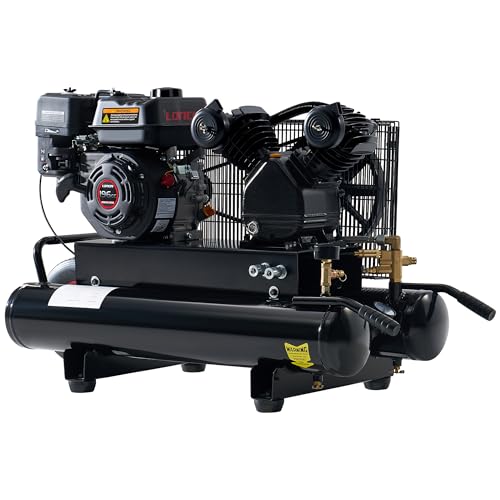 Albott 6.5HP 8-Gallon Gas Air Compressor
|
9.1/10 | Buy |
 VEVOR 9-Gallon 6.5HP Gas Air Compressor
|
8.9/10 | Buy | |
| Best Premium |
 HPDMC 13HP Gas Powered Air Compressor
|
8.8/10 | Buy |
 VEVOR 13.2-Gallon 7HP Gas Air Compressor
|
8.6/10 | Buy | |
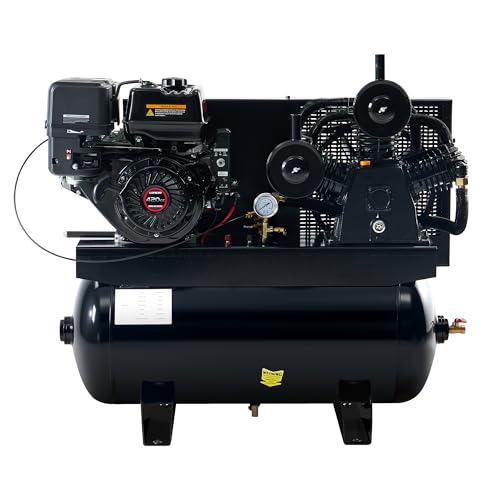 Albott 13HP Gas Air Compressor
|
8.6/10 | Buy | |
 VEVOR 15HP Gas-Powered Air Compressor
|
8.6/10 | Buy | |
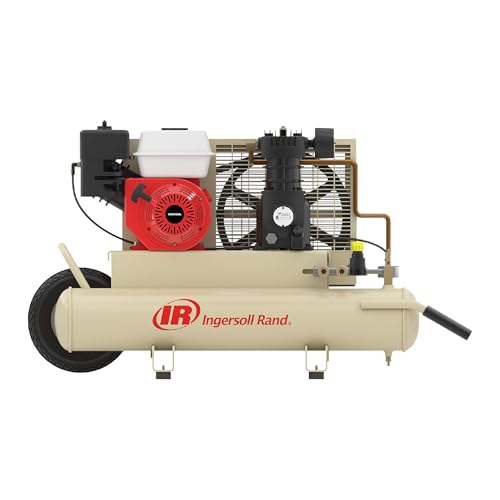 Ingersoll Rand SS3J5.5GH-WB 5.5 HP Compressor
|
8.3/10 | Buy | |
| Best Value |
 XtremepowerUS 13HP 30-Gallon Gas Air Compressor
|
8.0/10 | Buy |
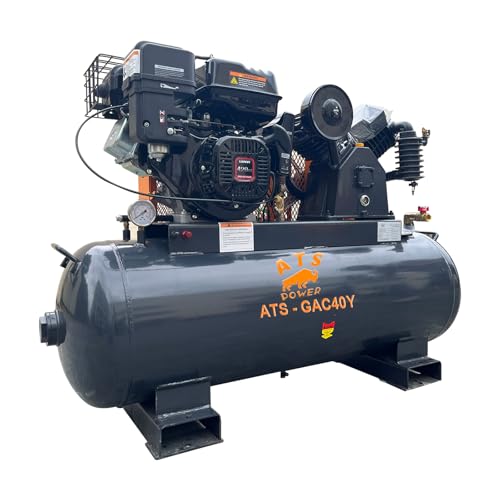 Generic 40-Gallon 15HP Gas Air Compressor
|
8.0/10 | Buy |
Albott 6.5HP 8-Gallon Gas Air Compressor
Built for off-grid job sites, this gas-powered unit delivers reliable pneumatic power with a 6.5 HP engine and a two-cylinder cast iron pump. Dual air outlets let two operators run tools simultaneously without depending on electrical hookups.
Pros
- Rugged cast iron pump and frame construction
- Dual air outlets support two simultaneous tools
- Gas-powered design eliminates need for electrical outlets
- Automatic safety valve ensures steady pressure management
Cons
- Very heavy at 166 pounds
- Modest 115 PSI maximum working pressure
- Substantial footprint requires ample vehicle cargo space
VEVOR 9-Gallon 6.5HP Gas Air Compressor
Built for remote jobsites without electrical access, this gas-driven unit supplies a dependable 9 CFM output from its 6.5HP engine. Dual outlets let two operators work simultaneously, though managing its 145-pound frame demands notable physical effort.
Pros
- High 9 CFM output drives demanding air tools
- Dual outlets support two operators at once
- Independent gas power works anywhere outdoors
- Fast 105-second tank fill time
Cons
- Heavy weight exceeds 145 pounds
- Maximum pressure capped at 115 PSI
- Produces gas exhaust requiring strict outdoor use
HPDMC 13HP Gas Powered Air Compressor
Built for service trucks and remote jobsite crews, the HPDMC 13HP gas-powered air compressor pairs a 30-gallon ASME-certified tank with a heavy-duty 3-cylinder cast iron pump rated for 44 CFM at 125 PSI. It delivers industrial pneumatic volume for mobile mechanics, spray foamers, and multi-tool operations independent of electrical grids.
Pros
- Massive rated air delivery of 44 CFM at 125 PSI readily powers continuous-demand pneumatic tools and multiple operators simultaneously.
- Heavy-duty solid cast iron 3-cylinder pump with removable individual cylinders provides cooler running and straightforward servicing.
- ASME-certified 30-gallon horizontal air receiver meets standard industrial and commercial jobsite safety requirements.
- Gas-powered autonomy eliminates breaker trips, voltage drops, and reliance on electrical extension cords in remote locations.
Cons
- Internal combustion engine produces exhaust emissions, strictly prohibiting indoor, enclosed garage, or basement use due to carbon monoxide hazards.
- Substantial physical dimensions (43 x 17 x 38 inches) and heavy cast iron mass require dedicated service truck mounting or mechanical lifting equipment.
- Electric starting battery and connection cables are not included with the unit and must be purchased separately.
VEVOR 13.2-Gallon 7HP Gas Air Compressor
Built for job sites lacking electrical hookups, this gas-powered VEVOR unit pairs a 7HP engine with dual outlets to run two pneumatic tools simultaneously. The 9 CFM delivery rate at 115 PSI ensures fast recovery times for outdoor construction and workshop tasks.
Pros
- Dual outlets operate two pneumatic tools at once
- Strong 9 CFM airflow provides rapid air delivery
- Automatic low-oil shutoff prevents pump damage
- Sturdy cast iron cylinders and frame construction
Cons
- Heavy unit weighing over 131 pounds
- Maximum pressure limited to 115 PSI
- Gas-powered design requires regular engine maintenance
Albott 13HP Gas Air Compressor
The Albott 13HP Gas Air Compressor combines a 30-gallon ASME-certified tank with a 3-cylinder cast iron pump delivering 18 CFM at 90 PSI and up to 180 PSI maximum pressure. It is designed for service truck operators, mobile mechanics, and remote jobsite crews needing high-volume pneumatic airflow without electrical grid access.
Pros
- Delivers a listed 18 CFM at 90 PSI to easily operate high-demand pneumatic tools like heavy impact wrenches and spray guns off the grid
- Rugged 3-cylinder cast iron pump and frame reduce deformation and wear under demanding work conditions
- Substantial 30-gallon ASME-certified horizontal tank provides a reliable air buffer and reduces engine cycle frequency
- Total independence from 120V electrical outlets, eliminating blown household breakers and extension cord voltage drops
Cons
- Substantial dry weight of 344 pounds requires mechanical lifting equipment or permanent truck bed mounting rather than hand carrying
- Internal combustion engine produces exhaust fumes and high sound levels, restricting operation strictly to well-ventilated outdoor areas
- Requires dual routine maintenance schedules for both the gas engine and the oil-lubricated 3-cylinder compressor pump
VEVOR 15HP Gas-Powered Air Compressor
Delivering an impressive 33 CFM at 115 PSI, this 15HP gas-driven VEVOR compressor features a 30-gallon horizontal tank and cast-iron pump for demanding off-grid jobsites. It is an ideal pneumatic solution for framing crews, mobile mechanics, and commercial workshops needing high-volume airflow without electrical hookups.
Pros
- High airflow delivery of 33 CFM at 115 PSI easily runs demanding commercial pneumatic tools.
- Gas-powered 15HP engine operates completely independently without requiring 120V or 240V electrical connections.
- Rugged cast-iron pump cylinders and automatic low-oil shut-off ensure dependable mechanical protection.
- Generous 30-gallon horizontal air reservoir features dual outlets for simultaneous multi-tool operation.
Cons
- Substantial dry weight of 271 pounds requires ramps, a liftgate, or multiple people to transport into a truck bed.
- Maximum operating pressure is capped at 115 PSI, which is lower than multi-stage 150 to 175 PSI systems.
- Gasoline engine requires strictly outdoor, well-ventilated operation along with routine engine oil and fuel maintenance.
Ingersoll Rand SS3J5.5GH-WB 5.5 HP Compressor
Built for rugged jobsites lacking electrical hookups, this wheelbarrow-style compressor pairs a 5.5 HP Honda engine with durable cast-iron construction. It delivers continuous 135 psi operation and supports two pneumatic tools simultaneously.
Pros
- Durable cast iron pump construction
- Reliable 5.5 HP gas-powered Honda engine
- Rated for 100% continuous duty operation
- Dual quick disconnects for multi-tool use
Cons
- Heavy 226-pound weight makes vehicle loading difficult
- Modest 0.825-gallon fuel tank requires frequent refilling
XtremepowerUS 13HP 30-Gallon Gas Air Compressor
Built for service truck beds and heavy-duty field maintenance, this gas-powered unit pairs a 13-horsepower engine with a 30-gallon horizontal tank. Its solid cast-iron pump and finned flywheel ensure cooler, low-RPM operation for demanding remote jobs.
Pros
- Heavy-duty cast-iron pump runs at cooler temperatures
- Gas-powered design is ideal for remote job sites
- Removable cylinders simplify routine maintenance
- Engineered for secure mounting on service trucks
Cons
- Extremely heavy at over 391 pounds
- Consumes significant truck bed or workspace footprint
- Gas emissions make it unsuitable for enclosed indoor use
Generic 40-Gallon 15HP Gas Air Compressor
Built for demanding pneumatic tools like sandblasters and impact wrenches, this two-stage compressor pairs a 420cc RATO gas engine with a 40-gallon ASME tank. It delivers 24 CFM at up to 175 psi, providing reliable air delivery for off-grid job sites and busy workshops.
Pros
- High 24 CFM output powers demanding pneumatic tools
- Electric and recoil start provide flexible operation
- Durable ASME-certified steel pressure tank
- Oil-free pump minimizes routine maintenance tasks
- Integrated low-oil shutdown protects the engine
Cons
- Very heavy unit at 360 pounds
- Gas engine requires outdoor or well-ventilated placement
- Large footprint demands significant floor space
How Gas-Powered Air Compressors Generate Mobile Pneumatic Energy
A gasoline air compressor operates by transforming the chemical energy of fuel into mechanical motion, which a reciprocating pump converts into stored pneumatic pressure. Standard electric workshop compressors rely on induction motors connected to stationary utility grids, but gas-powered machines operate completely untethered in remote environments. This independence makes them vital for agricultural repair, road construction, structural framing, and mobile service trucks operating far from electrical outlets. Grasping how these machines balance continuous engine rotation with fluctuating air demand requires examining each mechanical stage of the compression cycle.
Internal Combustion Engines and Power Transmission
The mechanical compression cycle starts at the internal combustion engine, which serves as the primary power source for the entire machine. Most industrial gas compressors use four-stroke overhead-valve (OHV) engines ranging from 5.5 horsepower up to 15 horsepower. During the four cycles of intake, compression, combustion, and exhaust, the engine crankshaft converts piston movement into smooth rotational torque. Operators start these commercial engines using either a manual recoil pull cord or an auxiliary electric starter wired to an on-board battery.
Rotational force travels from the engine drive shaft to the compressor pump through heavy-duty V-belts and cast-iron pulleys. While a few compact compressors use direct-drive connections, belt-driven designs dominate heavy-duty jobsite equipment. The pulley attached to the pump crankshaft features broad fan blades cast directly into its structure. As the drive belt spins this pump flywheel, the integrated fan blades pull cooling air across the cylinder heads and intercooler lines to dissipate excessive friction heat.
Pulley sizing also provides critical mechanical gear reduction between the high-speed engine and the slower reciprocating pump. Small utility engines typically operate between 3,000 and 3,600 RPM to produce their rated horsepower. Connecting that rotational speed directly to a cast-iron compressor pump would cause rapid valve fatigue, severe vibration, and premature bearing failure. By pairing a small drive pulley on the engine with a large flywheel on the pump, the system reduces pump speed down to roughly 800 to 1,200 RPM for durable operation.
The Reciprocating Piston Pump and Air Induction Cycle
When the engine flywheel turns the compressor pump crankshaft, reciprocating motion begins inside the cast-iron cylinder barrels. Heavy-duty aluminum connecting rods move pistons upward and downward inside precision-honed cylinder sleeves. As a piston travels downward on its intake stroke, it creates a localized vacuum inside the cylinder bore above the piston crown. Atmospheric pressure outside the compressor forces ambient air through an intake filter, removing abrasive jobsite dust before entering the pump head.
The resulting pressure drop pulls flexible reed valves or spring-loaded disc valves open against their valve plates. Ambient air rushes into the expanding chamber until the piston reaches the lowest point of its stroke. As the crankshaft continues rotating, the piston reverses direction and begins its upward compression travel. This upward momentum creates positive internal pressure that immediately forces the intake valves shut, preventing trapped air from escaping backward into the intake filter.
Trapped inside the sealed cylinder, the atmospheric air is compressed into a smaller volume as the piston rises toward top dead center. Compressing air molecules together concentrates heat and raises internal pressure according to basic pneumatic physics. When cylinder pressure exceeds the force holding the exhaust valve closed, the discharge reed lifts from its seat. The compressed, superheated air flows out through copper transfer lines toward the receiver storage tank.
High-capacity compressors often divide this workload across multiple stages to boost volumetric efficiency and reach higher pressures. Single-stage pumps compress air from atmospheric pressure straight to tank pressure in one stroke, typically reaching 115 to 135 PSI. Two-stage systems, such as industrial 175 PSI models, route air from large low-pressure cylinders through finned copper intercoolers into smaller high-pressure cylinders. This intercooling stage strips heat between compression cycles, preventing valve carbonization and increasing air delivery efficiency.
Continuous Run Mechanics: Pilot Unloader Valves and Throttle Controls
The most distinctive mechanical difference between electric and gas compressors involves how each system controls storage pressure. An electric compressor uses a pressure switch that shuts off the electric motor whenever the tank reaches its maximum cut-out limit. A gasoline engine cannot shut off and restart every few minutes without draining starting batteries, burning out starter motors, and disrupting work. Gas-powered compressors therefore use continuous-run pneumatic controls consisting of a pilot valve, an unloader mechanism, and an engine throttle cable.
The pilot valve serves as the pneumatic command center, constantly sensing air pressure inside the receiver tank through a small pilot line. Operators calibrate the pilot valve to maintain specific cut-in and cut-out pressure thresholds using internal adjustable springs. While the air tank fills below the cut-out limit, the pilot valve stays closed, keeping the engine running at full operating speed while the pump builds pressure. The compressor works under full load until tank storage reaches maximum pressure.
When tank pressure reaches the cut-out threshold, the pilot valve snaps open and directs high-pressure signal air through two control circuits. One pneumatic signal travels through a throttle control cable connected to the engine carburetor. This pressurized air extends an actuator piston, overriding the engine governor and dropping engine speed down to an idle around 1,800 RPM. Idling the engine saves fuel, reduces acoustic noise, and minimizes thermal wear while tools sit idle.
Simultaneously, the second pneumatic signal routes air to an unloader valve or head unloader mechanism that holds the pump intake valves open. With the intake valves held open, the pistons move freely without compressing air, circulating air harmlessly through the intake chamber. The pump runs completely unloaded while the engine idles at low speed. This unloaded state maintains continuous splash lubrication and cooling airflow across the cylinders without adding further pressure to the tank.
As pneumatic tools consume air from the storage tank, internal tank pressure drops steadily during work. When pressure falls below the preset cut-in point, the pilot valve closes and vents its internal control air through an exhaust port. The spring-loaded engine throttle snaps back to high operating speed, bringing the engine back to full RPM. At the same time, the unloader valve closes, allowing the intake valves to resume normal compression cycles and refill the receiver tank.
Storage Reservoirs, One-Way Check Valves, and Safety Assemblies
A heavy-duty one-way check valve sits between the pump discharge line and the air receiver tank. This check valve features a spring-loaded brass poppet or disc that allows air to enter the tank freely during compression strokes. When the engine drops to idle and the unloader vents the pump head, high tank pressure pushes against the reverse side of the check valve. The valve seals instantly, preventing stored air from escaping backward through the open pump head.
The receiver tank acts as a mechanical energy reservoir and pressure buffer for attached pneumatic tools. Gas compressors are built with heavy-gauge horizontal tanks, twin pontoon tanks, or wheelbarrow frames holding between 8 and 40 gallons. This storage volume absorbs sudden pressure drops when high-draw tools fire, stabilizing line pressure to air tools. The heavy steel tank also provides a rigid mounting platform that absorbs operating vibrations from the engine and pump.
Every gas compressor incorporates an ASME-certified safety relief valve installed directly into the receiver tank shell. If mechanical debris or component wear causes the pilot valve to fail, the pump could continue pressurizing the tank beyond safe limits. The safety valve features an internal calibrated spring that pops open automatically if pressure exceeds safe limits, venting air rapidly into the atmosphere. Operators should regularly test this safety device by gently pulling the external metal ring to verify proper operation.
Air Regulation, Moisture Management, and Tool Delivery
Compressed air stored in the receiver tank requires regulation before traveling to sensitive pneumatic equipment. An adjustable pressure regulator on the discharge manifold allows operators to set working pressure to match specific tool requirements. Dual pressure gauges display both internal tank pressure and regulated tool pressure for precise monitoring. Standard quick-connect couplers on the manifold allow operators to attach multiple hoses to power framing nailers, impact wrenches, or paint sprayers simultaneously.
Compressing atmospheric air naturally produces moisture condensation inside the steel storage tank due to thermodynamic temperature changes. Ambient air contains humidity, and squeezing large volumes of air into a compact storage space increases water vapor concentration. As hot compressed air cools against the steel tank walls, water vapor condenses into liquid that pools at the bottom of the tank. If neglected, this moisture causes internal tank rust and travels down air lines to ruin pneumatic tool seals.
Preventing internal rust requires operators to drain accumulated moisture daily through the bottom tank drain valve. Quality gas compressors feature accessible quarter-turn brass ball valves on the tank belly, which resist corrosion better than stiff needle petcocks. Opening the drain valve while the tank holds slight residual pressure purges accumulated water and debris quickly. Installing inline water traps and oil separators downstream provides clean, dry air for moisture-sensitive tools like paint spray guns.
Pump Lubrication, Engine Oil, and Maintenance Protocols
Because gas compressors handle demanding jobsite workloads, maintaining proper pump lubrication is essential for mechanical durability. Unlike compact oil-free air compressor designs that use Teflon-coated piston seals, commercial gas pumps feature cast-iron crankcases using splash lubrication. Small dippers on the connecting rods fling oil onto cylinder walls, wrist pins, and crankshaft bearings with every revolution. Checking the oil level through the clear sight glass prevents severe friction wear and seized pump pistons.
Operators must remember that the gas engine and the air pump require distinctly different lubricating oils. Gasoline engines require automotive detergent motor oils that suspend combustion soot until the oil is changed. In contrast, using detergent oil in an air compressor pump creates foaming, reduces lubricating film strength, and causes carbon buildup on valves. Maintaining pump health requires selecting non-detergent pump oil formulated specifically for reciprocating air compressors without detergent additives.
Modern industrial engines also include low-oil shutdown sensors that automatically stop the engine if oil drops below safe operating limits. This safety switch protects expensive engine components from seizing if the unit tilts on uneven ground or consumes oil during long shifts. Additionally, the pump intake air filter requires regular cleaning on dusty construction sites. A dirty air filter restricts airflow into the cylinders, forcing the engine to burn extra fuel while reducing delivered CFM performance.
CFM Sizing and Practical Jobsite Air Demands
Operating a gas compressor successfully requires matching its delivered CFM output at 90 PSI to specific tool requirements. Intermittent tools like framing nailers consume modest air volumes, allowing a portable 6.5 HP compressor producing 9 CFM to run several framing guns easily. High-demand continuous tools like sandblasters, orbital sanders, and heavy impact wrenches require continuous air delivery between 15 and 30 CFM. For these continuous applications, larger 13 HP to 15 HP units delivering 24 to 33 CFM maintain steady pressure without stalling tools.
Gas tank capacity and fuel consumption also determine how continuously a contractor can work across a busy shift. Most commercial engines feature fuel tanks holding between 0.8 and 1.5 gallons, providing dependable runtimes during intermittent tool cycling. Allowing the engine to idle unloaded for a minute before final shutdown helps cylinder heads cool down gradually. Understanding this mechanical harmony between fuel combustion, piston compression, pilot unloader cycling, and tank storage ensures long equipment life and dependable jobsite pneumatic power.
About the author
Kenny Koehler is a power-tool specialist with more than a decade of hands-on evaluation experience and a science-based approach to product testing. His expertise in repeatable testing, tool performance, impact wrenches, and professional equipment brings a practical, data-focused perspective to compressor and pneumatic-tool comparisons.