
What Is Two Stage Air Compressor: Working Principles and Workshop Guide for 2026
Learn what is two stage air compressor technology, how multi-stage compression works, and how to size workshop equipment for October 2026.
 By Tom Scalisi
Updated October 8, 2026
By Tom Scalisi
Updated October 8, 2026

Running continuous pneumatic equipment like rotary sanders, paint guns, or heavy impact wrenches often pushes entry-level air supplies past their physical limits. When standard single-cylinder units struggle to maintain line pressure above 100 PSI under heavy shop workloads, many mechanics and fabricators wonder what is two stage air compressor machinery and how it alters overall air delivery. Unlike basic units that compress atmospheric air in a single stroke, two-stage machines divide the compression workload across two distinct cylinders to achieve higher operating pressures and greater thermal efficiency. Evaluating single-stage versus two-stage compressors helps clarify why dedicated commercial facilities consistently rely on multi-stage pumps for uninterrupted pneumatic performance.
These heavy-duty systems use an initial large piston for primary compression before routing the pressurized air through an intercooler tube into a smaller high-pressure cylinder. This stepped mechanical process keeps running temperatures lower while packing air into storage tanks at ratings up to 175 PSI. While smaller portable compressors suit quick framing jobs or intermittent tire inflation, a stationary two-stage system provides the continuous volume required for industrial sandblasting, plasma cutting, and multi-bay auto service. Understanding the underlying mechanics, electrical requirements, and cooling advantages allows shop owners to invest in equipment that matches their real-world pneumatic demands.
| Award | Product | ACR Score About ACR ScoreThe ACR Score is our own rating from 0 to 10, based on performance, design and build, ease of use, and value. It reflects independent research and is never influenced by manufacturers, retailers, or affiliate commissions. Learn more › | |
|---|---|---|---|
| Best Overall |
DEWALT 60-Gallon Stationary Air Compressor
|
9.2/10 | Buy |
| Best Premium |
 EMAX 80-Gallon Stationary Air Compressor
|
9.2/10 | Buy |
| Best Budget |
 Campbell Hausfeld 60-Gallon Air Compressor
|
8.9/10 | Buy |
| Best Value |
 Campbell Hausfeld 80-Gallon Stationary Air
|
8.8/10 | Buy |
 NorthStar 2-Stage 24.4 CFM Compressor Pump
|
8.6/10 | Buy | |
 Ingersoll Rand 2340N5-V 5 HP Air Compressor
|
8.4/10 | Buy | |
 Ingersoll Rand 2340L5-V 5 HP Air Compressor
|
8.3/10 | Buy | |
 Ingersoll Rand 2475N7.5 7.5 HP 80-Gallon Two-Stage
|
8.1/10 | Buy | |
 VEVOR 10HP 3-Cylinder Air Compressor Pump Head
|
8.0/10 | Buy | |
 Compressor Source 2-3 HP Replacement Cast Iron Air
|
7.8/10 | Buy |
DEWALT 60-Gallon Stationary Air Compressor
The DEWALT DXCM602.COM is a heavy-duty 60-gallon vertical stationary air compressor engineered for dedicated workshops, featuring an oil-lubricated pump and a 3.7 HP motor delivering 11.5 CFM at 90 PSI up to 175 max PSI. Powered by 208V or 230V electrical service, it is an ideal stationary air source for mechanics, fabricators, and woodworkers running demanding pneumatic tools.
Pros
- High rated air output of 11.5 CFM at 90 PSI easily handles air-hungry continuous tools
- Durable oil-lubricated pump engineered for cooler operation and extended service life
- ASME-certified 60-gallon vertical steel pressure vessel ensures verified safety and high capacity
- Dual-voltage spread-volt motor simplifies integration into 208V or 230V electrical systems
Cons
- Stationary 200-pound footprint requires permanent shop placement and lacks mobility wheels
- Requires a dedicated 208V or 230V high-voltage circuit and cannot run on standard 120V household outlets
- Requires routine maintenance including oil level inspections and periodic pump oil changes
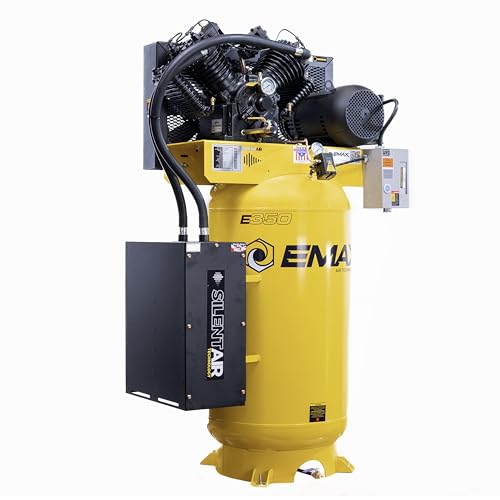
EMAX 80-Gallon Stationary Air Compressor
The EMAX 80-Gallon E350 stationary air compressor delivers 31 CFM using a 7.5 HP single-phase, two-stage pump paired with Silent Air technology that lowers sound by up to 50 percent. It is built for commercial workshops and auto garages needing high-volume air without overwhelming noise.
Pros
- Delivers a robust 31 CFM airflow to handle high-demand pneumatic equipment without stalling
- Silent Air technology lowers operating noise by up to 50 percent for a much quieter shop floor
- Pressure lubrication ensures dependable oil distribution across critical pump components
- Four-stage low-profile air filtration helps protect internal pump hardware from workshop dust
Cons
- Weighing 956 pounds, this massive stationary unit requires heavy equipment and dedicated space for delivery and placement
- The 7.5 HP single-phase motor requires dedicated electrical wiring suited for heavy workshop machinery
- Stationary design offers zero portability and must be anchored permanently in one work area
Campbell Hausfeld 60-Gallon Air Compressor
Built for demanding garage and workshop tasks, this stationary compressor combines a 3.7 HP motor with a two-stage cast-iron pump reaching 175 PSI. It provides steady airflow to support high-demand air tools like sprayers, grinders, and sanders.
Pros
- High 175 PSI maximum output pressure
- Durable cast-iron pump rated for longevity
- Large 60-gallon capacity supports sustained pneumatic tool use
- Vertical tank design saves workshop floor space
Cons
- Requires a dedicated 230V to 240V electrical connection
- Heavy 255-pound stationary build is difficult to move
Campbell Hausfeld 80-Gallon Stationary Air
Engineered for automotive repair shops and serious home garages, this stationary Campbell Hausfeld unit combines an 80-gallon ASME tank with a 5 HP motor delivering 16.0 CFM at 90 PSI. Its oil-lubricated cast-iron pump runs at a low 950 RPM, making it a dependable choice for continuous paint spraying, sanding, and air tool operation.
Pros
- Substantial 16.0 CFM delivery at 90 PSI easily powers continuous pneumatic tools like sanders and paint sprayers
- Heavy-duty cast-iron two-cylinder pump runs at a low 950 RPM for smoother operation and reduced thermal stress
- ASME-certified 80-gallon vertical tank maximizes air storage while minimizing workshop floor footprint
- Single-phase 208-230V motor includes overload protection and eliminates the need for an external magnetic starter
Cons
- Stationary footprint and substantial 460-pound weight require permanent shop placement and mechanical assistance during unloading
- Requires dedicated 208-230V single-phase electrical wiring and cannot run on standard 120V household outlets
- Maximum operating pressure caps at 140 PSI, which is lower than some two-stage compressors that reach 175 PSI
NorthStar 2-Stage 24.4 CFM Compressor Pump
Built with full cast iron construction and Swedish steel valves, this NorthStar two-stage pump delivers 24.4 CFM at 90 PSI for demanding pneumatic setups. Its low-RPM operation and V-style cylinder layout prioritize cooling and mechanical durability during heavy use.
Pros
- High airflow rating of 24.4 CFM at 90 PSI
- Heavy-duty FC35 cast iron construction
- Durable Swedish steel floating valve design
- V-style cylinders promote effective heat dissipation
- Low-RPM operation minimizes wear and running temperatures
Cons
- Heavy 135-pound weight complicates mounting and handling
- Substantial 21-inch cubic dimensions require ample space
Ingersoll Rand 2340N5-V 5 HP Air Compressor
Built for demanding shop environments, this stationary compressor pairs an 80-gallon tank with a 100% continuous duty rating for uninterrupted airflow. Its durable cast iron pump delivers 14.3 CFM at 90 PSI to power heavy-duty pneumatic machinery.
Pros
- Continuous duty cycle supports non-stop commercial workloads
- Rugged cast iron pump engineered for long operational life
- Generous 80-gallon tank maintains ample air reserves
- Strong 14.3 CFM output at 90 PSI
Cons
- Extremely heavy at 435 pounds, making installation difficult
- Requires dedicated 230-volt single-phase electrical wiring
- Tall 68.5-inch height requires ample vertical workshop clearance
Ingersoll Rand 2340L5-V 5 HP Air Compressor
Built for demanding workshop environments, this two-stage compressor provides continuous duty operation through an all-cast-iron design. Its 60-gallon vertical configuration helps conserve valuable floor space while reliably sustaining high-pressure air applications.
Pros
- Durable all-cast-iron construction
- Rated for 100% continuous duty
- Vertical tank configuration saves floor space
- Individually cast cylinders ease maintenance
Cons
- Extremely heavy at 430 pounds
- Requires dedicated 230-volt single-phase power
- Tall 69-inch profile requires significant overhead clearance
Ingersoll Rand 2475N7.5 7.5 HP 80-Gallon Two-Stage
The Ingersoll Rand 2475N7.5 is an industrial-grade 7.5 HP two-stage stationary air compressor pairing an 80-gallon ASME receiver tank with a rugged cast-iron pump rated for 100% continuous duty at up to 175 psig. It provides dependable, high-capacity air storage for professional auto mechanics, commercial garages, and demanding fabrication shops.
Pros
- Durable solid cast-iron two-stage pump engineered for over 15,000 hours of heavy-duty shop service
- True 100% continuous duty rating supports non-stop production in multi-bay automotive and fabrication environments
- Spacious 80-gallon ASME-certified vertical receiver tank stores ample air volume at up to 175 psig
- Extended 2,000-hour oil service intervals when utilizing All Season Select synthetic lubricant
- Individual cylinder casting and one-piece connecting rod simplify preventative maintenance and component access
Cons
- Substantial 611-pound dry weight requires dedicated floor anchoring, mechanical lifting gear for positioning, and a permanent shop footprint
- Demands high-power dedicated electrical service and professional stationary hardwiring rather than standard outlet convenience
- Extended two-year pump warranty coverage requires the separate purchase of the official lubricant start-up kit
VEVOR 10HP 3-Cylinder Air Compressor Pump Head
Built for demanding pneumatic applications, this heavy-duty cast-iron pump head delivers 17.5 CFM at 90 PSI with a two-stage compression system. It serves as a solid replacement unit for workshops and auto repair facilities running high-pressure air tools.
Pros
- High 185 PSI maximum working pressure
- Rugged cast-iron construction resists wear
- Strong 17.5 CFM airflow output at 90 PSI
- Integrated sight glass simplifies oil level monitoring
Cons
- Drive motor is not included
- Heavy unit weighing over 72 pounds
- Requires precise pulley alignment to reduce vibration
Compressor Source 2-3 HP Replacement Cast Iron Air
The Compressor Source CS2065A is a heavy-duty two-cylinder cast iron replacement pump delivering 7 CFM at 1180 RPM for 2 to 3 horsepower compressor setups. It offers garage DIYers and automotive mechanics a practical, budget-conscious way to rebuild failed compressor heads on tanks under 40 gallons.
Pros
- Durable cast iron twin-cylinder construction designed for steady garage and shop use
- Convenient oil sight glass eliminates guesswork during routine crankcase maintenance checks
- Delivers 7 CFM at 1180 RPM to support common automotive air tools and garage maintenance tasks
- Versatile electrical motor compatibility spanning 110V and 220V motors rated between 2 and 3 HP
Cons
- Bare pump configuration requires adapting your own discharge line, air intake filter, and drive belt setup
- Single-stage 7 CFM output is best suited for intermittent shop tools rather than continuous high-draw sandblasting
- At 37 pounds, mounting and shimming the pump on existing base plates requires careful mechanical alignment
Understanding Two-Stage Air Compressor Mechanics, Performance, and Shop Integration
A two-stage air compressor is a reciprocating machine that compresses air in two distinct steps to produce higher storage pressure and superior volumetric efficiency. While standard single-stage compressors compress atmospheric air in a single piston stroke, a two-stage pump uses two different cylinders connected by a finned cooling line. This dual-action design allows industrial workshops and automotive garages to store air up to 175 PSI without creating excessive pump heat. Understanding this mechanical configuration clarifies why continuous pneumatic tools perform far more consistently on multi-stage systems.
The Mechanics of Two-Stage Compression
The compression sequence begins when atmospheric air enters the first-stage cylinder through an intake air filter. This initial cylinder features a larger bore diameter because its role is drawing in atmospheric air and providing primary compression. As the large piston ascends, it compresses incoming air to an intermediate pressure level between 50 and 90 PSI. Once this intermediate threshold is reached, an exhaust valve opens to direct the heated air into the intercooler.
The finned intercooler performs a vital thermodynamic role between both compression stages. Compressing air naturally generates heat, causing gas molecules to expand and resist further compression. As air moves through the finned intercooler tubing, cooling airflow from the pump flywheel lowers the air temperature substantially. Cooling the air increases its overall density, reducing the mechanical work required by the second cylinder while preventing valve carbonization.
After exiting the intercooler, the cooled air enters the second-stage cylinder, which has a smaller diameter. Because this incoming charge is already pre-compressed, a smaller cylinder easily drives the air up to higher pressure levels. The second piston forces the air to its final pressure rating, typically between 140 and 175 PSI, before discharging it through a check valve into the tank. Distributing this mechanical work across two cylinders keeps running temperatures low and protects pump components.
Critical Components of a Two-Stage Pump
Heavy-duty two-stage pumps rely on dense cast-iron construction to withstand continuous compression cycles. Manufacturers like Ingersoll Rand and NorthStar use individually cast cylinders and FC35 grade cast-iron heads to dissipate heat rapidly. Cast-iron cylinder sleeves provide superior wear resistance compared to aluminum alternatives, allowing commercial pumps to operate reliably across thousands of service hours. The structural mass of solid cast iron also absorbs harmonic vibration, resulting in smoother operation in busy shop environments.
Valves inside a two-stage pump endure relentless mechanical stress and must resist warping under intense pressure. Many commercial pump heads utilize floating-type Swedish steel disc or reed valves designed to seal tightly without fatigue. Because incoming air from the first stage contains residual heat, second-stage discharge valves face harsh operating conditions that would degrade common stamped steel. High-grade valve materials ensure tight sealing, preventing compressed air from leaking back into cylinder chambers during intake strokes.
The crankshaft and lubrication assembly provide the mechanical foundation for dependable continuous duty performance. Most two-stage pumps feature an overhung balanced crankshaft connected to durable connecting rods and splash lubrication dippers. Premium models from manufacturers like EMAX incorporate advanced pressure lubrication systems to deliver oil directly to critical journal bearings and wrist pins. Reliable oil delivery reduces metal-to-metal friction, carries heat away from internal components, and keeps piston rings gliding smoothly.
Two-Stage Versus Single-Stage Performance Dynamics
The primary distinction between single-stage and two-stage compressors lies in maximum operating pressure and usable air reserves. Single-stage compressors generally top out around 125 to 150 PSI, as single pistons struggle to compress air further without overheating. In contrast, two-stage compressors routinely build tank pressures up to 175 PSI, creating a significantly denser air reserve within the tank. An 80-gallon tank pressurized to 175 PSI provides roughly one-third more usable air before the motor cycles on than a tank pressurized to only 135 PSI.
CFM output remains the true benchmark of compressor performance, dictating whether equipment can keep pace with demanding air tools. When evaluating workshop options, understanding air compressor CFM ratings at both 90 PSI and 175 PSI prevents buyers from undersizing their pneumatic machinery. While single-stage units experience sharp CFM drops as tank pressure climbs toward maximum levels, two-stage pumps maintain flatter delivery curves. This consistent airflow prevents pneumatic equipment from losing torque or speed during extended operating cycles.
Operating temperature represents another significant difference between single-stage and multi-stage pump designs. Single-stage pumps compress ambient air directly to final tank pressure in a single stroke, concentrating heat within a single cylinder head. Two-stage systems divide this heat between two stages, allowing the intercooler to strip away thermal energy before final compression. Slower operating pump speeds, often between 800 and 1,000 RPM, further reduce operating temperatures and drastically extend overall equipment longevity.
Electrical Demands and Workshop Installation
Operating a commercial two-stage compressor requires dedicated electrical infrastructure capable of handling high continuous and starting electrical loads. Most two-stage units rely on heavy induction motors rated between 3.7 and 7.5 running horsepower, which demand 208V, 230V, or 240V dedicated circuits. Standard 120V household receptacles cannot supply the continuous wattage needed to power these high-compression electric motors. Running an undersized electrical line risks substantial voltage drops, which can overheat motor windings and cause nuisance tripping on circuit breakers.
Starting inrush current presents a critical consideration when integrating large stationary compressors into home shops or commercial garages. High-displacement motors encounter tremendous mechanical resistance when starting against tank head pressure, requiring instantaneous current surges that exceed running amperage. To safeguard motors from thermal damage, larger models often utilize magnetic starters with integrated thermal overload relays. Dedicated wiring, appropriately rated double-pole breakers, and proper grounding ensure safe operation without straining workshop electrical panels.
Physical mounting and vibration management also impact long-term installation reliability in stationary workshop environments. Upright vertical tanks offer compact footprints, making them ideal for preserving valuable workspace along garage walls. Because heavy cast-iron pumps generate considerable oscillating mass during operation, securing the tank feet to a reinforced concrete floor with vibration dampening pads is essential. Rigid copper or flexible braided stainless steel discharge lines prevent vibration from transferring into hard workshop piping systems, eliminating stress fractures at threaded fittings.
Moisture Condensation and Air Line Management
Higher operating pressures inherently accelerate condensation buildup inside the receiver tank and downstream pneumatic piping. When a two-stage pump compresses large volumes of ambient air up to 175 PSI, water vapor naturally drops out of the air as it cools. Moisture settling at the base of steel receiver tanks accelerates internal rust and can enter air delivery lines if not properly managed. Implementing effective practices for removing moisture from air lines protects pneumatic tools, spray finishes, and plasma cutters from water contamination.
Routine tank purging is vital for preserving the structural integrity and storage capacity of ASME-certified steel pressure vessels. Accumulated water reduces the usable volume of the tank, forcing the pump to cycle more frequently to sustain line pressure. Many stationary compressors feature underside drain ports equipped with threaded needle petcocks or accessible quarter-turn brass ball valves. Installing an extended drain line or an automatic electronic drain valve ensures moisture is purged daily without requiring awkward maintenance routines under heavy tanks.
Air treatment hardware installed immediately after the compressor outlet further refines air quality before it reaches sensitive shop tools. In-line coalescing filters, particulate separators, and desiccant dryers strip away aerosolized oil droplets and microscopic moisture particles. Because two-stage compressors deliver high CFM volumes, sizing filtration components with adequate port dimensions prevents restrictive airflow drops across the manifold. Clean, dry air extends tool motor life, improves spray painting results, and prevents internal corrosion across pneumatic valving.
Pneumatic Tool Applications and CFM Matching
The decision to invest in a two-stage compressor typically hinges on the specific air consumption profiles of workshop tools. Intermittent tools like framing nailers, brad nailers, and light ratchet wrenches consume relatively low volumes of compressed air and operate comfortably on portable equipment. In contrast, continuous air tools like random orbital sanders, high-flow HVLP paint spray guns, and die grinders require continuous air delivery ranging from 8 to 18 CFM at 90 PSI. A stationary two-stage unit provides the sustained CFM output needed to prevent tool stalling during continuous production tasks.
Automotive repair shops and metal fabrication facilities demand both high airflow volume and elevated line pressure. Operating heavy-duty 3/4-inch or 1-inch pneumatic impact wrenches requires robust pressure reserves to break loose rusted commercial fasteners. Similarly, operating abrasive media blasting cabinets or air-powered plasma cutting tables requires sustained pressure above 90 PSI for clean cuts and consistent abrasive flow. A two-stage system provides the deep reserve capacity and rapid recovery speeds necessary to support multiple bays operating air tools simultaneously.
Duty cycle ratings define how long an air compressor can run under load without experiencing thermal fatigue or motor shutdown. While entry-level portable compressors are often restricted to intermittent 50 percent duty cycles, commercial two-stage machines feature 100 percent continuous duty ratings. Units from Ingersoll Rand, Campbell Hausfeld, and EMAX are specifically engineered to run continuously under high-demand commercial workloads. This industrial endurance ensures high-volume repair shops can tackle back-to-back fabrication jobs without waiting for pump cool-down intervals.
Maintenance Protocols for Two-Stage Equipment
Sustaining reliable operation across decades requires disciplined adherence to basic pump lubrication and preventative maintenance schedules. High-compression pumps generate substantial internal friction, making premium non-detergent synthetic compressor lubricants essential for protecting bearings and cylinder sleeves. Routine oil inspections using the crankcase sight glass ensure lubricant levels remain centered within safe operating thresholds. Performing scheduled oil changes prevents carbon deposits from accumulating on reed valves and ensures internal heat is efficiently dispersed through the oil reservoir.
Intake air filtration directly impacts internal pump wear and valve life in dusty workshop and body shop environments. Clean intake filters prevent airborne dust, overspray particles, and metal shavings from entering the first-stage cylinder and scoring cylinder walls. Inspecting filter elements every month and replacing them when clogged maintains unrestricted airflow into the pump head. Restricted intake passages force the first-stage piston to pull against a partial vacuum, elevating operating temperatures and noticeably reducing overall CFM output.
Drive belt tension and pulley alignment require periodic inspection to ensure efficient power transfer from the motor to the pump flywheel. V-belts that are loose can slip against motor sheaves, generating localized friction heat and reducing pump RPM under full compression loads. Conversely, over-tightened drive belts place excessive side loads on crankshaft and motor bearings, accelerating premature bearing wear. Verifying straight pulley alignment using a straightedge keeps the belt centered, reduces harmonic vibration, and extends the service life of drive components.
Selecting Between Complete Packages and Bare Pumps
Buyers exploring two-stage compressed air options can choose between fully integrated stationary compressor packages and standalone replacement pump heads. Complete packaged systems from brands like Campbell Hausfeld, DEWALT, or Ingersoll Rand include pre-wired motors, pressure switches, ASME tanks, and belt guards ready for electrical connection. These turnkey setups eliminate guesswork regarding motor horsepower matching, pulley sizing, and unloader valve plumbing. For existing installations with sound tanks and motors, sourcing a replacement cast-iron pump head from VEVOR or NorthStar provides a practical path to restoring heavy air delivery.
Evaluating noise output, physical space constraints, and realistic CFM demands ensures your compressor investment delivers long-term productivity. While two-stage units represent a substantial commitment in workshop infrastructure and electrical wiring, their continuous duty endurance and high operating pressures make them indispensable for serious pneumatic work. Selecting a system with appropriate tank reserves and robust cast-iron construction ensures your workshop tools operate at peak capability across demanding automotive, woodworking, and fabrication projects.
About the author
Tom Scalisi brings more than two decades of experience in construction, building maintenance, contracting, and hands-on tool use. His practical understanding of power tools, automotive work, repairs, and jobsite equipment helps readers evaluate compressors based on real workloads rather than specifications alone.