
How to Remove Water From Air Compressor Lines: Practical Guide for 2026
Learn how to remove water from air compressor lines with proper drainage, filters, and drying setups to protect your pneumatic tools in October 2026.
 By Bob Beacham
Updated October 8, 2026
By Bob Beacham
Updated October 8, 2026

Operating pneumatic equipment in a humid workshop often results in unwanted water spraying directly out of your air tools during critical tasks. This unexpected moisture ruins automotive spray paint finishes with fish eyes, washes away vital internal motor lubrication, and corrodes pneumatic nailers and impact wrenches from the inside out. Learning how to remove water from air compressor lines is essential for preserving expensive tool longevity and guaranteeing clean, dry air delivery across all workshop projects. Establishing the right combination of daily tank drainage, sloped distribution piping, and multi-stage filtration creates a dependable defense against internal line moisture.
Pressurized air naturally concentrates ambient water vapor until it cools down inside your receiver tank, air hoses, and garage distribution lines. When the temperature drops downstream, that vapor condenses into rapid liquid droplets that travel at high velocity straight toward your air chuck, plasma torch, or paint gun nozzle. Investing in dedicated water traps, coalescing elements, and point-of-use separators prevents pneumatic line contamination before it compromises your work. Whether you operate a portable jobsite pancake compressor or a stationary two-stage workshop system, addressing moisture buildup protects your equipment and ensures flawless project results.
| Award | Product | ACR Score About ACR ScoreThe ACR Score is our own rating from 0 to 10, based on performance, design and build, ease of use, and value. It reflects independent research and is never influenced by manufacturers, retailers, or affiliate commissions. Learn more › | |
|---|---|---|---|
| Best Overall |
ZHONG AN 1/4-Inch NPT Air Filter Pressure
|
9.2/10 | Buy |
| Best Budget |
 LNCHKA 1/4-Inch NPT Air Compressor Water Separator
|
8.9/10 | Buy |
| Best Premium |
 RVMARINEPAT 3/4-Inch NPT 4-Stage Air Compressor
|
8.3/10 | Buy |
 THB 1/2-Inch Compressed Air Line Moisture Filter
|
8.1/10 | Buy | |
 LE LEMATEC 1/4-Inch NPT Water Separator
|
7.8/10 | Buy |
ZHONG AN 1/4-Inch NPT Air Filter Pressure
The ZHONG AN 1/4-Inch NPT Air Filter Pressure Regulator combines pneumatic line regulation and moisture separation into a compact, lightweight unit with an integrated dial gauge. Featuring a push-pull locking adjustment knob and a manual drain valve, it provides a practical setup for DIY hobbyists and home woodworkers seeking cleaner air for finish nailers and pneumatic tools.
Pros
- Combines air filtration, moisture trapping, and pressure regulation in one affordable unit
- Top locking adjustment knob prevents accidental pressure changes during tool operation
- Integrated pressure gauge simplifies dialed-in tool adjustments for finish carpentry and inflation
- Bottom drain valve enables fast purging of trapped line condensation
Cons
- 1/4-inch NPT sizing may restrict high-volume airflow on continuous-demand pneumatic tools
- Small moisture collection bowl requires frequent manual draining during extended humid-weather run sessions
- Lightweight body construction requires careful alignment and thread sealing to prevent port leaks
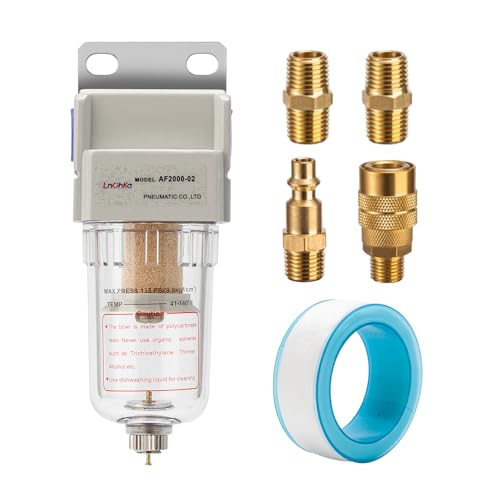
LNCHKA 1/4-Inch NPT Air Compressor Water Separator
The LNCHKA 1/4-inch NPT air line filter is a compact moisture separator engineered to trap condensation and particulates using a durable 5-micron brass element. Supporting up to 145 PSI and an 18 SCFM flow rate, it is an effective, budget-friendly addition for DIYers and home garage mechanics looking to protect pneumatic tools from water damage.
Pros
- Durable 5-micron porous brass filter element resists corrosion better than paper or plastic cartridges
- Generous 18 SCFM flow capacity easily accommodates common DIY and small-shop pneumatic tools
- Includes brass quick-connect fittings, bracket, and Teflon tape for straightforward installation out of the box
- Transparent polycarbonate bowl provides effortless visual inspection of fluid buildup
Cons
- Polycarbonate bowl can be vulnerable to cracking if exposed to harsh synthetic solvents or chemical fumes
- Manual drain requires proactive monitoring and regular physical purging to prevent water re-entry into the line
- 1/4-inch NPT port size and 18 SCFM rating are not suitable for large multi-operator industrial airline networks
RVMARINEPAT 3/4-Inch NPT 4-Stage Air Compressor
This 4-stage 3/4-inch NPT air drying system by RVMARINEPAT combines particulate filtration, pressure regulation, 0.01-micron coalescing oil removal, and a desiccant dryer rated up to 240 PSI. It provides clean, moisture-free air suited for automotive spray painting, plasma cutting, and heavy-duty garage workshops.
Pros
- Heavy-duty metal bowl construction supports up to 240 PSI without the cracking risks of clear plastic bowls
- Effective 0.01-micron coalescing filter traps aerosolized compressor oil before it reaches spray guns or plasma cutters
- Auto drain mechanism simplifies water purging from the initial separation stage without manual intervention
- Comes loaded with replacement filter elements, fittings, and multiple desiccant bead packs for easy initial maintenance cycles
Cons
- Desiccant beads require periodic replacement or heat reactivation once color shifting indicates moisture saturation
- Full 3/4-inch NPT ports will require reducer bushings if integrating directly into smaller 1/4-inch or 3/8-inch flexible air lines
- Multi-stage assembly creates a wide wall-mount footprint that requires dedicated rigid mounting in compact garage setups
THB 1/2-Inch Compressed Air Line Moisture Filter
The THB F704 is a heavy-duty 1/2-inch inline air line moisture trap engineered with a 5-micron filter element, rugged metal bowl, and 225 PSI maximum rating. It provides essential moisture and particulate protection for automotive mechanics, woodworkers, and DIY garage hobbyists running pneumatic tools.
Pros
- 5-micron filtration traps fine debris, pipe scale, and moisture droplets effectively
- Durable metal bowl construction with an integrated sight glass resists accidental workshop damage
- High maximum pressure tolerance rated up to 225 PSI handles heavy-duty compressor outputs
- Generous 1/2-inch port connection helps prevent excessive airflow restrictions across shop lines
Cons
- 2.7-ounce reservoir requires frequent manual draining in high-humidity climates or high-flow setups
- Arrives as a standalone filter unit, requiring user-supplied mounting brackets and thread fittings for installation
- Does not replace a dedicated refrigerated air dryer or desiccant system for critical moisture-free spray painting
LE LEMATEC 1/4-Inch NPT Water Separator
Built for paint sprayers, plasma cutters, and pneumatic tools, this inline filter strips moisture and oil directly at the tool intake. Its heavy-duty aluminum body and push-button drain valve ensure straightforward maintenance in demanding workshop setups.
Pros
- Durable aluminum and brass construction
- Quick push-button drain release
- Universal 1/4-inch NPT line compatibility
- Compact footprint fits directly onto tools
Cons
- Manual drain requires ongoing user attention
- Small chamber capacity fills quickly under heavy condensation
Complete Guide on How to Remove Water from Air Compressor Lines
Every pneumatic air system produces water as a normal physical byproduct of ambient air compression. The ambient atmosphere contains invisible moisture vapor that gets pulled into the pump intake and concentrated under pressure. As this pressurized air travels away from the pump head, cooling causes that humidity to convert into liquid droplets. Resolving this issue requires a strategic multi-tier setup that tackles liquid condensation at the receiver tank, along the main piping, and right at the tool.
The Thermodynamics of Moisture in Compressed Air Systems
Understanding why water accumulates in air lines begins with the fundamental physics of atmospheric air compression. When an air compressor pump draws in ambient air, it compresses both gas molecules and suspended humidity into a smaller volume. This mechanical compression process generates substantial heat, which temporarily allows the air to hold high concentrations of moisture vapor. As that hot air moves into the storage tank and cools toward room temperature, the moisture reaches its dew point and condenses into pooling water.
The volume of liquid produced depends heavily on your ambient relative humidity and the compressor duty cycle. Operating in hot, humid summer environments causes the pump to ingest significant water vapor over a typical work week. If this liquid remains unmanaged inside the storage tank, the rapid velocity of discharged airflow sweeps pooled water directly into your lines. Once liquid enters flexible rubber hoses or rigid piping, it creates pressure drops, washes out air tool grease, and causes internal parts to rust.
Different pneumatic tasks exhibit varying tolerance levels for downstream moisture contamination. Rough framing nailers and impact wrenches can tolerate small amounts of line moisture if they receive frequent oiling, though corrosion will eventually seize internal valves. In contrast, sensitive applications like automotive refinishing, sandblasting, and plasma cutting require completely dry air to avoid catastrophic bubbling, nozzle clogging, or arc spatter. Tailoring your drying strategy to your most sensitive air tool ensures you achieve clean results without unnecessary downtime.
Step 1: Establishing Daily Receiver Tank Drainage
The primary line of defense against air line moisture begins at the bottom of the compressor receiver tank. The storage tank acts as an initial expansion chamber where hot air begins to cool, allowing heavier water droplets to settle out of the airstream. If you allow this condensation to pool across multiple operating cycles, the standing water reduces usable tank capacity and accelerates internal metal corrosion. Purging the tank after every work session ensures that accumulated liquid gets expelled before it has a chance to enter the discharge manifold.
The design of your tank drain valve significantly influences how easily and reliably you maintain this draining routine. Basic factory compressors often feature recessed threaded needle petcocks that become stiff, corroded, and painful to turn with bare fingers. Replacing a difficult petcock with an accessible quarter-turn brass ball valve encourages consistent daily purging. For commercial environments or high-use shops, installing an electronic automatic timed drain valve eliminates human error by venting accumulated moisture at programmed intervals.
Always follow safe depressurization procedures when draining high-pressure receiver tanks in enclosed spaces. Opening a drain valve under full operating pressure creates a violent blast of rust particles, atomized oily sludge, and loud noise that can irritate eyes and ears. Reduce the tank pressure down to roughly ten to twenty pounds per square inch before slowly cracking open the bottom valve into a catch pan. Wearing protective eyewear and tilting portable tanks slightly ensures complete evacuation of sludge from the deepest contours of the cylinder.
Step 2: Designing Workshop Air Delivery Plumbing and Drop Legs
Relying solely on long rubber hoses connected directly to the compressor outlet virtually guarantees water delivery to your tools. Hot air discharged from the pump head remains too warm for filters to catch vapor immediately at the manifold. Installing a dedicated hard-piped distribution system using copper, aluminum, or specialized modular tubing allows the compressed air to cool naturally against metal walls. As the air cools over fifteen to twenty feet of pipe run, suspended water vapor condenses on the pipe interior where mechanical traps can easily capture it.
Proper pipe orientation plays a critical role in preventing condensation from rolling downhill directly into your workspace couplers. Main supply header pipes should slope gently backward toward the compressor or toward a dedicated collection leg at a grade of roughly one inch per ten feet. This subtle angle forces accumulating liquid to drain away from your active work areas by the pull of gravity. Any take-off connections feeding individual workstations must branch upward out of the top of the main header before curving down toward the floor.
These vertical take-offs, commonly known as drop legs, should always extend several inches past the tool connection point to create a water trap. Adding a ball valve or manual petcock to the very bottom of the drop leg creates a sump where gravity collects falling droplets. The actual tool outlet coupler should sit on a tee joint located several inches above that bottom drain sump. Purging these drop leg sumps at the start of each workday removes standing water before you ever connect an air hose.
Step 3: Installing Particulate Filters and Mechanical Water Separators
Once air has traveled along your piping and cooled sufficiently, mechanical water separators extract suspended liquid droplets from the stream. Models like the LNCHKA Air Compressor Water Separator utilize internal directional baffles to spin incoming air into a high-speed centrifugal vortex. This rotational force flings heavier liquid droplets and solid debris outward against the bowl walls, where they slide safely down into a quiet collection zone. An integrated 5-micron brass element then filters out fine particulate matter before clean air exits the chamber.
Matching the port size of your water filter to your required airflow volume prevents restrictive pressure drops across your system. A compact 1/4-inch NPT unit works reliably for smaller utility compressors and intermittent nailers requiring moderate flow rates under eighteen SCFM. For larger workshop systems powering high-demand continuous tools, stepping up to a unit like the 1/2″ Compressed Air Line Moisture & Water Filter provides generous flow capacity with a maximum rating of 225 PSI. Its 2.7-ounce metal bowl with an integrated sight glass makes monitoring fluid accumulation effortless during long fabrication sessions.
Combining your mechanical water filter with a precision regulator streamlines shop setup by controlling both line cleanliness and operating pressure simultaneously. Units like the 1/4″NPT Air Filter Pressure Regulator allow operators to fine-tune tool pressure with an easy pull-and-turn knob while separating dirt and water. Trapped moisture collects in the bottom bowl and vents cleanly through a built-in manual drain valve with minimal effort. Installing this combined unit at the entrance of your flexible hose run ensures consistent regulated pressure alongside baseline moisture extraction.
Step 4: Utilizing Coalescing Filters for Aerosols and Sub-Micron Vapors
Standard 5-micron particulate water separators perform well at capturing bulk liquid droplets, but they cannot stop atomized oil aerosols or sub-micron mist. When oil-lubricated compressor pumps run hot, microscopic droplets of vaporized compressor oil mix with fine water mist in the airstream. This microscopic emulsion passes straight through coarse filters, causing severe cratering, fish eyes, and peeling in spray paint applications. A dedicated coalescing filter uses densely packed borosilicate microfiber matrices to force microscopic aerosols to merge into larger, drainable liquid drops.
Industrial-grade setups often combine multiple filtration stages into a unified manifold to achieve medical or automotive refinishing purity. The 3/4″ NPT Air Compressor Water Separator provides a complete four-stage drying system capable of filtering down to an ultra-fine 0.01-micron threshold. Its initial stage captures coarse particulates and bulk water, while the secondary coalescing stage strips out oil mists and aerosols under operating pressures up to 240 PSI. High-flow 3/4-inch NPT ports ensure minimal dynamic pressure drop even when running demanding sandblasting cabinets or multiple spray guns.
Automated drainage features on multi-stage systems dramatically reduce manual maintenance overhead in busy commercial environments. Rather than requiring constant visual checks, the integrated auto drain automatically ejects accumulated water and oil whenever liquid levels rise or pressure cycles. Durable heavy-duty metal bowl construction offers enhanced jobsite safety and longevity compared to vulnerable polycarbonate housings that degrade when exposed to harsh solvents. Utilizing advanced coalescing filtration provides the necessary clean foundation before air enters sensitive finishing equipment.
Step 5: Incorporating Desiccant Dryers for Critical Dew Point Reduction
While mechanical and coalescing filters capture suspended liquid droplets, they cannot remove water that remains in an invisible gaseous vapor state. If warm air carrying gaseous vapor passes through a filter and cools further inside your spray gun, condensation will still form at the nozzle. Desiccant dryers solve this dilemma by routing compressed air through a packed bed of porous adsorbent beads, typically made from silica gel or activated alumina. These specialized beads attract and trap water molecules on a chemical level, driving the pressure dew point down to sub-zero levels.
Modern desiccant filtration canisters feature color-changing beads that provide an instant visual confirmation of moisture saturation. Fresh desiccant beads display a vivid color that gradually shifts as the beads adsorb their maximum capacity of water. When using modular setups like the RVMARINEPAT four-stage system, replaceable desiccant bead packs allow quick servicing without replacing the underlying metal hardware. Once saturated, beads can be replaced or carefully baked in an oven to regenerate their moisture-adsorbing properties for future use.
Desiccant dryers must always sit downstream of high-efficiency particulate and coalescing filters within your plumbing layout. If liquid water droplets or aerosolized pump oils strike desiccant beads directly, the pores quickly become fouled and permanently lose their adsorption ability. Upstream 5-micron and 0.01-micron filters strip away bulk contaminants first, allowing the desiccant stage to focus exclusively on residual vapor. This sequential arrangement maximizes the usable lifespan of your desiccant beads while guaranteeing exceptionally dry, professional-grade air delivery.
Step 6: Deploying Point-of-Use Mini Filters at the Tool
Even the most sophisticated stationary drying systems can leave small pockets of moisture if your final rubber air hose is exceptionally long. Ambient temperature swings across a fifty-foot hose coiled on a cold garage floor can cause residual vapor to condense just feet from your tool. Installing a lightweight point-of-use mini filter, such as the LE LEMATEC Air Compressor Water Separator, provides the ultimate safeguard right at the tool inlet. Threading directly between the air hose quick-coupler and your spray gun, it stops last-second condensation before it hits your workpiece.
Point-of-use separators must balance thorough moisture filtration with compact dimensions and minimal handling weight. The LE LEMATEC model utilizes a rugged aluminum housing with brass fittings that withstands jobsite drops and solvent exposure without cracking. A simple push-button drain valve allows painters and mechanics to vent collected liquid instantly with a single thumb press between spraying passes. This immediate drainage prevents captured liquid from backing up into the airstream when you tilt or invert your spray gun during intricate angle work.
Selecting appropriate point-of-use filtration depends largely on the physical demands and balance required for your specific pneumatic task. For automotive spray guns, airbrushes, and plasma torches, ultra-light inline filters prevent hand fatigue while maintaining unobstructed wrist mobility. Heavy framing nailers and impact wrenches can also benefit from compact inline water traps, particularly when working outdoors in freezing conditions where line moisture threatens to freeze internal valves. Adding this final barrier ensures that clean, dry air enters the tool regardless of conditions upstream.
Maintenance Routines and Common Drying Setup Mistakes
Maintaining a moisture-free air delivery system requires consistent operational habits alongside quality hardware installation. The most common error in home workshops is mounting a water filter directly to the compressor tank discharge nipple. Because discharged air is blistering hot at the tank outlet, water remains in a gaseous state and breezes right through the filter without condensing. Positioning your primary filter at least twenty to thirty feet downpipe allows the air to cool sufficiently for moisture droplets to form and be separated.
Routine maintenance of your filter elements and separator bowls ensures sustained airflow without unexpected pressure drops. Polycarbonate and metal filter cups should be wiped clean periodically to prevent oil slime and mineral deposits from clogging the drain mechanism. Sintered brass filter elements, like those found in AF2000-02 style separators, should be removed and rinsed in clean solvent every few months to clear trapped particulate. Replacing clogged elements restores proper SCFM flow rates and protects downstream pressure regulators from premature failure.
Neglecting to monitor desiccant bead saturation can quickly lead to downstream contamination in critical finishing projects. Always inspect sight glasses or transparent filter housings before starting extensive painting, sandblasting, or plasma cutting sessions. If beads exhibit color shifts indicating saturation, replace or regenerate them immediately rather than hoping upstream traps will compensate. Combining disciplined receiver draining with properly spaced filtration stages guarantees dry, dependable air that keeps your pneumatic tools performing at their peak for years to come.
Eliminating water from your air compressor lines is entirely achievable when you implement a disciplined, step-by-step approach. By pairing routine receiver tank purges with properly sloped distribution piping, multi-stage filtration, and point-of-use separators, you protect valuable tools from corrosion and ensure flawless finishes. Review your current air setup today, identify where hot air has time to cool, and install the right filtration barriers to match your specific tool requirements. A clean, dry air supply pays dividends in flawless project results, reduced maintenance costs, and years of trouble-free pneumatic power.
About the author
Bob Beacham is an experienced tools and workshop writer with deep knowledge of power equipment, mechanical systems, and practical DIY applications. His coverage of air compressors, welding equipment, saws, and workshop tools helps translate technical specifications into useful guidance for homeowners and serious DIYers.