
What’s An Air Compressor: Practical Guide for 2026
Learn what's an air compressor, how pneumatic systems store energy, and how to choose the right pump setup in this October 2026 guide.
 By Bob Beacham
Updated October 8, 2026
By Bob Beacham
Updated October 8, 2026

Pneumatic power tools and inflation accessories depend on converting atmospheric air into dense, pressurized kinetic energy stored under mechanical force. When unexpected pressure drops stall an impact wrench or leave vehicle tires underinflated, understanding what’s an air compressor becomes essential for setting up an efficient workshop or mobile repair rig. Rather than generating direct mechanical work like an electric motor, an air compressor acts as an energy storage system that packs air molecules tightly into a receiver tank or sends rapid bursts directly through an air hose. Learning how to use an air compressor safely ensures that air-powered machinery receives consistent volume and regulated pressure without overloading household circuits.
Modern pneumatic systems span compact 12V direct-current tire inflators, cordless portable pumps, and stationary cast-iron two-stage workshop units designed for continuous operation. Selecting the proper machine requires evaluating key engineering metrics like cubic feet per minute (CFM), pounds per square inch (PSI), duty cycles, and pump lubrication designs. Matching these operational demands protects internal components against thermal wear while maintaining continuous airflow for cleaning blow guns, nailing equipment, and automotive tasks.
| Award | Product | ACR Score About ACR ScoreThe ACR Score is our own rating from 0 to 10, based on performance, design and build, ease of use, and value. It reflects independent research and is never influenced by manufacturers, retailers, or affiliate commissions. Learn more › | |
|---|---|---|---|
| Best Overall |
CRAFTSMAN 12V Portable Tire Inflator with
|
9.2/10 | Buy |
| Best Premium |
 DEWALT Cordless Tire Inflator Portable Air
|
9.1/10 | Buy |
| Best Value |
 Craftsman 150 PSI Cordless Tire Inflator
|
8.9/10 | Buy |
| Best Budget |
 JASTIND Industrial Air Blow Gun Kit
|
8.8/10 | Buy |
 SARDVISA 13-Piece Air Blow Gun and Nozzle
|
8.8/10 | Buy | |
 OlarHike Portable Tire Inflator Air Compressor
|
8.8/10 | Buy | |
 Ingersoll Rand All Season Select Lubricant, 1L
|
8.6/10 | Buy | |
 AstroAI AIRUN H 12V DC Portable Air Compressor
|
8.4/10 | Buy | |
 VIAIR 88P 12V Portable Air Compressor
|
8.4/10 | Buy | |
 OlarHike 12000mAh Cordless Tire Inflator
|
8.3/10 | Buy |
CRAFTSMAN 12V Portable Tire Inflator with
The CRAFTSMAN 12V Portable Tire Inflator is an ultra-compact 1.9-pound roadside unit delivering up to 150 PSI with digital auto shut-off and built-in cord storage. Powered via a standard 12V car accessory plug, it offers fast tire top-offs and dependable emergency inflation without crowding trunk space.
Pros
- Weighs only 1.9 pounds for effortless glove box, under-seat, or trunk storage during road trips
- Digital auto shut-off prevents accidental over-inflation without requiring constant manual gauge monitoring
- Bright three-mode LED light provides critical illumination during nighttime roadside emergencies
- Comes fully equipped with multi-valve adapters, a replacement fuse, and a tailored carry pouch
Cons
- Requires a 12V DC vehicle accessory socket and does not include a 120V AC household outlet adapter
- Compact tankless pump is built strictly for tire inflation and cannot drive pneumatic nailers or air tools
- The 2.17-foot air hose length means the compressor must sit on the ground adjacent to the wheel valve stem
DEWALT Cordless Tire Inflator Portable Air
This compact DEWALT portable tire inflator delivers up to 150 PSI with smart auto shut-off, powered by an internal rechargeable battery or an included 10-foot 12V car plug. It provides an efficient, pocket-sized solution for vehicle owners, cyclists, and DIYers wanting rapid roadside top-offs without hauling a bulky tank compressor.
Pros
- True cordless freedom with an internal rechargeable battery plus a 10-foot 12V DC vehicle plug backup
- Accurate digital pressure gauge with 5 smart presets and automatic shut-off to eliminate overinflation
- Ultra-compact handheld design weighing just 0.63 kg for easy storage in glove boxes or saddlebags
- Integrated LED work light and emergency USB power bank functionality for travel safety
- Generous accessory bundle backed by a 3-year limited warranty
Cons
- Engineered exclusively for high-pressure inflation rather than operating pneumatic air tools or nailers
- Does not include a 120V AC residential wall outlet power adapter
- Compact tankless pump requires periodic cooling breaks during heavy multi-tire inflation runs
Craftsman 150 PSI Cordless Tire Inflator
Built for roadside emergencies and quick top-ups, this compact 1.28-pound Craftsman inflator combines a 6000mAh rechargeable battery with a 12V DC car adapter. Its real-time digital gauge and automatic shut-off make tire maintenance straightforward for daily commuters and road trippers.
Pros
- Operates cordlessly or via 12V car socket
- Automatic shut-off prevents accidental over-inflation
- Clear digital display shows live pressure readings
- Doubles as an emergency light and power bank
- Lightweight and easy to store in vehicles
Cons
- USB output port is limited to 5V/1A
- Battery runtime is tailored primarily for tire top-ups
JASTIND Industrial Air Blow Gun Kit
The JASTIND Industrial Air Blow Gun delivers powerful workshop blow-off performance with a durable chromed zinc alloy body, an adjustable brass airflow nozzle, and two protective-tipped extensions. It is an affordable, metal-built pneumatic accessory ideal for DIYers, mechanics, and woodworkers needing versatile cleanup reach.
Pros
- Solid all-metal zinc alloy and copper construction resists cracking compared to plastic blow guns
- Adjustable brass nozzle provides convenient airflow throttling right at the tool tip
- Protective rubber tips on extension wands help prevent scratching delicate finishes and sensitive components
- Integrated top hook makes bench and wall storage simple and accessible
Cons
- Does not state OSHA safety relief bypass compliance, so line pressure should be regulated safely before use
- All-metal zinc alloy body can transfer cold to the hand during extended continuous blowing sessions
- Specific quick coupler interchange style is not detailed in specifications, requiring fit verification for some shop air lines
SARDVISA 13-Piece Air Blow Gun and Nozzle
The SARDVISA 13-Piece Air Blow Gun Set delivers multi-purpose workshop cleanup and light inflation capability with an all-metal chrome-plated body and standard 1/4-inch NPT connection. It is an affordable, versatile starter kit for garage DIYers, hobbyists, and woodworkers needing flexible nozzle options at the workbench.
Pros
- All-metal chrome-plated body offers dependable durability compared to cheap molded plastic alternatives
- Comprehensive 13-piece accessory bundle covers machinery cleaning, crevice blowing, and small inflation tasks
- PVC-coated thumb lever provides comfortable control during repetitive workbench blow-offs
- Supplied Teflon tape and thread adapters make immediate out-of-the-box setup straightforward
Cons
- Lacks OSHA-compliant side-relief bypass venting, requiring users to manually regulate compressor line pressure for safety
- Alloy nozzle extensions and thread converters require careful hand alignment to avoid cross-threading
- Thumb-lever actuation can cause hand fatigue during prolonged, continuous blowing compared to full-handle pistol grips
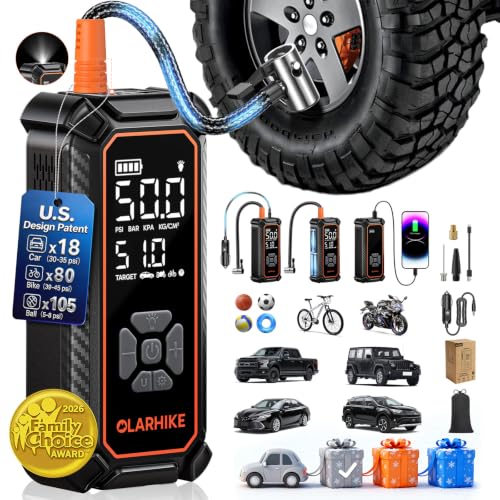
OlarHike Portable Tire Inflator Air Compressor
The OlarHike Portable Tire Inflator combines dual-power versatility via a 12V DC vehicle plug or built-in rechargeable battery with an automatic shut-off digital display. It provides dependable roadside tire top-offs and inflation for passenger cars, crossovers, motorcycles, and bicycles.
Pros
- Dual-power design allows cordless field operation or continuous power through any standard vehicle 12V DC port
- Automatic shut-off technology stops the motor precisely at preset pressure to prevent over-inflation
- Integrated 6000mAh battery reserve doubles as an emergency phone charger and includes an LED work light
- Pocket-sized footprint weighs well under two pounds for convenient transport in center consoles or backpacks
Cons
- Maximum vehicle pressure rating of 51 PSI is not suitable for heavy-duty commercial trucks, RVs, or high-pressure trailer tires
- Compact tankless inflator mechanism cannot power workshop pneumatic tools such as nail guns or air ratchets
- Recharging requires a standard 5V 2A or 5V 3A adapter and is not compatible with high-wattage fast chargers
Ingersoll Rand All Season Select Lubricant, 1L
Engineered as an all-weather OEM fluid, this synthetic lubricant protects reciprocating compressors during continuous duty while resisting carbon buildup on critical valves. It is a solid pick for equipment owners who want fewer oil changes and reliable year-round operation.
Pros
- Maintains stable viscosity in hot and cold seasons
- Lasts four times longer than petroleum oil
- Keeps valves and rings free of carbon deposits
- Protects bearings under continuous duty cycles
Cons
- Formulated specifically for reciprocating compressor systems
- One-liter bottle requires buying multiples for large pumps
AstroAI AIRUN H 12V DC Portable Air Compressor
The AstroAI AIRUN H is a compact 12V DC tire inflator delivering up to 35 L/min airflow with automatic shut-off and digital pressure presets. It is an ideal portable emergency compressor for drivers, commuters, and garage hobbyists seeking fast tire top-offs.
Pros
- Automatic shut-off stops pumping reliably once target PSI is reached
- High-airflow 120W motor provides rapid top-offs for daily driver tires
- Long 9.84-foot power cord reaches all passenger vehicle wheels with ease
- Bright built-in LED flashlight and backlit display assist during night repairs
- Lightweight 2.2-pound form factor stores neatly in glove boxes and trunks
Cons
- Requires a 12V DC vehicle outlet and does not include a 120V AC household plug
- Mandates a 10-minute cool-down interval after 15 minutes of continuous operation
- Not intended for high-volume inflatables like large pool floats or air mattresses
VIAIR 88P 12V Portable Air Compressor
Designed for passenger cars and light trucks with tires up to 33 inches, the VIAIR 88P delivers dependable 120 PSI output directly from a vehicle battery. Its generous 26-foot total reach, built-in gauge, and integrated work light make it a practical emergency companion for road trips and camping.
Pros
- Solid 1.47 CFM flow rate provides brisk inflation
- Generous 26-foot reach easily accesses all four tires
- Built-in LED work light aids dark roadside repairs
- Compact body weighs under five pounds for convenient storage
Cons
- Requires direct battery connection instead of standard 12V outlet
- Limited to a 25-minute duty cycle before cooling
- Not designed for tires larger than 33 inches
OlarHike 12000mAh Cordless Tire Inflator
The OlarHike Heavy Duty Tire Inflator is a compact 3.2-pound mobile air compressor featuring a twin-cylinder motor, integrated 12,000mAh battery, and 12V DC vehicle adapter. It provides rapid roadside inflation with auto-shutoff convenience, making it a dependable emergency tool for drivers, mechanics, and off-roaders.
Pros
- Twin-cylinder pump configuration delivers faster inflation times than typical single-piston mini inflators
- True dual-power flexibility prevents downtime by running via battery or vehicle 12V DC outlet
- Compact, lightweight 3.2-pound body offers exceptional portability without eating up cargo space
- 45W USB-C Power Delivery port provides practical utility beyond tire maintenance
- Auto-stop feature eliminates pressure guessing and prevents dangerous over-inflation
Cons
- Tankless mobile design is strictly intended for inflation and cannot operate continuous-draw pneumatic air tools
- Extended continuous runtime on large truck or RV tires will cause heat buildup that requires brief cool-down intervals
- Does not include a standard 120V AC household wall plug for direct residential outlet use
Understanding Air Compressors: Mechanics, Types, and Practical Selection
Pneumatic power plays a vital role across automotive maintenance, residential carpentry, and industrial fabrication. An air compressor captures ambient air, reduces its volume through mechanical power, and stores that pressurized air to operate tools or inflate tires. Understanding how these machines work and how their internal components interact allows operators to choose equipment that delivers reliable performance. Exploring these core mechanical principles reveals how atmospheric air transforms into versatile pneumatic force.
How Air Compressors Convert Atmospheric Air into Stored Energy
At its physical core, an air compressor is a power converter that reduces atmospheric gas volume to increase internal pressure. Atmospheric air at sea level rests at approximately 14.7 pounds per square inch of ambient pressure. When an air compressor draws this air into an enclosed chamber and shrinks the space, the gas molecules collide rapidly. According to gas laws, decreasing trapped air volume causes pressure and temperature to rise proportionally, generating potential kinetic energy.
The mechanical compression cycle begins when an intake stroke creates a low-pressure area inside the compression chamber. Ambient air rushes through an intake air filter that removes airborne dirt and contaminants before they reach internal valve plates. Flexible intake reed valves open inward to allow clean air into the cylinder bore. Once the piston reaches the bottom of its stroke, the intake valves snap shut to trap the air mass inside.
The driving mechanism then pushes the piston upward, compressing the trapped air molecules against the cylinder head. As internal pressure exceeds the resistance of the discharge valve, compressed air enters a delivery tube leading to the storage tank. A one-way check valve installed at the tank port allows air to enter while preventing backward flow. When the motor turns off, an unloader valve purges head pressure so the motor can start freely next cycle.
Displacement Mechanisms: Reciprocating Pistons, Diaphragms, and Mini Pumps
Most consumer, automotive, and jobsite compressors rely on positive displacement mechanisms that physically trap and squeeze discrete pockets of air. The reciprocating piston pump is the most prevalent positive displacement design in modern workshops. In a piston compressor, a rotating crankshaft driven by an electric motor moves a piston back and forth inside a cylinder. Precision piston rings or composite cup seals maintain an airtight seal against the cylinder wall during every stroke.
Compact emergency tire inflators adapt these displacement principles into miniaturized direct-drive configurations without heavy cast-iron flywheels. Portable 12V models, such as units produced by CRAFTSMAN, DEWALT, and VIAIR, use small electric motors connected to compact piston assemblies. These portable pumps typically deliver air directly through a hose rather than storing it in a bulky tank. Integrated cooling fans and automatic duty cycle limits help protect internal motor windings from excessive heat during inflation runs.
Rotary screw compressors represent another positive displacement architecture, primarily used in commercial facilities requiring continuous airflow. Instead of reciprocating pistons, rotary screw units squeeze air between two counter-rotating intermeshing helical rotors. This rotational design operates with minimal vibration, maintains a 100 percent continuous duty cycle, and runs significantly quieter than piston pumps. Reciprocating piston compressors remain the standard choice for DIYers and home garages due to their mechanical simplicity and lower initial cost.
Single-Stage versus Two-Stage Compression Architecture
Compressors are categorized as single-stage or two-stage depending on how many times air is mechanically compressed between intake and storage. In a single-stage compressor, air is drawn directly from the room and compressed to final working pressure in one piston stroke. Single-stage configurations are standard on portable jobsite compressors, pancake models, and compact vehicle tire inflators. These machines typically produce maximum pressures between 120 and 150 PSI, which is sufficient for light air tools, finish nailing, and tire maintenance.
Two-stage compressors divide the compression workload between two distinctly sized cylinders connected by an intercooler tube. The larger low-pressure cylinder first draws in atmospheric air and compresses it to an intermediate level, typically between 50 and 90 PSI. That warm air then passes through a finned metal intercooler line, where cooling airflow dissipates thermal energy before reaching the second cylinder. The smaller high-pressure cylinder then compresses the cooled air a second time, boosting final pressure up to 175 PSI.
Dividing the compression ratio across two stages reduces operating heat, decreases mechanical stress on valve plates, and improves volumetric efficiency. Cooling air between stages allows the second cylinder to pack more air mass into the receiver tank with less electrical power. Two-stage systems are standard in automotive service shops where heavy pneumatic tools run throughout the day. Storing air at 175 PSI creates a larger usable energy reserve in the same tank footprint compared to single-stage units.
Understanding CFM, SCFM, and Operating Pressure Ratings
Evaluating an air compressor requires separating air pressure from air volume, two distinct metrics that govern pneumatic tool compatibility. Pressure is measured in pounds per square inch (PSI) and indicates the mechanical force exerted by the air against a surface. Volume is measured in cubic feet per minute (CFM) and defines the quantity of air the pump delivers over time. While pressure determines whether a tool can fire a fastener, volume determines whether continuous tools can run without stalling.
Manufacturers typically express air volume as Standard Cubic Feet per Minute (SCFM), which standardizes flow measurements to sea-level atmospheric conditions. Because air becomes denser under higher pressure, a compressor delivers fewer cubic feet of air as output pressure increases. A portable pump might deliver 3.5 CFM at 40 PSI for light paint spraying, but only 2.4 CFM at 90 PSI for running pneumatic tools. Buyers must evaluate air delivery ratings at 90 PSI, since most pneumatic tools require 90 PSI to function properly.
Intermittent tools like brad nailers, framing guns, and tire chucks consume air in brief bursts, allowing small compressors to recover pressure between actuations. Continuous tools like random orbital sanders, high-speed die grinders, and HVLP spray guns draw massive volumes of air uninterrupted. If an air tool consumes 8 CFM at 90 PSI while the compressor only produces 4 CFM, the receiver tank will empty quickly, causing tool speed to drop. Selecting a compressor that delivers roughly 1.25 times your highest tool CFM demand ensures reliable operation.
Oil-Free Convenience versus Oil-Lubricated Pump Durability
Pump lubrication design plays a central role in maintenance routines, operating noise levels, and mechanical lifespan. Oil-free compressors feature pistons fitted with self-lubricating Teflon or PTFE composite piston rings operating inside coated cylinders. Because these units do not require crankcase oil, they can operate on uneven terrain and transport horizontally without leaking fluid. DIY homeowners and finish carpenters frequently choose oil-free units because they require zero oil changes and deliver clean air without oil residue into finished projects.
Oil-lubricated compressors utilize an internal crankcase filled with lubricating oil that splashes onto the crankshaft, bearings, and cylinder walls during operation. This protective oil film reduces friction between moving parts, dampens acoustic vibrations, and dissipates heat away from high-friction contact points. Consulting an air compressor oil guide confirms that these units require dedicated non-detergent or synthetic lubricants to prevent foaming and valve deposits. Using proper synthetic fluids, such as Ingersoll Rand All Season Select synthetic oil, ensures stable viscosity across broad temperature ranges.
While oil-free units offer exceptional portability and zero maintenance, their composite piston seals wear faster under continuous commercial workloads. Oil-lubricated cast-iron pumps spin at lower rotational speeds, generate lower-frequency operating sound, and deliver longer service lives when oil is changed regularly. For stationary garage workshops where the compressor stays in place, oil-lubricated models provide superior thermal management and durability. Matching pump lubrication to your maintenance willingness and work frequency guarantees reliable performance over years of ownership.
Form Factors: Tankless 12V Inflators versus Receiver Tank Units
Air compressors come in diverse configurations tailored to specific operational environments and mobility requirements. Tankless 12V portable tire inflators, such as models from AstroAI, OlarHike, and VIAIR, are designed specifically for vehicle emergencies, tire maintenance, and bicycle tires. These ultra-portable units draw direct-current electrical power from vehicle accessory sockets or alligator clamps attached directly to car batteries. Digital LCD screens, automatic shut-off presets, and integrated LED work lights provide user-friendly operation during roadside emergencies.
Despite achieving high operating pressures up to 120 or 150 PSI, compact 12V inflators produce relatively low total airflow volume. They are engineered to gradually fill enclosed tire cavities rather than supplying high-volume bursts through pneumatic lines. Consequently, tankless inflators cannot power pneumatic tools like impact wrenches, air ratchets, or blow guns. Attempting to attach industrial workshop accessories to a direct-drive tire inflator is impractical because these mini pumps lack the volume reserves and standard quick-connect couplers required by air tools.
Traditional workshop and jobsite compressors incorporate welded steel receiver tanks configured as pancake, hot dog, twin-stack, or vertical cylinders. The storage tank acts as an energy accumulator, storing high-pressure air so pneumatic tools can draw large bursts without stalling the motor. Accessories like the JASTIND industrial air blow gun or SARDVISA multi-piece nozzle kit require standard 1/4-inch NPT connections and continuous air delivery that only tank-equipped units provide. Choosing between a tankless inflator and a tank compressor depends directly on whether you need roadside portability or air tool support.
Moisture Control and Tank Maintenance: Preventing Internal Corrosion
Compressing atmospheric air naturally produces water condensation inside pneumatic storage tanks and delivery lines. Ambient air always carries water vapor, but when that air is compressed into a smaller volume, its moisture-holding capacity drops dramatically. As hot compressed air cools inside the steel receiver tank, water vapor condenses into liquid droplets that settle at the tank bottom. If this standing water is neglected, internal tank corrosion will rust the steel shell from the inside, compromising structural integrity over time.
Liquid moisture also migrates into downstream air lines, causing significant performance and durability problems for air tools. Water flowing through pneumatic hoses flushes out protective lubricants inside air motors, causing air tools to seize or rust prematurely. In paint spraying and woodworking finishing, water droplets passing through the air stream ruin paint coats and surface stains. Reading a compressor spitting water troubleshooting guide helps operators install inline desiccant dryers, water separators, and filter-regulators to trap moisture before it reaches delicate tools.
Preventing internal rust requires operators to purge accumulated condensation from the receiver tank after every operating session. Manufacturers place drain valves at the lowest point of the tank, utilizing either threaded needle petcocks or accessible quarter-turn brass ball valves. To purge moisture safely, reduce tank pressure below 20 PSI, position a catch cloth or tray underneath, and carefully open the drain valve until all moisture escapes. Leaving the valve slightly open during off-season storage allows the tank interior to dry thoroughly and prevents moisture buildup.
Electrical Requirements, Starting Surge, and Safe Tool Operation
Electric air compressors present unique electrical demands due to the high torque needed to start an electric motor against internal pump resistance. Electric induction motors require a substantial inrush current surge during startup, often drawing two to three times their standard running amperage for a brief split second. A compressor pulling 14 running amps can easily trip a standard 15-amp household circuit breaker if another appliance shares that circuit. Operating workshop compressors on dedicated 20-amp circuits or dedicated 240V lines prevents nuisance breaker trips and safeguards motor windings.
Using undersized electrical extension cords is among the leading causes of premature electric compressor motor failure. Long, lightweight extension cords cause a severe voltage drop, starving the motor of electrical power when it tries to start against head pressure. Low voltage causes electric motors to pull excessive current, overheat rapidly, and trigger internal thermal overload protection switches. Operators should always plug electric compressors directly into a wall outlet and use longer air hoses rather than electrical extension cords to reach distant work areas.
Maintaining safe operating conditions also requires routinely checking the manifold pressure regulator and ASME safety relief valve. The safety relief valve features a spring-loaded brass ring designed to release stored air automatically if the pressure switch fails to shut off the motor. Operators should inspect this ring periodically and give it a gentle tug under low tank pressure to ensure the internal seal moves smoothly. Always depressurize receiver tanks completely before disconnecting fittings, transporting heavy compressors, or performing maintenance to avoid accidental injury from pressurized air lines.
About the author
Bob Beacham is an experienced tools and workshop writer with deep knowledge of power equipment, mechanical systems, and practical DIY applications. His coverage of air compressors, welding equipment, saws, and workshop tools helps translate technical specifications into useful guidance for homeowners and serious DIYers.