
Why Is My Air Compressor Spitting Water: Causes and Solutions for 2026
Resolve why is my air compressor spitting water, stop line condensation, and protect your pneumatic tools with proper air drying systems in October 2026.
 By Bob Beacham
Updated October 8, 2026
By Bob Beacham
Updated October 8, 2026

Pressing the trigger on a blowgun or pneumatic nailer only to receive a sudden blast of misty spray is one of the most frustrating garage surprises. Moisture in compressed air lines ruins spray paint jobs, corrodes internal nailer seals, and causes plasma cutters to sputter mid-cut. Atmospheric humidity constantly enters the compressor pump through the intake filter during standard operation. Understanding the physics behind this problem is the first step toward keeping your air lines dry and protecting your valuable pneumatic investments.
If you are wondering why is my air compressor spitting water, the explanation comes down to basic atmospheric thermodynamics rather than an outright pump mechanical failure. Air compressor pumps draw in humid ambient air, heat it during rapid pressurization, and send it into the receiver tank where it cools and turns into liquid water. Without adequate tank drainage, line slope, and downstream filtration, that pooled water eventually travels through your discharge ports. Investing in proper multi-stage filtration and establishing a disciplined moisture purging routine will quickly restore clean, dry airflow to your workshop.
| Award | Product | ACR Score About ACR ScoreThe ACR Score is our own rating from 0 to 10, based on performance, design and build, ease of use, and value. It reflects independent research and is never influenced by manufacturers, retailers, or affiliate commissions. Learn more › | |
|---|---|---|---|
| Best Overall |
RVMARINEPAT 1/2-Inch 4-Stage Air Drying System
|
9.2/10 | Buy |
| Best Premium |
 DAIERTEK 1/2" NPT 3-Stage Air Dryer
|
9.1/10 | Buy |
| Best Budget |
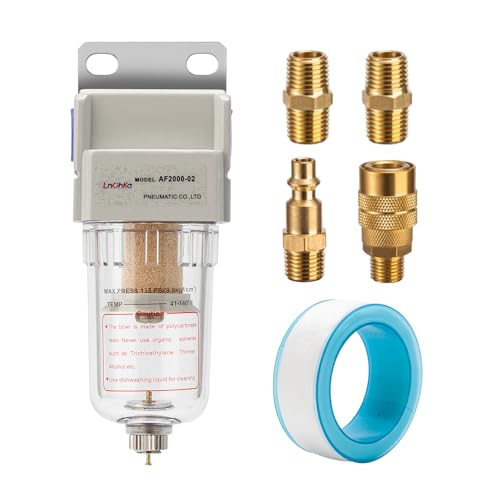 LNCHKA 1/4-Inch NPT Air Compressor Water Separator
|
8.9/10 | Buy |
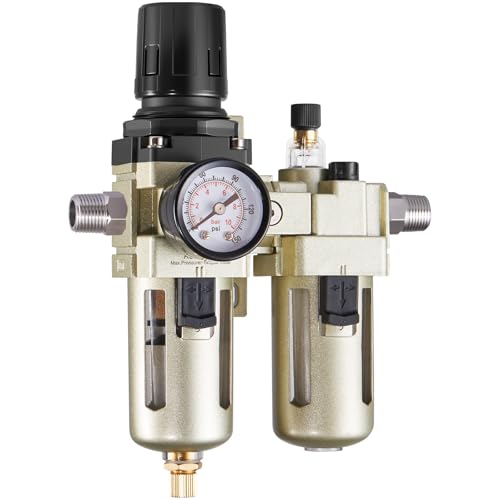 VEVOR 3/8 Inch NPT Air Compressor Filter Regulator
|
8.9/10 | Buy | |
| Best Value |
 VEVOR 3/8" NPT Dual Stage Air Compressor Filter
|
8.1/10 | Buy |
RVMARINEPAT 1/2-Inch 4-Stage Air Drying System
Built for moisture-critical tasks like spray painting and plasma cutting, this 4-stage system combines particulate, coalescing, and desiccant filtration with an integrated 0-240 PSI regulator. It includes replacement elements and an automatic drain to maintain clean air lines with minimal maintenance.
Pros
- Filters particulates and oil aerosols down to 0.01 microns
- Automatic drain valve minimizes routine maintenance
- Includes spare filter elements and extra desiccant packs
- Pop-up indicator signals when coalescing element needs replacement
Cons
- Desiccant beads require periodic replacement or regeneration
- Multi-stage configuration requires considerable wall mounting space
DAIERTEK 1/2" NPT 3-Stage Air Dryer
Designed for moisture-critical tasks like spray painting and plasma cutting, this 3-stage filtration unit combines particulate, coalescing, and desiccant drying with integrated pressure regulation. Durable metal bowls and color-changing media make routine monitoring straightforward in workshop setups.
Pros
- Comprehensive three-stage filtration delivers dry, clean air
- Durable metal bowl construction for workshop environments
- Color-changing desiccant beads simplify maintenance tracking
- Generous bundle includes spare filters and fittings
Cons
- Requires vertical mounting for proper auto-drain operation
- Desiccant media requires regular maintenance and replacement
LNCHKA 1/4-Inch NPT Air Compressor Water Separator
The LNCHKA 1/4-inch NPT air line filter is a compact moisture separator engineered to trap condensation and particulates using a durable 5-micron brass element. Supporting up to 145 PSI and an 18 SCFM flow rate, it is an effective, budget-friendly addition for DIYers and home garage mechanics looking to protect pneumatic tools from water damage.
Pros
- Durable 5-micron porous brass filter element resists corrosion better than paper or plastic cartridges
- Generous 18 SCFM flow capacity easily accommodates common DIY and small-shop pneumatic tools
- Includes brass quick-connect fittings, bracket, and Teflon tape for straightforward installation out of the box
- Transparent polycarbonate bowl provides effortless visual inspection of fluid buildup
Cons
- Polycarbonate bowl can be vulnerable to cracking if exposed to harsh synthetic solvents or chemical fumes
- Manual drain requires proactive monitoring and regular physical purging to prevent water re-entry into the line
- 1/4-inch NPT port size and 18 SCFM rating are not suitable for large multi-operator industrial airline networks
VEVOR 3/8 Inch NPT Air Compressor Filter Regulator
The VEVOR 3/8-inch NPT Filter Regulator Lubricator (FRL) combines a 5-micron brass water separator, adjustable pressure regulator, and micro-fog oiler rated up to 145 PSI. It provides clean, lubricated air for automotive mechanics and workshop woodworkers seeking to extend the service life of pneumatic tools.
Pros
- Compact 3-in-1 modular footprint cleans, regulates, and lubricates air in a single installation point
- Cleanable 5-micron brass filter element offers better durability than disposable paper filter media
- Semi-auto drain discharges condensation automatically when the compressor stops, helping prevent neglected bowl overflow
- Sturdy metal bowl cages protect the polycarbonate reservoir from bumps and accidental tool strikes
Cons
- Maximum 145 PSI operating limit is not rated for heavy-duty 175 PSI two-stage industrial compressor systems
- Inline oiler lubricates downstream hoses, requiring a separate dedicated line if you need dry air for spray painting or tire inflation
- Threaded 3/8-inch NPT ports require careful thread sealing with PTFE tape or paste to prevent slow joint leaks
VEVOR 3/8" NPT Dual Stage Air Compressor Filter
The VEVOR 3/8-inch NPT dual-stage filter regulator combines 25-micron and 5-micron brass elements with a semi-automatic drain to remove moisture and particulate from air lines up to 145 PSI. It provides dependable moisture separation and pressure control for garage hobbyists, woodworkers, and DIY mechanics.
Pros
- Two-stage 25-micron and 5-micron brass elements offer thorough particle and water separation
- Semi-automatic drain releases trapped condensation when the system depressurizes
- Polycarbonate bowls with metal protective guards allow quick visual inspection while resisting damage
- Standard 3/8-inch NPT threads integrate smoothly into common workshop air lines
Cons
- Maximum working pressure is limited to 145 PSI, so it is not suitable for 175 PSI two-stage systems without upstream regulation
- Polycarbonate bowls are vulnerable to damage from harsh chemical solvents or synthetic compressor lubricants
- Continuous air setups where pressure never drops require manual intervention to purge water from the drain
The Mechanics of Compressed Air Condensation and How to Stop Line Moisture
Experiencing water discharge from pneumatic tools indicates that atmospheric vapor has overwhelmed your system storage and filtration stages. Ambient air always holds water vapor, but compressor pumps can only compress the air molecules, not the water. When that pressurized air cools inside the receiver tank, moisture condenses rapidly and begins searching for an exit through your hose connections. Resolving this issue requires understanding how compression alters air temperature, how storage tanks accumulate liquid, and how filtration stages separate water from working air.
The Thermodynamics of Atmospheric Air Compression
Every cubic foot of ambient air surrounding your workshop contains a measurable amount of water vapor determined by local relative humidity and temperature. When an electric compressor pump pulls in free air, it reduces that volume by a factor of seven or eight to achieve standard working pressures between 90 and 125 PSI. While air molecules compress easily into a tight space, water vapor cannot be compressed in the same mechanical manner. Instead, the compression process concentrates the exact same quantity of water molecules into a fraction of the original volume.
Compression also generates significant thermal energy, causing the discharged air leaving the pump head to reach temperatures well above ambient room levels. Warm air holds significantly more vapor than cool air, which keeps the water invisible and gaseous as it passes through the pump discharge tube. As the compressed air enters the receiver tank, it begins to cool toward the ambient temperature of the garage or workshop floor. Once the air temperature drops below its pressure dew point, the air can no longer hold the concentrated vapor, forcing the water to condense into liquid droplets.
Why Receiver Tanks Become Liquid Reservoirs
The receiver tank on an air compressor functions as both an energy reservoir and a primary cooling vessel for hot compressed air. As warm air sits inside the steel tank, the large metal surface area conducts heat away into the surrounding environment. Droplets of liquid water continually form along the internal tank walls and trickle down toward the lowest point of the cylinder. Over several operating cycles, this condensation forms a substantial pool of stagnant liquid at the bottom of the vessel.
If an operator neglects to drain the tank regularly, the liquid water level slowly rises toward the intake of the internal discharge tube. When pneumatic tools draw sudden bursts of air, the high-velocity airflow sweeps across the pooled surface water and pulls liquid directly into the manifold. Portable pancake or hot dog tanks hold relatively small air buffers, meaning high tool consumption rapidly agitates and lifts accumulated water into the hose. Draining the tank daily or after every project remains the most fundamental defense against severe line spitting.
The Role of Operating Temperatures and Duty Cycle Limits
Compressor operating patterns directly influence how much water vapor transitions into liquid before reaching your air tools. When a pump runs continuously beyond its rated duty cycle, the entire pump head, discharge tube, and tank body become excessively hot. High operating temperatures keep moisture suspended as vapor throughout the tank rather than allowing it to condense safely at the bottom where it can be drained. This hot, moisture-saturated air then travels several feet down the air hose before cooling and condensing inside the tool itself.
Allowing the compressor adequate rest intervals helps stabilize cylinder temperatures and encourages condensation to drop out inside the receiver tank rather than inside your airlines. Oil-free universal motors often spin at high speeds and generate high thermal output, which can warm the tank considerably during extended runtimes. Oil-lubricated cast-iron pumps typically operate at lower speeds and dissipate heat more effectively, but they still require reasonable cycle breaks. Managing your workload so the pump stays within its recommended duty parameters helps maintain lower discharge temperatures.
How Water in Air Lines Damages Tools and Workpieces
Allowing liquid water to pass through air lines creates immediate problems for both pneumatic equipment and finished projects. Pneumatic impact wrenches, ratchets, and die grinders rely on specialized oil to lubricate tight-tolerance rotor vanes and internal bearings. When pressurized water shoots through the motor chamber, it washes away lubricating oils and leaves bare steel surfaces exposed to oxygen. Over time, internal corrosion seizes motor vanes, pits cylinder walls, and drastically shortens tool operational life.
Moisture causes even more severe disruptions in finishing applications like automotive spray painting and wood lacquer application. When water droplets exit a paint gun nozzle alongside atomized paint, they create surface defects known as fish eyes, blistering, and clouding. These flaws ruin paint adhesion and force painters to sand down and repaint entire panels. Similarly, plasma cutting torches require dry air to sustain a stable plasma arc; moisture causes arc sputtering, accelerates nozzle and electrode wear, and produces rough, dross-heavy edge cuts.
Tracing the Moisture Path: A Step-by-Step Diagnostic Method
Diagnosing excessive water discharge begins with a thorough inspection of the compressor receiver tank drain valve. Before starting your diagnostic check, shut off power to the compressor and confirm whether liquid discharges when you open the bottom drain valve. If opening the valve releases several cups of rusty liquid, the primary cause of your line spitting is simply a waterlogged tank. Conversely, if the tank is completely dry yet tools still spit water, the moisture is condensing inside the hose lines due to rapid temperature drops.
The next step involves inspecting the length, material, and environment of your discharge air lines. Rubber and PVC air hoses laid directly on cold concrete shop floors accelerate condensation because the cold floor rapidly chills warm air passing through the hose. Check your quick-connect couplers and regulators for visible water droplets or white mineral scale buildup. If your compressor uses an existing inline separator, examine the filter element to verify that it is not clogged or past its service life.
Workshop Air Line Layout and Passive Cooling Techniques
Plumbing a workshop air system correctly can eliminate a vast majority of liquid water before air ever reaches a tool or filter. Running a dedicated metal pipe system using copper or aluminum tubing gives hot compressed air time to cool and drop out moisture along the line. Installing the main line with a slight pitch back toward the compressor or toward a dedicated drainage drop allows gravity to collect liquid. Vertical drop legs with manual or automatic ball valves at the lowest point provide easy purge points for accumulated condensation.
Connecting air tools to drops that take off from the top of the main distribution pipe rather than the bottom prevents gravity-fed water from draining into whip lines. Taking air off the top of the line ensures that only air enters the tool drop, while heavy liquid droplets continue along the bottom of the main line toward a collection leg. Incorporating at least twenty to thirty feet of piping between the compressor discharge and your primary filter allows air to cool down to ambient temperature, maximizing the effectiveness of downstream water separators.
Multi-Stage Filtration: From Particulate to Coalescing Stages
Standard single-stage air filters catch large debris but often fail to stop microscopic liquid aerosols and fine mists. A comprehensive filtration setup utilizes multiple progressive stages to isolate different contaminant sizes. The first stage typically employs a particulate filter element, such as a 5-micron or 25-micron brass element, to capture rust flakes, pipe scale, and bulk water droplets. Brass filter elements are durable, resistant to corrosion, and can often be cleaned and reused during routine workshop servicing.
Following the particulate stage, a high-efficiency coalescing filter is required to remove sub-micron liquid aerosols and oil mists that bypass standard filters. Coalescing elements feature ultra-dense fibrous media, often rated down to 0.01 microns, which forces minute liquid droplets to collide, combine into larger drops, and fall into the collection bowl. Quality coalescing units frequently incorporate visual pressure drop indicators that pop up when the internal element becomes saturated, signaling that it is time for a replacement.
Desiccant Drying for Moisture-Sensitive Applications
While particulate and coalescing filters capture bulk liquid and suspended aerosols, they do not remove gaseous water vapor. Critical applications such as spray painting, powder coating, and sandblasting require a dedicated desiccant air dryer to achieve a sub-zero pressure dew point. Desiccant dryers pass compressed air through a chamber filled with highly porous silica gel beads that physically adsorb residual moisture vapor from the air stream.
Systems like the DAIERTEK 1/2″ NPT Air Compressor Dryer and the RVMARINEPAT 4-Stage Drying System combine mechanical filtration with deep desiccant drying. These multi-stage systems utilize blue color-indicating desiccant beads that turn pink as they absorb water vapor, providing an unmistakable visual signal when the beads require replacement or thermal regeneration. Metal bowls with transparent sight glasses protect the desiccant media from workshop impacts while allowing operators to inspect bead condition without depressurizing the system.
Point-of-Use Water Separators for General Garage Tasks
For light-duty pneumatic tasks like tire inflation, brad nailing, and occasional impact wrench use, a compact point-of-use separator provides effective protection. The LNCHKA Air Compressor Water Separator utilizes a 1/4″ NPT port size, a 5-micron brass element, and a transparent polycarbonate bowl suitable for small portable compressors delivering up to 18 SCFM. Polycarbonate bowls allow easy visual inspection of collected water, but operators must ensure they are shielded from harsh chemical solvents that can degrade plastic.
Similarly, the VEVOR Air Compressor Filter Regulator offers a dual-stage brass element design featuring 25-micron and 5-micron filtration within a 3/8″ NPT framework. This configuration handles moderate air demands up to 145 PSI working pressure, combining clean air delivery with a locking pressure regulation knob to maintain consistent line output. Selecting the proper port size matching your hose diameter ensures that your filtration system does not introduce unwanted CFM restriction or pressure drop during tool operation.
Automatic Versus Semi-Automatic and Manual Drain Valves
Water separators and receiver tanks require regular purging, and the style of drain valve installed dictates how easily maintenance can be performed. Traditional manual drain valves, such as needle petcocks or brass push-pins, require the operator to physically kneel down and open the valve by hand. Inaccessible or stiff manual petcocks frequently lead to neglected maintenance, allowing filter bowls to overflow back into the primary air stream.
Semi-automatic drain valves, such as those featured on VEVOR filter regulator units, simplify maintenance by automatically discharging collected liquid whenever system pressure drops below a threshold or when the compressor shuts off. Fully automatic float-style drains, found on industrial units like the RVMARINEPAT 4-Stage system, use internal mechanical floats that open an exhaust port whenever liquid reaches a preset level under full operating pressure. Installing automatic drainage ensures continuous moisture evacuation without relying entirely on operator memory.
Lubrication Circuits Versus Dedicated Dry Air Lines
Workshops that operate both rotary pneumatic tools and finishing equipment must carefully separate lubricated air lines from dry air circuits. Units like the VEVOR 3-in-1 Filter Regulator Lubricator combine moisture filtration, pressure control, and automated oil misting into a single assembly to keep impact wrenches and air ratchets running smoothly. However, inline lubricators atomize oil directly into the hose, making that line permanently unsuitable for tasks requiring clean, dry air.
Connecting a paint gun or plasma cutter to an air line that has ever been exposed to an inline lubricator will inevitably cause severe contamination and surface failure. The proper setup involves placing moisture separators and desiccant dryers upstream on a main header, then splitting the line into dedicated branches. One branch remains completely dry and oil-free for painting, blowing, and plasma cutting, while a secondary branch feeds through an inline lubricator specifically reserved for oil-lubricated mechanical tools.
Long-Term Maintenance and Inspection Protocols
Maintaining a dry compressed air system requires establishing a consistent routine of physical checks and component servicing. Always depressurize the receiver tank and inline filter bowls completely before attempting to unscrew bowls, clean brass filter elements, or change desiccant media. Check the brass elements every few months for particulate buildup or discoloration, washing them in mild solvent and drying them thoroughly before reinstallation.
Inspect the rubber O-rings and bowl seals during every element service to verify they remain supple and free from cracks that could cause micro-leaks. When installing replacement filters or drying systems, always align the airflow direction with the stamped directional arrows on the valve body to avoid blowing collected liquid back into the line. Establishing a habit of daily tank drainage and scheduled filter monitoring guarantees that your air tools receive clean, dry air year-round.
Eliminating water from your compressed air lines is an achievable task that combines understanding condensation physics with installing appropriate separation hardware. By draining your receiver tank after every working session, laying out lines with proper slope and drop legs, and installing multi-stage filtration suited to your specific air consumption, you protect both your tools and your project finishes. Consistent preventative maintenance ensures reliable pneumatic power whenever you flip the compressor switch.
About the author
Bob Beacham is an experienced tools and workshop writer with deep knowledge of power equipment, mechanical systems, and practical DIY applications. His coverage of air compressors, welding equipment, saws, and workshop tools helps translate technical specifications into useful guidance for homeowners and serious DIYers.