
Will a 6 Gallon Air Compressor Run an Impact Wrench? Performance Guide for 2026
Operating pneumatic tools requires sufficient airflow, but will a 6 gallon air compressor run an impact wrench for home mechanics in October 2026?
 By Bob Beacham
Updated October 7, 2026
By Bob Beacham
Updated October 7, 2026
Automotive maintenance frequently demands serious torque, especially when dealing with stubborn suspension fasteners or rusted lug nuts. Many garage hobbyists and DIY mechanics wonder if a compact jobsite tank can supply enough pneumatic muscle for heavy shop tools, asking specifically: will a 6 gallon air compressor run an impact wrench? The quick answer is yes, but only with substantial performance limits. A compact compressor stores enough air to break loose a few fasteners in short bursts, yet it cannot sustain continuous industrial use without significant pauses for tank recovery.
Standard pancake compressors typically deliver between 2.6 and 4.0 CFM at 90 PSI, whereas a standard half-inch pneumatic impact gun consumes between 4.0 and 5.0 CFM during operation. When evaluating pneumatic demand, understanding pneumatic CFM ratings helps clarify why continuous air delivery differs from intermittent stored air. Once the pressurized air inside a small vessel is depleted, tool torque drops rapidly until the pump refills the reservoir. Reviewing compressor air supply limits is essential before attempting complex mechanical teardowns with portable equipment.
| Award | Product | ACR Score About ACR ScoreThe ACR Score is our own rating from 0 to 10, based on performance, design and build, ease of use, and value. It reflects independent research and is never influenced by manufacturers, retailers, or affiliate commissions. Learn more › | |
|---|---|---|---|
| Best Overall |
Ingersoll Rand Edge Series 2317G 1/2-Inch Air
|
9.1/10 | Buy |
| Best Value |
 Ingersoll Rand 231C 1/2-Inch Air Impact Wrench
|
8.9/10 | Buy |
| Best Budget |
 AEROPRO 1/2-Inch Air Impact Wrench
|
8.6/10 | Buy |
| Best Premium |
 Metabo HPT 6-Gallon Pancake Air Compressor Review
|
8.6/10 | Buy |
 BESWELL BW-112BN 1/2-Inch Air Impact Wrench
|
8.3/10 | Buy | |
 AEROPRO A398 1/2-Inch Air Impact Wrench
|
8.3/10 | Buy | |
 Trivd Frol 1/2-Inch Air Impact Wrench
|
8.3/10 | Buy | |
 Ingersoll Rand 231HA-2 1/2-Inch Drive Air Impact
|
8.3/10 | Buy | |
 Metabo HPT EC914S 6-Gallon 200 PSI Pancake Air
|
8.3/10 | Buy | |
 CRAFTSMAN 6 Gallon 150 PSI Portable Oil-Free
|
8.1/10 | Buy |
Ingersoll Rand Edge Series 2317G 1/2-Inch Air
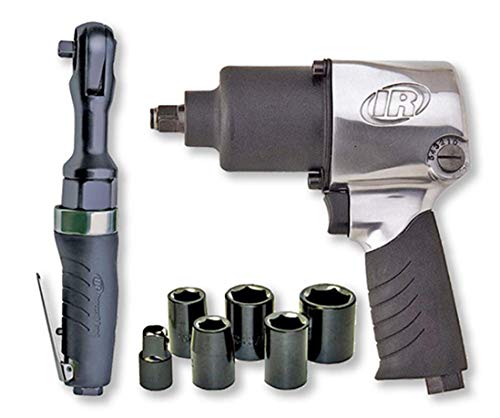
The Ingersoll Rand Edge Series 2317G combo kit pairs a 500 ft-lb 1/2-inch impact wrench and a 2.6-pound air ratchet for dependable vehicle maintenance. It is a practical, durable pneumatic package for garage hobbyists and DIY mechanics with a capable air supply.
Pros
- Delivers up to 500 ft-lbs of maximum torque to break loose stubborn vehicle lug nuts and suspension bolts
- Lightweight 2.6-pound air ratchet maneuvers easily inside cramped engine bays and beneath dashboards
- Twin hammer mechanism provides smooth, balanced impact force with reduced internal vibration
- Complete kit includes five utility sockets and a durable blow-molded carrying case
Cons
- High rotary airflow demand exceeds the continuous capacity of compact 1-gallon to 6-gallon pancake air compressors
- Does not include quick-connect air fittings, whip hoses, or thread sealant out of the box
- Air ratchet top speed of 170 RPM requires manual initial breakaway for extremely over-torqued fasteners
Ingersoll Rand 231C 1/2-Inch Air Impact Wrench
The Ingersoll Rand 231C is a classic 1/2-inch pneumatic impact wrench delivering up to 600 foot-pounds of reverse torque with a durable twin-hammer mechanism. Requiring a minimum 90 PSI air supply and a 3/8-inch hose, it is an ideal choice for DIY mechanics and garage workshops tackling tire rotations and bolt extraction.
Pros
- Up to 600 foot-pounds of reverse breakaway torque easily removes stubborn vehicle lug nuts and seized bolts
- Durable twin-hammer mechanism delivers smooth, reliable impacts with reduced tool vibration
- Adjustable power regulator offers precise forward power selection to prevent over-tightening
- Manageable 5.8-pound weight and 7.3-inch length allow convenient access in tight automotive spaces
- Pressure-fed lubrication system promotes long-term mechanical reliability in busy garage settings
Cons
- Requires an air compressor capable of maintaining at least 90 PSI and a 3/8-inch air hose (sold separately)
- Small portable or pancake air compressors will quickly deplete their air reserve during extended burst cycles
- Front exhaust port can blow loose dust and debris forward toward the work surface if positioned close to dirty components
AEROPRO 1/2-Inch Air Impact Wrench
The AEROPRO 1/2-inch air impact wrench delivers up to 1,200 ft-lbs of loosening torque with a lightweight 4.64-pound housing and twin hammer mechanism operating at 90 PSI. It is an ideal addition for garage workshop owners and DIY mechanics who already maintain a reliable pneumatic air supply and need serious breakaway force for vehicle maintenance.
Pros
- High 1,200 ft-lbs loosening torque breaks free stubborn vehicle lug nuts and rusted suspension bolts
- Lightweight 4.64-pound body substantially reduces arm fatigue compared to traditional all-metal impact wrenches
- Three-speed forward dial provides regulated speed control to prevent over-torquing during initial fastener seating
- Rear exhaust port keeps air blast and debris directed away from the technician
Cons
- Requires an external air compressor with sufficient air volume delivery that is not included with the bare tool
- Not practical for small 1-to-6 gallon pancake compressors due to the high intermittent CFM demand of 1/2-inch rotary air tools
- Bare-tool configuration requires users to supply their own 1/4-inch quick-connect fitting, 3/8-inch air hose, and impact sockets
Metabo HPT 6-Gallon Pancake Air Compressor Review
The Metabo HPT EC711S is a portable 6-gallon pancake air compressor delivering 2.8 CFM at 90 PSI with a 165 PSI tank ceiling and an operating sound level of 73 dB. With its quick 46-second recovery cycle and dual quick couplers, it is an excellent choice for finish carpenters, punch-list contractors, and DIYers running pneumatic nailers.
Pros
- 73 dB operational sound rating is substantially quieter than standard job-site pancake units
- 165 PSI maximum pressure provides ample air storage with a swift 46-second recovery cycle
- Two 1/4-inch universal quick couplers support multi-tool setups right out of the box
- Sturdy steel roll cage protects gauges and the manifold assembly against knocks and drops
- Oil-free 1.0 HP motor ensures low maintenance and reliable cold-weather motor startup
Cons
- At 38.5 lbs, it is slightly heavier than ultra-compact 1-to-3-gallon trim compressors
- Airflow of 2.8 CFM at 90 PSI is designed for intermittent fastening, not continuous rotary tools or paint sprayers
- Bare-tool configuration means air hoses and pneumatic fastening tools must be purchased separately
BESWELL BW-112BN 1/2-Inch Air Impact Wrench
Built for heavy-duty automotive and industrial jobs, this pneumatic wrench delivers 1,180 ft-lbs of nut-busting torque in a manageable 4.62-pound composite frame. Its twin-hammer mechanism and three-speed forward regulator give mechanics balanced power and vibration control for all-day use.
Pros
- High breakaway torque quickly frees seized fasteners
- Lightweight composite frame reduces arm fatigue
- Smooth twin-hammer design dampens operating vibration
- Internal cooling system supports prolonged heavy use
Cons
- Requires a compatible high-pressure shop air compressor
- Full-size housing can be cumbersome in tight clearances
AEROPRO A398 1/2-Inch Air Impact Wrench
The AEROPRO A398 is a 1/2-inch pneumatic impact wrench delivering up to 1380 ft-lbs of loosening torque and 810 ft-lbs of working torque at 90 PSI via a twin-hammer mechanism. Weighing 5.28 pounds with an aluminum body, it suits DIY mechanics and garage hobbyists who have an air compressor capable of supplying steady 90 PSI pneumatic line pressure.
Pros
- High breakaway power with up to 1380 ft-lbs of loosening torque at 90 PSI
- Twin-hammer design delivers balanced, smooth impact strikes on heavy fasteners
- Manageable 5.28-pound aluminum body reduces fatigue during vehicle maintenance
- Rear exhaust directs exhaust air and debris away from the immediate work area
- Includes a 1/4-inch NPT air fitting, spanner, and oil bottle out of the box
Cons
- Requires a dedicated air compressor with sufficient CFM reserves, as small pancake units can only manage very short bursts
- Pneumatic tool oil is not pre-installed, requiring routine manual oiling before each use
- High torque output demands caution on smaller automotive fasteners to avoid stripped threads
Trivd Frol 1/2-Inch Air Impact Wrench
The Trivd Frol 1/2-inch air impact wrench combines a twin-hammer mechanism with a lightweight 4.73-pound composite body, delivering up to 1500 ft-lbs of advertised torque at 90 PSI. It is a practical, budget-conscious choice for garage hobbyists and DIY auto mechanics tackling lug nuts and suspension hardware with a capable pneumatic air setup.
Pros
- High advertised torque output of up to 1500 ft-lbs for breaking loose seized vehicle fasteners and stubborn lug nuts
- Lightweight 4.73-pound composite housing reduces user arm and wrist strain compared to heavier all-metal impact guns
- Twin-hammer impact mechanism and 45mm cylinder provide balanced, smooth blows during heavy fastener work
- Multi-speed adjustment knob offers three forward speeds and full reverse power for precise fastening control
Cons
- Requires a substantial air supply at 90 PSI; compact pancake compressors will struggle to sustain air volume during continuous impact use
- Manufacturer indicates reaching maximum torque requires higher airflow and pressure than standard 90 PSI regulation
- Bare-tool package requires users to provide their own air hose, quick-connect fittings, and pneumatic tool oil
Ingersoll Rand 231HA-2 1/2-Inch Drive Air Impact
The Ingersoll Rand 231HA-2 is a heavy-duty 1/2-inch pneumatic impact wrench delivering up to 600 ft-lbs of reverse torque with an extended 2-inch anvil and twin-hammer mechanism. Designed for automotive garages and workshop tire service, it requires an air compressor supplying at least 90 PSI through a 3/8-inch air hose.
Pros
- Delivers up to 600 ft-lbs of reverse torque for breaking loose stubborn lug nuts and heavy chassis hardware.
- Twin-hammer mechanism and pressure-fed lubrication provide reliable durability and smooth power delivery.
- The 2-inch extended anvil offers practical clearance when servicing deep wheel wells and automotive rims without extra adapters.
- Adjustable power regulator gives operators straightforward forward torque management.
Cons
- Requires a minimum of 90 PSI and a 3/8-inch air hose, demanding more continuous air volume than standard compact pancake compressors can typically sustain.
- Sold as a bare tool without pneumatic couplers, air hose, or air compressor included.
- At 6.1 pounds, extended one-handed overhead use under a vehicle lift may contribute to arm fatigue.
Metabo HPT EC914S 6-Gallon 200 PSI Pancake Air
The Metabo HPT EC914S delivers an impressive 200 PSI maximum pressure and 4 CFM at 90 PSI from a 6-gallon tank, giving trim carpenters and remodelers the air volume needed to drive multiple nailers simultaneously. At roughly 41 pounds, it successfully combines high-pressure air storage with practical job-site portability.
Pros
- High 200 PSI tank ceiling stores substantially more usable air than conventional 150 PSI pancake models
- Generous 4 CFM at 90 PSI airflow rating supports multi-tool operation and reduces nailer drive hesitation
- Manageable 41-pound carry weight offers better portability than heavier twin-stack compressor configurations
- Engineered by Metabo HPT to support both lightweight trim nailers and larger framing or roofing guns
Cons
- At 41 pounds, it is noticeably heavier to carry than minimalist 1-to-3 gallon trim-only compressors
- Tank volume and CFM output remain inadequate for continuous high-demand air tools like HVLP sprayers or sanders
- Ships as a bare-tool compressor without included air hoses, pneumatic fittings, or nail guns
CRAFTSMAN 6 Gallon 150 PSI Portable Oil-Free
The CRAFTSMAN 6-Gallon 150 PSI Oil-Free Pancake Air Compressor delivers 2.6 SCFM at 90 PSI via a 1.0 HP low-voltage start motor with factory dual quick couplers. Weighing 30.8 pounds, it provides dependable air delivery for finish carpenters, DIY remodelers, and garage maintenance tasks.
Pros
- Delivers 2.6 SCFM at 90 PSI with a 150 PSI maximum tank ceiling for dependable finish fastening.
- Dual quick couplers allow two pneumatic tools to remain connected at the same time without splitters.
- Oil-free pump design ensures clean air delivery and zero periodic pump oil maintenance.
- Low-voltage start 1.0 HP motor supports reliable startups on standard 120V household outlets.
- Manageable 30.8-pound weight and integrated carry handle provide practical one-person jobsite transport.
Cons
- Air delivery rate of 2.6 SCFM at 90 PSI is not designed for continuous high-demand tools like rotary sanders or paint sprayers.
- Standard oil-free electric motor design generates typical high-pitch operational sound during tank recharge cycles.
- Sold as a bare compressor unit without included air hoses, couplers, or pneumatic nailers.
Air Delivery Reality: Operating an Impact Wrench with a 6-Gallon Compressor
Connecting a half-inch pneumatic impact gun to a portable pancake compressor is a common scenario in home garages. The pairing functions reasonably well for quick tasks, such as removing passenger car lug nuts during a seasonal tire swap or loosening a single stubborn caliper bracket bolt. However, the operational reality changes when the tool requires continuous trigger time. Stored pressure in a small vessel drops rapidly under heavy air consumption, altering tool behavior within seconds.
Delivered CFM Versus Impact Wrench Air Consumption
Pneumatic tools rely on steady air volume measured in cubic feet per minute to maintain rated motor speed and rotational torque. A typical half-inch air impact wrench, such as an Ingersoll Rand 231C or an AEROPRO twin-hammer gun, requires between 4.0 and 5.0 CFM at 90 PSI under steady load. In contrast, common six-gallon oil-free pancake units, such as the Craftsman pancake model or Metabo HPT EC711S, deliver roughly 2.6 to 2.8 CFM at 90 PSI. Even high-pressure options like the Metabo HPT EC914S max out around 4.0 CFM at 90 PSI.
Because the air pump produces fewer cubic feet per minute than the wrench consumes, a sustained air deficit occurs immediately upon pulling the trigger. The tool operates primarily on the compressed air stored in the six-gallon tank rather than the output of the active pump. Once that stored volume bleeds off, the impact mechanism slows down drastically. Operating under this continuous deficit means long bursts of trigger pull will rapidly starve the motor of operating pressure.
Usable Air Reserve and Pressure Buffer Calculations
A six-gallon vessel represents approximately 0.8 cubic feet of internal physical volume. When pressurized to 150 PSI, the tank stores compressed air that expands to provide usable volume at regulated operating pressure. If the tool regulator is set to 90 PSI, only the pressure differential between the tank maximum and the regulated line pressure provides effective working power. In practical terms, this equals roughly three to four cubic feet of free air before the tank drops below functional operating pressure.
When an impact gun draws air at high volume, this small reserve is exhausted in roughly eight to fifteen seconds of continuous trigger time. Higher-pressure tanks that reach 200 PSI, like specific Metabo HPT models, provide a slightly larger usable buffer because of the higher storage density. Even with higher pressure, the reserve remains finite. The wrench will deliver its peak breakaway torque on the first couple of strikes, but rotational power quickly diminishes as pressure drops toward the cut-in threshold.
Impact Gun Mechanics and Burst Operation Profiles
Pneumatic impact wrenches do not operate like rotary sanders or paint sprayers that demand uninterrupted air streams for minutes at a time. Impact mechanisms utilize an internal air motor connected to an anvil hammer assembly, such as a twin-hammer mechanism found in models like the Trivd Frol or BESWELL BW-112BN. Loosening a properly torqued wheel fastener generally takes only two to three seconds of rapid hammering. During these short bursts, the full operating torque of the tool is available from the initial tank pressure buffer.
Because fastener removal happens in brief pulses, a six-gallon tank can successfully remove three to four lug nuts in rapid succession before the compressor motor kicks on. The tool behaves normally during the initial burst because stored tank pressure matches the required operating threshold. The limitation appears only when attempting to spin off all twenty lug nuts on a light truck without pausing. Understanding this burst profile explains why many home mechanics find the combination workable for basic maintenance.
Air Line Restrictions, Hose Diameter, and Dynamic Pressure Drop
Air delivery performance depends heavily on the delivery plumbing between the compressor manifold and the pneumatic tool inlet. Many entry-level compressor kits include a thin, coiled 1/4-inch inner diameter air hose. While a 1/4-inch hose functions adequately for light brad nailers or tire inflation chucks, it severely restricts airflow when connected to a heavy impact wrench. Restricting the air channel causes severe dynamic pressure drop, meaning pressure at the tool inlet plummets well below the regulator setting while the trigger is pressed.
To extract full breakaway torque from an air wrench, a 3/8-inch inner diameter air hose should always be used. Most heavy-duty impact wrenches, including the Ingersoll Rand 231HA-2 and AEROPRO tools, require a 3/8-inch hose to achieve their rated loosening power. Using a wider hose diameter minimizes frictional line resistance over standard twenty-five-foot or fifty-foot runs. A shorter hose run also preserves air density, delivering maximum hammer velocity directly to the fastener.
Quick-connect couplers present another common bottleneck in small compressor setups. Standard automotive or industrial 1/4-inch body couplers feature narrow internal orifices that choke high instantaneous airflow. High-flow style couplers and plugs allow significantly greater volume to pass through the line without creating artificial flow resistance. Upgrading to high-flow fittings helps a six-gallon setup deliver full hammer impact despite the small storage capacity.
Duty Cycle Limits and Pump Heat Management
Most portable six-gallon pancake units utilize single-stage, oil-free electric pumps running at high motor RPM. These compact motors are typically rated for an intermittent duty cycle, commonly around fifty percent. This rating indicates the compressor pump should only run for roughly five minutes out of every ten-minute window to avoid excessive heat buildup. Operating an impact wrench continuously forces the small pump to cycle constantly, running non-stop as it struggles to replenish the tank.
Continuous cycling generates substantial friction and heat inside the compression cylinder, accelerating piston seal wear and stressing thermal overload components. If forced to run through prolonged mechanical repairs without rest, the compressor thermal overload switch may trip to prevent motor burnout. Proper pacing is critical when using a compact air supply for automotive tools. Allowing the compressor to complete its recovery cycle and rest between fastener groups preserves the longevity of the pump.
Automotive Tasks: What Works and What Stalls
Evaluating practical automotive workloads helps determine whether a six-gallon tank matches your intended mechanical projects. Removing passenger car wheel lugs, servicing brake rotors, or breaking loose shock absorber bolts are well within the capacity of a six-gallon system. For these intermittent tasks, the impact gun breaks the fastener loose quickly, allowing the user to switch sockets or position a jack stand while the compressor completes its recovery cycle. In these situations, the workflow naturally aligns with compressor recovery times.
Significant problems arise when tackling continuous automotive jobs like suspension bushing replacement, ball joint pressing, or heavy agricultural equipment repair. Severely seized axle nuts or rusted subframe bolts often require continuous hammering for thirty seconds or more. Under that level of continuous demand, a six-gallon tank drops below functional working pressure before the fastener moves. Once line pressure drops under 70 PSI, the impact gun loses its hammering power and simply stalls against the bolt.
Similar air supply constraints occur with other pneumatic tools commonly found on jobsites. For example, our six-gallon compressor framing nailer guide illustrates how small tanks excel with single-shot nailers but struggle under rapid multi-tool cycling. When matched with heavy rotary air tools like die grinders, cut-off tools, or pneumatic dual-action sanders, a six-gallon pancake unit will deplete its reserve in seconds. Impact wrenches succeed only because their operating mode is naturally intermittent.
Optimizing Setup for Maximum Torque Output
Achieving reliable fastener removal with a compact compressor requires careful attention to line pressure and tool maintenance. The regulator on the compressor manifold should be adjusted to 90 to 100 PSI while the tool is idle to account for slight dynamic pressure drop during trigger operation. Setting regulated pressure too low prevents the internal air motor from reaching full rotational speed. Setting line pressure excessively high can damage internal tool seals without providing extra torque.
Tool lubrication plays a vital role in maximizing pneumatic efficiency when air volume is limited. Placing a few drops of clean pneumatic air tool oil directly into the tool inlet before each session reduces internal friction across the rotor vanes and cylinder walls. Proper lubrication allows the air motor to spin freely and generate peak hammer velocity using minimal air volume. Neglecting tool lubrication increases mechanical drag, forcing the tool to consume more air to achieve the same loosening force.
Air hose management also directly impacts delivered power. Mechanics should avoid linking multiple extension hoses together when working around a vehicle. Using a single twenty-five-foot 3/8-inch hose connected straight to the regulated manifold port keeps line resistance as low as possible. If extra reach is needed, run a heavy-gauge electrical cord to reposition the compressor closer to the vehicle rather than stretching hundreds of feet of restrictive air line.
Recognizing When a Compressor Upgrade Is Necessary
While a six-gallon unit handles occasional garage chores, serious automotive hobbyists eventually encounter its firm physical boundaries. If your projects involve complete suspension rebuilds, drivetrain swaps, or regular tire rotations across multiple vehicles, waiting for a small tank to recover becomes frustrating. The constant noise and downtime interrupt workflow, making standard shop repairs take twice as long as necessary.
Upgrading to larger workshop air compressors featuring twenty to thirty-gallon tanks provides the air volume required for uninterrupted tool operation. Larger stationary or upright compressors deliver between 5.0 and 7.0 CFM at 90 PSI, comfortably matching or exceeding the continuous consumption of standard half-inch impact guns. A larger tank provides a substantial cushion that absorbs continuous usage without dropping regulated line pressure.
Operating Safety and Moisture Protection
Operating high-flow pneumatic tools on small compressors generates elevated moisture levels within the system. Because the pump cycles frequently to replenish the six-gallon tank, the air inside stays hot and holds suspended water vapor. When that warm air travels down the line and cools, water droplets condense rapidly inside the hose and pass straight into the impact wrench. Moisture inside a pneumatic tool strips away protective lubricating oil and accelerates corrosion of the motor cylinder and bearings.
Installing an inline moisture filter or water separator near the compressor outlet protects pneumatic tools from rust and premature wear. Additionally, always drain moisture from the bottom of the tank through the drain valve after finishing work. Opening the tank drain valve purges accumulated condensation, preventing internal tank corrosion and maintaining full air capacity. Regular draining ensures clean, reliable operation and prolongs the service life of both your compressor and your pneumatic tools.
Final Practical Takeaway
A six-gallon air compressor can successfully operate a half-inch pneumatic impact wrench for small, intermittent automotive repairs. By using a 3/8-inch inner diameter air hose, high-flow fittings, and proper tool lubrication, you can remove passenger car lug nuts and standard chassis fasteners effectively. The key requirement is managing expectations and respecting the recovery limits of a compact air pump. Pacing your work to match the tank recharge cycle provides dependable torque without damaging your equipment.
About the author
Bob Beacham is an experienced tools and workshop writer with deep knowledge of power equipment, mechanical systems, and practical DIY applications. His coverage of air compressors, welding equipment, saws, and workshop tools helps translate technical specifications into useful guidance for homeowners and serious DIYers.