
Which Air Compressor Do I Need: Practical Sizing and Selection Guide for 2026
Determine which air compressor do i need for pneumatic tools, workshop tasks, and tire inflation with this guide updated for November 2026.
 By Bob Beacham
Updated October 8, 2026


Air tools that suddenly lose torque or stall during a project usually point to a severe mismatch between tool consumption and compressor delivery. Deciding which air compressor do i need starts with understanding how volume and pressure interact under sustained load. A compact pancake compressor easily drives an intermittent finish nailer, but running continuous rotary sanders or automotive paint sprayers requires substantially higher volume. Clarifying your primary pneumatic tools and working environment prevents frustrating pressure drops and frequent motor cycling.
Electrical circuit limits and workshop noise tolerances also dictate the ideal setup. Powerful motors can draw high startup amps that trip standard household breakers, while loud pump assemblies quickly overwhelm an enclosed basement or residential garage. Low-RPM oil-free dual-piston designs now deliver quiet operation at manageable electrical draws, making them practical for indoor woodshops and home garages. Evaluating tank capacity, delivered airflow at 90 PSI, and duty cycle limits ensures you select a dependable machine tailored to your actual workload.
| Award | Product | ACR Score About ACR ScoreThe ACR Score is our own rating from 0 to 10, based on performance, design and build, ease of use, and value. It reflects independent research and is never influenced by manufacturers, retailers, or affiliate commissions. Learn more › | |
|---|---|---|---|
| Best Overall |
California Air Tools 2010A 2-Gallon Compressor
|
9.1/10 | Buy |
| Best Value |
 GX PUMP CS1-I PCP Air Compressor |
9.1/10 | Buy |
| Best Premium |
 California Air Tools CAT-4610S Ultra-Quiet 1.0 HP |
9.1/10 | Buy |
| Best Budget |
 MZB MZB-1100H-50 13.2-Gallon Air Compressor |
8.8/10 | Buy |
 California Air Tools CAT-4710W 4.7-Gal Compressor |
8.3/10 | Buy | |
 BUNKER INDUST 12V Off-Road Air Compressor |
8.0/10 | Buy | |
 California Air Tools 20020 Ultra-Quiet 2.0 HP |
7.8/10 | Buy |
California Air Tools 2010A 2-Gallon Compressor
Operating at just 60 decibels, this compact unit delivers reliable airflow with minimal noise disruption. Its rust-free aluminum tank and oil-free dual-piston pump make it well suited for indoor trim work and noise-sensitive spaces.
Pros
- Exceptionally quiet operation at only 60 decibels
- Lightweight rust-free aluminum tank design
- Low-maintenance oil-free dual-piston system
- Quick 14-second recovery time between cycles
Cons
- Modest 2-gallon tank limits continuous heavy tool use
- 120 PSI maximum pressure is below heavy-duty standards
- Air output is insufficient for sustained high-demand air tools
GX PUMP CS1-I PCP Air Compressor
The GX PUMP CS1-I is a portable, oil-free high-pressure air compressor engineered to deliver up to 4500 PSI (30 MPa) for PCP air rifles, paintball markers, and small HPA tanks. Featuring an integrated AC/DC power transformer and adjustable auto-shutoff, it offers target shooters and airgun enthusiasts an independent filling station without the hassle of dive shop visits.
Pros
- Integrated power supply eliminates the need to haul an external AC adapter brick when switching between garage outlets and a 12V car battery
- Completely dry operation requires no water buckets, circulation hoses, or pump oil maintenance
- Automatic pressure cut-off and 30-minute safety timer provide hands-free cylinder filling peace of mind
- Compact 17.6-pound frame with built-in carry handle fits easily in vehicle trunks for field use
- Includes an inline activated carbon moisture separator, spare O-rings, and standard 8mm quick connect hardware
Cons
- Engineered strictly for small HPA bottles up to roughly 1 liter and cannot fill large scuba breathing tanks
- Thermal limits require monitoring to ensure operational temperatures remain below 75 degrees Celsius
- Not compatible with standard low-pressure workshop pneumatic tools such as nailers or impact wrenches
California Air Tools CAT-4610S Ultra-Quiet 1.0 HP
The California Air Tools CAT-4610S delivers a remarkably quiet 60 dB sound profile with 2.20 CFM at 90 PSI from an oil-free dual-piston pump and a 4.6-gallon steel twin tank. Drawing only 8.5 amps, it is an excellent pneumatic choice for trim carpenters, woodworkers, and garage hobbyists working in noise-sensitive spaces.
Pros
- Ultra-quiet 60 dB sound level allows normal conversation while the pump runs
- Low 8.5-amp electrical draw prevents nuisance circuit breaker trips on 110V household lines
- Oil-free dual-piston pump requires no crankcase oil changes and boasts a 3000-plus hour life cycle
- Durable 4.6-gallon steel twin-tank configuration delivers steady air storage for sequential fastening
Cons
- Rated 2.20 CFM @ 90 PSI is insufficient for continuous-demand pneumatic tools like sanders or paint sprayers
- Weighs 56.2 pounds without transport wheels, requiring a solid two-handed carry between work areas
MZB MZB-1100H-50 13.2-Gallon Air Compressor
Designed for indoor workshops and residential garages, this compressor keeps operating noise down to a manageable 70 decibels. Its 13.2-gallon steel tank and wheeled frame suit DIY woodworkers, painters, and mechanics needing reliable airflow without regular pump maintenance.
Pros
- Quiet 70dB sound level ideal for indoor spaces
- Maintenance-free oil-free pump design
- Large 13.2-gallon durable steel tank
- Wheels and handle make transport manageable
Cons
- Hefty 72-pound weight makes vehicle loading difficult
- 115 PSI maximum pressure is modest for heavy-duty pneumatic tools
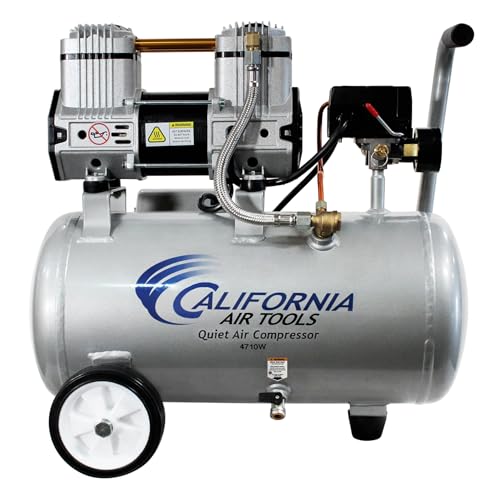
California Air Tools CAT-4710W 4.7-Gal Compressor
Built for garage workshops and DIY tasks, this mobile unit features an oil-free dual-piston pump that fills its 4.7-gallon steel tank in 78 seconds. Its low 7.5-amp motor draw ensures smooth startups on standard household circuits without tripping breakers.
Pros
- Fast 78-second tank fill time from empty
- Low 7.5-amp draw prevents tripped breakers
- Low-maintenance oil-free pump operation
- Wheels and pull handle ease transport at 35 pounds
Cons
- Delivers only 2.2 CFM at 90 PSI for demanding tools
- Steel tank construction is heavier than aluminum alternatives
BUNKER INDUST 12V Off-Road Air Compressor
The BUNKER INDUST 12V Air Compressor delivers a listed 12.36 CFM and up to 150 PSI through a heavy-duty dual-cylinder pump engineered for rapid truck and off-road tire inflation. Equipped with digital auto-stop pressure regulation and dual quick-connect couplers, it is a practical mobile pneumatic tool for 4x4 drivers, overland travelers, and fleet owners.
Pros
- High rated airflow of 12.36 CFM drastically cuts down airing-up time on large truck and off-road tires
- Digital auto-stop control automatically shuts down pump operation at the exact target pressure
- Dual-hose configuration with T-fitting facilitates simultaneous two-tire inflation to keep pressures balanced
- Heavy-duty Anderson-style plug ensures a secure, low-resistance connection to vehicle 12V power
- Alloy cylinders with cooling fins and cleanable intake filters offer solid protection in dusty trail environments
Cons
- Tankless direct-drive pump design is not built for sustained continuous-draw pneumatic shop tools like rotary sanders or impact wrenches
- Heavy 12V current draw requires a direct battery terminal connection and cannot operate from standard vehicle accessory sockets
- Alloy cylinder heads generate noticeable surface heat during prolonged high-pressure cycles, requiring careful handling around the cooling fins
California Air Tools 20020 Ultra-Quiet 2.0 HP
The California Air Tools 20020 provides a 20-gallon air reserve powered by a low-RPM 2.0 HP motor, delivering 5.30 CFM at 90 PSI at an ultra-quiet 70 dB sound level. Featuring an oil-free dual-piston pump and a 14-amp draw on standard 110V power, it suits home garage hobbyists and woodworkers seeking quiet, dependable pneumatic volume.
Pros
- Quiet 70 dB acoustic rating makes indoor garage and residential basement operation comfortable without extreme ear fatigue
- Strong air delivery of 5.30 CFM at 90 PSI effortlessly handles finish nailers, impact wrenches, and common pneumatic garage tools
- Long-life dual-piston oil-free pump is rated for over 3,000 hours of operation with zero crankcase oil maintenance
- Low 14-amp draw is compatible with standard 110V household power under proper dedicated circuit conditions
- Vertical 20-gallon steel tank with no-flat wheels combines substantial air storage with a compact shop footprint
Cons
- At 114 pounds, loading this vertical compressor into a pickup truck bed or moving it upstairs requires two people
- Not intended for continuous-duty high-consumption tools like uninterrupted sandblasters or production rotary sanders
- The tall 45-inch vertical profile requires deliberate handling when rolling across uneven outdoor terrain
Readers working through this often check do you need teflon tape for air compressor fittings next.
Matching Air Compressor Capabilities to Your Real-World Needs
Selecting the right air compressor depends on the specific tools you operate, your workspace limits, and the volume of air needed to sustain your workflow. Compressors do not produce infinite airflow on demand; they generate pressurized air and store it inside a tank reserve. Balancing air delivery, tank capacity, circuit limits, and pump design allows you to match equipment precisely to your tasks. A methodical look at pneumatic systems removes guesswork before you invest in workshop equipment.
Air Volume and Pressure: CFM at 90 PSI Versus Maximum PSI
Pneumatic tools rely on pressure, measured in pounds per square inch (PSI), and air delivery volume, measured in cubic feet per minute (CFM). While maximum PSI ratings are prominent on marketing labels, air volume delivery at specific working pressures is the true indicator of tool performance. Most pneumatic equipment operates between 70 and 90 PSI, which is why compressors are evaluated by their delivered CFM at 90 PSI. A compressor with 120 or 150 PSI maximum pressure can still stall tools if its pump delivers insufficient volume under active load.
Different pneumatic tools impose vastly different demands on a compressor pump. Fastening tools like brad nailers and finish staplers operate intermittently by consuming a brief burst of air per shot. Because these intermittent tools typically require between 0.5 and 2.5 CFM at 90 PSI, compact compressors run them without noticeable pressure drops. Continuous air tools like orbital sanders, die grinders, and paint sprayers consume large, uninterrupted air streams. Attempting to power a continuous tool rated at 6 to 10 CFM with an entry-level pump quickly exhausts the tank and stalls the tool.
Calculating required airflow starts with identifying your most demanding air tool. Take the tool manufacturer CFM rating and multiply it by a safety margin of 1.25 to 1.5. This buffer prevents the pump from running continuously at maximum capacity, reducing thermal stress and wear. If you plan to operate multiple tools simultaneously, combine their individual air requirements to establish your baseline volume requirement.
Tank Capacity and Air Storage: Buffer Volume Versus Pump Recovery
Air storage tanks serve as pressurized reservoirs that provide a buffer between tools and the compressor pump. When a tool demands more air volume than the pump produces in real time, the tank bridges the deficit until the pressure switch triggers the motor. Compact vessels, such as 2-gallon or 4.6-gallon tanks found on portable units like the California Air Tools 2010A and CAT-4610S, excel at trim work and tire maintenance. These smaller tanks maintain a portable footprint, though their limited air buffer means the pump cycles frequently during extended use.
Larger storage reservoirs become necessary when operating continuous tools or high-torque pneumatic equipment. Compressors equipped with 13.2-gallon or 20-gallon tanks, such as the MZB 13.2 Gallon Ultra Quiet or the California Air Tools 20020, offer substantially greater air storage reserves. A larger air buffer allows tools like automotive impact wrenches and spray guns to complete tasks without rapid line pressure drops. While a large vessel cannot compensate indefinitely for an undersized pump, it provides the recovery margin needed to prevent constant motor cycling.
Tank cycle dynamics include initial fill time and cut-in recovery speed. The cut-in threshold marks the lower pressure level where the switch activates the pump, while the cut-out threshold shuts the motor down once full tank pressure is restored. Units with rapid recovery times, such as dual-piston designs that regain operating pressure in under 15 to 20 seconds, keep operators working smoothly. Evaluating both tank capacity and pump recovery speed ensures the compressor maintains regulated line pressure throughout your workday.
Pump Architecture: Dual-Piston Oil-Free Motors Versus Splash Lubrication
The mechanical design of the compressor pump directly influences long-term durability, maintenance, and sound levels. Traditional jobsite compressors often feature single-cylinder oil-lubricated pumps or high-speed oil-free universal motors that spin at over 3,000 RPM. These older designs generate substantial friction, noticeable vibration, and harsh high-frequency noise. In contrast, modern prosumer compressors utilize dual-piston oil-free systems powered by low-RPM induction motors. These dual-piston assemblies operate at approximately 1,680 RPM, distributing mechanical load across two opposing cylinders to minimize wear and operating heat.
Oil-free dual-piston pumps offer practical advantages for home workshops, finish carpentry, and paint applications. Because the pump uses self-lubricating Teflon or PTFE cylinder sleeves, it requires zero oil checks and will not discharge oil mist into your air hose. This clean air delivery protects sensitive wood finishes, spray projects, and pneumatic tool seals from hydrocarbon contamination. In addition, oil-free designs start reliably in cold temperatures without the sluggish resistance caused by thickened motor oil.
Duty cycle ratings represent another critical distinction between pump designs. Duty cycle indicates the percentage of time a compressor can actively compress air within a ten-minute window without overheating, with standard ratings ranging from 50 to 70 percent. While dual-piston oil-free pumps are engineered for thousands of operating hours under intermittent workloads, they still require adequate cooling intervals between compression cycles. Splash-lubricated cast-iron pumps remain common in heavy industrial environments where continuous duty cycles are mandatory, but modern low-RPM oil-free systems satisfy most garage requirements.
Operational Noise Management: Decibel Ratings in Enclosed Workspaces
Excessive operating noise remains a frequent complaint among air compressor owners working in residential settings. Traditional direct-drive portable compressors typically produce noise levels between 80 and 90 decibels (dBA), which rivals the roar of a gas lawnmower. In an enclosed garage, basement workshop, or customer living area, that intense sound creates immediate communication barriers and ear fatigue. The logarithmic nature of the decibel scale means that an increase of 10 dBA represents a perceived doubling of loudness, making sound ratings a paramount consideration for indoor use.
Ultra-quiet air compressors engineered around low-RPM motors have transformed indoor pneumatic power options. Units such as the California Air Tools 2010A and CAT-4610S operate at a quiet 60 dBA, while larger models like the MZB 13.2 Gallon and California Air Tools 20020 operate around 70 dBA. At 60 dBA, the sound output is comparable to a normal conversation, allowing you to operate tools without disturbing family members or neighbors. Even at 70 to 75 dBA, these machines operate noticeably quieter than conventional contractor units, eliminating the harsh screech associated with high-speed universal motors.
Selecting an ultra-quiet model eliminates the need to isolate the compressor in an exterior shed or construct cumbersome acoustic sound baffles. Operating the machine directly adjacent to your workbench simplifies pressure adjustments and allows for short hose runs, which reduces pressure drops along the line. For woodworkers, finish carpenters, and automotive hobbyists working in residential zones, low decibel ratings provide a dramatically more comfortable working environment.
Electrical Compatibility: Motor Horsepower, Amperage Draw, and Circuit Limits
Matching compressor electrical requirements to your workshop wiring is essential for preventing nuisance breaker trips. Electric air compressors draw a surge of startup inrush current when the motor first spins up against internal cylinder head pressure. If that inrush current exceeds the rating of the branch circuit, the breaker trips immediately. Standard residential circuits supply 120 volts on either 15-amp or 20-amp breakers, often shared with lighting or other workshop appliances. Carefully examining motor running amperage ratings helps ensure trouble-free starts every time the pressure switch calls for air.
Low-amp draw motors offer significant installation flexibility across standard household outlets. Models like the California Air Tools CAT-4710W draw only 7.5 amps, while the CAT-4610S draws 8.5 amps, making them well-suited for standard 15-amp household circuits or portable generators. Larger 2.0 HP compressors, such as the California Air Tools 20020, require approximately 14 amps of running current. A 14-amp motor demands a dedicated 15-amp or preferably 20-amp circuit to accommodate startup current spikes without interrupting other electrical devices in your garage.
Extension cords represent a common source of electrical failure when powering heavy pneumatic equipment. Using an undersized 16-gauge or 14-gauge extension cord causes severe voltage drop, which starves the electric motor of power, overheats the windings, and trips thermal overload protection switches. To avoid motor damage, manufacturers strongly recommend plugging the compressor directly into a grounded wall receptacle. If you require extended reach across a garage or jobsite, run a longer 50-foot or 100-foot air hose rather than extending your electrical power cord.
Specialized Pneumatic Systems: High-Pressure Air and 12V Mobile Inflation
Standard workshop compressors operating up to 125 or 150 PSI cannot satisfy every high-pressure or mobile pneumatic requirement. Enthusiasts operating pre-charged pneumatic (PCP) air rifles, paintball markers, or small air tanks require extreme pressure levels up to 4,500 PSI (300 bar). Standard shop compressors are mechanically incapable of generating such intense pressures. Dedicated high-pressure compressors, such as the GX PUMP CS1-I, feature multi-stage compression systems, integrated cooling fans, auto-shutoff sensors, and built-in power transformers that operate on 12V vehicle batteries or standard wall outlets.
Mobile automotive and off-road applications demand a different specialized approach focused on high volume and direct current portability. Heavy-duty 12-volt air pumps, such as the BUNKER INDUST 12V dual-cylinder compressor, deliver massive airflow rates up to 12.36 CFM specifically tailored for rapid tire inflation. These compact inflators connect directly to vehicle batteries via high-current Anderson-style plugs, allowing drivers to air down for rough terrain and quickly reinflate large 4WD tires on the trail. Their digital LCD control panels and automatic shutoff features provide precise pressure management without requiring a bulky storage tank.
Understanding these specialized equipment categories prevents costly purchasing mistakes. Attempting to use a standard shop compressor to fill a 4,500 PSI PCP air rifle cylinder is physically impossible and hazardous. Similarly, relying on a bulky workshop compressor for roadside trail maintenance is impractical compared to a dedicated 12V direct-drive inflator. Clarifying whether your task demands standard regulated shop air, extreme high-pressure charging, or mobile off-road tire inflation immediately narrows your equipment focus.
Portability, Form Factor, and Moisture Drainage Maintenance
Portability requirements vary drastically between stationary garage setups and mobile jobsite applications. Hand-carry units like the California Air Tools 2010A weigh approximately 35 pounds and feature compact aluminum or steel frames that fit easily into a vehicle trunk. Mid-sized units equipped with rugged wheels and pull handles, such as the CAT-4710W at 35 pounds or the MZB 13.2-gallon model, roll smoothly across rough shop floors and outdoor terrain. Large 20-gallon stationary units weigh over 110 pounds, sacrificing vehicle portability in exchange for stationary air storage capacity and high continuous delivery.
Air tank maintenance is another critical operational factor that directly impacts equipment longevity and safety. As ambient air is compressed, atmospheric moisture condenses and pools at the bottom of the steel or aluminum storage vessel. If left undrained, this accumulated water causes internal tank corrosion, reduces usable storage volume, and travels downstream into delicate air tools. Regular maintenance requires opening the drain valve at the base of the tank at the conclusion of every working session to purge accumulated moisture under low residual pressure.
Drain valve design significantly affects how easily you can maintain your storage vessel. Many traditional compressors incorporate recessed, threaded needle petcocks that prove stiff to turn and prone to seizing over time. Modern compressors increasingly utilize quarter-turn brass ball valves that allow quick, hassle-free purging with a simple flick of the lever. Keeping the tank clean and dry preserves tank wall integrity and guarantees clean, moisture-free airflow for sensitive pneumatic tools.
Step-by-Step Selection: How to Determine Your Ideal Setup
Determining your ideal compressor setup involves a structured four-step assessment of your planned projects. First, audit your pneumatic tools and identify the single highest CFM requirement at 90 PSI. If your primary tasks involve brad nailing, finish carpentry, or tire maintenance, a compact 1.0 HP compressor delivering 2.2 CFM provides ample volume. If your plans include automotive impact wrenches, rotary sanders, or small paint sprayers, prioritize units delivering 5.0 CFM or higher paired with a 13-gallon to 20-gallon tank reservoir.
Second, evaluate your workspace acoustics and electrical infrastructure. If you work in an attached garage, basement, or shared apartment space, selecting an ultra-quiet pump operating between 60 and 70 dBA protects hearing and prevents disturbances. Verify your electrical circuit capacity, choosing a low-draw 7.5-amp to 8.5-amp motor for shared 15-amp household outlets, or reserving a dedicated circuit for larger 2.0 HP machines. Third, consider your transport frequency, deciding whether a lightweight hand-carry tank or a wheeled vertical unit best supports your workflow.
Finally, always confirm safety features, including ASME pressure relief valves, thermal overload resets, and easily accessible regulator controls. Aligning your pneumatic tool demands with confirmed CFM output, appropriate tank buffers, manageable electrical requirements, and comfortable noise thresholds ensures dependable performance across all your workshop projects.
A closely related question is covered in do you need an air compressor for a paint sprayer, which may help alongside this section.
About the author
Bob Beacham is an experienced tools and workshop writer with deep knowledge of power equipment, mechanical systems, and practical DIY applications. His coverage of air compressors, welding equipment, saws, and workshop tools helps translate technical specifications into useful guidance for homeowners and serious DIYers.