
What Size Air Compressor Should I Buy: A Practical Guide for 2026
Understand CFM ratings, tank sizes, and power draw to decide what size air compressor should i buy for your garage or workshop in November 2026.
 By Clint DeBoer
Updated October 8, 2026


Stalling an air tool halfway through a project usually happens when an undersized motor cannot keep up with air demand. Many homeowners and workshop mechanics struggle when trying to figure out %what size air compressor should i buy% because marketing labels highlight peak horsepower instead of steady air delivery. The real metric that defines compressor performance is sustained volume measured in cubic feet per minute at operating pressure. Matching that output to your specific pneumatic tools keeps line pressure stable and prevents motor overheating during heavy tasks.
Tank volume also dictates how long you can operate before the pressure switch triggers a motor recharge cycle. Small portable units handle intermittent fasteners with ease, while rotary sanders and paint sprayers demand much larger storage reserves and higher displacement pumps. Evaluating electrical branch circuits, operational sound levels, and pump duty cycles ensures you choose a machine that fits your work environment. Balancing these mechanical specifications against your daily workflow helps you select the right equipment without overspending or risking circuit overloads.
| Award | Product | ACR Score About ACR ScoreThe ACR Score is our own rating from 0 to 10, based on performance, design and build, ease of use, and value. It reflects independent research and is never influenced by manufacturers, retailers, or affiliate commissions. Learn more › | |
|---|---|---|---|
| Best Overall |
Ipflin 160 PSI Portable Tire Inflator and Air
|
8.9/10 | Buy |
| Best Value |
 Square D 9013FHG42J59M1X Pressure Switch |
8.3/10 | Buy |
 AstroAI Dual Power Portable Tire Inflator |
8.1/10 | Buy | |
| Best Budget |
 A.I.FORCE 4-Pack Air Compressor Rubber Foot Pads |
8.0/10 | Buy |
 Nilight 250 PSI Digital Tire Inflator Gauge |
8.0/10 | Buy | |
| Best Premium |
 BUNKER INDUST 12V Off-Road Air Compressor |
8.0/10 | Buy |
 I.E.E LF10A 26A 4-Port Pressure Switch |
7.8/10 | Buy | |
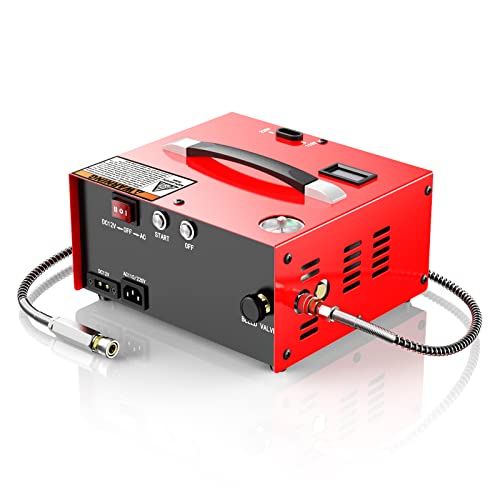 GX PUMP CS1-I Portable PCP Air Compressor |
7.8/10 | Buy | |
 California Air Tools 20020 Ultra-Quiet 2.0 HP |
7.8/10 | Buy |
Ipflin 160 PSI Portable Tire Inflator and Air
The Ipflin portable air compressor provides up to 160 PSI and 30 L/min airflow with a built-in 9600mAh battery and 12V DC vehicle backup. It is an ideal emergency inflator for motorists, garage DIYers, and cyclists who need quick tire pressure adjustments without hauling a heavy air tank.
Pros
- True dual-power flexibility allows cordless battery operation or direct 12V DC automotive corded power during roadside emergencies
- High 160 PSI maximum pressure rating handles high-pressure bike tires, trailer tires, and passenger vehicle inflation
- Automatic shutoff system prevents over-inflation by stopping airflow as soon as the preset pressure target is reached
- Built-in 9600mAh battery eliminates the need for separate external power tool batteries or standalone chargers
Cons
- High-pressure tire inflator design is strictly intended for inflation and cannot operate pneumatic tools like brad nailers or air ratchets
- Cordless lithium-ion battery requires periodic top-off charging during storage to maintain emergency readiness
- Continuous inflation runtime is capped at 30 minutes before requiring a short cool-down period
Square D 9013FHG42J59M1X Pressure Switch
Engineered for two-stage air compressors, this heavy-duty switch manages operating pressures between 135 and 175 PSI. It provides dependable control with an integrated unloader valve and manual shut-off lever for single or three-phase setups.
Pros
- Supports flexible adjustment from 100 to 200 PSI
- Works on both single and three-phase wiring configurations
- Includes integrated unloader valve and manual control lever
- Standard 1/4-inch female NPT port fits common setups
Cons
- Single sensing port offers limited connection flexibility
- Manual lever requires direct physical access on the tank
AstroAI Dual Power Portable Tire Inflator
Designed for both home garages and roadside needs, this inflator operates on 120V AC and 12V DC power. It offers dual pressure modes with automatic shut-off, making it a dependable choice for standard vehicles and household inflatables.
Pros
- Runs on both home outlets and car sockets
- Dual modes handle tires and high-volume inflatables
- Accurate digital preset with automatic shut-off
- Lightweight and compact 2.6-pound design
- Built-in LED light aids emergency roadside repairs
Cons
- Not suitable for heavy-duty truck tires
- Continuous runtime capped at 15 minutes
A.I.FORCE 4-Pack Air Compressor Rubber Foot Pads
The A.I.FORCE 4-piece rubber isolator foot pad set provides durable, vibration-damping replacement feet for portable and shop air compressors. Featuring a 1-1/2-inch outer diameter, a 1/4-inch mounting hole, and built-in stainless-steel washers, this set stabilizes tanks and prevents walking on concrete floors.
Pros
- Integrated stainless-steel washer provides high clamping security without tearing the rubber
- Substantially reduces compressor creep and wandering on smooth garage surfaces
- Compatible with common OEM part numbers across major consumer compressor brands
- Dense rubber compound resists cracking and shop chemical exposure
Cons
- Mounting bolts, washers, and locknuts are not included in the package
- Limited to compressors with 1/4-inch mounting bolt holes unless drilled out
Nilight 250 PSI Digital Tire Inflator Gauge
Built with solid brass and steel components, this inflator combines pressure reading, inflation, and deflation up to 250 PSI. It serves vehicle owners and mechanics who already own an air compressor and need an accurate digital gauge.
Pros
- Accurate digital readout within 1 percent
- Durable brass and steel hardware
- Backlit LCD display for low light visibility
- Includes spare valve caps and accessories
Cons
- Air compressor must be purchased separately
- Supports Schrader valves only
BUNKER INDUST 12V Off-Road Air Compressor
The BUNKER INDUST 12V Air Compressor delivers a listed 12.36 CFM and up to 150 PSI through a heavy-duty dual-cylinder pump engineered for rapid truck and off-road tire inflation. Equipped with digital auto-stop pressure regulation and dual quick-connect couplers, it is a practical mobile pneumatic tool for 4x4 drivers, overland travelers, and fleet owners.
Pros
- High rated airflow of 12.36 CFM drastically cuts down airing-up time on large truck and off-road tires
- Digital auto-stop control automatically shuts down pump operation at the exact target pressure
- Dual-hose configuration with T-fitting facilitates simultaneous two-tire inflation to keep pressures balanced
- Heavy-duty Anderson-style plug ensures a secure, low-resistance connection to vehicle 12V power
- Alloy cylinders with cooling fins and cleanable intake filters offer solid protection in dusty trail environments
Cons
- Tankless direct-drive pump design is not built for sustained continuous-draw pneumatic shop tools like rotary sanders or impact wrenches
- Heavy 12V current draw requires a direct battery terminal connection and cannot operate from standard vehicle accessory sockets
- Alloy cylinder heads generate noticeable surface heat during prolonged high-pressure cycles, requiring careful handling around the cooling fins
I.E.E LF10A 26A 4-Port Pressure Switch
Built for heavy-duty shop setups, this switch assembly supports up to 26 amps across single or three-phase air compressor systems. It includes an integrated 0-200 PSI gauge and pop-off safety valve for a complete manifold replacement.
Pros
- Heavy-duty 26-amp rating suits demanding motor setups
- Comes with matched pressure gauge and relief valve
- Four-port design offers versatile accessory connections
- UL Listed and CSA certified for electrical safety
Cons
- NEMA 1 enclosure is restricted to indoor environments
- Factory set strictly for 145-175 PSI compressor cycles
GX PUMP CS1-I Portable PCP Air Compressor
The GX PUMP CS1-I is a specialized 4500 PSI oil-free high-pressure air compressor engineered specifically for PCP air rifles, air pistols, and paintball tanks. Featuring an integrated 110V/12V power transformer, automatic pressure shutoff, and forced-air fan cooling, it is an ideal portable filling solution for airgunners and target shooters wanting independence from commercial fill stations.
Pros
- Internal AC/DC transformer eliminates the hassle of packing heavy external converter bricks
- Reaches 4500 PSI without requiring external water hoses, buckets, or crankcase oil maintenance
- Preset auto-stop feature and 30-minute safety limit prevent overfilling and reduce user distraction
- Digital real-time temperature readout makes heat monitoring straightforward during fills
- Dual-power capability allows seamless operation from home wall outlets or vehicle batteries in the field
Cons
- Strictly designed for small airgun cylinders up to 0.5L to 0.6L, not for large multi-liter SCBA or scuba tanks
- Maximum continuous run temperature must not exceed 75 degrees Celsius, requiring cooldown breaks during warm weather
- Not compatible with conventional shop pneumatic tools like impact wrenches, paint sprayers, or nail guns
California Air Tools 20020 Ultra-Quiet 2.0 HP
The California Air Tools 20020 provides a 20-gallon air reserve powered by a low-RPM 2.0 HP motor, delivering 5.30 CFM at 90 PSI at an ultra-quiet 70 dB sound level. Featuring an oil-free dual-piston pump and a 14-amp draw on standard 110V power, it suits home garage hobbyists and woodworkers seeking quiet, dependable pneumatic volume.
Pros
- Quiet 70 dB acoustic rating makes indoor garage and residential basement operation comfortable without extreme ear fatigue
- Strong air delivery of 5.30 CFM at 90 PSI effortlessly handles finish nailers, impact wrenches, and common pneumatic garage tools
- Long-life dual-piston oil-free pump is rated for over 3,000 hours of operation with zero crankcase oil maintenance
- Low 14-amp draw is compatible with standard 110V household power under proper dedicated circuit conditions
- Vertical 20-gallon steel tank with no-flat wheels combines substantial air storage with a compact shop footprint
Cons
- At 114 pounds, loading this vertical compressor into a pickup truck bed or moving it upstairs requires two people
- Not intended for continuous-duty high-consumption tools like uninterrupted sandblasters or production rotary sanders
- The tall 45-inch vertical profile requires deliberate handling when rolling across uneven outdoor terrain
Readers working through this often check do you need teflon tape for air compressor fittings next.
Determining the Correct Air Compressor Size for Your Workload
Selecting the right air compressor begins with evaluating the specific pneumatic tools you intend to power, the volume of air those tools consume, and how continuously you run them. Tank capacity in gallons indicates how much pressurized air sits in reserve, but the true measure of working capability is the pump delivery rate measured in cubic feet per minute at 90 PSI. Buyers who prioritize tank volume over pump displacement often discover that their compressor cycles constantly, drops line pressure, and overheats. Understanding how flow volume, tank storage, electrical supply, and duty cycles interact allows you to size your machine accurately from the start.
Understanding CFM vs PSI: The Core Sizing Formula
Air tools require two distinct pneumatic measurements to operate correctly: pressure and volume. Operating pressure is measured in pounds per square inch, while flow volume is measured in cubic feet per minute. Most standard pneumatic equipment, from framing nailers to impact wrenches, is designed to run at approximately 90 PSI. Because pressure remains relatively standard across common tool categories, air delivery volume at 90 PSI serves as the primary benchmark for matching a pump to your workload.
To determine the necessary flow rate, identify the tool in your shop that consumes the highest volume of air. A reliable sizing rule is to multiply that tool continuous consumption rating by 1.25 or 1.5 to establish a safe operational buffer. This extra margin accounts for natural line friction, fitting restrictions, and slight pressure drops across your air hose. Sizing your compressor around your hungriest tool guarantees that every smaller tool in your inventory operates without disruption.
Tank Capacity and Usable Air Reserves: Gallons Explained
Tank capacity, measured in gallons, represents the storage buffer between the pump and your pneumatic tool. A larger tank does not produce more air on its own; instead, it stores pressurized air so the pump does not need to start up the moment you pull a trigger. When you operate a tool that demands more air volume than the pump displaces, the tool draws directly from this stored reserve. Once tank pressure drops to the factory cut-in setting, the motor engages to replenish the lost volume.
Compact tanks ranging from 1 to 6 gallons excel in portability for framing nailers, tire top-offs, and general jobsite trim work. Mid-sized tanks holding between 10 and 30 gallons serve as versatile garage workhorses. Units like the California Air Tools 20020 provide a 20-gallon steel reservoir that cushions against sudden pressure drops during automotive repair work. This volume supports intermittent use of half-inch impact wrenches and pneumatic ratchets while preventing erratic motor cycling.
Continuous Demand vs Intermittent Firing Profiles
Pneumatic equipment falls into two operational categories: intermittent tools and continuous tools. Intermittent tools consume air in brief, localized pulses followed by pauses while the operator repositions workpieces. Fasteners, framing guns, finish nailers, and grease guns operate on this intermittent profile. Because the demand is non-continuous, the compressor pump has ample time during pauses to refill the receiver tank back to cut-out pressure.
Continuous tools consume an unbroken flow of pressurized air without built-in rest periods. Rotary sanders, orbital sanders, HVLP paint spray guns, and needle scalers require uninterrupted volume that exhausts small receiver tanks within thirty seconds. Most consumer and prosumer electric compressors feature a duty cycle rating between 50 percent and 70 percent, meaning they must rest periodically to dissipate heat. Running a compressor continuously beyond its rated duty cycle leads to thermal overload shutdowns, valve plate fatigue, and premature piston seal wear.
Motor Horsepower and Electrical Circuit Requirements
Horsepower ratings on consumer compressors have historically suffered from inflated marketing claims. Labels frequently tout peak or surge horsepower, which represents momentary output before motor stall rather than continuous operating power. When sizing a machine, focus on true continuous running horsepower and electrical amperage draw. A standard residential 120-volt, 15-amp branch circuit can reliably sustain an electric motor producing approximately 1.5 to 2.0 continuous running horsepower under full compression load.
The California Air Tools 20020 demonstrates balanced electrical engineering by pairing a true 2.0 horsepower motor with an operating draw of only 14 amps. By running at a low motor speed of 1680 RPM, it delivers 5.30 CFM at 90 PSI while remaining compatible with standard 110-volt household outlets. Compressors demand significant electrical current during startup, making light-duty extension cords a major hazard for nuisance breaker trips. Connecting the machine directly to a dedicated wall receptacle and using longer air hoses prevents severe voltage drops.
Single-Stage vs Two-Stage Compression Mechanics
Compressor pumps compress ambient atmospheric air using single-stage or two-stage mechanical architectures. Single-stage compressors draw atmospheric air directly into the cylinder and compress it to final tank pressure in a single piston stroke. These pumps typically produce maximum cutoff pressures between 125 and 150 PSI. Single-stage configurations are standard among portable jobsite units, inflators, and mid-sized garage compressors because they offer lightweight, cost-effective performance for general pneumatic tasks.
Two-stage compressors compress air sequentially across two distinct cylinders, routing air through an intercooler tube between stages to boost volumetric efficiency. Managing these high storage pressures requires robust electrical switching controls like the Square D Pumptrol pressure switch. The Square D unit is designed for two-stage compressors operating with a factory preset cut-in of 135 PSI and a cut-out of 175 PSI. Similarly, a heavy-duty control switch like the 26-amp four-port pressure switch provides the electrical capacity needed for single or three-phase setups.
A closely related question is covered in how often should you drain your air compressor, which may help alongside this section.
Oil-Free vs Oil-Lubricated Pumps: Lifespan and Noise
The internal lubrication design of a compressor pump directly influences its maintenance requirements, operating volume, and air purity. Modern oil-free compressors utilize dual-piston designs equipped with Teflon-coated piston rings and precision cylinders. These pumps require zero lubricating oil, eliminating the risk of oil mist passing through air lines into sensitive automotive paint or woodworking finishes. They also start reliably in sub-freezing temperatures because there is no thick crankcase oil to create drag on cold motor components.
Oil-lubricated compressors utilize cast-iron cylinders and splash-lubricated crankshafts that excel in heavy duty-cycle environments where continuous friction generates heat. However, noise production represents a major factor when sizing a compressor for indoor or attached garage spaces. Traditional oil-free pancake units utilize high-RPM universal motors that scream at 80 to 85 decibels or higher. Low-RPM dual-piston designs, such as the California Air Tools 20020 operating at only 70 decibels, dramatically reduce acoustic disruption, allowing normal conversation while working.
Portable 12V and Specialty High-Pressure Systems
Not every compressed air task requires a heavy steel receiver tank or household alternating current. For mobile tire maintenance, emergency roadside repair, and trail recovery, dedicated 12-volt inflators provide efficient, compact airflow. The BUNKER INDUST 12V Air Compressor features dual alloy cylinders capable of delivering up to 12.36 CFM and 150 PSI. Powered through an Anderson-style plug connected directly to a vehicle battery, it rapidly inflates large off-road tires without the bulk of a stationary garage reservoir.
Dual-power inflators like the AstroAI Tire Inflator operate on either 12V direct current or 120V household current, handling tires and high-volume inflatables with equal ease. Cordless units like the Ipflin 160 PSI Tire Inflator feature an integrated 9600mAh battery for compact emergency top-offs anywhere. Meanwhile, specialty applications like pre-charged pneumatic air rifles require pressures up to 4500 PSI. The GX PUMP CS1-I PCP Air Compressor fulfills this role with an oil-free, fan-cooled design powered by 12V, 110V, or 220V power sources.
Manifolds, Pressure Switches, and Vibration Isolation
An air compressor system relies on precision control components to safely direct and monitor pressurized air. The pressure switch coordinates motor cycling, while an integrated unloader valve exhausts trapped air off the pump heads when the motor stops. This mechanical pressure release ensures the electric motor does not have to start against high backpressure during its next cycle. Control assemblies also incorporate pop-off safety relief valves designed to release automatically if internal pressure exceeds safe thresholds.
Accurate delivery pressure is monitored at the tool end using dedicated gauges and regulators. When inflating vehicle tires or managing sensitive pneumatic equipment, a specialized tool like the Nilight Digital Tire Inflator Pressure Gauge provides precise digital readouts up to 250 PSI. Furthermore, reciprocating compressor pistons generate mechanical pulses that can cause machines to walk across smooth concrete floors. Installing heavy-duty isolators like the A.I.FORCE Rubber Foot Pads cushions the frame, absorbs vibration harmonics, and dampens low-frequency resonance.
Moisture Management and Tank Longevity
Compressing atmospheric air concentrates ambient moisture inside the receiver tank. As pressurized air cools against the steel tank walls, water vapor condenses and pools at the bottom of the vessel. If left unaddressed, standing water corrodes the internal steel lining, weakens tank welds, and eventually causes pinhole leaks. Moisture also travels downstream through pneumatic hoses, washing away factory lubricants inside air tools and causing water spotting in paint finishes.
Routine moisture purging is mandatory to preserve tank structural integrity and ensure clean air delivery. Every receiver tank features a bottom drain valve, typically configured as a threaded thumb petcock or a quarter-turn brass ball valve. Threaded petcocks can be stiff and awkward to turn, often discouraging users from performing daily maintenance. Upgrading to an accessible quarter-turn ball valve simplifies the draining routine, allowing you to expel accumulated condensation and sediment with a quick flick of the wrist after every session.
Practical Sizing Checklist for Common Workloads
Matching your compressor purchase to your primary application eliminates guesswork and prevents costly equipment mismatches. For basic household tire inflation, sports balls, and cleaning dust off workbenches, a compact 12V portable inflator or a 1-gallon to 3-gallon handheld compressor provides sufficient performance. Finish carpenters and trim installers operating brad nailers, pin nailers, and small crown staplers will find optimal balance in a quiet 2-gallon to 6-gallon pancake or twin-stack unit delivering 2.0 to 2.8 CFM at 90 PSI.
General automotive mechanics and active home hobbyists should target a 20-gallon to 30-gallon compressor delivering 5.0 to 6.5 CFM at 90 PSI. This capacity comfortably powers half-inch impact guns for tire rotations, air ratchets for engine tear-downs, and paint touch-up guns without continuous motor stalling. Demanding trade operations involving continuous sanding or media blasting require a stationary 60-gallon or 80-gallon two-stage system delivering 12 to 18 CFM at 90 PSI. Sizing your system according to continuous air demand protects both your tools and your compressor pump.
Ultimately, selecting the best compressor size comes down to respecting the balance between air tool consumption and pump displacement. Prioritizing sustained CFM at 90 PSI over misleading peak horsepower claims ensures your pneumatic tools run at their intended power ratings. Combine that adequate flow with a tank reserve tailored to your tool duty cycle, and you will maintain steady pressure across every project. Careful sizing eliminates frustrating pressure drops, prevents electrical breaker trips, and provides reliable pneumatic power for years to come.
Readers working through this often check how often should i drain my air compressor next.
About the author
Clint DeBoer is an experienced tool-industry specialist with decades of involvement in technical media, hands-on product evaluation, and testing methodology. His focus on performance, practical usability, and data-driven comparisons makes his expertise highly relevant to professional air compressors, pneumatic tools, and workshop equipment.