
What Makes an Air Compressor Quiet: Practical Guide for 2026
Learn what makes an air compressor quiet in October 2026 with this guide to low-RPM induction motors, dual pistons, and noise reduction.
 By Bob Beacham
Updated October 8, 2026
By Bob Beacham
Updated October 8, 2026

Operating a traditional pneumatic power system in an enclosed garage or basement often creates intense acoustic strain that disrupts an entire household. Standard universal motors spin at high speeds while generating severe mechanical clatter and exhaust pulses that easily exceed 80 decibels. Learning what makes an air compressor quiet helps woodworkers, mechanics, and homeowners select reliable equipment without enduring constant ear fatigue. Modern low-noise machinery relies on multi-piston configurations, low-speed motor designs, and specialized acoustic dampening to reduce sound down to 60 dBA or lower. Reviewing modern oilless air compressor mechanics reveals how updated pump assemblies produce steady air pressure without the deafening racket of older designs.
Low-noise pneumatic tools and quiet compressors combine precision cylinder machining with high-grade intake mufflers to suppress harsh operational vibrations. When a machine operates at sound levels comparable to a typical indoor conversation, trim carpenters can install molding and hobbyists can inflate vehicle tires late at night without disturbance. Finding the right compressor requires balancing low decibel ratings against necessary air delivery output, tank recovery times, and electrical circuit demands. Evaluating how quiet pump technology manages heat and airflow allows buyers to invest in dependable pneumatic power for sound-sensitive work environments.
| Award | Product | ACR Score About ACR ScoreThe ACR Score is our own rating from 0 to 10, based on performance, design and build, ease of use, and value. It reflects independent research and is never influenced by manufacturers, retailers, or affiliate commissions. Learn more › | |
|---|---|---|---|
| Best Overall |
Baococo 10-Gallon 2HP Quiet Air Compressor
|
9.2/10 | Buy |
| Best Premium |
 Stealth SAQ-1234 2-Gallon Air Compressor
|
9.2/10 | Buy |
| Best Value |
 Limodot 8-Gallon Quiet Air Compressor
|
9.1/10 | Buy |
 Metabo HPT EC28M Quiet Air Compressor
|
9.1/10 | Buy | |
| Best Budget |
 OlarHike Portable Tire Inflator Air Compressor
|
8.8/10 | Buy |
 Metabo HPT 6-Gallon Pancake Air Compressor Review
|
8.6/10 | Buy | |
 RyanTek 15-Gallon 2HP Air Compressor
|
8.6/10 | Buy | |
 AstroAI AIRUN H 12V DC Portable Air Compressor
|
8.4/10 | Buy | |
 VELPAX 2.4-Gallon Quiet Air Compressor
|
8.1/10 | Buy | |
 AstroAI L7 Cordless Tire Inflator Portable Air
|
8.0/10 | Buy |
Baococo 10-Gallon 2HP Quiet Air Compressor
Equipped with a 2HP copper-wound motor and a 10-gallon steel tank, this Baococo compressor runs at a modest 70 decibels. Its oil-free operation, rapid refill cycle, and wheeled base make it well suited for home garages and light workshop duties.
Pros
- Quiet 70dB operation suits indoor workspaces
- Fast 40-second tank pressure recovery
- Oil-free pump eliminates routine oil changes
- Dual couplers support multi-tool setups
- Wheels and handle provide smooth mobility
Cons
- 115 PSI maximum pressure limits heavy-duty pneumatic tools
- Ten-gallon tank requires noticeable floor storage space
Stealth SAQ-1234 2-Gallon Air Compressor
Operating at under 60 decibels, this compact unit provides exceptionally quiet performance for garage DIY tasks, brad nailing, and tire inflation. Its oil-free motor reaches up to 125 PSI while keeping routine maintenance to a minimum.
Pros
- Quiet operation suitable for indoor workspaces
- Maintenance-free oil-free pump design
- Durable steel tank with rubber vibration dampening
- Reliable pressure recovery for intermittent nailing
Cons
- Relatively heavy to carry at nearly 42 pounds
- Small two-gallon tank limits continuous tool use
- Modest 1.8 CFM flow rate at 90 PSI
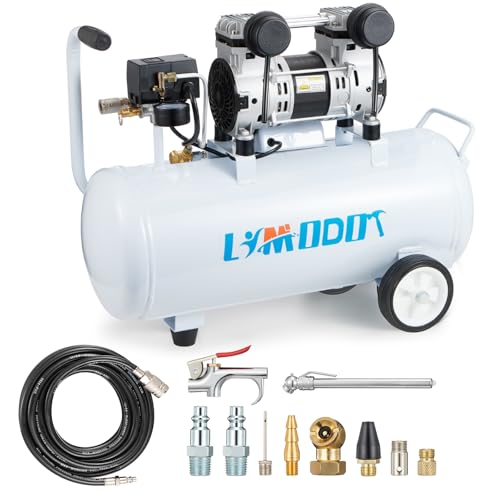
Limodot 8-Gallon Quiet Air Compressor
Limodot pairs an 8-gallon capacity with a quiet 68-decibel motor, keeping noise disruption low during indoor trim or workshop jobs. Delivering 2.8 CFM at 90 PSI alongside a quick 30-second recovery time, it provides steady airflow for DIY pneumatic tools without messy oil maintenance.
Pros
- Low 68 dB output prevents loud workshop disruption
- Fast 30-second pressure recovery keeps projects moving
- Oil-free pump eliminates messy oil changes
- Comprehensive 11-piece accessory kit included out of the box
- Integrated wheels make moving the 8-gallon tank easy
Cons
- 2.8 CFM output limits high-demand continuous tools
- Included PVC hose is stiffer than rubber alternatives
Metabo HPT EC28M Quiet Air Compressor
Operating at an ultra-quiet 59 dB, the Metabo HPT EC28M 1-gallon oil-free air compressor provides low-noise pneumatic air power in a compact 25.2-pound roll-cage frame. It is an ideal portable match for trim carpenters, punch-list contractors, and residential DIYers needing peaceful indoor fastening.
Pros
- Remarkably quiet 59 dB operation makes it well-suited for occupied residential job sites
- Lightweight 25.2-pound weight and ergonomic rubber grip make carrying up stairs straightforward
- Sturdy steel roll cage provides reliable physical protection around gauges and controls
- Oil-free pump mechanism eliminates pump lubrication maintenance and avoids messy oil leaks
- Universal quick-connect coupler simplifies tool connections across standard pneumatic lines
Cons
- Compact 1-gallon tank capacity is intended for intermittent fastening rather than continuous air tools
- Small air storage volume causes frequent motor cycling during rapid nailing sequences
- Bare-tool configuration does not include an air hose or pneumatic finish nailers
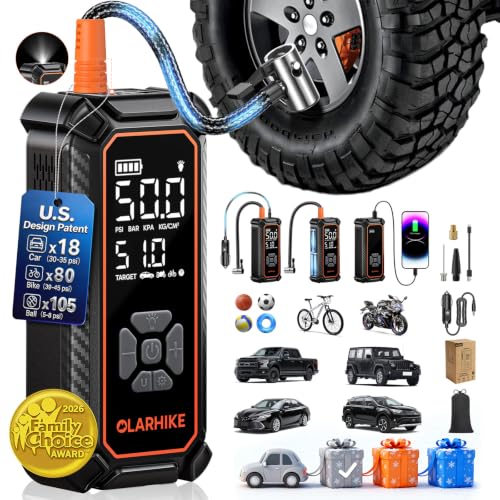
OlarHike Portable Tire Inflator Air Compressor
The OlarHike Portable Tire Inflator combines dual-power versatility via a 12V DC vehicle plug or built-in rechargeable battery with an automatic shut-off digital display. It provides dependable roadside tire top-offs and inflation for passenger cars, crossovers, motorcycles, and bicycles.
Pros
- Dual-power design allows cordless field operation or continuous power through any standard vehicle 12V DC port
- Automatic shut-off technology stops the motor precisely at preset pressure to prevent over-inflation
- Integrated 6000mAh battery reserve doubles as an emergency phone charger and includes an LED work light
- Pocket-sized footprint weighs well under two pounds for convenient transport in center consoles or backpacks
Cons
- Maximum vehicle pressure rating of 51 PSI is not suitable for heavy-duty commercial trucks, RVs, or high-pressure trailer tires
- Compact tankless inflator mechanism cannot power workshop pneumatic tools such as nail guns or air ratchets
- Recharging requires a standard 5V 2A or 5V 3A adapter and is not compatible with high-wattage fast chargers
Metabo HPT 6-Gallon Pancake Air Compressor Review
The Metabo HPT EC711S is a portable 6-gallon pancake air compressor delivering 2.8 CFM at 90 PSI with a 165 PSI tank ceiling and an operating sound level of 73 dB. With its quick 46-second recovery cycle and dual quick couplers, it is an excellent choice for finish carpenters, punch-list contractors, and DIYers running pneumatic nailers.
Pros
- 73 dB operational sound rating is substantially quieter than standard job-site pancake units
- 165 PSI maximum pressure provides ample air storage with a swift 46-second recovery cycle
- Two 1/4-inch universal quick couplers support multi-tool setups right out of the box
- Sturdy steel roll cage protects gauges and the manifold assembly against knocks and drops
- Oil-free 1.0 HP motor ensures low maintenance and reliable cold-weather motor startup
Cons
- At 38.5 lbs, it is slightly heavier than ultra-compact 1-to-3-gallon trim compressors
- Airflow of 2.8 CFM at 90 PSI is designed for intermittent fastening, not continuous rotary tools or paint sprayers
- Bare-tool configuration means air hoses and pneumatic fastening tools must be purchased separately
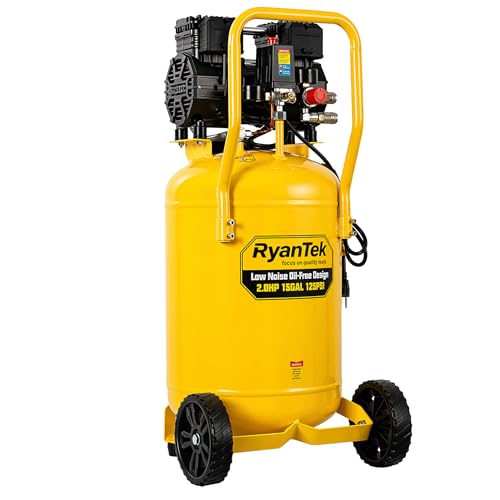
RyanTek 15-Gallon 2HP Air Compressor
Built for garage workshops and indoor tasks, this vertical compressor combines a quiet 66 dBA dual-cylinder motor with a spacious 15-gallon tank. It supplies a dependable 4.5 CFM at 90 PSI for continuous nailing, spraying, and inflation while conserving floor space.
Pros
- Quiet 66 dBA operation suitable for indoor spaces
- Generous 4.5 CFM output at 90 PSI
- Compact vertical tank saves workshop floor space
- Maintenance-free oil-free pump design
- Integrated wheels make rolling transport straightforward
Cons
- Heavy at 68.3 pounds to lift manually
- Maximum pressure caps at 125 PSI
AstroAI AIRUN H 12V DC Portable Air Compressor
The AstroAI AIRUN H is a compact 12V DC tire inflator delivering up to 35 L/min airflow with automatic shut-off and digital pressure presets. It is an ideal portable emergency compressor for drivers, commuters, and garage hobbyists seeking fast tire top-offs.
Pros
- Automatic shut-off stops pumping reliably once target PSI is reached
- High-airflow 120W motor provides rapid top-offs for daily driver tires
- Long 9.84-foot power cord reaches all passenger vehicle wheels with ease
- Bright built-in LED flashlight and backlit display assist during night repairs
- Lightweight 2.2-pound form factor stores neatly in glove boxes and trunks
Cons
- Requires a 12V DC vehicle outlet and does not include a 120V AC household plug
- Mandates a 10-minute cool-down interval after 15 minutes of continuous operation
- Not intended for high-volume inflatables like large pool floats or air mattresses
VELPAX 2.4-Gallon Quiet Air Compressor
Operating at roughly 60 decibels, this portable compressor provides steady air pressure for garage tasks, tire inflation, and trim carpentry without excessive noise. Its oil-free 1.5 HP motor keeps routine upkeep minimal while the integrated handle makes transport between work areas easy.
Pros
- Very quiet operation at roughly 60 dB
- Maintenance-free oil-less pump design
- Compact build with convenient carry handle
- Integrated overload protection and safety release valve
Cons
- Small 2.4-gallon tank limits continuous high-demand tool use
- Modest 115 PSI ceiling restricts heavy industrial applications
AstroAI L7 Cordless Tire Inflator Portable Air
The AstroAI L7 is a lightweight, handheld cordless air compressor delivering up to 150 PSI with an integrated 4000mAh rechargeable battery and precise auto-shutoff. It provides dependable, pocket-sized inflation performance for motorists, cyclists, and DIYers needing quick roadside tire top-offs.
Pros
- Weighs only 0.96 pounds for effortless storage in vehicle consoles, toolbags, or cycling packs
- High-speed digital sensor samples tire pressure at 200 times per second to prevent over-inflation
- Internal 4000mAh battery provides cordless freedom without tangling 12V cigarette lighter cords
- Versatile secondary utility as an emergency LED flashlight and portable USB power bank
Cons
- Not intended for heavy-duty truck tires or commercial tires larger than 25 inches in diameter
- Duty cycle requires allowing the unit to cool for 10 minutes after 15 minutes of continuous run time
- Tankless micro-compressor design cannot power workshop pneumatic air tools
The Engineering and Mechanics Behind Ultra-Quiet Air Compressors
Ultra-quiet air compressors achieve operating sound levels between 59 dBA and 70 dBA through deliberate mechanical engineering choices rather than simple cosmetic insulation. Manufacturers eliminate harsh clatter by combining low-speed induction motors, dual-cylinder pump architecture, specialized intake silencers, and heavy-duty vibration isolators. Standard jobsite compressors frequently register 80 dBA or higher, which can quickly cause operator fatigue and interrupt nearby household activities. Understanding the specific components that suppress compression noise helps buyers select equipment that delivers adequate pneumatic pressure while maintaining a peaceful working environment.
Motor Speed and Low-RPM Induction Engineering
Electric motor speed serves as the primary contributor to pneumatic operational noise. Traditional high-output portable compressors rely on universal motors spinning at 3,400 RPM or faster to maximize pump displacement from a small, lightweight frame. In contrast, ultra-quiet designs frequently employ four-pole induction motors engineered to operate at approximately 1,700 to 1,750 RPM. Halving the rotational speed dramatically lowers the frequency and mechanical volume generated by rotating internal components. This lower operational speed also reduces rotational wear on bearings and minimizes piston friction inside the compression sleeves.
Induction motors produce a low, steady hum rather than the piercing, high-pitched scream typical of high-speed universal brush motors. For example, machines like the Limodot 8-gallon air compressor utilize an induction motor running at 3,400 RPM engineered for smooth power delivery at 68 dB. The electrical windings in quality motors use dense copper wiring that maintains consistent torque across each compression cycle. Smooth torque delivery prevents sudden rotational stutter as the pump pushes against rising internal tank pressure. Because the motor operates without carbon brush friction, it eliminates high-frequency electrical arcing noise as well.
Dual-Piston Pump Architecture and Opposed Cylinders
Pump cylinder arrangement directly influences both air output and mechanical noise generation. Traditional loud compressors often employ a single piston that drives downward with immense force during each compression stroke. That asymmetrical motion produces intense rocking vibrations that reverberate through the entire pump housing and mounting plate. Quiet machines generally implement a dual-piston or twin-cylinder layout with pistons arranged in opposed or balanced positions. As one piston ascends to compress air, the opposing piston descends to draw in atmospheric air, creating balanced rotational counterweights.
This balanced dual-piston architecture spreads the mechanical workload evenly across the crankshaft. The RyanTek 15-gallon air compressor demonstrates this twin-cylinder approach, delivering 4.5 CFM at 90 PSI while generating only 66 dBA. Spreading displacement across two cylinders allows each piston stroke to be shorter and smoother. Smaller piston diameters require less kinetic impact at top dead center, softening the mechanical knock of the connecting rods. This balanced kinetic movement prevents harmonic vibration from transferring into surrounding framework.
Intake Air Silencing and Patented Flow Channels
A significant portion of operational noise comes from atmospheric air rushing violently into the pump cylinders. Rapid valve cycling creates pulsating sound waves as atmospheric air rushes through intake ports to fill the vacuum. Without proper dampening, these intake pulses create an aggressive suction roar that echoes across an enclosed room. Dedicated quiet compressors combat this problem by utilizing specialized intake silencers and internal flow channels. These silencers incorporate internal baffles and porous acoustic foam that absorb sound waves before air enters the compression chamber.
Advanced silent systems, such as the Baococo 10-gallon compressor, feature precision-engineered air valves alongside patented intake mufflers to limit sound output to approximately 70 dB. These specialized intake mufflers force incoming air through winding acoustic chambers that cancel out high-amplitude pressure waves. By smoothing the airflow velocity, the muffler prevents turbulent eddies that generate whistling and snapping frequencies. Screw-mounted air filter housings also prevent loose components from vibrating or leaking unfiltered sound. Maintaining clean intake filter elements ensures that incoming air moves freely without forcing the valves to chatter under restricted suction.
Vibration Isolation, Rubber Mounts, and Tank Resonance
A steel air receiver tank acts much like an acoustic drum when mechanical energy passes into its shell. If a vibrating pump assembly bolts directly to a metal tank, the hollow vessel amplifies the mechanical pulses into an echoing drone. Manufacturers of quiet systems isolate the pump and motor assembly using heavy-duty elastomeric rubber bushings. These isolators decouple the moving mechanical components from the rigid steel reservoir below. By absorbing kinetic energy at the mounting brackets, the isolators prevent the tank walls from resonating.
External contact points also play a critical role in preventing secondary workshop vibrations. The Stealth 2-gallon air compressor utilizes thick rubber-reinforced bases and handles to isolate operating vibration, maintaining noise levels below 60 dB. Similarly, the Metabo HPT EC28M 1-gallon model incorporates a protective steel roll cage fitted with wide rubber feet to prevent buzzing against concrete floors. Without sturdy rubber foot pads, a compressor can skid across a hard shop surface and transmit vibration directly into the building structure. Heavy rubber dampening absorbs low-frequency thumping before it travels into floor joists or workbench surfaces.
Decibel Scale Realities and Workshop Noise Perception
Decibel ratings follow a logarithmic scale, meaning small numerical differences represent substantial changes in perceived sound pressure. An increase of 10 decibels represents a tenfold increase in acoustic sound energy and sounds roughly twice as loud to human ears. A conventional pancake compressor operating at 80 dBA produces roughly four times the perceived volume of a quiet model operating at 60 dBA. In an enclosed garage or basement, this difference marks the line between needing hearing protection and speaking at normal vocal levels. Understanding this logarithmic scale prevents buyers from underestimating the acoustic impact of a few decibels.
Comparing equipment ratings highlights how quiet engineering transforms indoor work environments. The Metabo HPT EC28M operates at an ultra-low 59 dB, allowing normal conversations to occur alongside the cycling pump. In comparison, the Metabo HPT EC711S pancake compressor operates at 73 dB, which is notably quieter than older 82 dB contractor units but still noticeable in close quarters. Machines running at 60 dB, such as the VELPAX 2.4-gallon model, blend easily into background workshop activity without disturbing family members inside an adjacent home. Selecting an appropriate decibel threshold depends on whether the equipment runs in an open yard or a residential basement.
Balancing Sound Output with CFM Delivery and Air Volume
Lowering operating noise often introduces engineering compromises that buyers must carefully evaluate. Because quiet pumps frequently spin at reduced RPM, individual cylinders displace less air volume per minute than high-speed pumps of equivalent size. To compensate for lower rotational speeds, quiet machines must either employ larger dual cylinders or rely on extended pump cycles. Compact quiet compressors typically deliver between 1.5 and 2.8 CFM at 90 PSI, which suits intermittent tools like finish nailers, tire inflators, and airbrushes. However, continuous pneumatic tools like rotary sanders and paint sprayers demand considerably higher sustained CFM delivery.
When pneumatic tasks require sustained airflow, tank storage capacity becomes an essential buffer for low-noise pumps. Larger vessels allow quiet pumps to build up reserve pressure without cycling continuously during high-draw tasks. Users exploring extensive spray painting or continuous automotive air tools often benefit from reviewing larger workshop tank capacities to match high tool consumption. An 8-gallon or 15-gallon quiet compressor provides sufficient stored volume to support intermittent tool bursts without immediate pressure drops. Matching delivered CFM and tank volume to specific tool demands ensures the compressor maintains working pressure without overheating.
Compact 12-Volt and Battery Inflators: Portable Noise Considerations
Handheld tire inflators and mini compressors follow distinct acoustic principles compared to stationary shop machines. Devices like the AstroAI AIRUN H, OlarHike dual-power inflator, and AstroAI L7 utilize compact 12V DC or lithium-ion motors. Because these ultra-compact inflators lack room for heavy cast-iron cylinders or dual-piston assemblies, their miniature gearboxes produce a high-frequency buzzing sound. However, their small mechanical mass and lower overall wattage restrict total sound transmission to the immediate surrounding area. They operate without massive steel tanks that amplify acoustic reverberations.
Drivers and cyclists value these portable inflators primarily for roadside emergency speed and trunk convenience rather than whisper-quiet shop operation. Following practical guidelines for portable 12-volt air compressor operation ensures motorists inflate vehicle tires safely while managing device runtime. Portable 12-volt units feature automatic shut-off functions and digital gauges to finish tire top-offs rapidly, minimizing overall run time. Even though a compact inflator creates a noticeable mechanical buzz, its brief operating duration prevents acoustic fatigue. For quick tire maintenance and bicycle inflation, rapid inflation speed easily outweighs the need for low-decibel workshop silencing.
Heat Management and Friction-Resistant Oil-Free Materials
Compressing air naturally generates intense thermal energy that can degrade pump components and increase operational friction. In traditional compressors, excessive operating friction creates mechanical chatter and accelerates valve wear. Modern quiet oil-free compressors solve this issue by using Teflon-impregnated or PTFE composite piston rings paired with ceramic or polished aluminum cylinders. These slick, heat-resistant materials allow the piston to glide smoothly inside the cylinder bore without requiring oil lubrication. Reducing internal friction keeps mechanical sliding noise to an absolute minimum during full-pressure compression strokes.
Effective thermal dissipation also prevents internal components from warping or expanding unevenly under heavy duty cycles. Compressors such as the VELPAX 2.4-gallon unit integrate dedicated cooling fan systems to channel fresh air over the motor windings and cylinder heads. Lower operating temperatures protect internal reed valves from carbon build-up and fatigue, ensuring quiet valve seating over hundreds of running hours. High-temperature thermal overload switches also protect the motor windings from drawing excessive current if heat rises unexpectedly. Maintaining cool operating conditions directly supports both sound reduction and long-term mechanical reliability.
Maintenance Habits That Keep Compressors Operating Quietly
Even an exceptionally engineered quiet compressor can develop annoying rattles and elevated noise levels if routine maintenance is neglected. Over time, regular mechanical cycling can loosen frame bolts, manifold brackets, and hose coupler connections. Inspecting exterior fasteners periodically ensures that metal panels and tool cages do not buzz against each other during pump operation. In addition, checking the one-way tank check valve ensures backpressure does not leak back into the pump head upon shut-off. A properly functioning unloader valve releases head pressure cleanly without loud, prolonged hissing after the motor stops.
Daily condensation management represents another essential practice for preserving quiet, smooth operation. Compressing ambient air deposits moisture inside the steel storage tank, which must be drained regularly through the bottom drain valve. Allowing water to accumulate creates internal sloshing, reduces usable air volume, and promotes internal tank corrosion over time. Draining moisture after each work session keeps internal airflow clean and protects pneumatic tool mechanisms from corrosion. Keeping intake filters clean also ensures the pump motor does not strain or overheat, preserving smooth and quiet operation.
Practical Workspace Setup and Noise Control Strategies
Physical placement within a workshop significantly influences how sound waves travel through an enclosed building. Placing a quiet air compressor directly in a room corner creates an acoustic megaphone effect that amplifies low-frequency motor hum. Setting the machine on an anti-vibration rubber mat or a dense plywood platform dampens kinetic transfer into concrete slabs and wooden floors. Using longer air hoses allows users to position the compressor several feet away from the immediate work area. This distance provides additional acoustic separation while delivering consistent regulated air pressure directly to pneumatic tools.
Selecting between ultra-portable trim units and larger shop compressors ultimately depends on mobility needs and tool demand. Compact models like the Metabo HPT 1-gallon unit or Stealth 2-gallon compressor offer lightweight portability for indoor trim and cabinet installation. In contrast, larger 8-gallon to 15-gallon quiet compressors provide the sustained airflow needed for auto maintenance and workshop tasks. Investing in a low-RPM, dual-piston quiet compressor eliminates the harsh racket that historically characterized pneumatic power tools. By understanding the mechanical principles behind noise reduction, craftspeople can choose a capable pneumatic system that protects their hearing and enhances productivity.
About the author
Bob Beacham is an experienced tools and workshop writer with deep knowledge of power equipment, mechanical systems, and practical DIY applications. His coverage of air compressors, welding equipment, saws, and workshop tools helps translate technical specifications into useful guidance for homeowners and serious DIYers.