
What Is Scfm in Air Compressor: Sizing and Flow Guide for 2026
Understand what is scfm in air compressor systems for October 2026, and learn how standardized airflow ratings impact pneumatic tool performance.
 By Bob Beacham
Updated October 8, 2026
By Bob Beacham
Updated October 8, 2026
Operating pneumatic equipment efficiently requires matching tool air consumption directly with pump delivery output. When evaluating pump performance, understanding what is scfm in air compressor specifications reveals how much usable air volume a machine moves under standardized environmental conditions. Standard Cubic Feet per Minute measures compressed air delivery adjusted for specific temperature, atmospheric pressure, and relative humidity benchmarks. Many workshop mechanics and woodworkers discover that simply looking at tank size or peak horsepower causes tools like rotary sanders to stall unexpectedly. Learning how to read air compressor specifications provides clarity before connecting high-draw equipment to your system.
Delivering consistent pressure prevents frustration when switching between rapid-fire framing nailers and continuous paint spraying guns. Because ambient air density shifts with local temperature and elevation changes, SCFM establishes an objective baseline that eliminates guesswork across diverse workshop environments. Exploring versatile air compressor applications requires knowing whether your pump produces sufficient continuous flow or relies purely on stored tank reserves. Balancing delivered flow against tool consumption protects pump heads from thermal overload and ensures steady operation on demanding tasks.
| Award | Product | ACR Score About ACR ScoreThe ACR Score is our own rating from 0 to 10, based on performance, design and build, ease of use, and value. It reflects independent research and is never influenced by manufacturers, retailers, or affiliate commissions. Learn more › | |
|---|---|---|---|
| Best Overall |
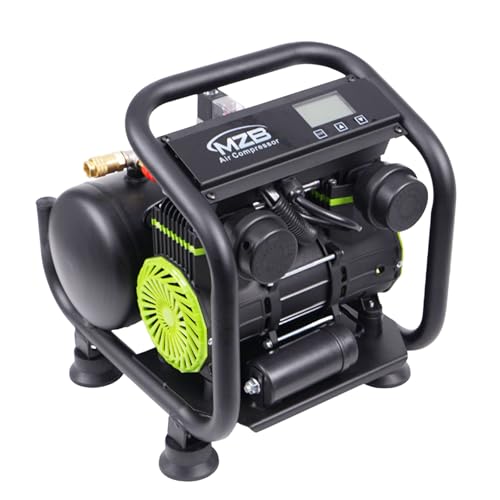
MZB MZB-900H-6 1.6-Gallon Air Compressor
|
9.2/10 | Buy |
| Best Value |
 California Air Tools 2010A 2-Gallon Compressor
|
9.1/10 | Buy |
| Best Premium |
 VEVOR 25-Gallon 200 PSI Air Compressor
|
9.1/10 | Buy |
| Best Budget |
 CRAFTSMAN 6-Gallon 150 PSI Portable Oil-Free
|
8.9/10 | Buy |
 VEVOR 60-Gallon Heavy-Duty Air Compressor
|
8.9/10 | Buy | |
 AAIN 6.3-Gallon 1.5HP Air Compressor
|
8.8/10 | Buy | |
 MZB MZB-1100H-50 13.2-Gallon Air Compressor
|
8.8/10 | Buy | |
 Klutch 20-Gallon Portable Air Compressor
|
8.4/10 | Buy | |
 VEVOR 12V Dual-Cylinder Air Compressor
|
8.1/10 | Buy | |
 VEVOR 14-Gallon 2HP Portable Air Compressor
|
8.0/10 | Buy |
MZB MZB-900H-6 1.6-Gallon Air Compressor
Built for trim carpentry and light pneumatic tasks, this compact MZB unit pairs a 1.6-gallon steel tank with an oil-free pump. It produces up to 115 PSI while keeping operating sound around 70 decibels.
Pros
- Low-maintenance oil-free pump design
- Moderate 70 dB operating sound level
- Compact footprint is convenient to transport
- Sturdy steel air tank construction
Cons
- Small 1.6-gallon capacity limits continuous air tool runtimes
- Modest maximum output pressure of 115 PSI
California Air Tools 2010A 2-Gallon Compressor
Operating at just 60 decibels, this compact unit delivers reliable airflow with minimal noise disruption. Its rust-free aluminum tank and oil-free dual-piston pump make it well suited for indoor trim work and noise-sensitive spaces.
Pros
- Exceptionally quiet operation at only 60 decibels
- Lightweight rust-free aluminum tank design
- Low-maintenance oil-free dual-piston system
- Quick 14-second recovery time between cycles
Cons
- Modest 2-gallon tank limits continuous heavy tool use
- 120 PSI maximum pressure is below heavy-duty standards
- Air output is insufficient for sustained high-demand air tools
VEVOR 25-Gallon 200 PSI Air Compressor
Built with a 2 HP belt-driven motor and a 25-gallon steel tank, this VEVOR compressor delivers 5.5 SCFM at 90 PSI with a 200 PSI maximum pressure. Its dual air outlets and wheeled design make it well-suited for powering multiple pneumatic tools across workshop and garage projects.
Pros
- High 200 PSI maximum operating pressure
- Dual air outlets for simultaneous tool operation
- Durable powder-coated carbon steel tank
- Wheels and pull handle ease transport
Cons
- Oil-lubricated design requires regular fluid checks
- Large 25-gallon footprint demands ample floor space
CRAFTSMAN 6-Gallon 150 PSI Portable Oil-Free
The CRAFTSMAN 6-Gallon Pancake Air Compressor delivers 2.6 SCFM at 90 PSI with a 150 PSI maximum tank pressure, providing dependable pneumatic power for trim nailing, tire inflation, and garage punch-list jobs. Built with a low-voltage startup motor and a manageable 30.8-pound frame, it suits DIY homeowners, finish carpenters, and mobile service technicians needing portable air supply.
Pros
- Factory dual quick-connect couplers allow two trim carpenters or nailers to connect to the manifold at the same time
- Low-voltage 1.0 HP motor starts reliably in colder weather and when running on standard 120V circuits
- Includes a 25-foot air hose out of the box so you can start working on trim or tires immediately
- Maintenance-free oil-free pump design keeps discharged air clean and eliminates the need for ongoing pump oil changes
Cons
- The 2.6 SCFM output at 90 PSI is insufficient for continuous-draw air tools such as HVLP paint sprayers, orbital sanders, or heavy pneumatic grinders
- Standard universal motor produces significant sound output that may require hearing protection when running indoors
- Manual drain valve requires regular reach-under access to purge moisture after every working session
VEVOR 60-Gallon Heavy-Duty Air Compressor
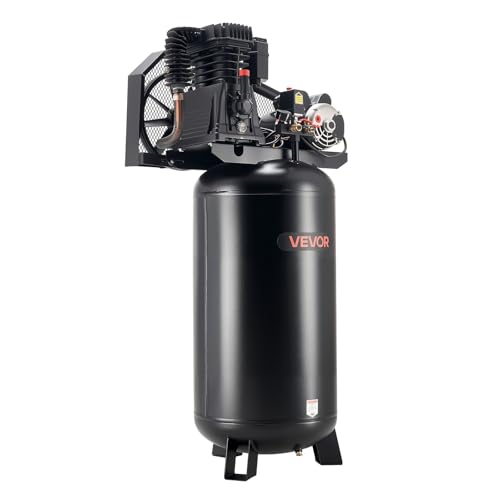
The VEVOR 60-Gallon Air Compressor delivers a rated 12 SCFM at 90 PSI with a 5 HP motor and a maximum pressure of 145 PSI, utilizing a belt-driven oil-lubricated pump on a vertical carbon steel tank. Powered by a 230V single-phase electrical connection, it provides serious air volume for auto mechanics, fabricators, and home workshop owners running air-demanding tools.
Pros
- Strong air delivery of 12 SCFM at 90 PSI handles demanding workshop pneumatic equipment without rapid pressure drop
- Large 60-gallon tank capacity creates an expansive pressurized reservoir for sustained tool use
- Belt-driven, oil-lubricated pump design offers smoother operation and longevity compared to direct-drive universal pumps
- Integrated oil sight mirror simplifies routine fluid checks to keep maintenance straightforward
- Dual air outlets enable two air hoses to operate without adding external splitters
Cons
- Substantial dry weight of nearly 236 pounds makes initial positioning and shop placement a multi-person task
- Requires a 230V single-phase power supply and arrives without an attached electrical plug, requiring hardwiring or custom plug installation
- Maximum pressure tops out at 145 PSI, which is lower than industrial two-stage systems that reach 175 PSI
AAIN 6.3-Gallon 1.5HP Air Compressor
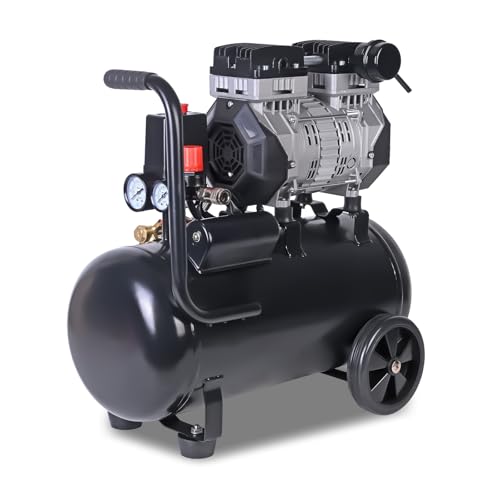
Delivering up to 6 CFM at 116 PSI, this unit fills its 6.3-gallon tank in under three minutes while running at an unobtrusive 70 dB. Its oil-free motor makes it a low-maintenance setup for garage tire inflation and light pneumatic chores.
Pros
- Quiet operation rated at only 70 dB
- Fast tank fill time under three minutes
- Oil-free pump eliminates messy maintenance
- Solid airflow delivery up to 6 CFM
Cons
- Maximum working pressure capped at 116 PSI
- Heavy to move around at 46.3 pounds
- Limited to short-duty runs with air tools
MZB MZB-1100H-50 13.2-Gallon Air Compressor
Designed for indoor workshops and residential garages, this compressor keeps operating noise down to a manageable 70 decibels. Its 13.2-gallon steel tank and wheeled frame suit DIY woodworkers, painters, and mechanics needing reliable airflow without regular pump maintenance.
Pros
- Quiet 70dB sound level ideal for indoor spaces
- Maintenance-free oil-free pump design
- Large 13.2-gallon durable steel tank
- Wheels and handle make transport manageable
Cons
- Hefty 72-pound weight makes vehicle loading difficult
- 115 PSI maximum pressure is modest for heavy-duty pneumatic tools
Klutch 20-Gallon Portable Air Compressor
Featuring a 2.0 HP 120V motor and a 20-gallon tank, the Klutch portable air compressor delivers a rated 4.2 SCFM at 90 PSI for versatile workshop air. Its oil-free pump and wheeled design make it a dependable choice for garage mechanics, woodworkers, and serious DIYers needing steady air storage.
Pros
- Generous 20-gallon air storage capacity provides a substantial buffer for intermittent shop tools
- Delivers a listed 4.2 SCFM at 90 PSI, outperforming smaller pancake compressors for workshop chores
- Oil-free pump design eliminates messy oil changes and allows clean, upright transport
- Rugged rubber wheels and built-in ergonomic handle make moving the 90-pound frame manageable
- Integrated thermal overload protection helps prevent motor burnout during demanding cycles
Cons
- Substantial 90-pound weight makes lifting into truck beds or carrying up stairs difficult without assistance
- Oil-free motor configurations generally produce noticeable operating noise compared to low-RPM lubricated units
- At 4.2 SCFM at 90 PSI, high-draw continuous air tools like sanders or grinders will require recovery pauses
VEVOR 12V Dual-Cylinder Air Compressor
The VEVOR 12V Dual-Cylinder Air Compressor delivers a manufacturer-rated 4.73 SCFM airflow and up to 150 PSI, driven by a 1HP motor for rapid off-road tire inflation and air locker operation. It serves truck owners, off-road enthusiasts, and mobile trail repair setups seeking high-volume 12V pneumatic power.
Pros
- Strong listed output of 4.73 SCFM significantly cuts down tire reinflation time after airing down on the trail
- Supplied differential lock wiring harness provides out-of-the-box compatibility with pneumatic air lockers
- Heavy-duty aluminum alloy housing dissipates heat effectively and resists physical trail vibrations
- Built-in thermal safety switch prevents motor damage at 230 degrees Fahrenheit
- Wide operational temperature threshold spanning -4 to 122 degrees Fahrenheit for dependable seasonal performance
Cons
- Substantial 19.07-pound dry weight requires secure tie-downs or rigid bracket mounting inside the vehicle
- High-draw 12V motor requires direct automotive battery connection and cannot run from standard accessory sockets
- Operates as a tankless compressor unit, requiring an auxiliary air tank if sustained pneumatic tool buffering is desired
VEVOR 14-Gallon 2HP Portable Air Compressor
Built for garage workshops, this vertical unit pairs a low-maintenance oil-free motor with a 14-gallon carbon steel tank. It delivers a steady 4.3 SCFM at 90 PSI, making it a reliable match for DIYers using air nailers, sprayers, and tire inflators.
Pros
- Oil-free pump requires minimal ongoing maintenance
- Generates 4.3 SCFM at 90 PSI for steady airflow
- Two wheels and handle ensure smooth mobility
- Durable 2.5 mm carbon steel tank resists corrosion
Cons
- Heavier build at 63 pounds to lift manually
- 125 PSI ceiling is limited to light-duty pneumatic tasks
Understanding SCFM and Airflow Dynamics in Compressed Air Systems
Standard Cubic Feet per Minute represents the true volume of air delivered by a compressor under fixed atmospheric conditions. While pressure measured in pounds per square inch dictates working force, airflow volume determines whether a pneumatic tool sustains continuous operation. Air tools starve and stall when pump output cannot replenish the volume consumed by their pneumatic motors. Understanding how manufacturers measure and report these ratings prevents frustrating equipment mismatches in home garages and busy workshops.
Defining Standard Cubic Feet per Minute and Baseline Conditions
Air changes its density and volume based on ambient temperature, barometric pressure, and atmospheric humidity. If pump output were measured on a freezing morning at sea level, the numbers would not match tests run on a humid afternoon at high elevation. Standard Cubic Feet per Minute resolves this inconsistency by establishing fixed reference conditions across the compressed air industry. Most engineering standards define this baseline at 14.7 pounds per square inch absolute pressure, 68 degrees Fahrenheit, and zero percent relative humidity.
Normalizing test environments to these parameters allows buyers to compare different compressors on an even playing field. A pump rated at 5.5 SCFM delivers a standardized mass of air equivalent to 5.5 cubic feet under those precise laboratory conditions. This measurement accounts for real-world environmental factors so you can anticipate how a machine performs in your workspace. Without a universal standard, comparing ratings between different manufacturers would lead to inaccurate expectations.
Distinguishing SCFM from CFM, ACFM, and Displacement Ratings
Reading compressor specification labels often reveals a confusing mix of airflow acronyms. General CFM refers to cubic feet per minute without referencing standard atmospheric conditions or working pressure. Actual CFM reflects the volume delivered at the discharge port under real-world operating temperature and elevation. In contrast, displacement CFM represents a theoretical calculation derived from cylinder bore, piston stroke, and pump speed.
Relying on displacement ratings can lead to severely undersized air systems. Displacement calculations ignore friction, clearance volume in the cylinder head, and air heating during compression. In practice, pumps lose fifteen to thirty percent of theoretical displacement due to mechanical and thermal inefficiencies. SCFM remains the most dependable metric because it measures delivered air after accounting for those operational losses.
The Impact of Operating Pressure on Delivered Air Volume
Compressor airflow ratings always specify a reference pressure, typically reported at 90 PSI or 40 PSI. As pressure inside the air tank rises, the pump piston faces increasing resistance with each stroke. This increased backpressure reduces volumetric efficiency and generates substantial heat in the cylinder head. Consequently, every air compressor delivers more volume at 40 PSI than it can deliver at 90 PSI.
The California Air Tools 2010A demonstrates this relationship clearly in its published specifications. Manufacturer information lists this ultra-quiet unit as delivering 3.10 CFM at 40 PSI, but flow drops to 2.20 CFM at 90 PSI. Low-pressure applications like blowguns and basic paint sprayers function well at 40 PSI. High-demand equipment like impact wrenches and nailers require 90 PSI, where available airflow naturally decreases.
Matching Continuous and Intermittent Tool Demand to Compressor Output
Pneumatic tools consume air in either intermittent bursts or continuous streams. Intermittent tools consume brief shots of air per cycle, making them easier to support with modest compressors. Finish nailers, staplers, and tire chucks require relatively small air volumes over an hour of work. In fact, learning about sizing an air compressor for nail guns shows that compact pancake units delivering 2.6 SCFM at 90 PSI easily keep up with finish carpentry.
Continuous tools present a much greater challenge because they demand uninterrupted airflow. Rotary sanders, die grinders, and HVLP spray guns consume between 6 and 15 SCFM during continuous operation. Pairing an undersized compressor with a continuous tool drains stored tank reserves within seconds, dropping pressure below operating thresholds. When pressure plummets, sanders lose speed and spray guns produce uneven atomization, damaging your work.
How Air Tank Reserve Differs from Active Pump Delivery
A widespread misunderstanding is assuming that a larger air receiver tank compensates for an undersized pump. An air tank functions only as a storage buffer, holding pressurized volume for sudden bursts of activity. The receiver itself produces no airflow; fresh air depends entirely on the motor and pump. While a large reservoir delays pressure drops, an undersized pump cannot restore air while continuous tools run.
Consider a tool consuming 8 SCFM at 90 PSI connected to a pump producing only 4.2 SCFM, such as the Klutch 20-gallon compressor. The tool runs normally until the air stored in the tank falls below the regulator threshold. Because the tool consumes air faster than the pump replaces it, work must stop while the compressor recharges the tank. Large tanks reduce motor cycling frequency on intermittent tools, but continuous work requires adequate pump SCFM.
Pump Architecture and Motor Horsepower Impact on Airflow
Pump mechanical design directly influences how much airflow an air compressor generates per minute. Many consumer compressors use direct-drive universal motors running at 3,400 RPM, producing noticeable noise and heat. Modern ultra-quiet compressors, such as the AAIN 6.3-gallon model, use twin-cylinder induction motors operating at lower rotational speeds to produce 5.5 to 6 CFM while running at 70 decibels. Lower operating speeds reduce wear and maintain volumetric efficiency over longer sessions.
Lubrication methods also affect sustained airflow capabilities during heavy use. Oil-free pumps utilize Teflon-lined cylinders and dual pistons, providing clean air for painting without fluid maintenance. However, oil-lubricated pumps, such as the belt-driven VEVOR 25-gallon model producing 5.5 SCFM at 90 PSI, utilize cast-iron cylinders that dissipate heat superiorly. Cast-iron construction resists thermal fatigue, allowing the pump to maintain consistent airflow during extended operating periods.
Single-Stage Versus Two-Stage Compression Performance
Air compressors utilize either single-stage or two-stage pump systems to generate working pressure. Single-stage compressors draw atmospheric air into a cylinder, compress it in one stroke, and send it into the tank. Units like the CRAFTSMAN 6-gallon pancake and VEVOR 14-gallon compressor use single-stage pumps suited for pressures between 125 and 150 PSI. These units deliver plenty of airflow for basic woodworking and automotive tire service.
Two-stage compressors use two cylinders of different sizes connected by a cooling tube. The first cylinder compresses air to an intermediate pressure before passing it through the intercooler. The second cylinder compresses the cooled, denser air to final pressures up to 175 PSI. Cooling between stages improves volumetric efficiency, allowing heavy-duty compressors like the VEVOR 60-gallon unit to supply 12 SCFM at 90 PSI for industrial production.
Flow Restrictions, Piping Losses, and Intake Maintenance
An air compressor cannot deliver its rated airflow if downstream plumbing restricts volume. Long runs of narrow 1/4-inch air hose cause significant friction and pressure drop before air reaches your tool. Switching to a 3/8-inch hose and high-flow couplers ensures that delivered SCFM reaches the pneumatic motor unhindered. Eliminating air leaks at quick connects also prevents wasting cubic feet of air every minute.
Intake filtration plays an equally critical role in sustaining rated airflow over time. As dust accumulates on the intake element, the pump cylinder must pull against vacuum restriction, reducing air intake per stroke. Regularly cleaning an air compressor filter restores free breathing and protects internal valve plates from abrasive debris. Clean intake filters keep pump temperatures manageable and prevent airflow volume from dropping during heavy use.
Calculating Duty Cycles to Prevent Thermal Overload
A compressor duty cycle defines how long the pump can run within a standard ten-minute period. Most consumer and light-commercial compressors feature a fifty to seventy percent duty cycle rating. A machine with a fifty percent duty cycle should run for no more than five minutes out of ten, resting the remaining time. Exceeding this rating causes excessive heat, warping reed valves and wearing piston seals prematurely.
Factoring duty cycle into your purchasing calculations prevents motor burnout. If an air sander requires 6 SCFM, buying a compressor rated for exactly 6 SCFM forces the pump to run non-stop. To stay within safe duty cycle limits, select a compressor that produces thirty to fifty percent more airflow than your tool requires. Proper sizing allows the motor to cycle off periodically, ensuring long service life without tripping thermal protectors.
Practical Steps for Sizing Your Workshop Air Supply
Selecting the right air compressor begins by cataloging the air consumption of every tool in your workspace. Identify the single tool that draws the highest continuous volume at 90 PSI. If two operators run tools simultaneously, add their individual requirements together to find your peak airflow baseline. Multiply that total baseline number by 1.25 to provide a comfortable buffer against line losses and unexpected demands.
Next, evaluate your available electrical circuits before finalizing an equipment choice. High-output workshop compressors producing over 10 SCFM often require dedicated 230-volt single-phase power. Smaller 120-volt portable units suit light framing, trim work, and basic garage repairs without demanding electrical upgrades. Balancing tool air demands against electrical supply and noise considerations guarantees a functional pneumatic workspace.
Daily Maintenance Practices That Protect Delivered Airflow
Consistent maintenance ensures that your air compressor continues delivering its rated SCFM year after year. Draining the air receiver daily through the bottom drain valve purges accumulated water condensation. Moisture takes up valuable storage volume inside the tank and accelerates internal rust that can ruin valve plates. Opening the drain valve while the tank holds slight pressure blows moisture and sludge out cleanly.
Inspecting drive belts, checking oil sight glasses, and verifying unloader valve function prevents sudden pressure drops. On oil-lubricated models, maintaining proper non-detergent oil levels prevents friction heat from dragging down motor performance. Depressurize the system before servicing fittings or tightening loose hose connections. Proactive care preserves motor efficiency and guarantees dependable airflow across every pneumatic project you tackle.
Understanding the true relationship between SCFM, operating pressure, and tool demand eliminates the frustration of stalled air tools and overworked pumps. Rather than focusing solely on tank gallons or peak horsepower marketing claims, prioritize verified delivered airflow at your working pressure. Selecting a compressor with adequate output and a suitable duty cycle gives your air tools the power they need for flawless results.
About the author
Bob Beacham is an experienced tools and workshop writer with deep knowledge of power equipment, mechanical systems, and practical DIY applications. His coverage of air compressors, welding equipment, saws, and workshop tools helps translate technical specifications into useful guidance for homeowners and serious DIYers.