
What Is Cfm in an Air Compressor: Practical Guide for 2026
What Is Cfm In An Air Compressor determines whether your pneumatic tools run smoothly. Learn CFM calculations, ratings, and tool demands for October 2026.
 By Kenny Koehler
Updated October 8, 2026
By Kenny Koehler
Updated October 8, 2026
Pneumatic tools quickly grind to a halt when an undersized air system starves them of pressurized volume. While many workshop owners focus strictly on maximum pressure, the actual volume of delivered air dictates whether a tool maintains torque or stalls mid-cut. Learning what is cfm in an air compressor gives you the exact measurement needed to match pneumatic power to demanding shop tasks. Without enough volume, even the highest pressure rating drops within seconds of pulling the trigger.
Operating continuous equipment like dual-action sanders or paint sprayers requires a continuous stream of compressed air rather than brief bursts. When you calculate pump output accurately, you avoid constant motor cycling and prevent circuit breakers from tripping during prolonged recovery cycles. Consulting an air compressor sizing guide for pneumatic tools helps clarify how individual tool ratings correspond to pump performance. Understanding your volume flow ensures your air tools perform reliably across every garage or jobsite project.
| Award | Product | ACR Score About ACR ScoreThe ACR Score is our own rating from 0 to 10, based on performance, design and build, ease of use, and value. It reflects independent research and is never influenced by manufacturers, retailers, or affiliate commissions. Learn more › | |
|---|---|---|---|
| Best Overall |
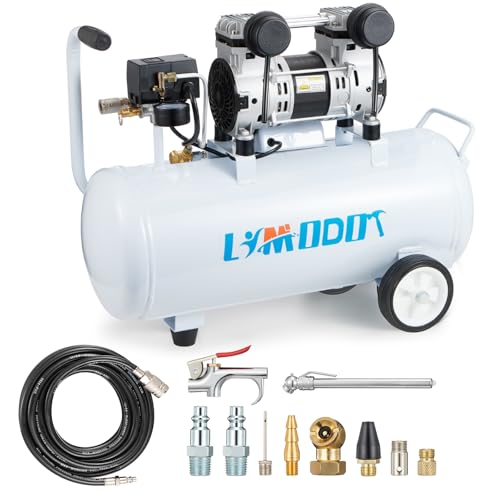
Limodot 8-Gallon Quiet Air Compressor
|
9.1/10 | Buy |
| Best Value |
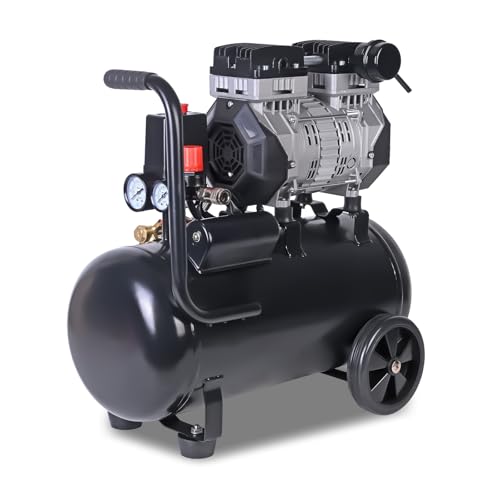 AAIN 6.3-Gallon 1.5HP Air Compressor
|
8.8/10 | Buy |
 ECOMAX 6-Gallon Pancake Air Compressor - 150 PSI
|
8.8/10 | Buy | |
| Best Premium |
 Campbell Hausfeld 80-Gallon Stationary Air
|
8.8/10 | Buy |
| Best Budget |
 FORNAX 2-Gallon 1HP Portable Air Compressor
|
8.6/10 | Buy |
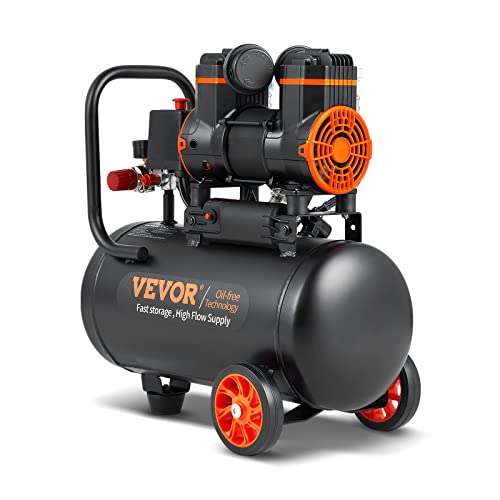 VEVOR 4.8-Gallon Oil-Free Air Compressor
|
8.6/10 | Buy | |
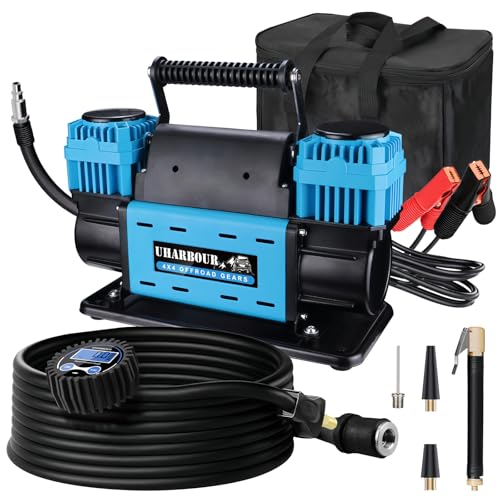 Uharbour 12V 12.35 CFM Air Compressor
|
8.6/10 | Buy | |
 VEVOR 2.1 Gallon Portable Air Compressor
|
8.4/10 | Buy | |
 VIAIR 400P Automatic 12V Air Compressor
|
8.4/10 | Buy | |
 Mazot 10-Gallon Quiet Air Compressor
|
8.3/10 | Buy |
Limodot 8-Gallon Quiet Air Compressor
Limodot pairs an 8-gallon capacity with a quiet 68-decibel motor, keeping noise disruption low during indoor trim or workshop jobs. Delivering 2.8 CFM at 90 PSI alongside a quick 30-second recovery time, it provides steady airflow for DIY pneumatic tools without messy oil maintenance.
Pros
- Low 68 dB output prevents loud workshop disruption
- Fast 30-second pressure recovery keeps projects moving
- Oil-free pump eliminates messy oil changes
- Comprehensive 11-piece accessory kit included out of the box
- Integrated wheels make moving the 8-gallon tank easy
Cons
- 2.8 CFM output limits high-demand continuous tools
- Included PVC hose is stiffer than rubber alternatives
AAIN 6.3-Gallon 1.5HP Air Compressor
Delivering up to 6 CFM at 116 PSI, this unit fills its 6.3-gallon tank in under three minutes while running at an unobtrusive 70 dB. Its oil-free motor makes it a low-maintenance setup for garage tire inflation and light pneumatic chores.
Pros
- Quiet operation rated at only 70 dB
- Fast tank fill time under three minutes
- Oil-free pump eliminates messy maintenance
- Solid airflow delivery up to 6 CFM
Cons
- Maximum working pressure capped at 116 PSI
- Heavy to move around at 46.3 pounds
- Limited to short-duty runs with air tools
ECOMAX 6-Gallon Pancake Air Compressor - 150 PSI
Delivering 2.6 SCFM at 90 PSI from a 6-gallon tank reaching up to 150 PSI, the ECOMAX pancake air compressor balances reliable pneumatic output with a portable 27.6-pound frame. Powered by an oil-free UMC motor engineered for cold-weather starting and equipped with dual quick couplers, it is a practical air supply for trim carpenters, punch-list contractors, and home garage users.
Pros
- Delivers 2.6 SCFM at 90 PSI with a 150 PSI maximum pressure ceiling, well suited for finish carpentry and general garage chores
- Compact 27.6-pound design with a rubberized carry handle allows easy one-handed carrying up stairs and into work vans
- Dual universal quick couplers allow two air lines to connect simultaneously for multi-tool efficiency
- Oil-free UMC motor provides low-maintenance operation with reliable cold-weather and low-voltage starting capability
- Q235b alloy steel tank build and wide rubber feet offer solid jobsite stability
Cons
- Airflow rating of 2.6 SCFM at 90 PSI is not designed for continuous high-consumption air tools like rotary sanders, die grinders, or HVLP sprayers
- Bare-tool configuration does not include pneumatic hoses, tire chucks, or finish nailers in the package
- The manufacturer does not list an official decibel (dBA) sound rating, making standard hearing protection advisable during indoor use
Campbell Hausfeld 80-Gallon Stationary Air
Engineered for automotive repair shops and serious home garages, this stationary Campbell Hausfeld unit combines an 80-gallon ASME tank with a 5 HP motor delivering 16.0 CFM at 90 PSI. Its oil-lubricated cast-iron pump runs at a low 950 RPM, making it a dependable choice for continuous paint spraying, sanding, and air tool operation.
Pros
- Substantial 16.0 CFM delivery at 90 PSI easily powers continuous pneumatic tools like sanders and paint sprayers
- Heavy-duty cast-iron two-cylinder pump runs at a low 950 RPM for smoother operation and reduced thermal stress
- ASME-certified 80-gallon vertical tank maximizes air storage while minimizing workshop floor footprint
- Single-phase 208-230V motor includes overload protection and eliminates the need for an external magnetic starter
Cons
- Stationary footprint and substantial 460-pound weight require permanent shop placement and mechanical assistance during unloading
- Requires dedicated 208-230V single-phase electrical wiring and cannot run on standard 120V household outlets
- Maximum operating pressure caps at 140 PSI, which is lower than some two-stage compressors that reach 175 PSI
FORNAX 2-Gallon 1HP Portable Air Compressor
Engineered for quiet operation around garages and small workshops, this compact compressor delivers up to 125 PSI with an oil-free 1HP motor. Its low 65 dB operating noise makes it well suited for indoor trim work, tire inflation, and basic pneumatic tools.
Pros
- Quiet operation suitable for indoor workspaces
- Low-maintenance oil-free pump design
- Reliable cold-weather startup capability
- Provides clean air output with integrated intake filtering
Cons
- Relatively heavy at over 39 pounds for its capacity
- Small 2-gallon tank limits continuous high-volume air tools
VEVOR 4.8-Gallon Oil-Free Air Compressor
Designed for garage maintenance and light workshop tasks, this 4.8-gallon compressor delivers 2.2 CFM at 90 PSI with a relatively quiet 70-decibel operation. Its oil-free dual-cylinder motor and automatic thermal protection make it well-suited for tire inflation, brad nailing, and intermittent spraying.
Pros
- Low 70 dB noise level suitable for indoor workshops
- Maintenance-free oil-free dual cylinder design
- Durable steel tank with multi-layer rust-resistant coating
- Built-in thermal overload and auto shut-off protection
Cons
- Maximum 116 PSI is lower than many competing tanks
- 2.2 CFM rating limits continuous high-demand air tools
Uharbour 12V 12.35 CFM Air Compressor
Equipped with dual motors, this heavy-duty compressor delivers a high 12.35 CFM airflow to reinflate off-road tires quickly after trail rides. An integrated digital gauge provides accurate pressure readings, though its 26-pound weight makes transport noticeably hefty.
Pros
- High 12.35 CFM output from dual motors
- Digital gauge provides clear, precise pressure control
- Rugged build designed for harsh trail environments
- Included storage bag keeps gear organized
Cons
- Heavy weight at over 26 pounds to haul
- Bulky dual-motor body requires substantial cargo room
VEVOR 2.1 Gallon Portable Air Compressor
Delivering 2.2 CFM at 90 PSI with a 116 PSI maximum operating threshold, the VEVOR 2.1 Gallon Air Compressor combines a 1.2 HP oil-free dual-cylinder motor with a compact 27-pound steel chassis. It serves DIY homeowners, finish carpenters, and garage hobbyists seeking a dependable, low-maintenance air supply for brad nailing, stapling, and tire inflation.
Pros
- Maintenance-free oil-free pump design eliminates messy fluid changes and allows spill-free transport
- Dual-cylinder intake setup delivers a solid 2.2 CFM at 90 PSI in a portable 27-pound frame
- Dual cooling fans and thermal overload protection safeguard motor longevity during heavy garage sessions
- Dual intake silencers help reduce harsh operating noise compared to unshielded high-RPM pumps
Cons
- Maximum operating pressure of 116 PSI provides less stored air buffer than standard 150 PSI contractor units
- 2.1-gallon air reservoir is not sized to sustain continuous high-draw tools like rotary sanders or paint sprayers
- The 3500 RPM motor runs fast, making regular cooling cycles necessary during warm weather work
VIAIR 400P Automatic 12V Air Compressor
Built for trucks, SUVs, and off-road vehicles running tires up to 35 inches, this heavy-duty 12V inflator delivers 2.30 CFM airflow with an automatic shutoff trigger gun. It connects straight to your battery terminals and includes a stable sand tray along with a 25-foot hose for rugged trail maintenance.
Pros
- High 2.30 CFM airflow delivers fast inflation speeds
- Automatic shutoff system simplifies moving between tires
- Long combined reach across vehicle tires
- Durable IP54 housing protects against dust and moisture
Cons
- Limited to a 33% duty cycle at 100 PSI
- Must connect directly to battery rather than interior 12V sockets
- Heavier unit at 10.7 pounds
Mazot 10-Gallon Quiet Air Compressor
Built with an enclosed noise-reduction housing and an oil-free motor, this Mazot compressor delivers a solid 5.26 CFM at 90 PSI for garage and workshop projects. It is well suited for DIYers needing quiet operation for trim nailing, tire inflation, and light painting.
Pros
- Quiet operation via enclosed sound-dampening housing
- High airflow of 5.26 CFM at 90 PSI
- Maintenance-free oil-free pump mechanism
- Dual gauges and quick-connect fittings included
- Comes with a 2-year warranty
Cons
- 120 PSI maximum pressure limits heavy-duty pneumatic tools
- Tall profile takes up significant floor space
Decoding CFM: The Engine of Pneumatic Tool Performance
Measuring compressed air output accurately requires looking past peak pressure ratings and focusing on sustained air delivery. Many DIYers assume that a tank with high storage pressure can run any air tool in their garage. In reality, airflow volume determines whether your pneumatic gear can operate continuously without stalling. Understanding how volume and pressure interact allows you to select the right equipment and protect your tools from early mechanical failure.
The Fundamental Definition of CFM in Pneumatic Systems
Cubic feet per minute, abbreviated as CFM, measures the volume of air an air compressor produces and delivers in sixty seconds. This measurement reflects the rate of air movement rather than the force behind it. While pounds per square inch indicates the pressure or force of the air, CFM represents the physical quantity of air flowing through the system. Think of air pressure as water pressure inside a garden hose, while airflow volume is the actual gallon output filling a bucket.
Every pneumatic tool requires a specific volume of compressed air to spin an internal rotor, drive a piston, or atomize liquid paint. If a compressor pump cannot replenish that consumed air fast enough, the pressure inside the air line plummets immediately. High operating pressure cannot compensate for a lack of air volume once tool consumption exceeds pump delivery. Sizing your system according to true air output prevents continuous pressure drops that stall your daily workshop tasks.
CFM Versus SCFM: Understanding Standardized Ratings
Compressor manufacturers often list air delivery in SCFM, which stands for standard cubic feet per minute. Because air expands when warm and contracts when cool, temperature, relative humidity, and atmospheric barometric pressure alter the physical density of the air being compressed. Standard cubic feet per minute normalizes these environmental variables to a uniform baseline, typically sixty-eight degrees Fahrenheit at thirty-six percent relative humidity and sea-level atmospheric pressure. This standardized baseline gives buyers a reliable metric for comparing pumps under identical operating conditions.
Actual CFM describes the volume of air delivered under specific local conditions, which naturally fluctuate based on workshop climate and altitude. A compressor operating at high elevations draws in thinner ambient air, reducing its actual airflow output compared to sea-level operation. When comparing product specifications, SCFM provides a level playing field across different pump mechanisms. Always treat SCFM as the most reliable benchmark for determining whether a machine can satisfy tool air consumption specifications.
Pressure Dependencies: Why CFM Changes at 40 PSI and 90 PSI
Air compressor pumps do not deliver a fixed volume across all pressure levels. As air pressure inside the tank rises, the pump cylinders work against greater mechanical resistance, which decreases the volume of fresh air they can compress per stroke. Consequently, a compressor always delivers a higher airflow volume at lower pressures, such as 40 PSI, than it does at elevated pressures like 90 PSI. Manufacturers list both numbers on equipment labels to illustrate how pump delivery changes across varied working loads.
For example, the Campbell Hausfeld 80-Gallon Air Compressor, 5 HP provides 17.3 CFM at 40 PSI but drops to 16.0 CFM at 90 PSI. Similarly, the compact Quiet Oil-Free Air Compressor, 68 dB delivers 4 CFM at 40 PSI, decreasing to 2.8 CFM at 90 PSI. Lower pressure ratings apply to light-duty equipment like paint touch-up guns or tire inflators, whereas heavy-duty air tools demand the higher 90 PSI standard. Evaluating pump output specifically at 90 PSI gives you the true metric for workshop utility.
Air Volume Versus Storage: The Interplay Between CFM and Tank Capacity
A widespread misconception is that purchasing an air compressor with a larger storage tank solves air delivery shortages. An air tank functions solely as a temporary storage reservoir, buffering compressed air until tools consume it. The tank does not generate air volume; only the mechanical pump motor creates airflow. A massive tank simply provides a longer grace period before line pressure falls below the minimum required operating threshold.
If you pair a low-volume pump with a large reservoir, continuous tool use will eventually drain the tank reserve completely. Once the pressure drops below the cut-in switch threshold, the pump restarts and struggles to keep up with tool demand while refilling the vessel. Conversely, a high-CFM pump mounted on a modest tank recovers lost pressure rapidly, sustaining tool performance with minimal interruption. Balancing storage capacity with continuous pump output prevents your compressor from running without pause.
Continuous Versus Intermittent Air Tool Demand
Pneumatic tools fall into two distinct operational categories: intermittent-demand tools and continuous-draw equipment. Intermittent tools consume compressed air in brief, isolated pulses followed by pauses while the operator repositions. Brad nailers, framing guns, and pneumatic staplers consume small fractions of a cubic foot per cycle, usually averaging under 1 to 2 CFM. Compact portable units like the ECOMAX Pancake Air Compressor MAX 150 PSI, with its 2.6 CFM at 90 PSI output, handle these intermittent tasks easily.
Continuous-draw tools present a far more demanding load profile because their valves remain wide open during operation. Rotary sanders, die grinders, needle scalers, and HVLP paint spray guns draw massive volumes of pressurized air uninterrupted. A typical dual-action orbital sander can easily consume 6 to 12 CFM at 90 PSI without stopping. Running a continuous-use tool on an undersized portable compressor forces the motor into continuous operation, overheating internal components and starving the tool of torque.
Delivery Restrictions: Air Hoses, Regulators, and Friction Loss
Generating adequate airflow at the compressor pump does not guarantee that full volume reaches your pneumatic tool. Air delivery suffers from dynamic friction loss as compressed air travels through narrow hoses, quick-connect couplers, and pressure regulators. A narrow 1/4-inch internal diameter hose creates substantial flow resistance, starving air tools over distances as short as twenty-five feet. Upgrading to a 3/8-inch or 1/2-inch internal diameter air hose preserves volume and reduces line pressure drop significantly.
Couplers and manifold fittings also act as mechanical chokepoints if they feature undersized internal orifices. Proper plumbing requires matching your hose size, fittings, and filtration components to the overall volume requirements of your tool kit. When connecting hoses to an air compressor, using high-flow quick-connect fittings helps eliminate restrictive bottlenecks at the regulator outlet. Maintaining an unrestricted delivery path ensures that your compressor output actually translates into working torque at the pneumatic spindle.
Duty Cycle Realities and Pump Heat Dissipation
Every air compressor pump operates within a specific duty cycle rating that defines its allowable run time versus rest time. Most consumer and light commercial oil-free compressors feature a fifty percent duty cycle, meaning they should run no more than thirty minutes out of every hour. Exceeding this duty cycle overheats the motor windings, degrades piston seals, and risks tripping thermal overload protection switches. Heavy continuous demand requires an industrial pump built with cast-iron components or specialized commercial mechanisms.
For portable 12-volt applications, manufacturers state specific duty cycle limitations to prevent motor damage. The VIAIR 400P – 40045 Portable Air Compressor provides 2.30 CFM free flow and carries a thirty-three percent duty cycle at 100 PSI. In industrial workshops, studying rotary screw air compressor mechanics reveals how continuous one-hundred percent duty cycle machinery operates without thermal fatigue. Matching your air volume requirements to the duty cycle of the pump preserves long-term equipment reliability.
Compressor Pump Mechanics and CFM Generation
The internal mechanical design of a compressor dictates both its air production efficiency and its operating sound profile. Modern quiet compressors utilize twin-cylinder, oil-free induction motors operating at reduced rotational speeds, typically around 1,450 to 3,500 RPM. Models like the FORNAX 2 Gallon Air Compressor produce 2.1 to 2.2 CFM at 90 PSI while generating an ultra-quiet 65 dB sound profile. Similarly, the AAIN Ultra Quiet Air Compressor, 6.3 Gallon delivers 5.5 to 6 CFM at 116 PSI while limiting sound to 70 dB.
Oil-lubricated cast-iron pumps operate differently, utilizing splash lubrication to dissipate heat across heavy reciprocating pistons. The Campbell Hausfeld 80-Gallon unit runs a two-cylinder cast-iron pump at 950 RPM to generate a substantial 16.0 CFM at 90 PSI. Low pump speeds reduce wear on reed valves and piston rings, making these units ideal for continuous automotive repair and body shop restoration. Selecting between quiet oil-free maintenance and heavy-duty cast-iron durability depends on your workspace noise tolerance and total daily air consumption.
Diagnosing Inadequate CFM: Common Symptoms in Workshop Air Lines
Identifying an airflow volume shortage early prevents costly damage to pneumatic tool motors and compressor pumps. When an air compressor lacks sufficient CFM for a connected tool, the regulated pressure gauge on the manifold visibly drops while the tool trigger remains depressed. You will notice rotary tools losing RPM, impact wrenches failing to reach torque specifications, and paint sprayers producing uneven, spattering spray patterns. These operational symptoms indicate that air is leaving the storage reservoir faster than the pump can replenish it.
Another telltale symptom of inadequate volume is continuous pump cycling accompanied by an uncomfortably hot crankcase. When a pump runs without pause trying to satisfy an oversized air tool, internal operating temperatures climb rapidly. This thermal stress degrades valve reeds, carbonizes lubricating oil in oil-bath pumps, and burns through Teflon piston seals in oil-free units. If your compressor never reaches its cut-out pressure while working, your tools are exceeding the pump output capacity.
Off-Road and Mobile Applications: High-Volume 12V Airflow
Mobile and off-road pneumatic applications present unique airflow dynamics where direct 12-volt battery power replaces standard alternating-current workshop circuits. High-volume mobile units like the Uharbour 12V 12.35 CFM Offroad Air Compressor focus on moving large volumes of atmospheric air into high-volume truck tires quickly. Unlike workshop tools requiring continuous 90 PSI delivery, off-road tire inflation transitions from zero to typical trail pressures of 30 to 40 PSI. This specific duty cycle emphasizes rapid free-flow displacement over high-pressure storage buffers.
When utilizing mobile 12-volt compressors, power delivery directly influences effective motor output and flow rates. Connecting heavy-duty battery clamps directly to a running vehicle alternator supplies the necessary voltage to sustain rated flow rates without overheating electrical leads. Long 12-volt power cords must use heavy gauge wiring to avoid voltage drops that weaken motor rotation and reduce air displacement. For trailside repairs and tire re-inflation, high free-flow volume cuts inflation times significantly.
Electrical Demands and Startup Inrush Associated with High-Output Pumps
Producing high CFM output requires substantial electrical power, creating specific demands on your garage or jobsite electrical circuits. Compact compressors producing between 2 and 3 CFM typically feature motors drawing 10 to 14 amps, making them compatible with standard 15-amp household branch circuits. However, starting these induction motors creates an instantaneous inrush current that can spike significantly higher than the running draw. If a compressor attempts to restart against residual head pressure on a shared household circuit, the breaker often trips instantly.
Stationary workshop machines delivering 15 CFM or more require dedicated 208 to 230-volt single-phase or three-phase electrical circuits. The Campbell Hausfeld 80-Gallon unit utilizes a 5 HP motor designed for dedicated 208-230V wiring, avoiding the startup current limitations of standard 120V residential outlets. Attempting to run high-CFM compressors on long, undersized household extension cords causes voltage drops that overheat motor windings and trigger thermal overloads. Running a dedicated circuit or using longer air hoses instead of electrical extension cords protects your equipment investment.
Practical Step-by-Step Method to Calculate Shop CFM Requirements
Determining the exact air compressor output your shop requires begins with an inventory of all pneumatic tools you plan to operate. Review the manufacturer specification plate or user manual for each tool to find its average air consumption rating at 90 PSI. If multiple workers share an air line simultaneously, add the individual CFM ratings of all tools operating at the same time. For solo hobbyists, simply identify the single highest-demand tool in your collection, such as an HVLP sprayer or orbital sander.
Once you establish your baseline air demand, apply a practical safety buffer to account for friction losses and continuous tool use. Multiply your highest tool CFM requirement by 1.25 or 1.5 to calculate the minimum recommended compressor pump rating. For instance, if an orbital sander demands 8 CFM at 90 PSI, select an air compressor delivering at least 10 to 12 CFM at that same pressure. This deliberate buffer prevents the pump from running constantly, protecting motor longevity and ensuring consistent air pressure at the tool.
Taking the time to match pump airflow volume with your specific pneumatic workload saves money, reduces project frustration, and extends tool life. Always verify the CFM rating specifically at 90 PSI rather than relying on maximum tank pressure or low-pressure inflation figures. Sizing your system with adequate volume reserves guarantees that your tools run at peak power without starving the line or overheating the motor.
About the author
Kenny Koehler is a power-tool specialist with more than a decade of hands-on evaluation experience and a science-based approach to product testing. His expertise in repeatable testing, tool performance, impact wrenches, and professional equipment brings a practical, data-focused perspective to compressor and pneumatic-tool comparisons.