
What Is a 6 Gallon Air Compressor Good For: Practical Uses and Limits for 2026
Learn what is a 6 gallon air compressor good for across pneumatic trim nailing, tire inflation, and general workshop projects updated for October 2026.
 By Tony Carrick
Updated October 8, 2026
By Tony Carrick
Updated October 8, 2026

Sizing pneumatic equipment properly often comes down to the balance between tank capacity and steady air volume delivery. While massive two-stage shop compressors remain fixed to garage floors, a portable pancake unit offers a balance between mobility and utility. Understanding what is a 6 gallon air compressor good for helps prevent common workshop frustrations like tools stalling mid-cut or motors overheating from continuous cycling. For tradespeople and homeowners alike, evaluating portable workshop air compressors begins with calculating real air consumption rather than relying on rough estimates.
Most modern six-gallon units deliver between 2.2 and 4.0 CFM at 90 PSI, running on standard 120-volt household electricity. This operational envelope makes them exceptional for intermittent air demands, such as driving finish nails or airing up vehicle tires, while revealing clear boundaries against continuous air-hungry tools. Knowing how these compact air reserves behave under pressure ensures you select the right tasks without overtaxing the oil-free pump. By reviewing real performance specifications, you can plan your workshop projects with confidence and efficiency.
| Award | Product | ACR Score About ACR ScoreThe ACR Score is our own rating from 0 to 10, based on performance, design and build, ease of use, and value. It reflects independent research and is never influenced by manufacturers, retailers, or affiliate commissions. Learn more › | |
|---|---|---|---|
| Best Overall |
Goodyear 6 Gallon 150 PSI Oil Free Electric
|
9.2/10 | Buy |
| Best Premium |
 BOSTITCH Pancake Air Compressor, Oil-Free
|
9.2/10 | Buy |
 CRAFTSMAN 6-Gal 150 PSI Oil-Free Pancake Air
|
8.9/10 | Buy | |
| Best Value |
 ECOMAX Air Compressor 6 Gallon 150 PSI Pancake
|
8.8/10 | Buy |
| Best Budget |
 VEVOR 6 Gallon Air Compressor
|
8.6/10 | Buy |
 Metabo HPT Pancake Air Compressor
|
8.6/10 | Buy | |
 FORNAX Portable Air Compressor 6.4 Gallon
|
8.4/10 | Buy | |
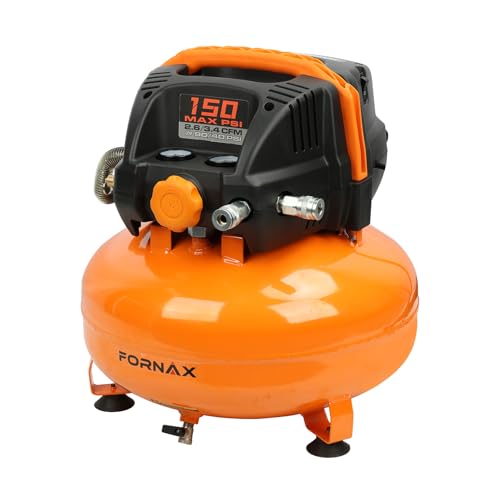 FORNAX Pancake Air Compressor with two couplers
|
8.4/10 | Buy | |
 ECOMAX Air Compressor 6 Gallon 175 PSI Pancake
|
8.4/10 | Buy | |
 Metabo HPT Portable Pancake Air Compressor
|
8.3/10 | Buy |
Capabilities, Tool Matching, and Practical Limits of a 6-Gallon Air Compressor
Determining whether a six-gallon tank matches your workshop requirements depends on how air storage interacts with continuous pump output. A six-gallon compressor serves as a portable pressure buffer designed to bridge the gap between compact tire inflators and stationary garage machinery. While it provides ample volume for tools that consume air in rapid bursts, it quickly depletes under sustained tool draw. Reviewing mechanical ratings, tool CFM demands, and operational duty cycles clarifies exactly where these portable machines excel and where their limitations emerge.
Understanding Air Flow Delivery and Usable Tank Reserves
The core capability of any compressor depends on maximum pressure measured in PSI and airflow delivery measured in cubic feet per minute (CFM). Most six-gallon pancake units produce between 2.2 and 4.0 CFM at 90 PSI, driven by electric motors between 1.0 and 1.7 horsepower. The six-gallon tank acts as a temporary buffer, holding compressed air so the motor does not need to run continuously during light tasks. When a pneumatic tool consumes more CFM than the pump produces, it draws air directly from this reserve until the tank pressure reaches the cut-in switch threshold.
If a tool draws volume faster than the pump can compress fresh air, line pressure drops steadily below the tool operating requirement. For intermittent equipment, the pump catches up during natural work pauses, restoring the tank to full cut-out pressure. When evaluating different capacities, some users compare smaller portable compressor tanks to understand how compact buffers manage brief cycles, but a six-gallon vessel provides significantly more breathing room before the motor restarts.
Ideal Applications for Finish Carpentry and Trim Woodworking
Finish carpenters and cabinetmakers frequently choose six-gallon pancake compressors because trim tools require very modest air volume per fastener. Brad nailers firing 18-gauge wire nails, micro-pinners, and 16-gauge finish nailers generally consume less than 0.5 to 1.0 CFM at 90 PSI. Because each shot expels only a small puff of air, the six-gallon tank easily supports dozens of fasteners before dropping to the cut-in trigger. This consistent line pressure allows trim installers to set baseboards, crown molding, and window casings flush without unexpected depth variations.
The rapid recovery time of these compressors keeps woodworking projects moving without unnecessary downtime. Quality six-gallon units can rebuild pressure from the 90 PSI cut-in point to full cut-out in roughly 45 to 60 seconds. Many models feature dual quick-connect couplers, allowing two carpenters to run light finish nailers simultaneously on a single jobsite. The oil-free pump architecture also prevents lubricating oil from venting through the tool exhaust, protecting delicate wood surfaces and finished trim from oil spots.
Framing, Roofing, and Heavy Fastener Performance
Driving heavy framing fasteners and roofing coils requires noticeably more pneumatic volume than installing interior trim. A standard framing nailer driving 3-inch or 3.5-inch nails into structural lumber requires roughly 2.0 to 2.5 CFM at 90 PSI at standard working speeds. A standard six-gallon compressor delivering 2.6 CFM at 90 PSI can comfortably support a single framing nailer in sequential fire mode. Single-operator tasks, such as framing basement partition walls, repairing deck joists, or installing subfloor panels, fall well within the operational capacity of these machines.
Complications arise when an operator attempts rapid bump-firing or connects two framing nailers to a standard 150 PSI pancake tank. High-speed framing rapidly exhausts the six-gallon buffer, causing line pressure to drop before the pump can recover. When pressure drops below 80 PSI, heavy framing nails fail to drive flush, leaving heads exposed and interrupting work progress. While high-pressure models operating up to 200 PSI can support multiple large nailers by storing denser air reserves, standard 150 PSI compressors remain single-gun framing tools.
Vehicle Tire Inflation and Home Pressure Maintenance
Tire inflation is among the most practical and frequent tasks for a six-gallon compressor in residential garages. Passenger vehicles, lawn tractors, utility trailers, hand trucks, and bicycles all match the working parameters of a six-gallon tank. Because typical car tires require between 32 and 45 PSI, a tank pressurized to 150 PSI delivers rapid airflow through standard brass chucks. A homeowner can easily top off four vehicle tires on a single tank fill without running electrical cords across the driveway.
Inflating completely flat truck tires from zero pressure requires more patience because of the substantial air volume involved. Although the compressor will successfully inflate large tires up to 80 PSI, the motor must run through several continuous cycles to deliver that total volume. High-pressure bicycle tires, such as road bike tires requiring 90 to 110 PSI, are handled with ease because their air chambers contain very low volume. Pairing the compressor with a quality digital inflator gauge provides quick, reliable pressure adjustments.
Dust Clearing, Air Blow Guns, and Intermittent Hand Tools
Air blow guns remain indispensable workshop accessories for cleaning machinery, clearing sawdust, and drying cleaned mechanical parts. A six-gallon compressor produces strong bursts of air that effectively dislodge dust from power tool tables and engine compartments. However, standard blow nozzles consume heavy air volume when held open continuously, draining a six-gallon tank within thirty seconds. Operating the blow gun in short, disciplined bursts maintains maximum nozzle velocity while preventing the compressor pump from running continuously.
Light-duty pneumatic hand tools, including 3/8-inch air ratchets or upholstery staplers, also operate reliably on a six-gallon air supply. A home mechanic can spin off loose chassis fasteners or remove valve cover bolts during routine maintenance without depleting the air reservoir. Because hand ratchets engage only for brief intervals, the tank maintains proper operating pressure. Conversely, running a continuous air drill or heavy rotary grinder quickly depletes the air reserve, requiring constant work stoppages while the motor rebuilds line pressure.
Tasks to Avoid: Continuous Air Tools and HVLP Spraying
Recognizing tasks that exceed a six-gallon compressor prevents tool damage and severe operational frustration. Rotary sanders, random orbital sanders, die grinders, needle scalers, and pneumatic cutoff wheels represent tools that quickly overwhelm a small compressor. These continuous-draw tools consume between 6 and 15 CFM at 90 PSI, which is three to five times what a pancake pump can produce. Running an orbital sander on a six-gallon tank drains the pressure reservoir in fifteen seconds, causing immediate speed loss while the pump overheats.
High Volume Low Pressure (HVLP) spray guns for automotive bodywork or large painting projects present another absolute mismatch. Professional paint atomization demands continuous, non-pulsing airflow between 8 and 14 CFM to prevent sputtering and textured finishes. A six-gallon compressor cannot sustain this volume, causing the spray pattern to collapse mid-stroke and compromising paint coats. While minor artistic airbrushes or brief touch-up pens can operate for short intervals, serious automotive spraying requires a stationary workshop compressor with a high-displacement pump.
How Maximum Working Pressure Expands Usable Air Storage
Although every six-gallon compressor features the same physical interior volume of roughly 22.7 liters, usable air storage varies based on maximum operating PSI. Because compressed air increases in density under higher pressure, higher maximum PSI packs more air molecules into the same steel vessel. A compressor rated for 150 PSI stores noticeably less usable air than an advanced unit rated for 165, 175, or 200 maximum PSI. Because pneumatic tools regulate pressure down to 90 PSI, only the air stored above that working threshold provides productive operating capacity.
A unit operating at 200 maximum PSI provides up to thirty percent more usable airflow than a standard 150 PSI model before triggering motor restart. This additional pressure buffer translates into more fasteners driven per cycle and shorter recovery intervals on busy jobsites. Higher storage pressures also help stabilize regulated outlet pressure when multiple tools draw from dual quick couplers. When comparing six-gallon models, checking maximum operating pressure provides clear insight into how long tools will run between motor recovery cycles.
Electrical Circuit Requirements and Cold Weather Starting
Most six-gallon portable compressors run on universal 120-volt electric motors designed for common household electrical outlets. While their normal running draw falls between 10 and 14 amps, startup inrush current spikes substantially higher as the pump overcomes head pressure. Connecting a compressor to a shared 15-amp branch circuit already powering shop lights or heaters can quickly trip the circuit breaker. For uninterrupted performance, connecting the unit directly to a dedicated 15-amp or 20-amp garage receptacle prevents unexpected power trips during startup cycles.
Using long, thin extension cords causes dangerous voltage drop that starves the motor and triggers internal thermal overload switches. If extra jobsite reach is required, equipment manufacturers recommend using a longer 50-foot air hose rather than extending electrical power cords. On unheated winter jobsites, sub-freezing temperatures stiffen synthetic seals and thicken pump resistance. Choosing compressors equipped with cold-start unloader valves allows the motor to spin freely up to speed before engaging full compression load, preventing cold-weather stalls.
Operational Noise Ratings Across Residential Workspaces
Operational noise levels represent an important consideration when using a compressor inside homes, basements, or attached garages. Standard oil-free pancake compressors feature high-speed universal motors spinning above 3,400 RPM, producing sound levels between 78.5 and 95 decibels. This sharp mechanical clatter can quickly cause operator fatigue and disturb family members during home renovation tasks. In small enclosed rooms, running an uninsulated high-RPM compressor without hearing protection poses genuine auditory risks over extended working sessions.
Modern equipment designs increasingly offer quiet dual-piston configurations that lower operating sound output down to 65 to 73 decibels. These low-noise pumps utilize low-RPM induction motors that run substantially cooler and generate less mechanical vibration. A reduction of ten decibels corresponds to a perceived sound cut of roughly fifty percent, making quiet compressors much easier to live with indoors. If your projects involve working inside occupied living spaces, choosing a low-decibel unit significantly improves everyday working comfort.
Moisture Management and Long-Term Tank Maintenance
Compressing ambient air naturally squeezes moisture out of the air stream, leaving liquid condensation inside the bottom of the steel tank. Neglecting daily tank draining causes internal rust, flaking scale, and eventual structural perforation of the pressure vessel. Following proper moisture draining methods protects tank longevity and prevents dirty moisture from discharging through pneumatic hoses into sensitive air tools. Water traveling downstream strips away factory tool lubricants and can damage pneumatic o-rings and internal valves.
Draining the storage tank should occur at the end of every work session while a small amount of residual pressure remains. Opening the bottom drain valve purges accumulated moisture and sediment rapidly through the valve port. Models equipped with quarter-turn brass ball valves offer far greater reliability than threaded thumb petcocks, which frequently seize or strip over time. Always depressurize the unit before seasonal storage, and periodically pull the ASME safety relief valve ring to verify free mechanical movement.
Matching Your Pneumatic Tool Demands to a Six-Gallon Tank
A six-gallon air compressor remains an exceptionally practical tool for homeowners, trim carpenters, and DIY garage hobbyists. It delivers dependable performance across brad nailing, finish nailing, staple installation, seasonal tire maintenance, and general workshop dust clearing. Its lightweight form factor, typically weighing between 28 and 42 pounds, combined with maintenance-free oil-free pump technology, provides unmatched portability and convenience. For intermittent, burst-style pneumatic applications, a six-gallon unit provides the ideal balance of tank volume, portability, and reliable utility.
However, attempting to run high-draw automotive tools like orbital sanders, continuous die grinders, or production paint guns quickly reveals the mechanical boundaries of this platform. Projects requiring continuous airflow demand larger stationary compressors with high-displacement pumps capable of sustaining high CFM delivery. For the wide variety of finish woodworking, home maintenance, and automotive tire pressure tasks, a six-gallon compressor offers reliable capability without taking up valuable floor space in your workshop.
About the author
Tony Carrick is an experienced product researcher and writer specializing in tools, home improvement, automotive maintenance, and consumer equipment. With extensive experience reviewing tools and tackling hands-on renovation projects, he brings a buyer-focused perspective to compressor performance, usability, and overall value.