
How to Stop Moisture in Air Compressor: Complete Air Drying Guide for 2026
Learn how to stop moisture in air compressor systems to protect tools and finishes with practical drying stages updated for October 2026.
 By Tom Scalisi
Updated October 8, 2026
By Tom Scalisi
Updated October 8, 2026

Atmospheric air contains ambient water vapor that rapidly condenses inside metal storage tanks whenever a pump compresses ambient air and raises its temperature. This condensation produces rust inside steel reservoirs, accelerates internal wear on pneumatic nailers, and causes catastrophic blistering across freshly sprayed automotive paint finishes. Learning how to stop moisture in air compressor setups is critical for preventing ruined workpieces, stalled sanders, and corroded valve seats. Managing this moisture requires understanding why air compression naturally squeezes out vapor like water from a saturated sponge.
Eliminating downstream condensation demands a coordinated multi-stage strategy rather than relying on a single basic filter bowl. Workshop operators achieve bone-dry compressed air by combining bottom tank drainage, dedicated aftercoolers, coalescing oil traps, and color-changing desiccant beads. Proper installation geometry, including sloping distribution pipes and vertical filter placement, also forces condensed liquid into collection traps before it enters high-flow air hoses. Exploring these filtration technologies ensures your pneumatic equipment receives clean, moisture-free airflow under demanding continuous-duty workloads.
| Award | Product | ACR Score About ACR ScoreThe ACR Score is our own rating from 0 to 10, based on performance, design and build, ease of use, and value. It reflects independent research and is never influenced by manufacturers, retailers, or affiliate commissions. Learn more › | |
|---|---|---|---|
| Best Overall |
1/2" NPT 4 Stage Air Drying System for Air
|
9.2/10 | Buy |
| Best Budget |
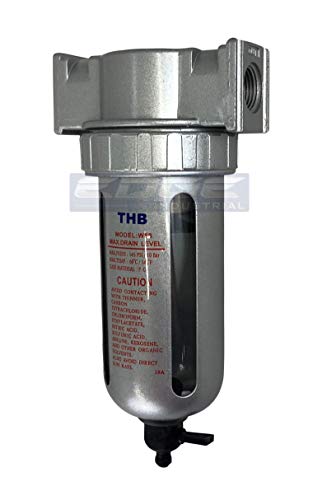 1/2" Particulate filter water trap seperator
|
9.1/10 | Buy |
 LE LEMATEC Inline Air Compressor Water Separator
|
8.3/10 | Buy | |
| Best Premium |
 3/4" NPT Air Compressor Water Separator
|
8.3/10 | Buy |
| Best Value |
 DEWALT Inline Dessicant Dryer with Viewing Window
|
8.1/10 | Buy |
 NANPU Industrial Grade Heavy Duty Compressed Air
|
8.1/10 | Buy | |
 1/2" NPT Air Compressor Water Separator
|
8.1/10 | Buy | |
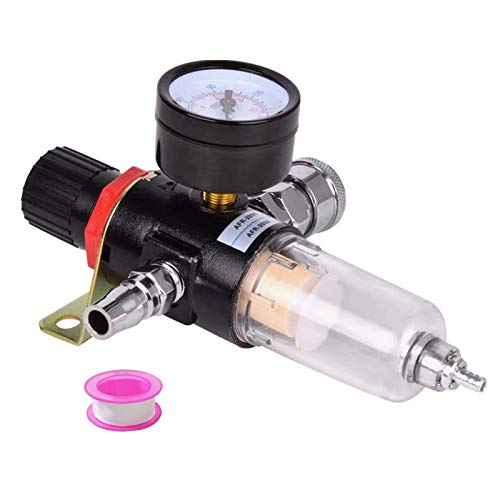 Hotusi 1/4" BSP Air Compressor Moisture Filter
|
7.8/10 | Buy | |
 3/4" NPT Air Compressor Dryer
|
7.8/10 | Buy |
The Engineering Guide to Eliminating Compressed Air Moisture
Stopping liquid water from contaminating your pneumatic tools requires addressing condensation at every point along the air stream. A standard compressor pump cannot prevent moisture formation on its own because physics dictates that compressing ambient air concentrates atmospheric humidity. Effective moisture control relies on progressive separation, beginning at the storage tank and extending through precision filtration stages to the point of tool connection.
The Thermodynamics of Moisture Accumulation in Compressed Air
Ambient air always contains dissolved moisture in the form of invisible water vapor. When a compressor draws in several cubic feet of room air and compresses it into a fraction of that volume, the air temperature spikes dramatically. Hot compressed air can hold a substantial amount of water vapor in gaseous form during the initial pumping stroke.
Trouble starts as soon as that compressed air enters the receiver tank and begins to cool toward ambient room temperature. Cool air has a much lower dew point and cannot hold the same quantity of dissolved vapor as hot air. As thermal energy dissipates through the steel tank walls, excess humidity rapidly condenses into liquid water pools at the bottom of the vessel.
When tools draw air from the receiver, this rapid airflow sweeps moisture droplets directly into connecting hoses and distribution pipes. Operating high-demand tools like dual-action sanders or paint sprayers accelerates this effect because continuous flow keeps the air stream warm until it expands inside the tool. That sudden pressure drop creates instant chilling, causing rapid condensation right where you need dry air most.
Foundation Management: Receiver Tank Purging and Auto Drain Systems
Managing internal tank condensation serves as the foundational step in any pneumatic moisture reduction strategy. Leaving water pooled inside an air receiver reduces usable storage volume and corrodes internal steel walls from the inside out. Stagnant moisture also turns into an acidic sludge that strips lubricant from downstream air tools.
Manual tank draining requires opening the bottom drain valve after every single operating session. Factory thumb petcocks frequently corrode or become stiff to turn, which tempts workshop owners to postpone this essential maintenance chore. Upgrading a sticky needle valve to a smooth brass quarter-turn ball valve simplifies daily purging and encourages regular compliance.
Automated drain valves offer a hands-off solution for busy commercial shops and forgotten home garage compressors. Electronic timed solenoid valves discharge collected condensate at set intervals regardless of operator presence. Pneumatic semi-automatic drains, like those found on industrial moisture bowls, open automatically whenever line pressure drops to zero after shutting down the system.
Temperature Dissipation and Interstage Aftercooling Strategies
Filtration devices cannot effectively capture moisture while compressed air remains hot and vaporized. Standard water separators and coalescing elements only remove liquid droplets, meaning gaseous humidity passes straight through filter bowls undetected. Cooling the air stream before it reaches primary filtration units is essential for forcing vapor into separable liquid.
Many workshop installations route hot discharge air through copper tubing runs or aluminum hard lines along shop walls before entering filter manifolds. Metal piping acts as a giant heat sink that dissipates compression heat into the surrounding ambient room air. Spacing out your filter array at least twenty to thirty feet away from the compressor pump allows the air stream adequate time to cool below its dew point.
Dedicated aftercoolers provide an even more compact cooling solution for high-output compressors operating in tight footprints. Placing an air-to-air heat exchanger with a cooling fan between the pump head and the receiver tank condenses up to eighty percent of vapor before it ever settles in the tank. Lowering the intake temperature protects downstream desiccant media from thermal degradation and extends filter element lifespan.
Stage One Separation: Mechanical Particulate Filters and Water Traps
The first mechanical defense in an air drying line is a standard particulate water trap. Units like the 1/2-inch NPT particulate filter from THB utilize internal directional vanes to spin incoming airflow into a high-velocity vortex. Centrifugal force throws heavy water droplets and rust scale against the outer bowl walls, where liquid collects away from the moving air stream.
These mechanical separators incorporate a five-micron porous filter element to strain solid debris and larger moisture aerosols. Trapping particulate matter early prevents pipe scale from fouling downstream regulators or clogging fine coalescing fibers. The collected liquid drops into a lower baffle zone designed to prevent turbulence from re-entraining water back into clean airflow.
Durable bowl construction plays an important safety role during high-pressure operation. While polycarbonate bowls allow quick visual inspection of accumulated liquid, industrial metal bowls with external sight glasses offer superior impact resistance against accidental shop impacts. Regularly purging the collected liquid prevents the water level from reaching the filter element and flooding downstream lines.
Stage Two Separation: Coalescing Oil and Sub-Micron Aerosol Filters
Standard mechanical water traps stop bulk liquid, but microscopic moisture mists and oil aerosols slip right through standard five-micron elements. Oil-lubricated compressor pumps naturally discharge minute amounts of oil mist past piston rings into the compressed air line. Combining water mist with atomized pump oil produces a sticky emulsion that ruins pneumatic valves and contaminates paint jobs.
Coalescing filters resolve this problem by forcing air through dense, borosilicate microglass fiber matrixes rated down to 0.01 microns. As tiny liquid aerosols navigate this dense fiber pathway, they collide with microfibers and merge into larger, heavier droplets. Gravity then pulls these accumulated liquid drops down into the bottom of the filter bowl for discharge.
Multi-stage air drying assemblies from RVMARINEPAT pair a five-micron pre-filter with a 0.01-micron coalescing stage to protect delicate downstream equipment. Most coalescing assemblies feature a pop-up differential pressure indicator on the top housing. When the internal element becomes saturated with trapped aerosols, the red indicator pops up to signal that it is time to install a fresh replacement element.
Stage Three Deep Drying: Chemical Desiccant Air Dryers
Mechanical and coalescing filters capture suspended liquid droplets, but they cannot remove vaporized moisture. Achieving true deep drying for sensitive tasks requires chemical adsorption using a desiccant air dryer. Desiccant dryers pass clean compressed air through a packed bed of porous silica gel beads that chemically attract and bind water molecules.
Units such as the heavy-duty desiccant dryers from NANPU and DEWALT produce ultra-dry air with extremely low dew points suitable for automotive refinishing. High-grade silica beads feature color-changing moisture indicators that shift from vibrant blue to light pink as the material reaches water saturation. This clear visual feedback lets operators know exactly when the media requires replacement or thermal regeneration.
Desiccant beds must always sit downstream of mechanical water separators and oil-coalescing filters. Introducing raw liquid water directly into desiccant media quickly saturates the beads and ruins their adsorption capacity. Oil aerosols will coat the microscopic pores of silica gel permanently, destroying its drying ability within hours of continuous tool operation.
Complete Multi-Stage Assemblies for Critical Workshop Tasks
Assembling individual filters, regulators, and dryers into a cohesive line can create multiple leak points if fittings are improperly sealed. Complete all-in-one drying stations, such as the 3/4-inch and 1/2-inch multi-stage systems from RVMARINEPAT and DAIERTEK, combine these filtration phases into a rigid manifold. These modular stations integrate particulate filtration, pressure regulation, oil coalescing, and desiccant drying within a unified aluminum block.
High-flow ports measuring 1/2-inch or 3/4-inch NPT minimize dynamic pressure drop across the entire drying assembly. High-volume pneumatic equipment like plasma cutting torches and sandblasters demand substantial continuous air volume at consistent pressure. Undersized filtration ports choke airflow, forcing the compressor pump to cycle continuously while starving the tool at the end of the line.
Integrated pressure regulators with locking adjustment knobs allow precise pressure calibration right after final drying. Locking knobs prevent accidental pressure shifts caused by shop vibrations or accidental bumps. Heavy-duty metal bowls rated up to 240 PSI ensure structural integrity during unexpected line pressure surges in commercial shop environments.
Point-of-Use Defense: Miniature Inline Separators for Spray Guns
Even an immaculate wall-mounted filtration system cannot eliminate moisture that condenses inside long rubber hoses on cold shop floors. Warm air leaving the workshop wall cools as it travels through fifty feet of air hose laid across cold concrete. This secondary temperature drop causes residual vapor to condense into liquid drops just inches away from the tool inlet.
Mounting a lightweight inline filter directly to the air inlet of your spray gun or plasma torch provides vital final-stage protection. Compact units like the LE LEMATEC inline separator weigh only a few ounces and feature a slim profile that does not disrupt gun balance. Sintered bronze elements inside these miniature filters catch rogue droplets and pipe scale before they can ruin automotive clear coats.
Transparent polycarbonate housings on inline traps allow operators to monitor water collection in real time while working. A quick push-button drain valve allows instant ejection of trapped moisture without disconnecting the air line or depressurizing the hose. Incorporating an inline trap guarantees that hose sweat never reaches your paint nozzle or cutting tip.
Designing an Optimized Workshop Air Distribution Layout
Physical plumbing architecture plays a massive role in whether water reaches your pneumatic tools or drains away harmlessly. Never run air distribution lines level or allow them to sag between mounting brackets. Slope your main distribution trunk away from the compressor at a slight downward pitch of approximately one inch for every twenty feet of pipe run.
Install vertical drop legs with manual drain valves at the lowest points of the piping run to collect running condensate. When branching off the main line to feed an air tool station, always route the takeoff pipe out of the top of the main trunk using a gooseneck configuration. Taking air from the top of the pipe prevents gravity-fed moisture flowing along the bottom of the main trunk from spilling into tool drops.
Pipe material selection also influences condensation management and system cleanliness. Smooth-walled aluminum piping and rigid copper tubing resist internal corrosion and shed thermal energy far faster than traditional iron pipe. Never install standard PVC plumbing for compressed air distribution because pressurized plastic can shatter into dangerous high-velocity shards under impact.
Systematic Inspection and Maintenance Routines for Dry Air
Keeping an air drying setup operating at peak efficiency requires consistent maintenance habits rather than occasional reactive fixes. Start every work session by checking the receiver tank drain to purge any accumulated condensation from overnight cooling. Inspect filter bowl sight glasses on mechanical separators to confirm auto drains are seating properly without hissing air.
Monitor the color of your desiccant beads before beginning moisture-sensitive projects like spray painting or plasma cutting. When the blue beads transition toward pink through the sight glass, unscrew the metal bowl and refill it with fresh desiccant media. Saturated desiccant can often be baked in a dedicated shop oven at moderate heat to restore its moisture-absorbing properties for future reuse.
Always depressurize your air distribution lines completely before unthreading filter bowls or servicing coalescing elements. Turn off the main shutoff valve, bleed stored pressure through a blow gun, and verify that all system pressure gauges read zero. Keeping spare five-micron and 0.01-micron replacement elements on your shop shelf prevents unexpected downtime when filters eventually reach their loading limit.
About the author
Tom Scalisi brings more than two decades of experience in construction, building maintenance, contracting, and hands-on tool use. His practical understanding of power tools, automotive work, repairs, and jobsite equipment helps readers evaluate compressors based on real workloads rather than specifications alone.