
Is a 6 Gallon Air Compressor Good: Practical Guide for 2026
Is is a 6 gallon air compressor good for your garage? Review CFM output, tank recovery times, and tool limits for October 2026.
 By Bob Beacham
Updated October 8, 2026
By Bob Beacham
Updated October 8, 2026

Pneumatic tools demand steady air pressure, but dragging a massive stationary tank across a jobsite or crowding a small garage creates unnecessary headaches. Many hobbyists and woodworkers naturally ask is a 6 gallon air compressor good before spending money on workshop equipment. A six-gallon unit strikes a popular balance because it offers enough stored volume for trim carpentry, tire inflation, and routine blow-gun dusting while remaining easy to lift into a truck bed. Understanding your equipment requirements helps prevent mid-project stalling, so checking our air compressor CFM sizing guide ensures you match air volume to your intended tools.
Portable pancake and horizontal units typically deliver between 2.2 and 4.0 CFM at 90 PSI, which suits intermittent firing rather than continuous rotary grinding. If your daily tasks center around finishing trim, installing quarter-round moulding, or inflating vehicle tires, a compact 6-gallon pressure vessel provides reliable utility on standard 15-amp household circuits. Problems only arise when users expect a small portable motor to drive continuous tools like dual-action sanders or automotive paint guns without frequent pauses. Reviewing certified pump output, working decibel ratings, and tank recovery speed clarifies whether this compact platform meets your realistic pneumatic demands.
| Award | Product | ACR Score About ACR ScoreThe ACR Score is our own rating from 0 to 10, based on performance, design and build, ease of use, and value. It reflects independent research and is never influenced by manufacturers, retailers, or affiliate commissions. Learn more › | |
|---|---|---|---|
| Best Overall |
Goodyear 6-Gallon 150 PSI Portable Oil-Free
|
9.2/10 | Buy |
| Best Budget |
 ECOMAX 6-Gallon Pancake Air Compressor - 150 PSI
|
8.8/10 | Buy |
| Best Value |
 VEVOR 6.3 Gallon Portable Air Compressor
|
8.8/10 | Buy |
| Best Premium |
 ECOMAX 6-Gallon 150 PSI Portable Pancake Air
|
8.8/10 | Buy |
 Metabo HPT 6-Gallon Pancake Air Compressor Review
|
8.6/10 | Buy | |
 FORNAX Portable Air Compressor 6.4 Gallon
|
8.4/10 | Buy | |
 FORNAX 6-Gallon Pancake Air Compressor
|
8.4/10 | Buy | |
 ECOMAX 6-Gallon 175 PSI Portable Pancake Air
|
8.4/10 | Buy | |
 Metabo HPT EC914S 6-Gallon 200 PSI Pancake Air
|
8.3/10 | Buy | |
 CRAFTSMAN 6 Gallon 150 PSI Portable Oil-Free
|
8.1/10 | Buy |
Goodyear 6-Gallon 150 PSI Portable Oil-Free
The Goodyear 6-gallon pancake air compressor delivers 3 SCFM at 90 PSI and 150 max PSI powered by a reliable 1 HP induction motor. At 32 pounds with an oil-free pump, it provides dependable portable air for trim carpenters, DIY home projects, and garage tire inflation.
Pros
- Produces 3 SCFM at 90 PSI, offering solid airflow for sequential finish nailing and light framing tasks
- Equipped with a durable 1 HP induction motor for dependable and consistent pressure build-up
- Oil-free pump mechanism requires zero ongoing lubrication maintenance and prevents oil contamination in air lines
- Two clearly visible analog pressure gauges make monitoring regulated line pressure straightforward
- Compact 32-pound pancake design is easy to lift, load into vehicles, and store on shop shelves
Cons
- Airflow rating of 3 SCFM is not designed to support continuous rotary air tools like orbital sanders or paint sprayers
- Comes with a single 1/4-inch quick-connect coupler rather than dual outlets for running two tools simultaneously
- Sold as a bare compressor without an included air hose, tire inflator chuck, or pneumatic nail guns
ECOMAX 6-Gallon Pancake Air Compressor - 150 PSI
Delivering 2.6 SCFM at 90 PSI from a 6-gallon tank reaching up to 150 PSI, the ECOMAX pancake air compressor balances reliable pneumatic output with a portable 27.6-pound frame. Powered by an oil-free UMC motor engineered for cold-weather starting and equipped with dual quick couplers, it is a practical air supply for trim carpenters, punch-list contractors, and home garage users.
Pros
- Delivers 2.6 SCFM at 90 PSI with a 150 PSI maximum pressure ceiling, well suited for finish carpentry and general garage chores
- Compact 27.6-pound design with a rubberized carry handle allows easy one-handed carrying up stairs and into work vans
- Dual universal quick couplers allow two air lines to connect simultaneously for multi-tool efficiency
- Oil-free UMC motor provides low-maintenance operation with reliable cold-weather and low-voltage starting capability
- Q235b alloy steel tank build and wide rubber feet offer solid jobsite stability
Cons
- Airflow rating of 2.6 SCFM at 90 PSI is not designed for continuous high-consumption air tools like rotary sanders, die grinders, or HVLP sprayers
- Bare-tool configuration does not include pneumatic hoses, tire chucks, or finish nailers in the package
- The manufacturer does not list an official decibel (dBA) sound rating, making standard hearing protection advisable during indoor use
VEVOR 6.3 Gallon Portable Air Compressor
Delivering 3.35 CFM at 90 PSI with a 1450W 2 HP oil-free motor and 6.3-gallon steel tank, this VEVOR compressor offers dependable air delivery for pneumatic nailing, tire care, and garage repairs. Dual intake silencers and built-in thermal protection make it a low-maintenance, practical option for home workshops and DIY mechanics.
Pros
- Generous 3.35 CFM output at 90 PSI readily handles common intermittent garage and workshop pneumatic tools.
- Dual silencer assemblies help dampen intake sound and keep airborne dust out of the pump cylinders.
- Maintenance-free oil-free pump eliminates crankcase oil level checks and oil-contaminated air lines.
- Rugged Q235B steel pressure vessel features triple-layer rust and wear protection.
- Integrated dual cooling fans and thermal overload shutoff protect the electric motor from heat strain.
Cons
- Maximum working pressure tops out at 116 PSI, which is lower than typical 135 to 175 PSI jobsite compressors.
- At 43 pounds, manual transport across stairs or jobsites requires noticeable physical effort.
- Continuous high-demand tools such as rotary sanders or large sprayers will outpace the pump during extended use.
ECOMAX 6-Gallon 150 PSI Portable Pancake Air
The ECOMAX 6-Gallon 150 PSI Pancake Air Compressor delivers portable, low-maintenance pneumatic power with its 1.5 HP oil-free pump, dual quick-connect couplers, and bundled 10-piece accessory kit. Featuring cold-weather starting support and a flip-up handle, it is an accessible choice for DIYers, trim carpenters, and garage tire maintenance.
Pros
- Comes with a 10-piece accessory kit including an air hose, tire chuck, and blow gun ready out of the box
- Dual quick-connect couplers enable two operators to run pneumatic lines simultaneously
- Oil-free pump design requires zero motor oil maintenance and prevents oil discharge into air lines
- Low-voltage and cold-weather startup capability helps ensure reliable motor turnover in chilly garages
- Flip-up carrying handle and built-in cord bracket simplify transport and tidy storage
Cons
- PVC air hose included in the kit can become stiff and difficult to manage in freezing temperatures
- Not intended for continuous high-demand air tools such as rotary sanders or automotive paint sprayers
- Standard universal motor noise level makes hearing protection advisable during indoor use
Metabo HPT 6-Gallon Pancake Air Compressor Review
The Metabo HPT EC711S is a portable 6-gallon pancake air compressor delivering 2.8 CFM at 90 PSI with a 165 PSI tank ceiling and an operating sound level of 73 dB. With its quick 46-second recovery cycle and dual quick couplers, it is an excellent choice for finish carpenters, punch-list contractors, and DIYers running pneumatic nailers.
Pros
- 73 dB operational sound rating is substantially quieter than standard job-site pancake units
- 165 PSI maximum pressure provides ample air storage with a swift 46-second recovery cycle
- Two 1/4-inch universal quick couplers support multi-tool setups right out of the box
- Sturdy steel roll cage protects gauges and the manifold assembly against knocks and drops
- Oil-free 1.0 HP motor ensures low maintenance and reliable cold-weather motor startup
Cons
- At 38.5 lbs, it is slightly heavier than ultra-compact 1-to-3-gallon trim compressors
- Airflow of 2.8 CFM at 90 PSI is designed for intermittent fastening, not continuous rotary tools or paint sprayers
- Bare-tool configuration means air hoses and pneumatic fastening tools must be purchased separately
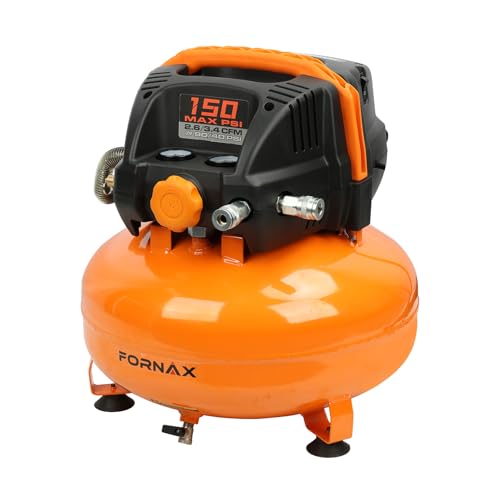
FORNAX 6-Gallon Pancake Air Compressor
The FORNAX 6-Gallon Pancake Air Compressor delivers 2.6 CFM at 90 PSI and up to 150 PSI of maximum pressure, featuring dual couplers and a lightweight 28.8-pound portable footprint. It is a practical pneumatic power source for DIY homeowners, finish carpenters, and garage hobbyists driving nailers or managing tire inflation.
Pros
- Dual quick-connect couplers allow two nailers to operate simultaneously without adding an external splitter manifold
- Generous 6-gallon air tank capacity with a 150 PSI maximum pressure ceiling provides a dependable air reserve
- Lightweight 28.8-pound profile simplifies one-handed carrying up stairs and transport into work vans
- Maintenance-free oil-free pump eliminates oil checks, oil changes, and mess around finished work surfaces
Cons
- Operating sound output rated at 95 dBA is loud and makes hearing protection necessary, especially in closed rooms
- Airflow output of 2.6 CFM at 90 PSI cannot support continuous-demand tools like sanders, grinders, or paint sprayers
- Supplied as a bare-tool compressor without an included air hose, tire inflator chuck, or pneumatic nailers
ECOMAX 6-Gallon 175 PSI Portable Pancake Air
The ECOMAX 6-Gallon Pancake Air Compressor delivers up to 175 PSI and 3 CFM at 90 PSI, providing dependable recovery and dual quick couplers for trim fastening and garage tasks. Weighing approximately 31.5 pounds and featuring cold-weather start capability, it suits DIY homeowners and punch-list contractors seeking a complete portable air setup.
Pros
- High 175 PSI maximum tank pressure provides substantial usable air volume in a compact 6-gallon footprint
- Rated 3 CFM at 90 PSI supports quick pressure recovery between fastening cycles and tire inflation tasks
- Dual quick-connect couplers support running two pneumatic hoses without adding aftermarket splitters
- Comes complete with a 25-foot hose and essential pneumatic accessories for immediate out-of-the-box utility
- Oil-free pump design ensures low ongoing maintenance with no oil levels to monitor or change
Cons
- Output of 3 CFM at 90 PSI is unsuited for continuous high-consumption air tools like sanders or grinders
- Included 25-foot PVC air hose can be stiff and retain tight coils in cold working environments
- Manufacturer does not publish an official dBA rating, and standard oil-free pancake pumps can be loud indoors
Metabo HPT EC914S 6-Gallon 200 PSI Pancake Air
The Metabo HPT EC914S delivers an impressive 200 PSI maximum pressure and 4 CFM at 90 PSI from a 6-gallon tank, giving trim carpenters and remodelers the air volume needed to drive multiple nailers simultaneously. At roughly 41 pounds, it successfully combines high-pressure air storage with practical job-site portability.
Pros
- High 200 PSI tank ceiling stores substantially more usable air than conventional 150 PSI pancake models
- Generous 4 CFM at 90 PSI airflow rating supports multi-tool operation and reduces nailer drive hesitation
- Manageable 41-pound carry weight offers better portability than heavier twin-stack compressor configurations
- Engineered by Metabo HPT to support both lightweight trim nailers and larger framing or roofing guns
Cons
- At 41 pounds, it is noticeably heavier to carry than minimalist 1-to-3 gallon trim-only compressors
- Tank volume and CFM output remain inadequate for continuous high-demand air tools like HVLP sprayers or sanders
- Ships as a bare-tool compressor without included air hoses, pneumatic fittings, or nail guns
CRAFTSMAN 6 Gallon 150 PSI Portable Oil-Free
The CRAFTSMAN 6-Gallon 150 PSI Oil-Free Pancake Air Compressor delivers 2.6 SCFM at 90 PSI via a 1.0 HP low-voltage start motor with factory dual quick couplers. Weighing 30.8 pounds, it provides dependable air delivery for finish carpenters, DIY remodelers, and garage maintenance tasks.
Pros
- Delivers 2.6 SCFM at 90 PSI with a 150 PSI maximum tank ceiling for dependable finish fastening.
- Dual quick couplers allow two pneumatic tools to remain connected at the same time without splitters.
- Oil-free pump design ensures clean air delivery and zero periodic pump oil maintenance.
- Low-voltage start 1.0 HP motor supports reliable startups on standard 120V household outlets.
- Manageable 30.8-pound weight and integrated carry handle provide practical one-person jobsite transport.
Cons
- Air delivery rate of 2.6 SCFM at 90 PSI is not designed for continuous high-demand tools like rotary sanders or paint sprayers.
- Standard oil-free electric motor design generates typical high-pitch operational sound during tank recharge cycles.
- Sold as a bare compressor unit without included air hoses, couplers, or pneumatic nailers.
Evaluating 6-Gallon Air Compressors for Workshop and Jobsite Tasks
Deciding whether a 6-gallon air compressor fits your workshop depends entirely on the pneumatic equipment you plan to connect. A six-gallon air tank provides a compact reservoir of compressed air that excels at light-duty trade applications and routine home maintenance. However, this receiver capacity creates strict boundaries regarding sustained tool operation and airflow volume. Reviewing the mechanical realities of these compact machines clarifies whether this popular size matches your project demands or falls short under heavy workloads.
How a 6-Gallon Air Compressor Operates and Stores Power
Every portable compressor uses an electric motor to drive a reciprocating piston that draws ambient air through an intake filter and forces it into the receiver. As the pump cycles, air molecules compress tightly inside the 6-gallon cylinder until reaching the factory cut-out pressure. Understanding how air compressors build pressure helps clarify why storage capacity functions as an operational buffer rather than an endless source of air. When you depress a pneumatic trigger, air exhausts from the tank until the pressure switch drops to the cut-in threshold and restarts the electric motor.
The primary advantage of a 6-gallon pressure vessel is its balance of physical footprint and usable air cushion. A six-gallon receiver holds enough pressurized volume to absorb brief bursts of air demand without forcing the pump to restart after every single cycle. For instance, when firing individual fasteners, the stored air maintains consistent working line pressure while the motor rests. Once line pressure drops below the cut-in point, typically around 90 to 120 PSI, the pump activates to refill the tank. This cycling buffer protects the electric motor from continuous operation while keeping the tool adequately pressurized.
Single-stage compression pumps power virtually all 6-gallon portable units on the market today. These pumps compress ambient air directly to maximum working pressure in a single piston stroke before pushing it through a one-way check valve into the receiver. Because single-stage designs generate noticeable heat during compression, their duty cycles are structured around intermittent rather than continuous runs. A 6-gallon tank acts as a mechanical shock absorber, providing the cooling intervals necessary to keep compact single-stage pumps operating within safe thermal thresholds.
Pneumatic Tools That Run Smoothly on a 6-Gallon Tank
Pneumatic fastening tools represent the sweet spot for any 6-gallon portable air compressor. Finish nailers, 18-gauge brad nailers, pin nailers, and pneumatic staplers consume very little air volume per discharge, often requiring less than 0.1 cubic feet per shot. Because the air demand occurs in brief fractions of a second, the 6-gallon reservoir easily absorbs dozens of cycles before the motor needs to cycle on. Carpentry crews and hobbyist woodworkers can install baseboards, window casings, and cabinetry trim without waiting for tank recovery.
Framing nailers and roofing nailers also perform well on a 6-gallon tank when operated at a steady pace. While large-body framing tools consume more air than delicate finish guns, high-pressure models like the Metabo HPT EC914S deliver 4 CFM at 90 PSI to support consistent drives. Many portable units feature dual quick-connect couplers, allowing two workers to connect hoses simultaneously for punch-out work. As long as users avoid rapid bump-firing across multiple tools, a quality 6-gallon unit maintains sufficient pressure to seat nails flush into framing lumber.
Routine maintenance tasks around a home garage match the capabilities of a 6-gallon air compressor perfectly. Inflating passenger vehicle tires, motorcycle tires, bicycle tubes, and sports equipment requires moderate pressure but minimal continuous air volume. Blow guns used for clearing dust from workshop benches, machinery tables, and air filters also run smoothly off these compact tanks. The 6-gallon storage volume delivers strong bursts of air pressure that clear debris quickly without causing the regulator to collapse.
High-Demand Tools That Overwhelm 6-Gallon Reserves
Continuous-use pneumatic tools quickly reveal the operational limits of any 6-gallon air compressor. Rotary tools such as dual-action orbital sanders, die grinders, cut-off wheels, and needle scalers require constant airflow ranging from 6 to 15 CFM at 90 PSI. Because most 6-gallon compressors produce between 2.2 and 4.0 CFM at 90 PSI, the connected tool consumes air much faster than the pump can replenish the tank. Within fifteen to twenty seconds of continuous trigger engagement, tank pressure plunges below the required operating threshold.
Paint spraying equipment presents another significant challenge for compact 6-gallon compressors. High-volume, low-pressure spray guns require a continuous stream of air to atomize finishes cleanly and prevent surface defects. When connected to a 6-gallon tank, rapid volume depletion causes line pressure drops that result in spitting, uneven spray patterns, and orange peel textures. The electric motor will run non-stop trying to recover pressure, quickly overheating the pump assembly. If automotive refinishing or extensive cabinet spray painting is your primary objective, a stationary 20-gallon or larger compressor is necessary.
Heavy automotive repair tools such as high-torque pneumatic impact wrenches fall into a gray area on a 6-gallon tank. Breaking loose several lug nuts during a tire rotation is entirely feasible because the tool is used in brief bursts. However, using an air chisel for suspension teardowns or running an impact wrench continuously on stubborn fasteners will drain the tank rapidly. Operators will frequently pause while waiting for the pump to rebuild working pressure, turning straightforward mechanical jobs into frustrating delays.
Air Delivery Volume and Maximum Operating Pressure Explained
Evaluating an air compressor requires separating maximum operating pressure from delivered air volume. Operating pressure determines the force available to drive a fastener or break loose a bolt, while CFM measures the volume of air delivered over time. Basic 6-gallon models, such as the VEVOR 6.3-gallon unit, operate at a maximum of 116 PSI while delivering 3.35 CFM at 90 PSI. Higher-pressure models like the Metabo HPT EC711S achieve 165 PSI, and the EC914S reaches up to 200 PSI while delivering 4.0 CFM at 90 PSI.
Maximum operating pressure directly impacts how much usable air resides inside a 6-gallon tank. When a compressor packs air to 175 or 200 PSI instead of 135 or 150 PSI, it compresses more standard cubic feet of air into the exact same physical space. This higher storage pressure acts as an expanded reserve, providing up to 30 to 40 percent more runtime before line pressure drops to the cut-in point. For tradespeople running pneumatic nailers, higher maximum PSI translates directly into longer intervals between pump recharge cycles.
Delivered CFM ratings at 90 PSI remain the most reliable metric for judging actual tool performance. Manufacturers often advertise peak horsepower figures, but sustained CFM at 90 PSI reveals what the motor and pump can actually deliver under load. Units delivering between 2.6 and 3.0 CFM at 90 PSI, like the ECOMAX and CRAFTSMAN pancake models, easily handle light carpentry and basic garage chores. If you anticipate running larger framing guns or working at a faster clip, opting for a model delivering 3.5 to 4.0 CFM at 90 PSI provides valuable breathing room.
Noise Ratings and Workspace Environment Considerations
Operational noise is a critical factor determining workshop comfort and neighborhood goodwill. Traditional oil-free pancake compressors utilize high-RPM universal motors that spin at speeds exceeding 3,400 RPM. These open, high-speed pumps produce harsh acoustic levels, often registering between 80 and 95 dBA at standard operating distance. Working next to a 95 dBA compressor inside a closed two-car garage or basement quickly leads to ear fatigue and disrupts household members.
Modern compressor engineering has introduced ultra-quiet pump platforms that dramatically lower operational noise levels. Dual-piston designs, such as the FORNAX 6.4-gallon model rated at 65 dB, operate at lower motor speeds and incorporate specialized intake silencers. Running at 65 dB produces roughly the sound level of a normal conversation, allowing woodworkers to operate indoors without heavy hearing protection. Even mid-tier models like the Metabo HPT pancake manage to maintain sound output at 73 dB, which remains noticeably quieter than traditional open-frame units.
Workspace location should heavily influence your choice between a standard high-speed pancake and a quiet dual-piston model. If your 6-gallon compressor will live exclusively on outdoor framing jobsites where ambient construction noise masks motor sound, a standard pancake unit offers rugged durability. Conversely, if you work inside occupied homes installing interior trim or spend evenings in an attached garage, choosing a quiet model is well worth the consideration. Lower decibel ratings transform the user experience from an abrasive distraction into a manageable workshop background hum.
Electrical Demands and Cold-Weather Starting Reliability
Electric motor efficiency and power draw dictate whether a 6-gallon compressor functions smoothly on standard residential wiring. Most 6-gallon models utilize 1.0 to 1.5 horsepower motors that draw between 10 and 14 running amps on standard 120-volt circuits. When the motor first engages, startup inrush current spikes significantly higher for a fraction of a second. If connected to a shared 15-amp branch circuit powering workshop lights or auxiliary tools, this startup surge can easily trip the circuit breaker.
Cold-weather jobsite conditions introduce additional starting challenges for electric air compressor motors. Freezing temperatures increase mechanical resistance within cylinder seals, making it difficult for the motor to turn over against cold air. Models engineered with low-voltage and cold-weather starting features, such as those found on ECOMAX and Metabo HPT units, use efficient motor windings to overcome startup resistance. An integrated unloader valve also depressurizes the pump head when the motor stops, allowing the motor to spin up freely without fighting trapped head pressure during restart.
Extension cord selection plays a critical role in preventing motor stalling and nuisance breaker trips. Using light-duty household extension cords causes severe voltage drops across long wire lengths, starving the electric motor of power during startup. This voltage reduction causes the motor to hum, overheat, and trip its internal thermal overload switch. To ensure smooth operation, always plug the compressor directly into a 20-amp wall outlet or use a heavy-duty 12-gauge cord. Alternatively, running a longer air hose instead of an electrical extension cord eliminates voltage drop entirely.
Maintenance Protocols and Moisture Drainage Management
Virtually all modern 6-gallon portable air compressors feature oil-free pump mechanisms designed for zero lubrication maintenance. These pumps utilize self-lubricating PTFE cylinder sleeves and piston rings that eliminate regular oil level monitoring and fluid changes. Before putting a new unit into heavy service, reviewing manufacturer procedures for breaking in an oilless air compressor helps seat the internal components properly. Running the machine with the drain valve wide open for fifteen to twenty minutes allows internal mechanical tolerances to stabilize smoothly.
Moisture accumulation inside the steel air receiver represents the primary maintenance threat to any portable compressor. When ambient air compresses inside the cylinder, water vapor condenses into liquid water that settles at the lowest point of the tank bottom. If left unchecked, this standing water corrodes the structural steel walls from the inside out, weakening the pressure vessel over time. Moisture also migrates down the air line, contaminating pneumatic tools, rusting internal cylinder components, and ruining spray finishes.
Purging condensation through the tank drain valve at the end of every working day is mandatory for tank longevity and safety. Many compact 6-gallon compressors feature bottom-mounted drain valves that range from threaded needle petcocks to convenient quarter-turn brass ball valves. Always disconnect power, dial down the regulator, and open the drain valve slowly while moderate pressure remains in the tank to blast out standing water. Regularly pulling the ring on the ASME safety relief valve also verifies that the safety mechanism opens freely to prevent dangerous over-pressurization conditions.
Portability, Weight Distribution, and Jobsite Durability
Jobsite mobility is one of the strongest selling points of the 6-gallon air compressor category. These machines generally weigh between 27 and 42 pounds, making them light enough for an individual tradesperson to lift into a truck or carry up stairs. For example, the ECOMAX pancake weighs only 27.6 pounds, while the CRAFTSMAN model registers at 30.8 pounds, optimizing grab-and-go convenience. A centrally balanced carry handle and a compact footprint allow these units to slide behind truck seats or store neatly beneath garage workbenches.
Tank architecture also plays a significant role in jobsite stability and transport durability. Pancake-style tanks feature a wide, circular base with rubber isolator feet that prevent the compressor from tipping over on uneven jobsite subfloors. Other models utilize a horizontal pontoon layout wrapped in a protective tubular steel roll cage, such as the VEVOR and Metabo HPT designs. These rugged steel frames shield sensitive components, including pressure gauges, regulator knobs, and electrical switches, from accidental impacts and jobsite drops.
Manifold features and connector layouts directly affect daily workflow productivity. Look for compressors equipped with dual quick-connect couplers, allowing you to run two separate air hoses simultaneously for coordinated trim work. Clear, legible dual gauges display tank pressure alongside regulated tool output pressure, ensuring you dial in the exact PSI needed for delicate fasteners. Integrated cord wraps and hose storage brackets further keep jobsite transit organized and reduce clutter during transport between work areas.
Determining if a 6-Gallon Compressor Fits Your Specific Needs
Assessing whether a 6-gallon compressor is a wise investment ultimately comes down to your primary tool inventory and workflow tempo. If your pneumatic tasks center on finish carpentry, brad nailing, stapling, craft woodworking, tire inflation, and routine garage cleanup, a 6-gallon compressor provides outstanding performance, excellent portability, and modest electrical demands. It delivers sufficient stored volume to keep intermittent tools running seamlessly without demanding substantial floor space or heavy transport effort. For the vast majority of DIY homeowners and mobile finish carpenters, this equipment category represents an ideal practical solution.
Conversely, buyers expecting to power air-hungry automotive tools, high-volume paint sprayers, or continuous sanding machines should bypass the 6-gallon platform entirely. The physical laws of compressed air mean that a compact 120-volt single-stage pump simply cannot generate the sustained CFM required for continuous rotary air tools. Investing in a larger 20 to 60-gallon workshop compressor with higher continuous air delivery avoids tool starvation, pump burnout, and project delays. Matching your specific tool air requirements to realistic compressor capabilities ensures you select equipment that enhances productivity rather than causing constant frustration.
About the author
Bob Beacham is an experienced tools and workshop writer with deep knowledge of power equipment, mechanical systems, and practical DIY applications. His coverage of air compressors, welding equipment, saws, and workshop tools helps translate technical specifications into useful guidance for homeowners and serious DIYers.