
Is 3 Gallon Air Compressor Enough? Practical Guide for 2026
Is 3 gallon air compressor enough for your projects? Learn how tank size, CFM ratings, and tool demands compare in October 2026.
 By Tony Carrick
Updated October 7, 2026
By Tony Carrick
Updated October 7, 2026

Delivered airflow volume measured at 90 PSI versus sustained pneumatic tool consumption often creates confusion when shopping for portable workshop gear. Many hobbyists and contractors wonder whether a compact tank can keep up with their daily chores without constantly stalling out mid-task. Deciding whether a 3 gallon air compressor provides adequate performance comes down to evaluating intermittent fastener cycles against heavy, continuous airflow demands. Selecting the right equipment requires matching your specific tool roster to realistic pump output before starting your next project.
Answering whether is 3 gallon air compressor enough requires balancing tank reserve capacity, pump recovery speed, and specific tool operating requirements. While small pancake and horizontal tanks excel at trim carpentry, stapling, and routine vehicle tire inflation, continuous tools like rotary sanders or spray guns quickly drain small air reserves. Understanding motor output, operational decibels, and duty cycle limits ensures you choose equipment suited to your intended workspace without experiencing sudden pressure dropoffs during critical work sessions.
| Award | Product | ACR Score About ACR ScoreThe ACR Score is our own rating from 0 to 10, based on performance, design and build, ease of use, and value. It reflects independent research and is never influenced by manufacturers, retailers, or affiliate commissions. Learn more › | |
|---|---|---|---|
| Best Overall |
ECOMAX 3-Gallon Portable Pancake Air Compressor
|
8.8/10 | Buy |
| Best Budget |
 Ironton 3-Gallon Oil-Free Pancake Air Compressor
|
8.6/10 | Buy |
| Best Premium |
 Makita MAC320Q Quiet Series 1.5 HP 3-Gallon
|
8.1/10 | Buy |
 FORNAX 3-Gallon Pancake Air Compressor
|
7.8/10 | Buy | |
| Best Value |
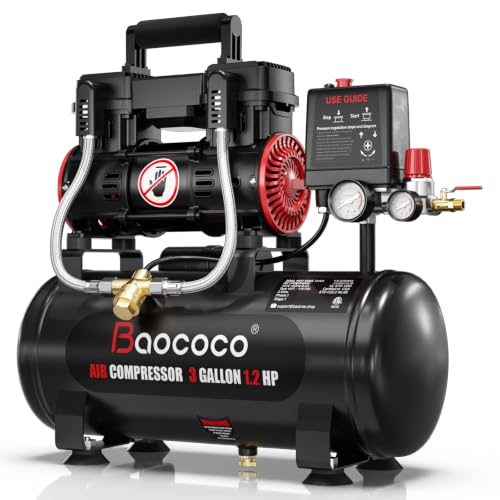 Baococo 3-Gallon Ultra Quiet Air Compressor
|
7.8/10 | Buy |
ECOMAX 3-Gallon Portable Pancake Air Compressor
Delivering 0.6 SCFM at 90 PSI with a 110 max PSI 3-gallon tank, this ultra-lightweight 16.3-pound pancake compressor is built for light-duty DIY tasks and tire inflation. It provides a convenient, low-maintenance air source complete with an 11-piece accessory kit for homeowners and hobbyists.
Pros
- Extremely lightweight at only 16.3 pounds with a balanced flip-up carry handle for easy mobility
- Generous 11-piece accessory pack provides immediate utility for tire filling, blow-off tasks, and air connections
- Oil-free pump design ensures simple, maintenance-free operation for casual home users
- Dual quick-connect couplers allow flexible setups without needing aftermarket splitters
Cons
- Rated airflow delivery of 0.6 SCFM at 90 PSI is strictly limited to intermittent fastening and inflation
- Maximum pressure threshold of 110 PSI provides less air reserve than larger 150-165 PSI contractor compressors
- Not suitable for continuous high-demand air tools like paint sprayers, sanders, or heavy impact wrenches
Ironton 3-Gallon Oil-Free Pancake Air Compressor
The Ironton 3-Gallon Oil-Free Pancake Air Compressor combines a 0.3 HP motor and 110 PSI max pressure with an ultra-portable 20.6-pound frame and fold-down handle. It is a practical, low-maintenance option for DIY homeowners and hobbyists handling light brad nailing, stapling, and tire inflation.
Pros
- Lightweight 20.6-pound build with a fold-down carry handle makes one-handed portability nearly effortless
- Wide pancake base delivers outstanding stability with a low center of gravity to prevent tipping
- Zero-maintenance oil-free pump means clean discharge air and no messy oil changes
- Protective shroud includes convenient molded wraps for both the power cord and air hose
- Large regulator knob and quick-connect coupler allow fast, intuitive line adjustments
Cons
- Modest 0.3 HP motor and 110 PSI ceiling cannot support continuous high-CFM air tools like sanders or sprayers
- 3-gallon capacity requires occasional recovery pauses during rapid fastener firing
- Bare-tool setup does not include an air hose, tire chuck, or pneumatic nailer out of the box
Makita MAC320Q Quiet Series 1.5 HP 3-Gallon
The Makita MAC320Q Quiet Series delivers dependable pneumatic compression at a quiet 60 dB rating, pairing a 1-1/2 HP motor with a low-RPM dual-piston oil-free pump. It is an ideal fit for finish carpenters, DIY woodworkers, and indoor garage hobbyists seeking clean, low-maintenance air power without loud jobsite noise.
Pros
- Exceptionally quiet 60 dB operating noise allows easy conversation and indoor trim work without hearing fatigue
- Low 1,750 RPM pump speed runs cooler and helps extend the working lifespan of the motor and pump assemblies
- Dual-piston oil-free pump design requires zero crankcase fluid maintenance and prevents oil discharge into air lines
- Heavy-duty full tubular roll-cage frame safeguards vital components against jobsite drops, bumps, and vehicle transport hazards
Cons
- Substantial net weight of nearly 57 pounds makes one-handed carrying demanding across large jobsites without integrated wheels
- A 3-gallon air reservoir is not intended for sustained high-demand pneumatic tools such as rotary sanders or spray guns
- Lacks integrated transport wheels, requiring manual lifting when moving across jobsite terrain or stairs
FORNAX 3-Gallon Pancake Air Compressor
Built for quick household inflations and light pneumatic jobs, this compact unit features an oil-free pump that requires minimal upkeep. At under 20 pounds, it is exceptionally easy to carry, though its low air delivery restricts it to lighter-duty tasks.
Pros
- Low-maintenance oil-free pump mechanism
- Very lightweight and easy to transport
- Compact pancake footprint saves garage space
- Sufficient 110 PSI pressure for basic tasks
Cons
- High noise output rated at 89 dB(A)
- Limited air delivery of 0.8 CFM at 90 PSI
- Lower 110 PSI ceiling than typical workshop compressors
Baococo 3-Gallon Ultra Quiet Air Compressor
The Baococo 3-Gallon Ultra Quiet Air Compressor delivers up to 115 PSI at approximately 70dB, powered by a 1.2HP copper motor and an oil-free pump. With a 20-second recovery cycle, dual quick couplers, and integrated transport wheels, it is a practical, budget-friendly choice for indoor trim work, DIY repairs, and garage tire maintenance.
Pros
- Operates at roughly 70dB, allowing conversation and indoor use without deafening noise
- Rapid 20-second tank recovery cycle helps keep intermittent nailing projects moving
- Dual quick-connect couplers allow quick tool changes or running two air lines at once
- Built-in wheels and sturdy carry handle make rolling or lifting across the workspace easy
- Oil-free pump eliminates messy crankcase checks and prevents oil leaks during vehicle transport
Cons
- Maximum tank pressure tops out at 115 PSI, lower than 135 to 175 PSI contractor-grade units
- Manufacturer does not publish continuous CFM at 90 PSI, making it unsuited for continuous air tools like sanders or grinders
- Compact 3-gallon air reserve requires frequent motor cycling under rapid pneumatic demand
Evaluating When a 3-Gallon Air Compressor Is Enough for Your Workshop and Jobsite Tasks
Determining whether a three-gallon compressed air system meets your needs depends directly on your intended pneumatic tools. For light punch-list carpentry, inflating vehicle tires, and blowing dust from workpieces, a compact reservoir delivers plenty of volume. However, pairing this tank capacity with high-draw mechanics tools quickly reveals strict mechanical limits. Understanding where that performance threshold lies prevents tool stalls and unnecessary project delays.
Compressed air storage functions as a temporary energy buffer between the pump mechanism and your air tools. When your tool uses less air volume than the pump produces, the tank remains pressurized and supports smooth operation. When tool demand exceeds pump production, the reservoir quickly empties and forces you to pause while pressure recovers. Evaluating your tool roster before purchasing ensures you pick the right capacity for your projects.
Understanding Air Delivery: Tank Reserve Buffer Versus Delivered CFM
Tank capacity measured in gallons indicates storage volume, but it does not represent how much continuous work a compressor can perform. The more critical specification is standard cubic feet per minute, abbreviated as CFM, measured at ninety pounds per square inch. A three-gallon tank provides a small reserve, but pump output determines whether that air supply sustains steady tool operation. Without adequate pump replenishment, a small tank empties in a matter of seconds.
Many compact pancake units produce modest air delivery suited strictly for brief operational bursts. For example, the FORNAX Pancake Air Compressor delivers approximately 0.8 CFM at 90 PSI, while the ECOMAX pancake unit delivers around 0.6 SCFM at 90 PSI. These volumetric output numbers are well suited for firing single fasteners or inflating vehicle tires. In contrast, workshop tools that consume four to eight CFM quickly starve these pumps of air and cause severe pressure drops.
Intermittent Fastening Versus Continuous Air Tools
Pneumatic tools fall into two distinct operational categories based on how they consume compressed air during active use. Intermittent tools consume a discrete burst of air each time the operator pulls the trigger. Fastening tools like brad nailers, pin nailers, and narrow crown staplers operate on this intermittent firing cycle. Because users pause naturally between individual shots to align trim pieces, the pump has ample time to recover between cycles.
Continuous air tools operate under an entirely different pneumatic dynamic by drawing high volumes of air without interruption. Rotary orbital sanders, high-speed die grinders, cut-off wheels, and paint sprayers require constant airflow to maintain working speeds. A three-gallon tank cannot sustain these continuous tools because the reservoir drains faster than a compact pump can compress fresh air. Attempting to run a pneumatic sander on a small tank results in immediate tool stalling and severe motor strain.
When tool air demand matches the pump delivery profile, users experience seamless performance and consistent line pressure. Firing an 18-gauge brad nailer uses less than 0.5 CFM on average during typical trim installation work. Because tool consumption remains below the delivery threshold of units like the FORNAX or ECOMAX compressors, the three-gallon tank easily keeps pace. Matching the intermittent nature of your projects to the compressor airflow profile is the key to reliable operation.
Practical Performance Across Common Home and Garage Tasks
Tire inflation represents one of the most common applications where a three-gallon compressor proves entirely adequate. Topping off passenger car tires, bicycle tires, lawnmower tires, and utility trailer wheels requires moderate pressure but relatively low overall air volume. A portable unit easily brings passenger tires up to proper inflation pressure without exhausting the tank reserve buffer. However, seating bead seals on large truck or tractor tires may require larger initial air bursts than three gallons can supply.
Finish woodworking and interior trim carpentry represent another ideal operational match for three-gallon air systems. Installing baseboards, crown molding, and door casings with 16-gauge or 18-gauge finish nailers demands minimal air volume per cycle. The compressor cycles on occasionally, refills the small three-gallon reservoir within twenty to thirty seconds, and shuts down cleanly. Cabinetmakers and finish carpenters frequently rely on compact pancake compressors specifically because they deliver enough air without cluttering the jobsite floor.
Automotive repair and mechanical maintenance present significant hurdles for three-gallon compressed air tanks. While a small unit can occasionally power an air ratchet for a loose bolt, heavy-duty pneumatic impact wrenches struggle under low air volume. Removing stubborn lug nuts requires sudden high airflow that quickly drops line pressure below the wrench torque rating. For automotive shops running air chisels, impact guns, or tire changers, a stationary compressor with a larger tank remains essential.
Motor Horsepower, Operating Pressure, and Pressure Switch Cycles
Motor horsepower directly drives how efficiently a compressor pump can compress ambient air into the storage vessel. Small utility compressors often utilize compact electric motors engineered for low electrical draw and lightweight transport. For instance, the Ironton Oil-Free Pancake Air Compressor features a 0.3 HP motor paired with a 110 PSI maximum pressure rating for basic utility chores. This motor size keeps electrical consumption low while generating sufficient pressure for common inflation and craft stapling duties.
More robust jobsite compressors incorporate higher horsepower ratings to accelerate recovery times and handle heavier trim workloads. The Makita MAC320Q Quiet Series steps up to a 1-1/2 HP electric motor that drives an efficient dual-piston pump assembly. Similarly, the Baococo 3Gallon Ultra Quiet Air Compressor utilizes a 1.2 HP motor with copper windings to produce up to 115 PSI of maximum pressure. Higher horsepower allows the pump to cycle back up to operating pressure significantly faster between tool actuations.
Pressure switch calibration controls the exact cut-in and cut-out thresholds that dictate pump cycling intervals during operation. On the Ironton pancake compressor, the pressure switch engages the motor at 85 PSI and cuts power automatically once tank pressure reaches 110 PSI. This 25 PSI differential creates a reliable working buffer for standard pneumatic finish tools that operate around 70 to 90 PSI. Setting proper regulator thresholds prevents air tools from starving before the motor restarts.
Tank Recovery Speed, Refill Times, and Cycle Frequency
Initial tank fill time measures how many seconds a compressor takes to pressurize from a completely empty state up to auto cut-off. Specifications for the Baococo ultra-quiet model indicate a cold-start fill time of approximately 50 seconds from zero to full working pressure. Once pressurized, subsequent recovery cycles require only about 20 seconds to refill the tank from cut-in back to cut-out. Fast recovery intervals prevent users from standing idle while waiting for line pressure to rebuild.
Excessive cycling frequency occurs when air demand continuously drains the tank faster than the recovery speed can replenish it. If your compressor kicks on after every two or three fastener shots, tool consumption may be pushing the boundaries of your tank capacity. High cycle frequency increases mechanical wear on pump pistons, valves, and motor windings over long work sessions. Choosing a compressor with a strong recovery rate helps maintain smooth tool operation and prolongs equipment life.
Operational Sound Levels: Low-RPM Induction Versus High-Speed Motors
Operating noise levels represent one of the most noticeable differences among modern portable air compressors on the market. Traditional small compressors often employ high-RPM universal motors that produce loud, piercing mechanical noise during every cycle. For example, the FORNAX 3-gallon pancake compressor operates at 4,950 RPM and produces a sound rating of 89 dBA under full load. In an enclosed garage or finished room, sound levels approaching 90 dBA cause significant ear fatigue without hearing protection.
Quiet series compressors resolve noise issues by utilizing low-speed induction motors running at significantly lower revolutions per minute. The Makita MAC320Q Quiet Series operates at just 1,750 RPM, which drastically dampens motor vibration and mechanical friction. This low-speed pump design drops operational noise down to 60 dB, making it quiet enough for indoor finish work without disrupting building occupants. Low operating noise transforms the user experience during long residential remodeling projects.
Advanced intake mufflers and precision flow channels also contribute to low decibel output in modern quiet compressors. The Baococo 3Gallon Ultra Quiet model utilizes specialized silent air valves and flow channels to achieve an operating noise level around 70 dB. Reducing pump sound to normal conversation levels allows carpenters and woodworkers to communicate safely on active jobsites. When selecting a three-gallon unit for indoor use, low decibel performance is often as important as tank capacity.
Electrical Requirements, Breaker Safety, and Duty Cycle Limits
Portable three-gallon air compressors run conveniently on standard 120-volt household alternating current circuits. Most compact units draw modest running current, allowing them to plug into standard 15-amp garage or workshop outlets without modification. However, electric compressor motors experience a brief surge of inrush current during the initial fraction of a second when starting against head pressure. If a circuit already powers heavy shop lighting or power tools, that startup inrush can trip standard circuit breakers.
Duty cycle ratings define the percentage of time a compressor pump can run safely within any given operational window. Most oil-free utility compressors carry intermittent duty cycle ratings, meaning they require regular resting periods to shed compression heat. If an undersized three-gallon tank is forced to run continuously to support high-demand tools, the pump heads can overheat and cause premature seal failure. Exceeding rated duty cycles risks damaging internal components and shortening overall equipment life.
Weight, Form Factor, and Jobsite Portability
Form factor and physical dimensions directly influence how easily a three-gallon compressor transports between work locations. Low-profile pancake designs feature a wide base that keeps the center of gravity low to the floor, preventing accidental tip-overs when pulling air hoses. The Ironton pancake model features a wide footprint engineered for stability on uneven subfloors and crowded workbenches. Compact dimensions allow these units to store neatly beneath workbenches or ride inside vehicle trunks without consuming valuable cargo space.
Total carry weight plays a major role for remodelers and handymen who must haul pneumatic equipment up staircases and across job sites. The ECOMAX pancake compressor weighs only 16.3 pounds, featuring an integrated flip-up handle that makes one-handed carrying effortless. Similarly, the FORNAX pancake unit maintains an easily manageable weight of 18.90 pounds for simple portability. For contractors carrying toolboxes, fasteners, and hoses in a single trip, a lightweight three-gallon compressor significantly reduces physical strain throughout the workday.
Condensation Purging and Tank Maintenance
Compressing atmospheric air naturally draws ambient moisture into the compressor system, where it cools and condenses along internal tank walls. Over extended periods of use, accumulated water pools at the bottom of the steel pressure vessel, initiating internal oxidation and corrosion. Allowing liquid water to stand inside an air tank weakens the structural integrity of the steel over time. Regular tank draining remains the most vital maintenance step for preserving any compressed air system.
Draining the storage tank after every work session purges liquid condensation before oxidation can begin inside the cylinder. Most three-gallon compressors feature an underside drain valve designed to vent trapped water when turned under low residual pressure. Operators should always disconnect power, depressurize down to low pressure, and wear eye protection while opening the valve to expel pooled moisture. Neglecting this routine purge allows moisture into pneumatic hoses, where it degrades internal tool seals.
Final Verdict: When 3 Gallons Fits Your Workshop Needs
A 3-gallon air compressor is more than enough for homeowners, hobbyists, and finish carpenters whose work centers on intermittent air consumption. It excels at tire inflation, sports gear maintenance, seasonal air dusting, and running 18-gauge brad nailers or crown staplers across interior trim jobs. The compact footprint, light carry weight, and standard 120-volt convenience make it an outstanding tool for punch-list repairs and mobile contractor setups. For these everyday residential tasks, buying a larger compressor adds unnecessary bulk.
However, if your workshop plans involve heavy automotive restoration, spray painting, sandblasting, or continuous grinding, a three-gallon tank will quickly prove insufficient. Continuous tools demand sustained volumetric flow rates that compact single-stage pumps simply cannot deliver without stalling and overheating. In production framing or multi-gun roofing crews, rapid firing cycles will constantly outrun the recovery speed of a three-gallon reservoir. Knowing your air consumption requirements beforehand ensures you invest in equipment that matches your actual workflow.
About the author
Tony Carrick is an experienced product researcher and writer specializing in tools, home improvement, automotive maintenance, and consumer equipment. With extensive experience reviewing tools and tackling hands-on renovation projects, he brings a buyer-focused perspective to compressor performance, usability, and overall value.