
Is 2 Gallon Air Compressor Enough: A Practical Guide for 2026
Is 2 Gallon Air Compressor Enough for garage projects in October 2026? Learn what air tools run smoothly, CFM delivery limits, and realistic runtimes.
 By Tony Carrick
Updated October 7, 2026
By Tony Carrick
Updated October 7, 2026

Evaluating pneumatic tools often begins with a fundamental sizing question: is 2 gallon air compressor enough for everyday garage maintenance, home woodworking, and automotive care? Portable compressors with two-gallon air reservoirs are wildly popular because they are lightweight, simple to store, and easy to carry between job sites. However, matching a compact tank to demanding pneumatic equipment requires understanding the critical balance between stored air capacity and continuous pump output. Many buyers assume that tank volume alone dictates tool performance, but motor horsepower and delivered cubic feet per minute at operating pressure determine real capability.
A compact two-gallon setup easily manages intermittent tasks like brad nailing, airbrushing, and topping off vehicle tires. In contrast, tools with sustained airflow requirements like rotary sanders or automotive paint sprayers will quickly drain a small air reservoir and stall out. Examining air compressor CFM delivery, maximum working pressure ratings, recovery cycle times, and operational noise levels helps clarify whether a two-gallon compressor fits your specific workflow. This guide breaks down exactly what a two-gallon air compressor can accomplish, where its mechanical limits lie, and how to select the right equipment for your project needs.
| Award | Product | ACR Score About ACR ScoreThe ACR Score is our own rating from 0 to 10, based on performance, design and build, ease of use, and value. It reflects independent research and is never influenced by manufacturers, retailers, or affiliate commissions. Learn more › | |
|---|---|---|---|
| Best Overall |
Stealth SAQ-1234 2-Gallon Air Compressor
|
9.2/10 | Buy |
| Best Value |
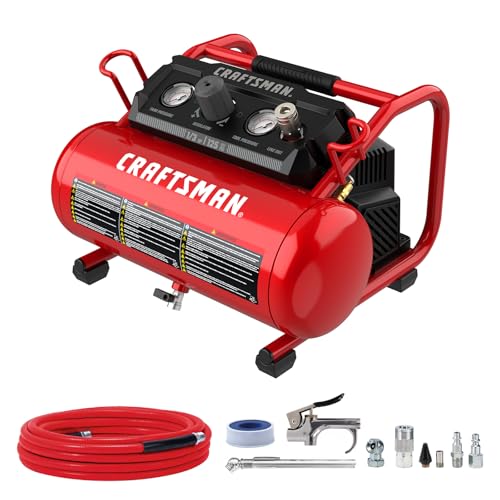 CRAFTSMAN 2-Gallon Portable Air Compressor
|
9.1/10 | Buy |
| Best Premium |
 California Air Tools 2010A 2-Gallon Compressor
|
9.1/10 | Buy |
| Best Budget |
 ECOMAX 2-Gallon 125 PSI Air Compressor
|
8.9/10 | Buy |
 Baococo 8 Gallon Portable Air Compressor
|
8.6/10 | Buy | |
 VEVOR 2 Gallon 1HP Air Compressor
|
7.8/10 | Buy |
Stealth SAQ-1234 2-Gallon Air Compressor
Operating at under 60 decibels, this compact unit provides exceptionally quiet performance for garage DIY tasks, brad nailing, and tire inflation. Its oil-free motor reaches up to 125 PSI while keeping routine maintenance to a minimum.
Pros
- Quiet operation suitable for indoor workspaces
- Maintenance-free oil-free pump design
- Durable steel tank with rubber vibration dampening
- Reliable pressure recovery for intermittent nailing
Cons
- Relatively heavy to carry at nearly 42 pounds
- Small two-gallon tank limits continuous tool use
- Modest 1.8 CFM flow rate at 90 PSI
CRAFTSMAN 2-Gallon Portable Air Compressor
This CRAFTSMAN 2-gallon portable compressor package pairs a max 125 PSI oil-free pump with a versatile 10-piece pneumatic accessory kit using standard 1/4-inch NPT fittings. It is a practical, lightweight solution for DIYers and homeowners tackling tire inflation, air dusting, and light fastening.
Pros
- Complete out-of-the-box pneumatic package with air hose, blow gun, tire chuck, and 1/4-inch NPT quick-connect hardware
- Lightweight 19-pound carry weight makes moving between the garage, driveway, and workbench effortless
- Oil-free pump eliminates crankcase oil checks and prevents oil aerosol contamination in downstream air lines
- Dual quick couplings allow quick hookups without needing additional brass splitters
Cons
- Small 2-gallon receiver tank and 1/3 HP motor are limited to light-duty pneumatic tasks rather than continuous air-hungry tools
- The included starter air hose and accessories are entry-level components that high-volume shops may eventually want to upgrade
- Fittings utilize standard 1/4-inch auto profile plugs which require matching couplers if your shop uses alternate pneumatic profiles
California Air Tools 2010A 2-Gallon Compressor
Operating at just 60 decibels, this compact unit delivers reliable airflow with minimal noise disruption. Its rust-free aluminum tank and oil-free dual-piston pump make it well suited for indoor trim work and noise-sensitive spaces.
Pros
- Exceptionally quiet operation at only 60 decibels
- Lightweight rust-free aluminum tank design
- Low-maintenance oil-free dual-piston system
- Quick 14-second recovery time between cycles
Cons
- Modest 2-gallon tank limits continuous heavy tool use
- 120 PSI maximum pressure is below heavy-duty standards
- Air output is insufficient for sustained high-demand air tools
ECOMAX 2-Gallon 125 PSI Air Compressor
Built for quick inflation, finish nailing, and light workshop tasks, this compact 16.8-pound compressor pairs an oil-free pump with a 125 PSI maximum output. It includes a versatile 10-piece accessory kit, making it an accessible setup for DIYers and garage hobbyists.
Pros
- Lightweight frame is exceptionally easy to carry
- Maintenance-free oil-free pump mechanism
- Comes with a complete 10-piece accessory bundle
- Dual couplers enable swift pneumatic connections
Cons
- Modest 1/3 HP motor limits sustained high-demand air delivery
- Compact 2-gallon capacity requires frequent pump cycling
Baococo 8 Gallon Portable Air Compressor
The Baococo 8-gallon portable air compressor pairs a 2HP electric motor with a 150 PSI receiver tank, delivering 2.8 SCFM at 90 PSI. It provides a solid, accessible air source for garage DIYers tackling tire inflation, car detailing, and pneumatic finish nailing.
Pros
- Useful 8-gallon tank capacity cushions air demand better than smaller pancake style compressors
- 150 PSI peak tank pressure accommodates common automotive tire inflators and pneumatic nailers
- Standard 120V 60Hz power compatibility allows easy plug-and-play use in residential garages
- Sufficient airflow rating of 2.8 SCFM at 90 PSI for light woodworking, trim carpentry, and cleaning tasks
Cons
- Continuous high-CFM pneumatic tools like rotary sanders and heavy-duty 1/2-inch impact wrenches will quickly deplete tank reserves
- Contradictory product listing notes an oil-free tank in the title while mentioning regular oil checks in the description, requiring users to inspect pump details before first start
- Does not include an air hose, quick-connect fittings, or downstream regulator accessories in the box
VEVOR 2 Gallon 1HP Air Compressor
Built for DIYers tackling tire inflation and light pneumatic work, this compact unit delivers 2.1 CFM at 90 PSI with a maintenance-free oil-free pump. Its sturdy steel tank and integrated safety shut-offs offer dependable performance for home garages.
Pros
- Maintenance-free oil-free pump design
- Durable rust-resistant three-layer steel tank
- Reliable automatic overheating and overpressure shut-off
- Adequate air delivery for light pneumatic tools
Cons
- Small two-gallon tank limits continuous high-demand tool use
- Produces 81 dB of operational noise
- Relatively heavy at 33 pounds for quick carrying
Evaluating Usable Capacity: Is a 2 Gallon Air Compressor Enough?
Deciding whether a two-gallon air compressor meets your needs depends entirely on the air consumption profile of your pneumatic tools. For light trim carpentry, hobby crafting, and standard tire maintenance, a two-gallon tank provides plenty of volume to complete tasks efficiently. However, continuous pneumatic tools demand far more air volume than a compact storage tank can supply. Understanding the mechanical relationship between stored pressure, continuous pump airflow, and tool consumption prevents frustrating performance bottlenecks in your workshop.
Tank Storage Reserve Versus Continuous Airflow Delivery
An air compressor tank acts as a temporary pressurized storage buffer rather than an endless generator of pneumatic energy. The pump compresses ambient air and stores it inside the vessel until pressure reaches the factory cut-out threshold, typically between 120 and 125 PSI. When you trigger an air tool, the stored air discharges instantly to maintain regulated line pressure. If your tool draws air faster than the pump can replenish it, the tank pressure drops below the cut-in threshold and the motor recharges the vessel.
Air tool consumption is measured in cubic feet per minute, abbreviated as CFM, evaluated at working pressures like 90 PSI or 40 PSI. A typical two-gallon compressor produces between 1.8 CFM and 2.2 CFM at 90 PSI, depending on whether it utilizes a 1/3 horsepower or 1.0 horsepower motor. Continuous tools like rotary orbital sanders or die grinders consume anywhere from 6 to 12 CFM at 90 PSI. A two-gallon tank provides only a brief buffer before line pressure drops, causing high-demand tools to stall while the pump runs continuously.
Pneumatic Tasks Well Suited for a 2 Gallon Air Compressor
Intermittent pneumatic tools represent the sweet spot for two-gallon air compressors because they operate in short bursts with pauses between cycles. Finish nailers, 18-gauge brad nailers, and pneumatic staplers consume only a tiny fraction of a cubic foot of air per fired fastener. A compact two-gallon tank can fire dozens of brad nails before the internal pressure drops to the cut-in point. Because operators pause to reposition materials, the motor easily recovers full pressure without disrupting the work rhythm.
Tire inflation is another everyday task where a two-gallon compressor performs reliably. Topping off bicycle tires, sports equipment, passenger car tires, and utility trailers requires modest volumes of compressed air within standard 125 PSI limits. Compact models like the CRAFTSMAN Air Compressor and the ECOMAX Air Compressor often include multi-piece accessory kits containing ball foot air chucks and tire gauges. These portable packages make routine seasonal tire maintenance simple and accessible in residential driveways.
Craft airbrushing and dusting applications also match the capabilities of small air tanks. Airbrushes operate at low working pressures, usually between 15 and 35 PSI, drawing minimal volume from the storage vessel. The two-gallon capacity acts as an effective pulsation dampener, smoothing out piston pulses so the airbrush receives steady airflow. Using a blow gun nozzle to clear sawdust from workbenches requires short bursts that a compact tank handles without straining the motor.
Pneumatic Tools That Exceed 2 Gallon Capacity Limits
Continuous pneumatic tools demand steady airflow that quickly overwhelms a two-gallon compressor pump. Rotary orbital sanders, high-speed die grinders, and pneumatic cut-off tools require massive volumes of air to maintain rotational speed under load. When connected to a two-gallon tank, these continuous tools exhaust the pressurized buffer in less than ten seconds. Once the storage reserve empties, operating line pressure falls below usable levels and the motor runs non-stop without catching up.
Paint spraying equipment presents a similar capacity hurdle for compact air systems. Standard high volume low pressure spray guns require continuous air volume between 8 and 15 CFM at 40 PSI to atomize paint smoothly. Operating a full-size spray gun on a two-gallon tank leads to rapid pressure drops that create uneven spray patterns and splattered finishes. While tiny airbrushes work fine, applying automotive clear coats or spraying kitchen cabinets requires a much larger stationary workshop compressor.
Heavy-duty construction fastening tools also test the limits of compact tanks. A single framing nailer can drive occasional nails for fence repairs, but rapid bump-fire framing on subflooring rapidly depletes a small tank. Driving large framing spikes requires substantial air volume per cycle to sink fasteners flush into dense framing lumber. Rapid firing causes line pressure to sink below driving requirements, leaving fasteners standing proud of the wood surface.
Motor Horsepower, Recovery Speeds, and Duty Cycle Realities
Motor output determines how fast a two-gallon compressor can recover between operational cycles. Compressors equipped with 1/3 horsepower motors draw minimal electrical power, but they take longer to recharge the storage vessel. In contrast, models like the California Air Tools 2010A feature a 1.0 horsepower motor delivering 2.20 CFM at 90 PSI. That extra mechanical output recharges the tank from 90 PSI to 120 PSI in just 14 seconds, minimizing downtime between fastening tasks.
Rapid recovery speed keeps the regulated line pressure consistent across repetitive fastening work. When an air pump takes multiple minutes to replenish the tank, operators spend valuable project time waiting for pressure to build. Dual-piston oil-free pumps fill a two-gallon reservoir from empty to maximum pressure in under one minute. Consistent air replenishment ensures that pneumatic nailers drive fasteners to uniform depths without requiring manual depth adjustments.
Operating duty cycle ratings represent another vital factor that users must consider. Most small consumer compressors feature intermittent duty ratings, meaning the pump should run for only a fraction of any given hour. Forcing a compact unit to supply high-draw continuous air tools causes the pump to run non-stop, generating excessive internal friction and heat. Excessive heat risks premature piston seal wear and can trip automatic thermal overload protectors that shut down the motor.
Operational Decibels and Indoor Workshop Sound Levels
Operating noise is one of the most critical considerations when running a compressor in residential spaces. Traditional open-frame compressors powered by high-RPM universal motors often emit sound levels above 80 decibels. For example, the VEVOR Air Compressor produces approximately 81 dB during operation, which creates significant noise in small garages. Prolonged exposure to sound at that intensity can cause operator fatigue in enclosed basements and may disturb neighboring households.
Modern quiet-series compressors have addressed noise concerns by pairing slow-turning induction motors with dual-piston pump assemblies. Units like the Stealth Air Compressor 2 Gallon and California Air Tools 2010A operate at approximately 60 decibels. A 60 dB sound rating matches normal indoor conversation, allowing users to run the compressor indoors without hearing protection. Low-speed motors spinning at roughly 1,680 RPM generate substantially less mechanical vibration than universal motors spinning at 3,400 RPM.
Low operational noise provides tremendous advantages for finish carpenters and woodworkers working in occupied homes. Installing interior trim, crown molding, or cabinet face frames requires a quiet environment that respects homeowners. An ultra-quiet compressor allows seamless communication on the job site while the air pump cycles in the corner. When deciding if a two-gallon model suits your needs, sound comfort is just as important as raw pneumatic performance.
Electrical Demand, Household Circuits, and Jobsite Portability
Compact two-gallon air compressors operate efficiently on standard 120-volt household electrical circuits. Large stationary compressors draw heavy inrush startup amperage that can trip common 15-amp residential breakers. In comparison, two-gallon units with 1/3 HP to 1 HP motors draw modest startup current, allowing smooth motor starts. This manageable electrical demand makes small compressors dependable for older homes and portable generators at remote job sites.
Portability remains one of the primary reasons DIYers and tradespeople choose two-gallon compressors. The ECOMAX Air Compressor weighs only 16.8 pounds, while the CRAFTSMAN Air Compressor weighs 19 pounds. Even aluminum-tank units with larger motors like the California Air Tools 2010A remain manageable at approximately 35 pounds. Integrated rubber-reinforced carry handles and compact footprints allow operators to transport these units effortlessly between job locations.
To maintain electrical stability and protect motor components, operators should avoid using long, thin extension cords. Running power through undersized cords causes severe voltage drop, which starves electric motors of voltage and overheats internal windings. The safer practice is plugging the compressor directly into a wall outlet and running a longer pneumatic hose to your workspace. Quality air hoses deliver full pressure across long distances without creating electrical hazards or tripping circuit breakers.
Moisture Condensation and Daily Tank Maintenance
The process of compressing atmospheric air naturally produces heat and forces moisture out of suspension inside the storage vessel. Because a two-gallon tank cycles frequently, moisture accumulates quickly at the bottom of the reservoir during extended work sessions. Leaving water inside a steel tank promotes internal rust, weakens structural welded seams, and sends moisture into downstream tools. Moisture traveling through pneumatic lines strips away air tool oil, leading to premature corrosion and internal tool failure.
Draining accumulated tank condensation after every project session is crucial for maintaining equipment safety and performance. Most portable compressors feature a bottom drain valve designed to purge stored water and sediment. Before opening the drain, reduce tank pressure down to roughly 20 PSI so air can expel moisture without excessive force. Operators should always wear safety glasses when draining tanks, as escaping pressurized air can blow debris at high speed.
Tank construction material also affects long-term maintenance requirements and corrosion vulnerability. Structural steel tanks found on models like the Stealth and VEVOR provide exceptional impact resistance but demand consistent draining to prevent rust. Aluminum tanks, such as the reservoir on the California Air Tools 2010A, naturally resist rust and deliver cleaner air to tools. Regardless of tank material, daily draining and routine safety valve checks keep your compressor operating reliably for years.
Sizing Decisions: When to Choose Two Gallons Versus Larger Tanks
Choosing a two-gallon compressor makes complete sense if your work centers on brad nailing, stapling, and occasional tire inflation. The combination of lightweight handling, compact storage footprints, and modest power draw suits residential hobbyists and mobile trim carpenters. However, if you routinely use continuous air tools like pneumatic die grinders or rotary sanders, a two-gallon tank will fall short. In those demanding situations, stepping up to an 8-gallon portable unit or a dedicated stationary shop compressor provides necessary air reserves.
Matching your compressor tank capacity to the specific CFM requirements of your pneumatic tools ensures reliable jobsite productivity. A two-gallon compressor delivers excellent value and convenience when operated within its intended intermittent duty boundaries. Take time to check the air consumption ratings on your tool collection before committing to a specific tank size. Selecting the right balance of tank buffer, motor horsepower, and noise output guarantees that your air compressor supports your workshop goals.
About the author
Tony Carrick is an experienced product researcher and writer specializing in tools, home improvement, automotive maintenance, and consumer equipment. With extensive experience reviewing tools and tackling hands-on renovation projects, he brings a buyer-focused perspective to compressor performance, usability, and overall value.