
How to Use an Air Compressor Paint Sprayer: A Practical Guide for 2026
Master how to use an air compressor paint sprayer techniques, pressure settings, and fluid controls to get professional workshop finishes in November 2026.
 By Clint DeBoer
Updated October 28, 2026

Spraying a smooth finish requires balanced pneumatic airflow and steady fluid delivery rather than raw pressure alone. Learning how to use an air compressor paint sprayer begins with understanding how cubic feet per minute, regulated working pressure, and fluid viscosity interact at the spray gun cap. Many DIYers encounter rough orange peel textures or sudden sputtering because their pneumatic supply cannot sustain continuous volume without severe line drop. Pairing your spray gun with a clean, moisture-free air source and an upgraded air compressor hose line prevents sudden pressure restrictions before the atomization process even starts.
Different coating projects require distinct pneumatic tools, ranging from fine-detail gravity-feed airbrushes to high-volume low-pressure automotive spray guns. Successful application depends on dialing in your fluid control needle, adjusting the fan pattern width, and maintaining consistent gun distance across every pass. Overlooking basic air filtration or failing to compensate for compressor recovery cycles will quickly ruin clear coats and cabinet enamels. Once you master the mechanical balance of air volume, fluid thinning, and trigger technique, your workshop finishes become clean, predictable, and remarkably durable.
| Award | Product | ACR Score About ACR ScoreThe ACR Score is our own rating from 0 to 10, based on performance, design and build, ease of use, and value. It reflects independent research and is never influenced by manufacturers, retailers, or affiliate commissions. Learn more › | |
|---|---|---|---|
| Best Overall |
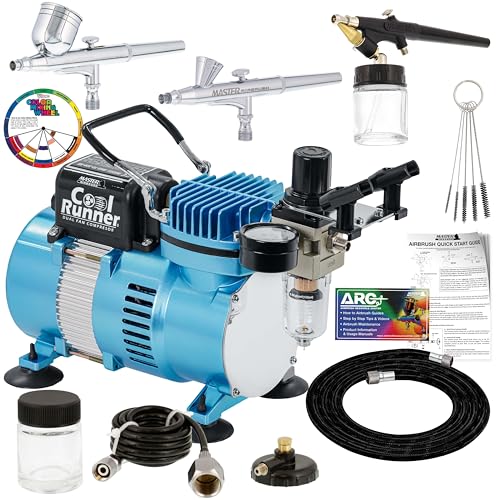
Master Airbrush Cool Runner II 3-Airbrush Kit
|
8.9/10 | Buy |
| Best Value |
 AEROPRO R500 LVLP Paint Spray Gun |
8.8/10 | Buy |
| Best Budget |
 GATTLELIC 3-Nozzle HVLP Spray Gun Kit |
8.4/10 | Buy |
 PNTGREEN 1.4mm HVLP Gravity Feed Spray Gun |
8.0/10 | Buy |
Master Airbrush Cool Runner II 3-Airbrush Kit
Equipped with three specialized airbrushes and a dual-fan compressor, this comprehensive set provides steady airflow for extended creative sessions. It is well suited for hobbyists, decorators, and crafters needing versatile nozzle sizes for both broad coverage and fine detail.
Pros
- Dual cooling fans reduce heat during long sessions
- Versatile selection of three distinct nozzle sizes
- Includes helpful accessories like cleaning brushes and guide
- Built-in holder keeps airbrushes secure while working
Cons
- Relatively bulky setup requires considerable workspace
- Single-piston 1/5 HP motor limits heavy industrial use
AEROPRO R500 LVLP Paint Spray Gun
Equipped with three interchangeable nozzles and low air consumption demands, this LVLP sprayer delivers controlled atomization across automotive and woodworking tasks. Its Teflon-coated body and stainless steel needle setup simplify maintenance while handling various coating viscosities.
Pros
- Includes three interchangeable nozzles for versatility
- Low air requirement suits smaller compressors
- Teflon finish facilitates quick and easy cleaning
- Two-stage trigger allows smooth fluid adjustment
- Durable stainless steel internal components
Cons
- Requires a separate air compressor to operate
- 600 cc capacity requires refills on larger projects
- Pneumatic setup demands proper pressure regulation
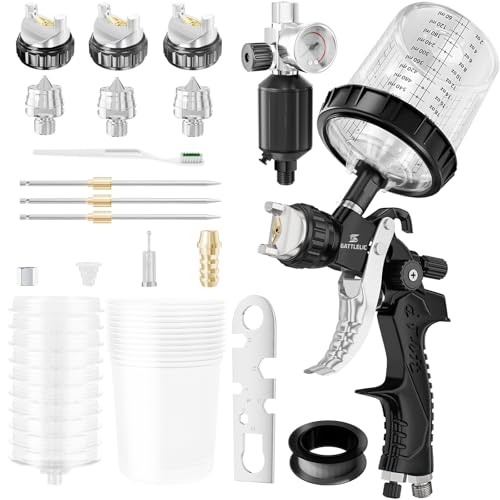
GATTLELIC 3-Nozzle HVLP Spray Gun Kit
Designed for automotive work and furniture refinishing, this GATTLELIC spray gun kit provides three interchangeable nozzle sizes alongside an integrated air filter regulator. Its disposable cup system minimizes cleanup time while reducing paint and solvent waste.
Pros
- Includes three nozzle sizes for varied coatings
- Disposable cups reduce solvent use and cleanup time
- Integrated air regulator features a built-in filter
- Brass 15-hole cap produces uniform atomization
Cons
- Requires matching needle swaps with every nozzle change
- High air demand at 275 liters per minute
- Total kit weight exceeds 3.2 pounds
PNTGREEN 1.4mm HVLP Gravity Feed Spray Gun
Built for automotive touch-ups and furniture finishing, this pneumatic HVLP sprayer pairs a stainless steel 1.4mm nozzle with a 600cc gravity cup. Three dedicated adjustment valves provide precise control over fluid, fan pattern, and air volume for smooth, even coats.
Pros
- Three adjustment valves allow precise pattern and flow control
- Durable stainless steel nozzle resists wear and corrosion
- Lightweight 1.46-pound build reduces hand fatigue during long jobs
- Detachable 600cc cup makes thorough cleaning straightforward
Cons
- High 15 CFM air consumption requires a powerful compressor
- 1.4mm nozzle cannot handle heavy or unthinned materials
Complete Guide to Operating an Air Compressor Paint Sprayer
Operating a pneumatic paint sprayer requires synchronizing your compressor air volume, inline pressure regulation, and fluid dynamics into a unified system. Atomization occurs when high-velocity compressed air shears liquid coating into a fine, uniform mist as it exits the fluid tip. Understanding how each mechanical control functions prevents costly finish imperfections such as runs, dry spray, and uneven mottling. Mastering this pneumatic workflow ensures clean, professional transfer efficiency whether you spray automotive panels, wooden cabinets, or craft projects.
Matching Compressor CFM and Tank Capacity to Spray Gun Demand
Continuous pneumatic tools like spray guns demand a steady volume of air rather than quick, intermittent bursts. Air delivery is rated in cubic feet per minute at specific pressures, typically measured at forty or ninety pounds per square inch. While finish nailers consume minimal air, full-size paint guns require sustained volume that can rapidly deplete compact portable tanks. Comparing single-stage versus two-stage compressor delivery illustrates how pump displacement and tank recovery speeds directly dictate whether a spray gun maintains atomization without pressure drop.
A mismatch between compressor output and spray gun air consumption forces the pump to run constantly under heavy duty cycle stress. For example, high-volume low-pressure sprayers like the PNTGREEN HVLP can consume up to fifteen cubic feet per minute at three bar operating pressure. If your compressor pump only supplies four or five cubic feet per minute, line pressure drops mid-pass and causes fluid to spit rather than atomize. Operating smaller compressors often requires waiting between passes for the tank to rebuild pressure, or switching to an air-efficient tool design.
Distinguishing HVLP, LVLP, and Airbrush Pneumatic Systems
Selecting the right spray tool depends heavily on your available pneumatic supply and project scale. High-Volume Low-Pressure systems, such as the GATTLELIC spray gun, use high air volume to break apart thick coatings while maintaining a gentle cap pressure to minimize overspray. The manufacturer specifies an air consumption of two hundred seventy-five liters per minute at two point five to three point five bar, delivering a broad two hundred forty millimeter fan pattern. This high transfer efficiency saves paint, but it demands an air compressor capable of substantial output to maintain consistent fluid breakup.
Low-Volume Low-Pressure guns provide a practical alternative for workshop owners with moderate compressor capacities. The AEROPRO Tools R500 LVLP operates efficiently within a modest air consumption range of three point zero to three point nine cubic feet per minute at two point zero to three point five bar. This reduced air requirement allows smaller workshop compressors to support smooth automotive basecoats, primers, and clearcoats without starving the air supply. The gun features a Teflon-coated body and a six hundred cubic centimeter gravity-feed cup that streamlines cleanups after spraying.
Detail work and miniature projects call for specialized low-pressure systems rather than large production guns. The Master Airbrush Cool Runner II kit utilizes a dedicated one-fifth horsepower single-piston compressor equipped with dual cooling fans that extend continuous running time without overheating. This compact system pairs with dual-action gravity-feed models like the G22 and G25, featuring fluid tips down to zero point two millimeters for delicate lines and graphic artwork. Single-action siphon models like the E91 handle broader craft coverage, demonstrating that pneumatic spraying scales from fine artistic detailing up to full vehicle refinishing.
Air Filtration, Regulators, and Moisture Management
Clean, bone-dry air is essential for defect-free spray application because moisture and oil in the supply line ruin fresh paint films instantly. Compressing ambient air creates intense heat, which cools inside the storage tank and condenses into liquid water. If this water travels downstream through your delivery line, it causes severe fish eyes, blistering, and clouding in the wet coat. Regularly maintaining an air compressor drain valve ensures accumulated condensation purges from the bottom of the tank before reaching your spray equipment.
Installing dedicated point-of-use filtration provides a crucial final defense right before the spray gun handle. The GATTLELIC package includes a two-in-one air compressor filter regulator that mounts directly to the gun inlet to capture airborne particulates and lingering oil vapor. This mini regulator allows users to dial in exact working pressure while monitoring dynamic pressure drops during trigger pull. Maintaining dynamic pressure, which is the pressure measured while air actively flows through the cap, prevents the gun from dropping below optimal atomization thresholds.
Selecting the Correct Nozzle and Needle Diameter
Fluid nozzle and needle pairings control the volume and particle distribution of paint entering the atomization zone. Smaller nozzle apertures restrict fluid flow to produce exceptionally fine mist, making them ideal for thin materials like stains, inks, and basecoats. Larger nozzles open the fluid orifice to allow thick primers, gel coats, and high-solids paints to pass through without clogging. Selecting the proper diameter establishes the baseline balance between fluid delivery speed and compressed air atomization force.
Multi-nozzle kits allow a single spray gun to handle diverse coating steps across an entire project. The AEROPRO Tools R500 includes one point three, one point five, and one point seven millimeter nozzles, giving the user flexibility from basecoats to medium-viscosity primers. The GATTLELIC model offers one point four, one point seven, and two point zero millimeter options for broader commercial and furniture applications. Whenever you change a fluid nozzle, you must also swap the matching fluid needle to prevent internal leakage and ensure accurate fluid metering.
Coating Preparation, Thinning, and Viscosity Testing
Pouring unreduced paint straight from the can into a gravity cup almost always leads to heavy orange peel and clogged fluid tips. Most automotive coatings, enamels, and varnishes require proper thinning with compatible reducers or solvents to flow cleanly through pneumatic passages. Always check manufacturer technical data sheets to determine recommended reduction ratios and temperature-specific thinners. Straining your thinned paint through a fine mesh cone filter before filling the cup removes dried flakes and debris that would otherwise lodge in the fluid nozzle.
Measuring viscosity with a standard flow cup provides an objective way to confirm consistent paint thickness. To test viscosity, submerge the cup in thinned paint, lift it out, and use a timer to track how many seconds elapse until the steady liquid stream breaks. If the paint drains too slowly, add small amounts of reducer until the drain time aligns with your spray gun nozzle specifications. Using disposable cup systems, like the ten mixing cups supplied with the GATTLELIC kit, simplifies measuring and minimizes solvent waste during cleanup.
Calibrating Spray Gun Knobs: Fluid, Fan, and Air Pressure
Pneumatic spray guns feature three primary adjustment valves that govern atomization quality, spray pattern size, and fluid output. The bottom air adjustment valve regulates line pressure entering the gun body, allowing fine adjustments without walking back to the compressor manifold. The fan control valve directs pressurized air to the side horns of the brass air cap, spreading the spray from a tight circular spot to an elongated oval fan. The fluid needle knob controls how far the needle retracts from the nozzle when you pull the trigger.
Calibrating these controls requires test spraying against a piece of scrap masking paper hung at eye level. Begin by setting your dynamic air pressure at the inline regulator to the manufacturer recommended range, such as forty-three pounds per square inch for the PNTGREEN HVLP. Open the fan control fully, back out the fluid knob two to three turns, and pull the trigger briefly against the test surface. Inspect the resulting pattern for even coverage across the vertical fan without heavy center bands, split ends, or excessive fluid puddling.
Proper Trigger Technique, Distance, and Pass Overlap
Applying an even wet film requires strict physical discipline and consistent gun movement across the workpiece. Hold the spray gun perpendicular to the surface at a consistent distance of six to eight inches, matching the recommended one hundred seventy to two hundred forty millimeter range. Arcing your wrist changes the distance dynamically, resulting in heavy paint pooling at the center of the stroke and dry, thin coats at the edges. Move your entire arm and torso parallel to the surface to maintain uniform standoff distance from start to finish.
Smooth application also relies on a two-stage trigger stroke to manage air and paint delivery independently. Depressing the trigger halfway opens the internal air valve to start pressurized airflow through the cap before fluid begins to discharge. Pulling the trigger fully then draws the needle back, introducing paint smoothly into the established air stream without sputtering. Release fluid delivery at the end of each pass while maintaining airflow, and overlap each subsequent stroke by fifty percent to build an unbroken, level coating.
Diagnosing Common Spray Defects and Pneumatic Sputtering
Recognizing spray pattern flaws early allows you to correct air pressure, viscosity, or gun settings before ruining an entire panel. An orange peel texture usually indicates inadequate atomization pressure, excessive coating viscosity, or holding the gun too far from the surface. In contrast, paint runs and sags occur when fluid output is set too high, travel speed is too slow, or the gun is positioned too close to the workpiece. Adjusting one variable at a time helps pinpoint the exact cause without introducing new application errors.
Intermittent spitting or sputtering during a pass indicates air entering the fluid passage where only liquid should flow. Common causes include a loose fluid nozzle, a damaged needle packing seal, or insufficient paint remaining in the gravity cup. Sputtering also happens when a clogged cup vent creates a vacuum that starves the gravity feed system. If your air compressor cycles continuously and drops below cut-in pressure, fluid atomization breaks down completely, requiring an immediate pause until the tank recovers operating pressure.
Gun Teardown, Solvent Flushing, and Long-Term Maintenance
Thorough cleaning immediately after spraying is necessary to keep precision fluid passages free from hardened paint residues. Begin by dumping residual coating from the gravity cup and wiping the internal reservoir with solvent-dampened lint-free towels. Fill the cup partially with appropriate cleaning thinner, reattach the lid, and spray the solvent through the gun into a dedicated waste container until the discharge runs clear. Back-flushing by placing a gloved finger over the air cap while pulling the trigger forces air backward, bubbling solvent through the fluid passages to dislodge trapped pigments.
Periodic deep cleaning requires disassembling the air cap, fluid nozzle, and needle using the included multi-wrench and cleaning brushes. Never use metal wire or hard steel picks to clean orifice holes in brass air caps, as minor scratches distort the spray fan permanently. Coat moving needle components lightly with non-silicone gun lubricant to keep seals supple and prevent sticking during storage. Properly maintained pneumatic spray guns deliver reliable atomization, predictable fluid delivery, and flawless surface finishes across years of workshop projects.
About the author
Clint DeBoer is an experienced tool-industry specialist with decades of involvement in technical media, hands-on product evaluation, and testing methodology. His focus on performance, practical usability, and data-driven comparisons makes his expertise highly relevant to professional air compressors, pneumatic tools, and workshop equipment.