
How to Hook Two Air Compressors Together: Practical Setup Guide for 2026
Learn how to hook two air compressors together safely to boost CFM output and storage capacity for pneumatic tools in this October 2026 guide.
 By Tony Carrick
Updated October 8, 2026
By Tony Carrick
Updated October 8, 2026

Stalling continuous pneumatic tools like rotary sanders, paint sprayers, or media blasters is a frequent headache in small workshops and home garages. When an undersized pump cannot keep up with high cubic feet per minute (CFM) consumption, operating pressure plunges rapidly and stops your work cold. Many craftspeople and mechanics solve this performance bottleneck by figuring out how to hook two air compressors together into a unified air delivery network. Combining the output of two machines allows you to effectively double your available air volume without purchasing a bulky, dedicated industrial unit.
Achieving a balanced dual-compressor configuration requires careful mechanical plumbing and strict electrical planning. Simply connecting two air lines with standard fittings can cause motor burnout, tripped circuit breakers, or severe backpressure if basic pneumatic rules are ignored. Installing dedicated one-way check valves, balancing pressure switch differentials, and isolating motor electrical circuits are essential steps for long-term system reliability. Operating two synchronized machines also expands your usable tank buffer for extended nailing or spraying sessions. When executed correctly, linking two pumps creates a dependable power reserve capable of handling demanding pneumatic tasks smoothly.
| Award | Product | ACR Score About ACR ScoreThe ACR Score is our own rating from 0 to 10, based on performance, design and build, ease of use, and value. It reflects independent research and is never influenced by manufacturers, retailers, or affiliate commissions. Learn more › | |
|---|---|---|---|
| Best Overall |
ALL-TOP Dual Cylinder 12V Air Compressor
|
9.2/10 | Buy |
| Best Budget |
 WYNNsky 20-Piece 1/4-Inch Air Tool Kit
|
9.1/10 | Buy |
| Best Value |
 ECOMAX Wall Mount 0.5-Gal Air Compressor
|
8.6/10 | Buy |
 MADONGLI 100 PSI Air Bag Compressor Kit
|
8.6/10 | Buy | |
 VIAIR 88P 12V Portable Air Compressor
|
8.4/10 | Buy | |
 Harrier Hardware 11-Piece Air Compressor Starter
|
8.3/10 | Buy | |
| Best Premium |
 DEWALT 30-Gallon Vertical Portable Electric Air
|
8.3/10 | Buy |
 Air Lift 25804 160 PSI Air Shock Controller
|
8.0/10 | Buy | |
 XAQMHSW 2-Way 1/4-Inch NPT Air Hose Splitter
|
7.8/10 | Buy | |
 FORNAX 6-Gallon Pancake Air Compressor: 150 PSI
|
7.8/10 | Buy |
ALL-TOP Dual Cylinder 12V Air Compressor
Built for rapid tire inflation on large trucks and off-road rigs, this dual-cylinder pump pushes an impressive 12.35 CFM flow rate up to 150 PSI. The rugged metal frame, integrated thermal safeguards, and extended 26-foot hose provide reliable utility for heavy-duty vehicle recovery.
Pros
- High 12.35 CFM output swiftly inflates large tires
- Dual aluminum cylinder construction helps dissipate heat
- Generous 26-foot hose reaches all corners of large vehicles
- Equipped with automatic thermal and over-current safety switches
Cons
- Heftier 24-pound build demands extra carrying effort
- Third-party gauges require built-in over-pressure protection
WYNNsky 20-Piece 1/4-Inch Air Tool Kit
This starter package bundles a 15-foot recoil hose, blow gun, and essential fittings into a compact carrying case. It provides the core accessories needed for basic tire inflation, surface dusting, and standard pneumatic tool hookups.
Pros
- Broad 20-piece assortment of standard pneumatic fittings
- Blow gun includes five swappable nozzle attachments
- Self-coiling hose design stores away neatly
- Dedicated case keeps all small adapters organized
Cons
- 120 PSI working limit excludes high-pressure pneumatic tools
- 15-foot hose length limits overall work radius
ECOMAX Wall Mount 0.5-Gal Air Compressor
Built for garage workshops, this space-saving wall-mounted unit integrates a 30-foot retractable hose reel and a low-maintenance oil-free motor. The 0.5-gallon tank and 125 PSI output make it ideal for tire inflation and light pneumatic fastening without cluttering floor space.
Pros
- Convenient built-in retractable 30-foot hose reel
- Low-maintenance oil-free motor design
- Wall-mount form factor frees up workshop floor space
- Solid 125 PSI maximum working pressure
Cons
- Small 0.5-gallon tank limits continuous high-demand airflow
- Does not include starter air tool accessories
- Relatively heavy at nearly 21 pounds to mount
MADONGLI 100 PSI Air Bag Compressor Kit
Built for truck and van owners hauling heavy loads, this on-board kit delivers in-cab suspension adjustments up to 100 psi. Its steel-housed compressor and pure copper coil offer dependable chassis leveling for work vehicles.
Pros
- Convenient in-cab control panel for quick leveling adjustments
- Durable pure copper motor and steel compressor housing
- Shock-absorbing gaskets effectively reduce operational vibration
- Complete package includes all necessary installation hardware
Cons
- Recommended regular operating range tops out at 70 psi
- Air lines require manual sleeving to prevent abrasive wear
VIAIR 88P 12V Portable Air Compressor
Designed for passenger cars and light trucks with tires up to 33 inches, the VIAIR 88P delivers dependable 120 PSI output directly from a vehicle battery. Its generous 26-foot total reach, built-in gauge, and integrated work light make it a practical emergency companion for road trips and camping.
Pros
- Solid 1.47 CFM flow rate provides brisk inflation
- Generous 26-foot reach easily accesses all four tires
- Built-in LED work light aids dark roadside repairs
- Compact body weighs under five pounds for convenient storage
Cons
- Requires direct battery connection instead of standard 12V outlet
- Limited to a 25-minute duty cycle before cooling
- Not designed for tires larger than 33 inches
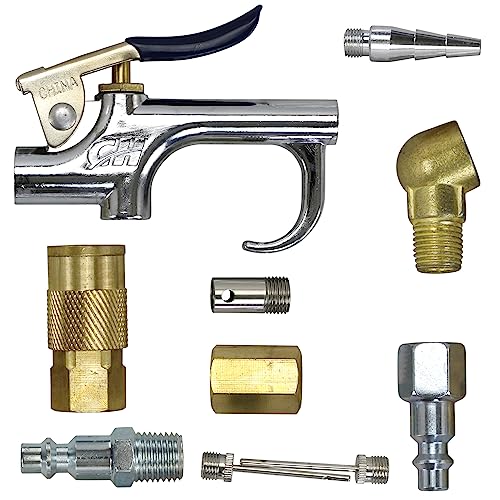
Harrier Hardware 11-Piece Air Compressor Starter
The Harrier Hardware 11-piece air compressor accessory kit provides essential pneumatic connections including a blow gun, tire chuck, and standard 1/4-inch NPT fittings. It is a practical starter set for garage DIYers and homeowners looking to handle basic inflation and shop cleanup tasks.
Pros
- Comprehensive 11-piece starter bundle covers basic inflation and workbench cleanup needs.
- Standard 1/4-inch NPT fitting compatibility connects easily with common workshop air hoses.
- Dedicated plastic storage container prevents losing small needles, inflator tips, and fittings.
- Cost-effective entry option for homeowners setting up a newly purchased air compressor.
Cons
- Supplies only one coupler and plug set, requiring extra fittings for multi-tool setups.
- Thread sealant or PTFE tape is not pre-applied and must be added to ensure leak-free connections.
- Designed for light DIY and garage duties rather than high-demand industrial production.
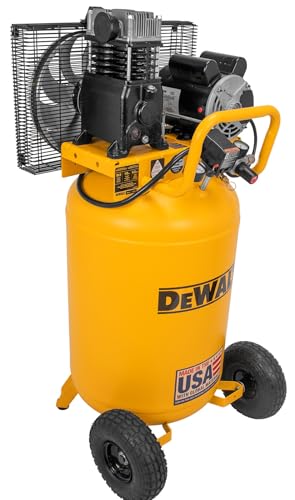
DEWALT 30-Gallon Vertical Portable Electric Air
Delivering 6.2 SCFM at 90 PSI with a high-capacity 175 PSI max pressure rating, the DEWALT DXCM303 30-Gallon Electric Air Compressor offers substantial air reserves for demanding workshop tools. Featuring rugged pneumatic wheels and a factory high-flow regulator, it is an outstanding mobile solution for garage mechanics and serious DIY woodworkers.
Pros
- Substantial 175 PSI maximum pressure provides longer run time between motor recovery cycles
- Solid airflow output of 6.2 SCFM at 90 PSI supports a wide variety of pneumatic garage tools
- High-flow regulator supplies up to 65% more usable operating pressure to connected hoses
- Heavy-duty pneumatic wheels make rolling this 196-pound upright compressor around the garage practical
Cons
- Substantial 196-pound total weight makes vehicle loading and transport between jobsites difficult without ramps or assistance
- Large vertical shop profile is designed for roll-around floor use rather than hand-carry punch-list applications
Air Lift 25804 160 PSI Air Shock Controller
The Air Lift 25804 provides on-the-fly air shock pressure adjustments directly from the cab using an integrated 160 PSI compressor and dash gauge. Its universal fit design makes it a versatile solution for drivers needing accessible suspension control under changing loads.
Pros
- Direct pressure control from inside the cabin
- Includes 160 PSI compressor and dash gauge
- Universal fitment accommodates diverse vehicle setups
- Compact footprint weighing only 3.7 pounds
Cons
- Universal design may require vehicle-specific mounting modifications
- Basic analog gauge lacks advanced digital controls
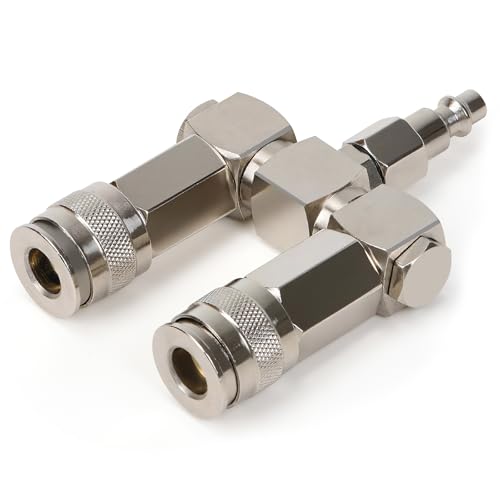
XAQMHSW 2-Way 1/4-Inch NPT Air Hose Splitter
Built for dual-tool setups, this nickel-plated steel manifold splits a single compressor line with full 360-degree swivel mobility to minimize hose tangles. It suits garage and workshop users operating standard pneumatic tools up to 300 PSI.
Pros
- Durable nickel-plated steel construction
- 360-degree swivel design prevents hose binding
- Universal coupler accepts multiple plug profiles
- Quick push-to-connect operation requires no tools
Cons
- Confined to standard 1/4-inch NPT connections
- Maximum working pressure capped at 300 PSI
- Simultaneous dual-tool use can reduce airflow volume
FORNAX 6-Gallon Pancake Air Compressor: 150 PSI
The FORNAX 6-gallon pancake air compressor delivers 2.6 CFM at 90 PSI and 150 max PSI with dual couplers and an oil-free pump, weighing in at an easy-to-carry 28.8 pounds. It is a practical setup for DIY homeowners and finish carpenters tackling trim nailing, tire inflation, and workshop blow-off tasks.
Pros
- Dual quick-connect couplers support running two pneumatic nailers simultaneously
- Solid airflow delivery with 2.6 CFM at 90 PSI and 3.4 CFM at 40 PSI
- Manageable 28.8-pound portable weight simplifies one-handed transport
- Maintenance-free oil-free pump eliminates messy oil checks and changes
- Comes with a 14-piece accessory kit for out-of-the-box pneumatic utility
Cons
- High operating noise level rated at 95 dBA makes hearing protection mandatory, especially indoors
- Limited CFM output is unsuitable for continuous-demand air tools like HVLP paint sprayers or orbital sanders
- Fast-spinning 3,550 RPM motor generates noticeable vibration during recharge cycles
Dual Compressor Synchronization: Practical Plumbing, Electrical Setup, and Tuning
Running out of air pressure during heavy sanding or painting reveals the output limits of a single workshop compressor. Rather than purchasing a costly commercial unit, connecting two smaller compressors into a combined system provides a practical solution. This configuration resolves two primary workshop bottlenecks: inadequate CFM delivery and limited tank storage capacity. Integrating two machines successfully requires an understanding of pneumatic flow dynamics, backflow prevention, and household electrical constraints.
Air Volume Versus Storage Buffer: Understanding What Dual Systems Deliver
Coupling two air compressors together primarily increases air delivery volume rather than operating pressure. Air pressure in pounds per square inch (PSI) does not double when you join two tanks; two 150 PSI compressors still yield 150 PSI maximum pressure. Combining compressors in parallel adds their individual air delivery rates together. Pairing a compact unit like the FORNAX Pancake Air Compressor with two couplers, delivering 2.6 CFM at 90 PSI, with a matching secondary machine yields roughly 5.2 CFM at 90 PSI.
This combined flow rate allows you to power continuous pneumatic tools that would starve a lone consumer unit. Tools such as rotary sanders, paint sprayers, and abrasive blasters consume air continuously and rapidly empty small receiver tanks. When both pumps run simultaneously, air replenishment rivals tool consumption, preventing severe pressure drops during operation. Intermittent tools like framing nailers also benefit from the expanded storage buffer, allowing rapid firing without waiting through recovery cycles.
You can also configure two compressors strictly to expand air storage capacity without running both motors simultaneously. In this setup, a secondary compressor tank serves as an auxiliary receiver vessel while remaining disconnected from electrical power. The primary compressor fills both tanks, doubling stored volume before line pressure drops below the tool cut-in threshold. While recovery times take longer with one pump running, this storage-first approach provides a massive buffer for intermittent, high-draw applications.
Electrical Circuit Requirements: Preventing Breaker Trips and Voltage Drop
The most common problem when setting up dual compressors is electrical circuit overload. Electric compressor motors draw substantial running current, but startup inrush current is significantly higher. When a motor switches on against head pressure, the momentary current spike can reach three to five times normal running amperage. Attempting to run two electric compressors on a single 15-amp or 20-amp 120-volt household circuit will trip the breaker the moment both motors cycle together.
To ensure reliable operation, each compressor must plug into a completely separate electrical branch circuit. You should inspect your workshop breaker panel to verify that the chosen wall outlets connect to distinct breakers. For larger workshop units, such as a stationary DEWALT 30-Gallon Vertical Portable Electric Air compressor delivering 6.2 SCFM at 90 PSI, a dedicated 15-amp or 20-amp line is mandatory on its own. Pairing a larger machine with a secondary unit requires strict circuit segregation to prevent tripping breakers mid-task.
Voltage drop caused by undersized extension cords represents another severe electrical hazard. Long, thin cords increase electrical resistance, starving the motor of operating voltage and generating excessive heat within the windings. This voltage drop can stall the motor or trigger its thermal overload switch during cold-weather startups. If you need to position compressors further from wall outlets, extend your pneumatic air hoses instead of using light-duty electrical extension cords.
Mechanical Plumbing Architecture: Parallel Manifolds and Fitting Sizing
Plumbing two compressors together requires a parallel piping architecture where discharge lines from both tanks merge into a single distribution manifold. A heavy-duty fitting, such as a 2-Way Air Hose Splitter, 1/4″ NPT Air Compressor manifold, serves as the junction point where two incoming lines unite before feeding your primary air hose. Using brass or nickel-plated steel manifolds rated for at least 300 PSI provides the strength needed for pressure fluctuations. All threaded joints must be sealed with quality PTFE thread tape to eliminate micro-leaks.
Fitting dimensions dictate whether your dual-pump setup can deliver combined flow without severe friction loss. Standard 1/4-inch industrial quick couplers, like those found in the WYNNsky 1/4 Inch NPT Air Accessory Kit – 20 Piece or the Harrier Hardware 11-Piece Air Compressor Starter set, are convenient for tool connections but restrict high airflow at the main junction. For maximum efficiency, step up the common supply line to a 3/8-inch internal diameter hose immediately after the manifold. This larger hose cross-section minimizes flow restriction and preserves dynamic working pressure over longer distances.
You must also choose whether to connect compressors before or after their factory pressure regulators. Connecting after individual regulators allows pressure adjustments at each machine, but small factory regulators often cause noticeable flow restriction. Connecting directly into unregulated tank ports using a tee fitting provides unrestricted volume transfer into a single high-flow master regulator downstream. The master regulator then governs line pressure consistently, ensuring that both tanks feed your pneumatic tools without uneven pressure drop.
One-Way Check Valves: Protecting Pumps and Unloader Mechanisms
Installing dedicated one-way brass check valves on each compressor discharge line is an essential safety requirement. Check valves permit compressed air to flow outward toward the common manifold while preventing air from traveling backward into the opposite tank. Without check valves, a compressor with slightly higher operating pressure will back-feed air into the secondary machine. This reverse flow disrupts pressure switch readings, causes erratic motor cycling, and can force high-pressure air through idle pump assemblies.
Back-feeding also interferes with the mechanical unloader valve on each compressor pressure switch. When a motor reaches cut-out pressure and stops, the unloader valve vents trapped head pressure between the pump cylinder and the tank check valve. This pressure release allows the motor to restart without resisting trapped cylinder pressure. If backflow from the second compressor pressurizes that unloader line, the valve may hiss continuously or fail to unload, causing motor stall on restart.
Never bypass or tamper with the factory ASME safety relief valves on either tank. Each receiver vessel must retain its functioning pop-off safety ring to prevent dangerous over-pressurization if a pressure switch fails to open. Regularly pull the safety ring on both units while the tanks contain moderate pressure to confirm the internal springs seat cleanly and move freely. Maintaining independent safety devices on every interconnected tank ensures that your dual setup remains safe under all operating conditions.
Pressure Switch Coordination: Lead-Lag Calibration Versus Balanced Cycling
Pressure switches govern when compressor motors turn on at cut-in pressure and shut off at cut-out pressure. When two compressors share an air line, you must choose between balanced switch settings and a staged lead-lag configuration. In a balanced setup, you adjust both pressure switches to identical cut-in and cut-out thresholds, such as 90 PSI on and 125 PSI off. However, manufacturing tolerances make exact simultaneous switching rare, often resulting in one machine starting slightly before the other.
The lead-lag configuration is widely considered the superior tuning strategy for mixed workshop operations. In this setup, you designate the primary compressor as the lead unit with standard settings, such as kicking in at 100 PSI and shutting off at 130 PSI. The secondary lag unit is calibrated to cut in at a lower threshold, such as 85 PSI, and stop at 120 PSI. Under light-duty tasks like tire inflation, only the lead compressor cycles, saving electrical power and reducing shop noise.
When using continuous high-consumption tools like sanders, the primary compressor runs continuously as pressure drops past its capacity. Once system pressure falls below 85 PSI, the secondary lag compressor switches on automatically to provide extra air volume. Working together, both pumps overcome tool demand and drive system pressure back up toward the cut-out threshold. This staged cycling prevents both motors from starting at the exact same moment, mitigating electrical surges while providing on-demand power reserves.
Moisture Management and Condensation Across Multiple Storage Tanks
Compressing atmospheric air produces substantial moisture as temperatures rise during compression and drop inside storage tanks. When you hook two air compressors together, the higher volume of compressed air causes twice as much condensation across both vessels. Neglecting moisture drainage allows water to collect at the bottom of both tanks, reducing storage capacity and accelerating internal corrosion. Accumulated water can also carry into your air lines, ruining automotive paint finishes and washing away pneumatic tool lubricants.
Both compressors require daily moisture draining through their underside tank drain valves after every work session. Many portable compressors come equipped with stiff, threaded needle petcocks that are difficult to operate and prone to clogging with rust debris. Upgrading these factory petcocks to accessible quarter-turn brass ball valves makes daily draining fast, painless, and consistent. Always depressurize the tanks down to approximately 10 to 15 PSI before opening drain valves to forcefully eject pooled moisture without damaging valve seals.
To ensure clean, moisture-free air delivery at the tool, place an in-line water separator downstream of your combined manifold. Positioning this filtration assembly at least twenty feet away from compressor discharge ports allows warm air to cool and condense before reaching the filter element. For moisture-sensitive tasks such as spray painting or automotive finishing, pairing a coalescing filter with a desiccant dryer module downstream guarantees that the high-volume air supply remains completely dry.
Step-by-Step Installation Procedure for Garage Workshops
Before beginning mechanical assembly, disconnect both compressors from electrical power and drain all existing air pressure completely from both receiver tanks. Pull each tank safety relief ring to verify zero internal pressure before unthreading any factory fittings. Gather all necessary components, including high-flow quick couplers, one-way brass check valves, sealing thread tape, and a rated two-way manifold block. Clean all external port threads with a wire brush to remove old thread sealant or metal shavings that could contaminate check valve seats.
Wrap all male NPT pipe threads with three to four tight wraps of quality PTFE thread tape, applying tape clockwise along the threads. Thread a dedicated one-way check valve directly into the discharge port of each compressor, ensuring the directional flow arrow points toward the outlet. Connect flexible air lines from each check valve output into the inlet ports of your central manifold splitter block. Attach your main 3/8-inch supply hose to the single outlet port of the manifold, and install your high-flow master pressure regulator downstream.
Perform a comprehensive leak check before putting the dual setup into active service with high-draw air tools. Plug each compressor into its separate dedicated electrical circuit, turn on both power switches, and allow the system to pump up to full cut-out pressure. Once both motors shut down, apply a soapy water solution to every threaded connection, check valve joint, and manifold fitting using a spray bottle. If bubbles form around any fitting, depressurize the system and tighten or reseal the joint to eliminate air loss.
Common Operational Mistakes and Unbalanced Pump Setups
A frequent mistake when hooking two compressors together is pairing units with wildly disparate pump capacities and duty cycles. For example, pairing a tiny 12V portable tire inflator with a stationary cast-iron workshop compressor creates extreme mechanical imbalance. Highly compact inflators like the VIAIR 88P 00088 12V Portable Air Compressor Kit or the ALL-TOP Air Compressor Kit are engineered for vehicle tire inflation off battery clamps, not stationary shop manifolds. Attempting to plumb 12V utility pumps into garage air lines will quickly overheat their small cylinders and trigger thermal cut-offs.
Similarly, specialized vehicle suspension hardware like the Air Lift 25804 Air Shock Controller Kit w/160 PSI or the Air Bag Compressor Kit, On Board Air Compressor system operates on low-volume direct-line inflation tailored for ride control rather than continuous shop tool air flow. Plumb only stationary, electric workshop compressors together, such as combining a compact wall-mount unit like the ECOMAX Wall Mount Air Compressor with a secondary portable pancake unit. Matching pump displacement and motor duty cycles ensures that neither machine is forced to run beyond its rated thermal capabilities.
Another common oversight involves daisy-chaining two compressors in series, feeding the discharge of the first compressor directly into the intake of the second. Compressing pre-pressurized air into a standard single-stage pump elevates compression heat exponentially, leading to severe pump head overheating, piston ring failure, and catastrophic pump burnout. Always connect consumer compressors in parallel into a common manifold rather than in series. Parallel plumbing preserves factory intake conditions while safely aggregating air volume output.
Building a balanced dual-compressor system provides a cost-effective way to unlock continuous pneumatic tool performance without replacing your existing equipment. By ensuring dedicated electrical circuits, installing reliable one-way check valves, and staging pressure switches through a lead-lag configuration, you can maximize CFM delivery safely. Daily tank draining and proper filtration preserve tool longevity and maintain dry, dependable air flow for all your workshop projects.
About the author
Tony Carrick is an experienced product researcher and writer specializing in tools, home improvement, automotive maintenance, and consumer equipment. With extensive experience reviewing tools and tackling hands-on renovation projects, he brings a buyer-focused perspective to compressor performance, usability, and overall value.