
How to Get Water out of Air Compressor: Practical Step-by-Step Guide for 2026
Learn how to get water out of air compressor steps for air compressor tanks and air lines safely in October 2026 to prevent tank rust, tool damage, and pneumatic pressure loss.
 By Clint DeBoer
Updated October 7, 2026
By Clint DeBoer
Updated October 7, 2026
Atmospheric humidity naturally enters an air compressor intake, condensing into liquid moisture as high pressure builds and temperatures drop inside the steel reservoir. Learning how to get water out of air compressor protects your pneumatic equipment from internal tank corrosion, line contamination, and sudden tool failure. Water pooling at the bottom of a storage vessel decreases usable air capacity and washes away crucial lubricating oil from nailers, ratchets, and grinders. Establishing a regular purge routine ensures steady line pressure and delivers dry, clean air to every connected pneumatic tool.
Trapped moisture also ruins delicate finish work, causing water droplets to spoil spray painting or abrasive blasting projects. Implementing practical drainage steps alongside inline filtration safeguards your shop tools and maintains optimal pneumatic airflow. Whether you operate a compact jobsite pancake compressor or a stationary vertical garage unit, clearing liquid buildup requires straightforward mechanical habits. Consistent moisture control extends air tool longevity, stops scale formation inside air hoses, and prevents dangerous pinhole rust leaks along tank welds.
| Award | Product | ACR Score About ACR ScoreThe ACR Score is our own rating from 0 to 10, based on performance, design and build, ease of use, and value. It reflects independent research and is never influenced by manufacturers, retailers, or affiliate commissions. Learn more › | |
|---|---|---|---|
| Best Overall |
Hromee AW2000-02 1/4-Inch Filter Regulator
|
8.1/10 | Buy |
| Best Budget |
 LitOrange Brass Blow Out Adapter (2-Pack)
|
8.0/10 | Buy |
 AIRZOE 1/4-Inch NPT Air Compressor Filter
|
8.0/10 | Buy |
Hromee AW2000-02 1/4-Inch Filter Regulator
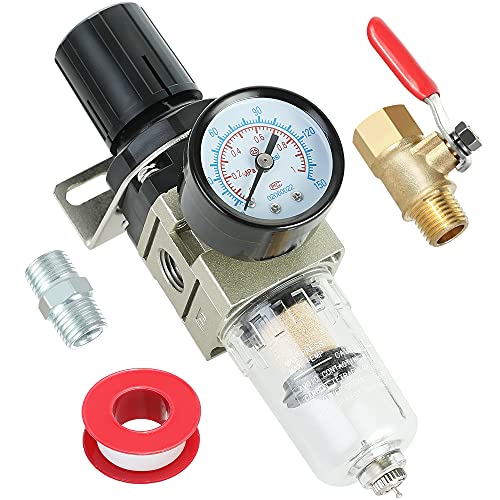
Designed for compact workspaces, this piggyback system integrates moisture filtration and pressure regulation into a single unit. Its brass filter element helps protect pneumatic tools from water and debris, while the included bracket and shutoff valve simplify setup.
Pros
- Durable brass filter element resists wear over time
- Dual-unit gauge provides clear pressure readings
- Compact piggyback design suits space-constrained setups
- Includes shutoff valve, bracket, and seal tape
Cons
- Requires manual operation to drain collected fluids
- Pressure capacity is capped at 150 PSI
LitOrange Brass Blow Out Adapter (2-Pack)
Machined from lead-free brass, this adapter pair connects standard air compressors to outdoor faucets and irrigation systems to blow out standing water. It offers an easy, durable winterizing solution for homeowners, RV travelers, and boat owners.
Pros
- Durable, lead-free brass construction
- Compact design fits confined plumbing areas
- Standard 3/4-inch hose and 1/4-inch air compressor fit
- Convenient two-pack bundle
Cons
- Requires a compatible external air compressor to operate
- Requires eye protection and caution during pressure blowout
AIRZOE 1/4-Inch NPT Air Compressor Filter
The AIRZOE AF2000-02M is an in-line 1/4-inch NPT pneumatic moisture filter rated for up to 26.5 SCFM and 145 PSI working pressure. Equipped with a reusable 5-micron brass filter element and a manual push drain, it provides cost-effective particulate and water separation for home garages and small workshops.
Pros
- Reusable 5-micron brass element cleans easily and avoids recurring replacement cartridge costs
- Flow rating of 26.5 SCFM easily accommodates brad nailers, staple guns, and tire inflation tools
- Compact footprint and standard 1/4-inch NPT threads simplify installation on compact air setups
- Straightforward manual drain valve allows fast water discharge at the end of a project
Cons
- Manual drain requires regular visual inspection and manual release rather than draining automatically
- Flow capacity of 26.5 SCFM is not suited for continuous high-demand tools like sandblasters or dual-action sanders
- Does not replace a desiccant dryer for critical moisture-free tasks like professional automotive spray painting
Complete Guide to Removing Moisture from Compressed Air Systems
Removing moisture from a compressed air setup requires addressing liquid water in the tank and vapor in air lines. Water forms naturally as atmospheric humidity is compressed, making moisture management vital for equipment ownership. Ignoring moisture causes corroded tank walls, sluggish pneumatic tools, and ruined painted finishes. A systematic approach combines daily reservoir drainage with inline filtration to maintain dry, reliable airflow.
Why Condensation Accumulates Inside Air Compressor Tanks
Atmospheric air contains ambient humidity in the form of water vapor. Compressing cubic feet of air into a small storage volume concentrates that moisture significantly. The pump generates heat during compression, keeping water vaporized inside the cylinders. As air enters the cooler steel storage tank, the temperature drops rapidly below its dew point. This cooling causes vapor to condense into liquid droplets that settle at the base.
Liquid water accumulates continuously during extended operation, especially in humid or damp workshops. Standing water occupies interior tank space, effectively shrinking your usable air buffer. A reduced air buffer forces the pump to cycle on and off more frequently. Frequent cycling increases motor heat, draws extra power, and accelerates wear on mechanical components.
Water sitting against unpainted steel tank bottoms triggers internal oxidation and rust. Corrosion weakens the pressure vessel from the inside out over months of neglect. Because internal rusting remains hidden, users rarely notice thinning metal until pinhole leaks appear. Loose rust flakes can also break away and clog downstream valves or regulators.
Step-by-Step Procedure for Draining Water from the Tank Drain Valve
Safely purging water begins with powering down the compressor and managing pressure. Switch off the power switch and disconnect the electrical plug. Never drain a tank at full operating pressure like 150 PSI, as high pressure violently expels dirty sludge. Bleed tank pressure down to roughly 10 to 20 PSI using a blow gun. Moderate residual pressure helps push sediment out smoothly without creating an uncontrolled blast.
Place a shallow catch pan or rag directly underneath the drain valve. Portable pancake, hot dog, and twin-stack compressors usually require tilting toward the drain port to move water. Tilt the unit carefully while keeping hands clear of hot motor surfaces. Always wear safety glasses to protect against flying debris, dirty droplets, and sudden pressure bursts.
Slowly open the drain valve by turning the petcock screw or ball valve lever counterclockwise. A mixture of compressed air, rusty water, and sludge will discharge into your container. Keep the valve open until liquid stops spraying and only dry air escapes. Gently rock the compressor to ensure any trapped liquid pockets reach the drain opening.
Close the drain valve firmly once water and residual pressure are fully discharged. Avoid over-tightening small brass petcocks with pliers, which can snap valve stems. If storing the unit long-term, leave the drain valve cracked open in a dry area. Leaving it cracked promotes airflow and prevents condensation from collecting during seasonal downtime.
Upgrading Drain Valves for Effortless Routine Purging
Factory drain valves on many compressors are standard threaded brass thumb petcocks. These tiny valves are awkward to reach, sit low to the ground, and hurt fingers to turn. Over time, rust and sediment seize the threads, tempting users to skip daily draining. Neglecting drainage out of inconvenience is a leading cause of premature tank failure.
Retrofitting the tank with a quarter-turn brass ball valve simplifies daily maintenance. A simple brass elbow, extension nipple, and lever-operated ball valve bring the drain to an accessible position. Quarter-turn levers give clear visual confirmation of valve position. The wider passage of a ball valve also allows sludge to exit without clogging the opening.
Stationary workshop compressors often benefit from automated tank drain systems. Electronic timed solenoid valves open automatically for several seconds at set intervals. Pneumatic auto-drains operate mechanically by sensing pressure changes when the pump cycles. While automated valves require an initial setup, they eliminate human error in busy workspaces.
Installing Inline Water Traps and Particulate Filters
Draining the tank removes pooled water, but airborne moisture still enters air lines. As warm air leaves the tank, it cools inside hoses and forms secondary condensation. Inline water separators installed at the compressor outlet catch this moisture before it reaches tools. Internal baffles spin the air to fling liquid droplets against the bowl walls.
Dedicated filters like the AIRZOE 1/4″ NPT Compressed Air Filter AF2000-02M provide reliable moisture separation. This unit uses a 5 micron brass filter element to capture solid particles and liquid moisture. Reusable brass elements provide long service life and can be washed clean when needed. Operating across 0 to 145 PSI with flow up to 26.5 SCF, it suits general garage air setups.
Maintaining an inline filter requires monitoring the clear collection cup. When liquid approaches the maximum line, press the manual drain button at the base. Emptying the bowl promptly prevents swirling air from pulling collected water back into the airstream. Periodically cleaning the internal brass element preserves full airflow for high-demand tools.
Utilizing Combined Filter Regulators for Tool Protection
Pneumatic setups often combine moisture removal and pressure control into a single unit. A compact filter regulator saves space near the compressor while handling two critical delivery functions. Setting output pressure accurately protects sensitive air tools from strain while the filter extracts water. Stable working pressure prevents tool stalling and ensures uniform fastening results.
The Hromee 1/4 Inch Air Compressor Filter Regulator Combo AW2000-02 integrates essential air control features. This unit includes an adjustable regulator knob, a dual-scale gauge up to 150 PSI, a mounting bracket, and a forged brass ball valve. Its porous brass filter element captures moisture and fine particles to deliver clean air. A transparent cup allows quick inspection of accumulated fluid without disassembly.
An inline shutoff ball valve, like the plastic-covered lever on the Hromee model, simplifies routine maintenance. You can stop downstream airflow instantly to switch tools or drain the filter without venting the tank. Mounting the regulator assembly firmly prevents vibration from loosening pipe joints. Thread seal tape on all NPT fittings ensures leak-free performance under pressure.
Clearing Water from Downstream Lines and Plumbing Systems
Compressed air also works well for purging water from external plumbing, sprinklers, and camper lines. Standing water in pipes freezes during winter, expanding and cracking copper, PEX, or PVC lines. Blowing out water lines with compressed air offers a quick, chemical-free winterization technique. Pressurized air pushes standing water out through open faucets and sprinkler heads.
Connecting an air compressor to plumbing requires fittings like the Litorange Lead-Free Brass Winterize Sprinkler blow out plug adapter. This adapter connects a 1/4 inch quick-connect plug to standard 3/4 inch garden hose threads. Solid lead-free brass construction ensures durability while keeping water lines safe and non-toxic. Its compact design fits easily into tight RV access compartments and irrigation boxes.
Controlling pressure is critical when clearing domestic water lines and sprinkler systems. Never apply full tank pressure to residential plumbing, as high pressure can rupture plastic fittings. Regulate compressor output between 30 and 50 PSI before blowing air into the lines. Wear safety glasses and open faucets one by one until only fine mist exits.
Advanced Moisture Control for Spray Painting and Critical Air Tools
Certain pneumatic applications require air that is entirely free of water vapor and oil mist. Automotive spray painting, media blasting, and plasma cutting show immediate defects from tiny moisture droplets. Water in spray paint lines causes bubbling, fish-eyes, and poor clear coat adhesion. Mechanical water separators catch liquid droplets, but they cannot remove un-condensed vapor.
Achieving dry air requires adding secondary desiccant dryers downstream from primary filters. Desiccant beads absorb moisture vapor to lower the dew point well below room temperature. Indicating silica gel beads change color to signal when the media is fully saturated. Installing desiccant dryers twenty to thirty feet away from the compressor allows air to cool first.
Piping layout in a home workshop also assists in passive water separation. Sloping rigid air lines slightly away from the compressor directs condensation into low-point drop legs. Each drop leg features a manual drain valve to purge water before it reaches tools. Feeding tool drops from the top of the main line prevents water from draining into hoses.
Diagnostic Signs That Your Air System Has Excess Moisture
Recognizing signs of moisture contamination helps prevent damage to expensive pneumatic tools. The clearest sign is liquid spraying from the exhaust ports of nailers, ratchets, or blow guns. If a blow gun leaves wet droplets on your workpiece, lines are heavily saturated. Sputtering tools and spitting air hoses indicate that water has bypassed the tank drain.
Checking air tool exhaust and oil condition provides another clear diagnostic clue. When moisture mixes with air tool oil, it turns into a cloudy, milky emulsion. This emulsion lacks lubricity, causing friction, heat buildup, and sticky motor vanes. Sluggish tool startup or bad exhaust odors indicate that moisture has stripped the protective oil film.
Air pressure drops at the tool can also point to pooled water inside the air hose. Water sitting inside a hose narrows the effective diameter, restricting air volume during tool use. Disconnecting the hose and blowing air through it into a bucket quickly clears trapped water. Heavy, water-laden hoses feel unwieldy and develop internal odors if left wet.
Practical Habits for Long-Term Tank and Tool Health
Developing a consistent maintenance routine keeps your air compressor operating smoothly for years. Purge the tank at the end of every work session, regardless of runtime. Brief twenty-minute jobs still generate condensation along bottom tank welds. Leaving water sitting overnight in unheated garages promotes rapid rust and hose contamination.
Compressor placement also affects how much condensation forms inside the tank. Running the machine in a dry, well-ventilated area limits the humidity pulled into the pump. Keep the air intake away from steam vents, wash areas, or damp corners. Cleaning or replacing the intake filter regularly maintains efficient airflow into the pump cylinders.
If water discharges through your lines, re-oil your pneumatic tools right away. Place several drops of pneumatic tool oil into the air inlet and run the tool briefly. This quick lubrication displaces residual moisture and protects internal steel components. Combining regular tank draining with proper filtration ensures clean, dry air for every project.
About the author
Clint DeBoer is an experienced tool-industry specialist with decades of involvement in technical media, hands-on product evaluation, and testing methodology. His focus on performance, practical usability, and data-driven comparisons makes his expertise highly relevant to professional air compressors, pneumatic tools, and workshop equipment.