
How to Get Rid of Water in Air Compressor: Practical Guide for 2026
Purge moisture and learn how to get rid of water in air compressor tanks and air lines using reliable filtration methods in October 2026.
 By Tony Carrick
Updated October 7, 2026
By Tony Carrick
Updated October 7, 2026

Rust-colored moisture spraying out of pneumatic nailers or spray guns indicates a severe condensation problem inside your air delivery lines. Ambient atmospheric air naturally contains water vapor, which condenses into liquid water whenever a compressor pump compresses and cools that intake volume. Learning how to get rid of water in air compressor is essential because accumulated liquid rusts steel storage tanks from the inside out, ruins expensive air tools, and contaminates paint finishes. Neglecting regular moisture removal compromises pneumatic efficiency and can even create safety hazards if you make a habit of storing an air compressor pressurized over extended periods.
Preventing liquid carryover requires a multi-stage approach that combines routine tank maintenance with dedicated inline filtration hardware. Basic thumb petcocks at the base of the tank handle bulk liquid pooling, but microscopic vapor travels freely downstream into rubber air hoses unless mechanical water traps intercept it. Modern moisture management systems utilize 5-micron particulate filters, coalescing oil-water separators, and color-changing desiccant dryers to scrub the air stream clean. Understanding the physical mechanics of condensation allows workshop owners and field tradesmen to configure reliable air lines that keep tools dry under heavy daily workloads.
| Award | Product | ACR Score About ACR ScoreThe ACR Score is our own rating from 0 to 10, based on performance, design and build, ease of use, and value. It reflects independent research and is never influenced by manufacturers, retailers, or affiliate commissions. Learn more › | |
|---|---|---|---|
| Best Overall |
ZHONG AN 1/4-Inch NPT Air Filter Pressure
|
9.2/10 | Buy |
| Best Budget |
 LNCHKA 1/4-Inch NPT Air Compressor Water Separator
|
8.9/10 | Buy |
 VEVOR 3/8 Inch NPT Air Compressor Filter Regulator
|
8.9/10 | Buy | |
 CNZG PNEU 1/4-Inch NPT Air Compressor Water Trap
|
8.8/10 | Buy | |
| Best Premium |
 CAtArt 1/2-Inch NPT 3-Stage Industrial Air Dryer
|
8.6/10 | Buy |
 CAtArt 4-Stage 3/4" NPT Air Compressor Dryer
|
8.4/10 | Buy | |
 RVMARINEPAT 3/4-Inch NPT 4-Stage Air Compressor
|
8.3/10 | Buy | |
| Best Value |
 VEVOR 3/8" NPT Dual Stage Air Compressor Filter
|
8.1/10 | Buy |
 THB 1/2-Inch Compressed Air Line Moisture Filter
|
8.1/10 | Buy | |
 NANPU 3/4-Inch NPT Industrial Compressed Air
|
8.1/10 | Buy |
ZHONG AN 1/4-Inch NPT Air Filter Pressure
The ZHONG AN 1/4-Inch NPT Air Filter Pressure Regulator combines pneumatic line regulation and moisture separation into a compact, lightweight unit with an integrated dial gauge. Featuring a push-pull locking adjustment knob and a manual drain valve, it provides a practical setup for DIY hobbyists and home woodworkers seeking cleaner air for finish nailers and pneumatic tools.
Pros
- Combines air filtration, moisture trapping, and pressure regulation in one affordable unit
- Top locking adjustment knob prevents accidental pressure changes during tool operation
- Integrated pressure gauge simplifies dialed-in tool adjustments for finish carpentry and inflation
- Bottom drain valve enables fast purging of trapped line condensation
Cons
- 1/4-inch NPT sizing may restrict high-volume airflow on continuous-demand pneumatic tools
- Small moisture collection bowl requires frequent manual draining during extended humid-weather run sessions
- Lightweight body construction requires careful alignment and thread sealing to prevent port leaks
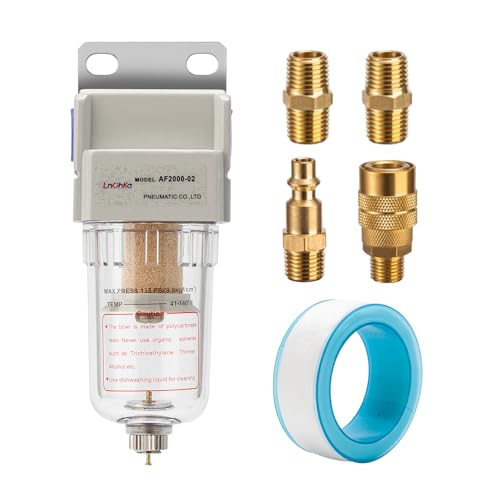
LNCHKA 1/4-Inch NPT Air Compressor Water Separator
The LNCHKA 1/4-inch NPT air line filter is a compact moisture separator engineered to trap condensation and particulates using a durable 5-micron brass element. Supporting up to 145 PSI and an 18 SCFM flow rate, it is an effective, budget-friendly addition for DIYers and home garage mechanics looking to protect pneumatic tools from water damage.
Pros
- Durable 5-micron porous brass filter element resists corrosion better than paper or plastic cartridges
- Generous 18 SCFM flow capacity easily accommodates common DIY and small-shop pneumatic tools
- Includes brass quick-connect fittings, bracket, and Teflon tape for straightforward installation out of the box
- Transparent polycarbonate bowl provides effortless visual inspection of fluid buildup
Cons
- Polycarbonate bowl can be vulnerable to cracking if exposed to harsh synthetic solvents or chemical fumes
- Manual drain requires proactive monitoring and regular physical purging to prevent water re-entry into the line
- 1/4-inch NPT port size and 18 SCFM rating are not suitable for large multi-operator industrial airline networks
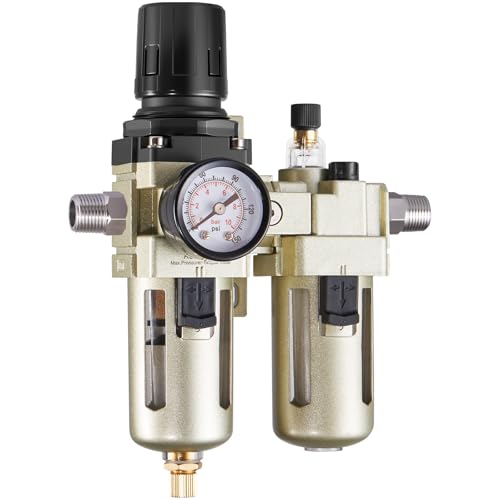
VEVOR 3/8 Inch NPT Air Compressor Filter Regulator
The VEVOR 3/8-inch NPT Filter Regulator Lubricator (FRL) combines a 5-micron brass water separator, adjustable pressure regulator, and micro-fog oiler rated up to 145 PSI. It provides clean, lubricated air for automotive mechanics and workshop woodworkers seeking to extend the service life of pneumatic tools.
Pros
- Compact 3-in-1 modular footprint cleans, regulates, and lubricates air in a single installation point
- Cleanable 5-micron brass filter element offers better durability than disposable paper filter media
- Semi-auto drain discharges condensation automatically when the compressor stops, helping prevent neglected bowl overflow
- Sturdy metal bowl cages protect the polycarbonate reservoir from bumps and accidental tool strikes
Cons
- Maximum 145 PSI operating limit is not rated for heavy-duty 175 PSI two-stage industrial compressor systems
- Inline oiler lubricates downstream hoses, requiring a separate dedicated line if you need dry air for spray painting or tire inflation
- Threaded 3/8-inch NPT ports require careful thread sealing with PTFE tape or paste to prevent slow joint leaks
CNZG PNEU 1/4-Inch NPT Air Compressor Water Trap
The CNZG PNEU 1/4-inch water trap air line filter (AF2000-02) provides essential inline moisture and debris separation with a 5-micron brass element rated for up to 145 PSI and 27 CFM airflow. It is a practical, budget-friendly add-on for DIYers, finish carpenters, and garage mechanics looking to protect pneumatic tools from water-related wear.
Pros
- 5-micron cleanable brass filter element separates fine line scale and condensed water
- Generous 27 CFM rated capacity easily supports most single-tool woodworking and automotive setups
- Includes mounting bracket hardware and two brass 1/4-inch fittings right in the package
- Compact 5.7-inch height fits easily into tight mobile rigs or compact workshop drops
Cons
- Manual drain requires user attention to regularly purge collected water from the bowl
- Maximum 145 PSI rating makes it unsuitable for high-pressure 175 to 200 PSI industrial shop lines
- Thread specifications list both PT and NPT, requiring proper application of PTFE thread seal tape during assembly
CAtArt 1/2-Inch NPT 3-Stage Industrial Air Dryer
The CAtArt 3-stage industrial air drying system provides serious pneumatic filtration by pairing 5-micron and 0.01-micron filters with a desiccant dryer and an integrated 0-240 PSI regulator. Delivering up to 141 CFM of clean, moisture-free airflow, it is an excellent upgrade for automotive painters, plasma cutting setups, and dedicated home workshops.
Pros
- Three-stage system eliminates moisture, oil aerosol, and particulate debris from compressed air lines
- Generous 141 CFM rating handles high-consumption air tools without severe line restriction
- Color-changing beads and pop-up indicator provide clear visual cues for filter maintenance
- Automatic drain on the primary bowl purges liquid condensation without manual intervention
- Solid aluminum valve body handles operating pressures up to 240 PSI
Cons
- Desiccant beads require periodic replacement or heat regeneration once fully saturated
- 1/2-inch NPT ports will require step-down adapters for smaller 3/8-inch or 1/4-inch air lines
- Requires careful thread sealing with PTFE tape during initial assembly to prevent minor fitting leaks
CAtArt 4-Stage 3/4" NPT Air Compressor Dryer
The CAtArt 4-Stage 3/4-inch NPT Air Dryer and Water Separator delivers dry, contaminant-free compressed air across a 0 to 240 PSI operating range with integrated pressure regulation and automatic draining. It is an effective inline filtration solution for automotive painters, plasma cutter operators, and workshop hobbyists needing clean air delivery.
Pros
- Multi-stage filtration down to 0.01 microns plus desiccant drying delivers clean air for moisture-sensitive pneumatic tasks.
- Generous 3/4-inch NPT sizing accommodates high-volume main shop lines without bottlenecking tool air delivery.
- Clear visual maintenance cues eliminate guesswork when it is time to swap cartridges or replace desiccant beads.
- Hands-free auto-drain mechanism reduces daily maintenance chores by expelling collected water automatically.
- Heavy-duty construction rated up to 240 PSI with an integrated locking pressure regulator.
Cons
- Desiccant beads require periodic replacement or heat reactivation once they absorb maximum moisture.
- Multi-bowl assembly measures roughly 13 inches wide and requires solid wall anchoring and clearance.
- Requires adapter fittings if your workshop lines or portable compressor output use 1/4-inch or 3/8-inch NPT threads.
RVMARINEPAT 3/4-Inch NPT 4-Stage Air Compressor
This 4-stage 3/4-inch NPT air drying system by RVMARINEPAT combines particulate filtration, pressure regulation, 0.01-micron coalescing oil removal, and a desiccant dryer rated up to 240 PSI. It provides clean, moisture-free air suited for automotive spray painting, plasma cutting, and heavy-duty garage workshops.
Pros
- Heavy-duty metal bowl construction supports up to 240 PSI without the cracking risks of clear plastic bowls
- Effective 0.01-micron coalescing filter traps aerosolized compressor oil before it reaches spray guns or plasma cutters
- Auto drain mechanism simplifies water purging from the initial separation stage without manual intervention
- Comes loaded with replacement filter elements, fittings, and multiple desiccant bead packs for easy initial maintenance cycles
Cons
- Desiccant beads require periodic replacement or heat reactivation once color shifting indicates moisture saturation
- Full 3/4-inch NPT ports will require reducer bushings if integrating directly into smaller 1/4-inch or 3/8-inch flexible air lines
- Multi-stage assembly creates a wide wall-mount footprint that requires dedicated rigid mounting in compact garage setups
VEVOR 3/8" NPT Dual Stage Air Compressor Filter
The VEVOR 3/8-inch NPT dual-stage filter regulator combines 25-micron and 5-micron brass elements with a semi-automatic drain to remove moisture and particulate from air lines up to 145 PSI. It provides dependable moisture separation and pressure control for garage hobbyists, woodworkers, and DIY mechanics.
Pros
- Two-stage 25-micron and 5-micron brass elements offer thorough particle and water separation
- Semi-automatic drain releases trapped condensation when the system depressurizes
- Polycarbonate bowls with metal protective guards allow quick visual inspection while resisting damage
- Standard 3/8-inch NPT threads integrate smoothly into common workshop air lines
Cons
- Maximum working pressure is limited to 145 PSI, so it is not suitable for 175 PSI two-stage systems without upstream regulation
- Polycarbonate bowls are vulnerable to damage from harsh chemical solvents or synthetic compressor lubricants
- Continuous air setups where pressure never drops require manual intervention to purge water from the drain
THB 1/2-Inch Compressed Air Line Moisture Filter
The THB F704 is a heavy-duty 1/2-inch inline air line moisture trap engineered with a 5-micron filter element, rugged metal bowl, and 225 PSI maximum rating. It provides essential moisture and particulate protection for automotive mechanics, woodworkers, and DIY garage hobbyists running pneumatic tools.
Pros
- 5-micron filtration traps fine debris, pipe scale, and moisture droplets effectively
- Durable metal bowl construction with an integrated sight glass resists accidental workshop damage
- High maximum pressure tolerance rated up to 225 PSI handles heavy-duty compressor outputs
- Generous 1/2-inch port connection helps prevent excessive airflow restrictions across shop lines
Cons
- 2.7-ounce reservoir requires frequent manual draining in high-humidity climates or high-flow setups
- Arrives as a standalone filter unit, requiring user-supplied mounting brackets and thread fittings for installation
- Does not replace a dedicated refrigerated air dryer or desiccant system for critical moisture-free spray painting
NANPU 3/4-Inch NPT Industrial Compressed Air
The NANPU 3/4-Inch NPT Desiccant Air Dryer provides high-flow moisture extraction rated up to 140 CFM and 215 PSI for sensitive air systems. It is an ideal addition for automotive paint spraying, plasma cutting, and precision shop tools requiring dry pneumatic air.
Pros
- High 140 CFM flow rate maintains air volume without bottlenecking high-demand pneumatic tools
- Durable metal bowl with a built-in sight glass provides both safety and effortless desiccant monitoring
- Rated up to 215 PSI, making it compatible with high-pressure garage and commercial shop air systems
- Includes two starter bags of color-indicating beads, 3/4-inch NPT brass-threaded fittings, and sealing tape
Cons
- Desiccant beads require periodic replacement or heat regeneration once fully saturated from blue to pink
- Works best when paired with an upstream bulk water separator to prevent soaking the desiccant prematurely
- Requires reducer bushings if integrating into smaller 1/4-inch or 3/8-inch DIY garage air hose lines
Eliminating Moisture and Condensation from Compressed Air Systems
Compressed air systems naturally generate substantial volumes of liquid water during standard operation, making moisture control an unavoidable reality for every workshop owner. Ambient air holds moisture in the form of relative humidity, but compressing that air into a fraction of its original volume forces water vapor beyond its saturation point. Liquid droplets pool at the tank floor and travel into downstream hose assemblies where they corrode tool bearings and ruin fine spray finishes. Mastering how to get rid of water in air compressor involves addressing condensation at the receiver tank, along hardline distribution pipes, and at individual pneumatic drop points.
The Physical Mechanics of Condensation Inside Compressed Air Systems
Every cubic foot of air pulled through an intake filter contains invisible water vapor dictated by ambient room temperature and relative humidity. When the pump compresses atmospheric air up to standard workshop pressures, that volume heats up rapidly due to mechanical friction and adiabatic compression. As that superheated air cools inside the storage tank, its dew point drops drastically, causing water vapor to condense against the cold interior steel walls. High ambient humidity accelerates this process, turning the receiver tank into an active reservoir of pooled water after just a few hours of operation.
Operating temperatures drop further as compressed air travels away from the pump through air hoses and rigid plumbing lines. This secondary cooling phase causes additional suspended moisture to drop out of the air stream far downstream from the compressor tank itself. Without dedicated line separation, that traveling water enters pneumatic motors, washing away internal lubricating oils and causing premature mechanical wear. The distinction between oil-free versus oil-lubricated compressor designs also affects downstream air cleanliness, as oil-lubricated pumps introduce fine oil mists that mix with condensed water to form an abrasive sludge.
Understanding that moisture production is a physical certainty shifts your maintenance strategy from passive tolerance to active water extraction. Expecting an air compressor to run completely dry without auxiliary drying equipment is mechanically impossible under normal atmospheric conditions. The volume of water generated scales directly with the duty cycle of your pump and the overall volume of air displaced each minute. Recognizing this thermodynamic reality highlights why relying solely on tank drainage leaves your downstream tools vulnerable to liquid damage.
Purging Receiver Tanks Through Manual and Automatic Drain Valves
The bottom receiver tank drain valve represents the primary frontline defense against massive water accumulation. Because liquid water is denser than air, it naturally settles into the lowest concave section of vertical or horizontal receiver vessels. Factory compressors typically ship with threaded needle petcock valves, which require manual twisting to crack open and vent trapped fluids. These basic needle valves often stiffen over time, suffer from thread corrosion, and discourage regular maintenance due to their awkward underside placement.
Upgrading a stubborn factory petcock to an accessible quarter-turn brass ball valve makes daily draining effortless and reliable. A quarter-turn ball valve provides an unrestricted bore that expels thick rusty sediment without clogging, unlike narrow needle orifices that trap rust flakes. Extending the drain port toward the front edge of the tank frame using brass pipe nipples allows operators to purge the tank without kneeling on dirty shop floors. Establishing a strict routine of opening the valve after every work session ensures stagnant water never sits inside the tank overnight to degrade interior metal walls.
Industrial facilities and high-demand commercial workshops often rely on electronic solenoid drains or mechanical float-style automatic drain valves. Electronic timed drain valves open for a programmed duration at set intervals, automatically blowing out collected condensation without operator intervention. Mechanical zero-loss drains offer an even cleaner solution by venting pooled liquid only when an internal reservoir fills, preventing unnecessary loss of compressed air volume. Whichever drain style you choose, completely depressurizing the tank during seasonal cleanouts helps verify that drain ports remain free of caked rust scale.
Inline Water Separators and Particulate Filtration Hardware
While tank drains evacuate pooled liquid, inline centrifugal water separators remove traveling moisture droplets suspended in high-velocity air streams. These units utilize internal cyclone vanes to spin incoming compressed air, throwing heavy water droplets outward against transparent polycarbonate or metal bowl walls. Gravity pulls the separated moisture down into the bottom of the bowl, while an integrated brass filter element intercepts floating dust and scale particles. Units like the ZHONG AN 1/4″ NPT Air Filter Pressure Regulator and LNCHKA Air Compressor Water Separator utilize porous 5-micron brass elements that capture particulate debris alongside bulk water droplets.
Bowl material selection plays a critical role in safety and long-term durability across different workshop operating environments. Transparent polycarbonate bowls allow quick visual monitoring of collected water levels, but they degrade when exposed to synthetic compressor lubricants or aggressive paint thinners. Heavy-duty options feature aluminum or steel bowls fitted with narrow glass sight windows to provide visual inspection without sacrificing chemical and impact resistance. Systems such as the THB 1/2″ Compressed Air Line Moisture & Water Filter utilize metal bowls rated up to 225 PSI, offering robust containment for industrial high-pressure air distribution systems.
Drainage mechanisms on filter bowls range from simple push-button manual drains to spring-loaded semi-automatic and float drains. Semi-automatic drain bowls vent trapped fluids automatically whenever line pressure drops below roughly 5 to 10 PSI, such as when the compressor powers down for the night. The VEVOR Air Compressor Filter Regulator Lubricator integrates semi-auto draining to prevent water bowl overflow if an operator forgets manual maintenance. Ensuring your filter assembly matches your tool flow requirements prevents excessive pressure drops, which can be referenced when understanding compressor CFM ratings across continuous pneumatic equipment.
Coalescing Oil-Water Separators for Fine Aerosol Removal
Standard centrifugal separators effectively capture liquid water slugs, but they cannot stop fine microscopic aerosol mists from passing downstream. Fine droplets suspended as aerosols slip right through standard 5-micron or 25-micron brass elements without condensing against bowl walls. Coalescing filters resolve this limitation by forcing compressed air through dense, multi-layered microfiber media designed to trap sub-micron particles. Units like the CAtArt 1/2″ NPT Industrial Air Dryer incorporate secondary stage 0.01-micron coalescing elements capable of stripping out 99.9% of suspended liquid aerosols and oil mists.
As tiny moisture and oil droplets pass through the dense fibrous matrix, they collide, combine, and coalesce into larger liquid beads. These enlarged droplets become heavy enough to run down the outside of the cartridge, collecting at the base of the filter housing for drainage. Coalescing filters also capture minute carbon fragments and pump wear particles that could otherwise clog sensitive proportional air valves. Maintaining these filter elements requires watching differential pressure drop indicators, which pop up a visible flag when the media becomes saturated with trapped contaminants.
Protecting a delicate coalescing filter cartridge requires placing a standard particulate separator directly upstream in the air supply line. Feeding unfiltered air filled with large rust flakes and heavy water slugs directly into a 0.01-micron element causes premature clogging and severe airflow restriction. Multi-stage units like the CAtArt 3/4″ NPT 4-Stage Air Dryer mount the particulate filter, regulator, and coalescing element on a single shared manifold block. This staged progression ensures each filter stage targets specific particle sizes, maximizing element lifespan and keeping line pressure stable under heavy tool operation.
Desiccant Drying Systems for Critical Ultra-Dry Air Delivery
Finishing tasks like automotive spray painting, powder coating, and plasma torch cutting require air that is not just free of liquid, but chemically dry. Even when coalescing filters remove 100% of liquid water, warm air can still hold water vapor that condenses into droplets the moment it expands through a spray nozzle. Desiccant air dryers solve this challenge by channeling pre-filtered air through a chamber filled with porous silica gel beads or molecular sieve pellets. Models like the NANPU Industrial Grade Heavy Duty Compressed Air Desiccant Dryer absorb remaining vapor molecules, dropping the pressure dew point low enough to prevent any downstream condensation.
Most workshop desiccant canisters use color-indicating silica beads that provide a clear visual cue when the drying media reaches full moisture saturation. Active beads typically display a deep cobalt blue color, which gradually transitions to light pink as the beads absorb their maximum capacity of water vapor. Once the desiccant media turns completely pink, it can no longer extract moisture from the passing air stream and must be replaced or baked dry. Advanced four-stage systems such as the RVMARINEPAT 3/4″ NPT Air Compressor Water Separator include pre-packaged replacement bead packs to ensure uninterrupted maintenance cycles.
Desiccant canisters must always be installed as the final stage of an air treatment array, immediately downstream of coalescing filtration. Exposing bare silica beads to raw liquid water or lubricating oil destroys their active absorption pores, causing the beads to break down into useless powder. Placing the desiccant stage right before your point of use or spray station guarantees that the dry air does not reabsorb condensation from long lengths of moist shop piping. This staged configuration delivers hospital-clean, moisture-free compressed air suitable for fine lacquer spraying, sandblasting cabinets, and precision CNC plasma cutting tables.
Workshop Hardline Layout and Condensation Drop Legs
Physical plumbing geometry within a stationary workshop layout provides passive water removal before the air stream ever reaches your inline filters. Running flexible rubber hoses straight from a hot compressor pump directly into your spray gun guarantees water problems because the hot air has had no time to cool and condense. Installing copper, aluminum, or black iron hardlines creates a thermal heat exchanger that cools air as it travels away from the pump. Cooling the compressed air while it is still inside rigid metal piping forces water vapor into liquid form where mechanical drop legs can trap it.
A properly designed workshop distribution loop should incorporate a continuous gentle slope back toward the compressor or toward a dedicated drainage manifold. When plumbing vertical air drops down from an overhead ceiling trunk line, the takeoff tee should always point straight upward off the top of the main pipe. Taking air from the top of the header prevents liquid water running along the bottom of the pipe from spilling directly into tool drop lines. The vertical drop pipe should then extend well past the tool outlet coupling, forming a low dead-end reservoir known as a drop leg or drip leg.
Equipping the base of every vertical drop leg with a manual ball valve allows operators to purge trapped condensation before connecting expensive pneumatic tools. This simple passive plumbing design captures the vast majority of liquid water droplets before they can contaminate filter regulators or desiccant canisters. Spacing your air treatment filters at least twenty to twenty-five feet of piping distance away from the compressor pump allows hot air to reach ambient temperature. Intercepting chilled air maximizes the condensation extraction efficiency of centrifugal separators and extends the operational service life of coalescing and desiccant elements.
Diagnostic Verification and Routine System Maintenance
Verifying that your moisture extraction setup operates correctly requires regular visual inspections and simple point-of-use flow tests. Crack open the drain valve at the bottom of your air receiver tank at the end of each working day to observe fluid discharge volume and rust coloration. If thick, orange-tinted liquid pours out continuously, the tank interior is already experiencing active oxidation that demands more frequent draining intervals. In dry, properly conditioned systems, opening the tank drain produces a short hiss of air with only a minor spray of clear liquid mist.
Performing a mirror test at your primary tool coupling offers immediate confirmation of downstream air purity before beginning sensitive painting or finish nailing tasks. Hold a clean, room-temperature pocket mirror or polished metal plate roughly two inches away from an open blowgun nozzle and trigger a continuous five-second blast of air. Any appearance of foggy condensation, water droplets, or oily residue reveals that your inline separators, coalescing filters, or desiccant beads require immediate servicing. Inspecting filter bowl sight glasses weekly and cleaning dirty brass elements in solvent preserves high flow capacity without restricting working pressure.
Protecting your pneumatic equipment from moisture damage ultimately comes down to consistency rather than complex mechanical engineering. Combining a daily tank drain routine with properly sized point-of-use water separators ensures your air tools receive clean, dry airflow year-round. Investing in multi-stage filtration hardware safeguards expensive spray finishes and prevents internal pneumatic motor seizure caused by traveling condensation. Establishing these straightforward workshop habits extends the operating lifespan of both your compressor tank and every air tool connected to your pneumatic lines.
About the author
Tony Carrick is an experienced product researcher and writer specializing in tools, home improvement, automotive maintenance, and consumer equipment. With extensive experience reviewing tools and tackling hands-on renovation projects, he brings a buyer-focused perspective to compressor performance, usability, and overall value.