
How to Fill Paintball Tank With Air Compressor: A Practical Guide for 2026
Learn how to fill paintball tank with air compressor equipment safely in November 2026, covering HPA pressures, adapters, and dedicated PCP pump setups.
 By Kenny Koehler
Updated November 10, 2026


Most workshop owners assume that a standard garage air compressor can inflate any pressurized vessel, from automotive tires to pneumatic nailer reservoirs. When attempting to charge high-pressure air paintball cylinders, standard garage equipment falls drastically short of the required force. Typical garage and workshop units deliver between 90 and 175 PSI, whereas paintball tanks require between 3000 and 4500 PSI to function properly.
Learning how to fill paintball tank with air compressor systems requires understanding specialized high-pressure pneumatic equipment rather than standard utility units. While conventional two-stage workshop compressors supply reliable volume for common air tools, charging a paintball cylinder demands dedicated high-pressure PCP pumps or bulk scuba cascading stations. Navigating these pressure differences, choosing compatible fill adapters, and maintaining safety valves ensures reliable fills without damaging expensive equipment.
| Award | Product | ACR Score About ACR ScoreThe ACR Score is our own rating from 0 to 10, based on performance, design and build, ease of use, and value. It reflects independent research and is never influenced by manufacturers, retailers, or affiliate commissions. Learn more › | |
|---|---|---|---|
| Best Overall |
IORMAN 4500 PSI Scuba Adapter Fill Station
|
9.1/10 | Buy |
| Best Budget |
 SZRKRLA CO2 Tank Adapter with 3000 PSI Gauge |
8.4/10 | Buy |
| Best Value |
 WaveToGo Scuba to Paintball HPA Fill Station |
8.4/10 | Buy |
| Best Premium |
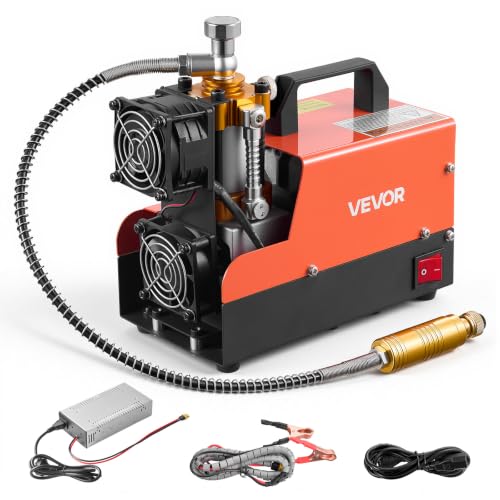 VEVOR 4500 PSI Portable PCP Air Compressor |
8.3/10 | Buy |
 HK Army HP8 800psi Tank Regulator |
8.1/10 | Buy | |
 GOYOJO 4500 PSI PCP Air Compressor |
7.8/10 | Buy |
IORMAN 4500 PSI Scuba Adapter Fill Station
The IORMAN Scuba Adapter Fill Station is a specialized high-pressure pneumatic transfer accessory rated up to 4500 PSI, featuring a 24-inch spring-guarded whip line and an 8mm female quick-disconnect. It provides an efficient charging link between scuba storage tanks and PCP air rifles or paintball HPA tanks for target shooters and airgun hobbyists.
Pros
- High working pressure rating up to 4500 PSI suitable for modern PCP airguns and paintball tanks
- Stainless steel coiled spring wrap protects the 24-inch high-pressure line from kinks and abrasion
- Upgraded double O-ring sealing layout helps prevent high-pressure air leaks during fill cycles
- Standard 8mm female quick-disconnect coupling fits common PCP and paintball male fill nipples
Cons
- Designed strictly for high-pressure HPA setups and will not interface with standard 1/4-inch workshop air couplers
- Requires periodic visual inspection and replacement of rubber O-rings to prevent pressure leaks
- Does not include an integrated inline pressure gauge or standalone bleed valve on this specific model
SZRKRLA CO2 Tank Adapter with 3000 PSI Gauge
Built from lightweight aluminum, this SZRKRLA fill station adapter features an integrated 3000 psi gauge and an 8mm quick plug for venting and refilling cylinders. It offers dependable compatibility across paintball tanks, remote lines, and emergency air setups utilizing standard G1/2-14 connections.
Pros
- Durable, lightweight aluminum body
- Integrated 3000 psi pressure gauge
- Standard 8mm quick disconnect fitting
- Broad compatibility with paintball and dive tanks
Cons
- Prone to damage if over-tightened during installation
- Pressure gauge capped at 3000 psi
WaveToGo Scuba to Paintball HPA Fill Station
The WaveToGo Scuba Fill Station is a dedicated high-pressure pneumatic transfer adapter engineered to refill 3000 PSI and 4500 PSI paintball tanks and PCP airguns directly from scuba cylinders. Featuring an integrated pressure gauge, quick-disconnect fitting, and manual bleed valve, it provides a portable solution for airgun enthusiasts and paintball players wanting independent tank fills.
Pros
- Compatible with common scuba cylinder valves including K, J, and H configurations without extra adapters
- Operates across high-pressure pneumatic thresholds up to 3000 PSI and 4500 PSI
- Integrated pressure gauge allows immediate visibility of transfer pressure
- Dedicated bleed screw relieves trapped line pressure for safe and easy disconnects
- Lightweight 10-ounce profile takes up virtually no space in a gear bag or field toolbox
Cons
- Requires a pre-filled scuba cylinder as an air source; does not generate compressed air on its own
- Not compatible with standard low-pressure workshop air tools or 90 to 150 PSI garage compressors
- Lacks an extended whip hose for users who prefer distant cylinder positioning during fills
VEVOR 4500 PSI Portable PCP Air Compressor
Designed for airgun shooters and paintball players on the move, this dual-power compressor operates on both household AC outlets and 12V vehicle batteries. Its integrated fan-cooling system removes the hassle of external water pumps, though users must monitor fills closely due to the manual shut-off design.
Pros
- Flexible dual-voltage operation for field or home use
- Built-in fan cooling eliminates water pumps and buckets
- Lightweight and compact profile is easy to transport
- Accurate pressure gauge allows clear real-time monitoring
Cons
- Lacks auto-stop and requires constant manual monitoring
- Requires a separate external filter for scuba tanks
- Inflation speed is modest on larger air reservoirs
HK Army HP8 800psi Tank Regulator
Crafted from aircraft-grade aluminum, the HK Army HP8 delivers a steady 800 psi output for compressed air setups rated up to 4500 psi. Features like a full-color gauge, dual O-rings, and a protective fill valve cover make it a dependable component for standard paintball and airsoft markers.
Pros
- Durable aircraft-grade aluminum body
- Dual O-rings prevent broken seals
- Easy-to-read full-color air gauge
- Universal bottle compatibility
- Fill valve cover blocks dirt and debris
Cons
- Fixed 800 psi output lacks pressure adjustability
GOYOJO 4500 PSI PCP Air Compressor
The GOYOJO PCP Air Compressor delivers up to 4500 PSI for air rifles and paintball cylinders using a 300W oil-free pump and built-in auto shut-off. With dual 12V DC and 120V AC power inputs, it offers convenient high-pressure fills for outdoor shooting sports without needing an external adapter.
Pros
- Integrated internal transformer allows seamless switching between 12V DC car battery and 115V AC wall power without an external power brick
- Adjustable auto shut-off stops pumping automatically once target cylinder pressure is reached
- Maintenance-free oil-free pump design requires no fluid checks or crankcase refills
- Compact 18-pound steel chassis with an integrated carry handle for field transport
Cons
- Strictly intended for high-pressure air cylinders under 1L and cannot operate workshop air tools or inflate vehicle tires
- Cooling fan generates continuous operational noise and requires bleeding residual line pressure manually after each run
- Not designed for filling large scuba tanks exceeding 1000cc capacity
Essential Methods for Filling Paintball Tanks with Air Compressors
Connecting a paintball cylinder to an air source requires precise pressure matching and specialized pneumatic hardware. Standard workshop compressors cannot bridge the extreme gap between everyday tool pressures and high-pressure paintball tanks. Resolving this process safely depends on choosing between dedicated multi-stage high-pressure compressors and bulk transfer fill stations.
High-Pressure Air Demands Versus Standard Workshop Compressors
Pneumatic workshop tools typically operate within a pressure range of 90 to 150 PSI to drive nailers and paint spray guns. High-pressure air paintball cylinders, in contrast, demand working storage pressures of either 3000 PSI for standard aluminum vessels or 4500 PSI for carbon fiber wrapped bottles. Attempting to fill a paintball bottle directly from a common pancake or garage compressor will only yield a few usable marker shots before the cylinder depressurizes completely. The massive differential between low-pressure workshop air delivery and high-pressure air containment makes dedicated compression machinery mandatory.
Modifying a standard utility compressor to achieve thousands of pounds per square inch is physically impossible and presents severe mechanical hazards. Standard cast-iron and aluminum compressor tanks are engineered to rupture-tested limits far below high-pressure cylinders. Also, players must distinguish between high-pressure air and carbon dioxide systems. Carbon dioxide relies on liquid-to-gas expansion inside specialized vessels, whereas compressed air depends entirely on extreme mechanical compression within certified pressure vessels.
Dedicated High-Pressure PCP Compressors for Direct Home Filling
Dedicated pre-charged pneumatic compressors represent the most convenient self-contained solution for filling paintball tanks at home. These compact multi-stage machines compress atmospheric air through sequential cylinders until output reaches 300 bar or 4500 PSI. Unlike heavy industrial breathing air stations, modern portable PCP units are engineered specifically for small cylinders under one liter in volume. Their manageable size allows players to maintain independent air supplies without visiting commercial fields or dive shops.
Power flexibility is a significant advantage of modern high-pressure compressors designed for personal gear. Units like the VEVOR 4500 PSI PCP compressor feature a 250W motor powered through an external 500W converter, allowing operation from standard 120V household outlets or 12V automotive batteries. Other options, like the GOYOJO 4500 PSI PCP air compressor, utilize an integrated transformer with a 300W motor and auto-stop functionality. Integrated high-speed cooling fans eliminate the need for external water buckets, helping dissipate intense compression heat during operation.
Scuba Bulk Storage and Cascading Fill Stations
Cascading bulk air from a large scuba cylinder remains a rapid and widely adopted method for charging paintball tanks. Scuba tanks store massive volumes of compressed air at 3000 to 4500 PSI, acting as large passive reservoirs. Rather than waiting for a small portable compressor to generate pressure over fifteen minutes, a scuba fill station transfers air in seconds. This method requires access to a certified local dive shop or commercial facility to recharge the primary scuba cylinder periodically.
Connecting the storage vessel to a paintball tank requires a dedicated high-pressure charging station. The WaveToGo Paintball HPA Tank Fill Adapter provides a universal scuba interface compatible with standard K-valve, J-valve, and H-valve configurations. It incorporates a heavy-duty stainless steel whip hose, an integrated pressure gauge for real-time monitoring, and a built-in bleed valve. Alternative options like the IORMAN DIN Valve Scuba Adapter thread securely into standard 4500 PSI DIN fittings using double O-ring seals and 8mm quick-disconnect couplings.
Critical Paintball Tank Regulators and Connection Fittings
Every compressed air paintball cylinder relies on a specialized regulator assembly threaded into the bottle neck. This regulator serves two vital functions: it houses the male fill nipple for intake air and steps down internal cylinder pressure to an operational output pressure. Most tournament and recreational paintball markers require an operating output between 400 and 800 PSI to cycle smoothly. Understanding this pressure step-down prevents operators from confusing internal tank capacity with marker working pressure.
Regulators like the HK Army HP8 are constructed from aircraft-grade aluminum and engineered to handle internal cylinder loads up to 4500 PSI. They deliver a standard output pressure of 800 PSI, suitable for the vast majority of compressed air markers on the market. Accessories like the SZRKRLA Paintball Tank Adapter feature aluminum construction with an 8mm quick plug, a 1/8-inch NPT port, and a standard ASA thread with a 3000 PSI gauge. Maintaining clean fill nipple O-rings is essential, as damaged seals cause immediate venting during high-pressure charging.
Step-by-Step Operation for Dedicated PCP Air Compressors
Before initiating a fill cycle, carefully inspect the paintball cylinder for exterior damage, deep gouges, or an expired hydrostatic testing date. Wipe the tank fill nipple with a clean microfiber cloth to remove dust, oil, and debris that could enter the regulator. Connect the compressor whip hose by pulling back the collar on the 8mm female quick-disconnect fitting and sliding it firmly over the male fill nipple. Release the collar and tug gently on the hose to verify that the locking bearings have engaged securely.
Ensure the compressor block bleed valve screw is tightened clockwise to close the exhaust port before applying electrical power. Connect the unit to an appropriate 120V household circuit or attach the heavy-duty alligator clips directly to a 12V automotive battery terminal. Verify that the cooling fan engages immediately upon flipping the primary power switch. Once cooling airflow is confirmed, start the compression pump motor and monitor both the compressor pressure gauge and cylinder regulator gauge closely.
When target pressure is reached, turn off the motor switch immediately while allowing the cooling fan to continue running. Before attempting to disconnect the hose, loosen the brass bleed valve screw counterclockwise to vent pressurized air trapped inside the whip line. Attempting to uncouple a pressurized quick-disconnect fitting is nearly impossible and can ruin the internal O-ring seal. Inspecting supply lines regularly using a high-pressure air hose guide ensures all connections remain structurally sound over extended service periods.
Step-by-Step Procedure for Scuba Station Air Transfers
Using a bulk scuba cascade system requires a stable, upright foundation for the primary supply cylinder. Inspect the scuba valve face and verify that the rubber O-ring is seated flush without nicks or flat spots. For yoke systems, slide the fill station adapter pocket over the scuba post and tighten the threaded T-handle until clamped firmly against the valve face. Connect the female quick-disconnect coupling on the fill station whip hose to the male fill nipple on the paintball tank, checking that the bleed valve is closed.
Crack the main scuba tank handwheel very slowly to initiate the air transfer process. Opening the supply valve too quickly causes rapid adiabatic heating, which expands the air artificially and strains regulator internal seals. A slow, steady hiss indicates an ideal transfer rate, allowing air to equalize smoothly between the two vessels. Once the target pressure is reached on the station gauge, close the scuba valve handwheel completely and open the bleed valve to vent residual line pressure before detaching the bottle.
Moisture Management and Downstream Air Filtration
Compressing atmospheric air up to 4500 PSI concentrates ambient moisture into dense liquid droplets that can damage sensitive pneumatic mechanisms. Water inside a paintball tank promotes internal oxidation, contaminates regulator piston shims, and fouls delicate marker solenoid valves. Standard workshop compressors lack the multi-stage filtration necessary to extract water at these extreme densities. Without dedicated filtration hardware, high-pressure moisture will travel directly into your equipment during every fill cycle.
Dedicated PCP compressors address this issue by incorporating integrated moisture separators alongside external inline filter canisters. These secondary filtration tubes pack dense molecular sieves and cotton filter cartridges to trap oil mists and vaporized water before air enters the tank. Routine compressor care aligns closely with principles found in air compressor moisture drain valve maintenance, where regular liquid discharge prevents corrosion. Releasing trapped water extends pump cylinder life and ensures pristine air quality for competitive play.
Critical Safety Protocols, Adiabatic Heat, and Burst Disks
High-speed gas compression generates significant thermal energy through a thermodynamic process known as adiabatic heating. When a paintball tank is filled rapidly, the cylinder skin often becomes noticeably warm to the touch. This elevated temperature artificially raises internal pressure readings while filling is underway. As the tank cools to ambient room temperature over the following hour, the internal pressure will drop slightly, resulting in what players refer to as a cold fill settling.
Safety burst disks provide vital mechanical over-pressure protection on all certified paintball tank regulators. Most modern 4500 PSI regulators feature two distinct burst disks: a high-pressure disk rated near 7500 PSI and a low-pressure disk rated around 1800 PSI. The high-pressure disk protects the structural bottle from catastrophic over-inflation, while the low-pressure disk protects the downstream marker. Never attempt to disconnect pressurized foster fittings without first cracking the bleed valve, and always wear appropriate eye protection during high-pressure charging.
About the author
Kenny Koehler is a power-tool specialist with more than a decade of hands-on evaluation experience and a science-based approach to product testing. His expertise in repeatable testing, tool performance, impact wrenches, and professional equipment brings a practical, data-focused perspective to compressor and pneumatic-tool comparisons.