
How to Connect a Hose to an Air Compressor: Complete Setup and Safety Guide for 2026
Learn how to connect a hose to an air compressor safely and prevent air leaks with proper quick-connect fittings and thread sealing techniques in November 2026.
 By Clint DeBoer
Updated October 8, 2026


Setting up pneumatic power in a garage or workspace requires a leak-free air path between the tank regulator and your pneumatic tools. Air escaping from poorly seated fittings drops line pressure, causes the pump to cycle continuously, and robs impact wrenches and nailers of needed torque. Learning how to connect a hose to an air compressor properly ensures that your delivery system operates efficiently while preventing sudden disconnects under high pressure. Standard air lines handle working pressures up to 300 PSI, which means every quick-connect coupler and threaded joint must maintain an airtight mechanical seal.
Many pneumatic setups also suffer when condensation forms in the tank, making routine maintenance and removing moisture from air lines just as critical as the initial connection. Using compatible 1/4-inch National Pipe Taper fittings alongside proper PTFE thread seal tape eliminates common hissing leaks at the regulator manifold. Taking time to inspect your coupler sleeves, internal rubber O-rings, and hose whip restrictors protects your equipment against premature wear. This guide breaks down the hardware components and safety steps necessary to establish dependable pneumatic hose connections every time you power on your compressor.
| Award | Product | ACR Score About ACR ScoreThe ACR Score is our own rating from 0 to 10, based on performance, design and build, ease of use, and value. It reflects independent research and is never influenced by manufacturers, retailers, or affiliate commissions. Learn more › | |
|---|---|---|---|
| Best Overall |
EVOULTES 16-Piece 1/4 NPT Air Fitting Kit
|
9.2/10 | Buy |
| Best Budget |
 SOKOSEY 1/4-Inch NPT Brass Coupler 2-Pack |
9.1/10 | Buy |
 LUMITECO 11-Inch Swivel Tire Inflator Hose |
9.1/10 | Buy | |
| Best Premium |
 Minimprover 12-Inch Blowout Adapter with Valve |
9.1/10 | Buy |
 ZKZX 1/4" to 3/4" GHT Blowout Adapter 2-Pack |
8.4/10 | Buy | |
 Hromee 3/8-In x 6-Ft Hybrid Lead-In Air Hose |
8.4/10 | Buy | |
 Ailbiuko 6-Foot 3/8-Inch Air Hose Kit |
8.4/10 | Buy | |
 LUMITECO 2-Pack Closed Flow Ball Foot Air Chuck |
8.1/10 | Buy | |
 ptiysta Brass Locking Tire Chuck (2 Pack) |
7.8/10 | Buy | |
| Best Value |
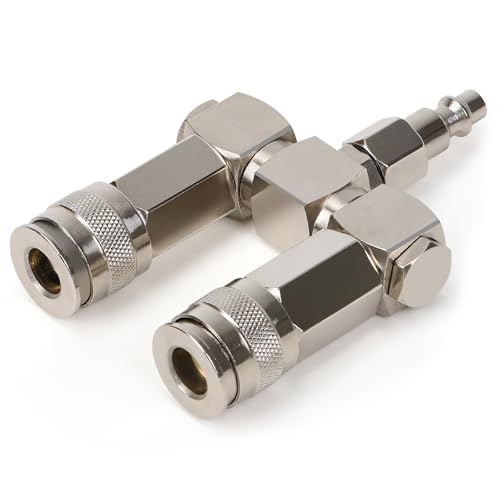 XAQMHSW 2-Way 1/4-Inch NPT Air Hose Splitter |
7.8/10 | Buy |
EVOULTES 16-Piece 1/4 NPT Air Fitting Kit
This 16-piece kit supplies the essential plugs, couplers, and sealing tape needed to hook up standard pneumatic tools. Rated up to 300 PSI, the anodized fittings offer reliable push-to-connect operation for home workshops and auto garages.
Pros
- Smooth push-to-connect coupling action
- Includes teflon tape and extra sealing rings
- Corrosion-resistant anodized finish
- Handles operating pressures up to 300 PSI
Cons
- Plugs are aluminum rather than solid steel
- Limited strictly to 1/4-inch NPT pneumatic setups
SOKOSEY 1/4-Inch NPT Brass Coupler 2-Pack
Built from solid brass, these SOKOSEY quick-connect couplers handle operating pressures up to 300 PSI. They provide a sturdy, corrosion-resistant link for fast tool changes across standard 1/4-inch pneumatic systems.
Pros
- Corrosion-resistant solid brass construction
- High pressure capacity rated to 300 PSI
- Broad compatibility with industrial M-style plugs
- Enables fast, efficient air tool swapping
Cons
- Fixed male NPT threads require compatible female ports
- Only connects with M-style industrial fittings
LUMITECO 11-Inch Swivel Tire Inflator Hose
This braided extension hose upgrades portable inflators with a 360-degree swivel lock-on chuck and a protective heat sleeve. It provides a secure, leak-free connection for bicycles, cars, and motorcycles with awkward valve angles.
Pros
- Swivel chuck rotates 360 degrees for awkward valve angles
- Rubber sleeve protects hands from hot compressor fittings
- Converts twist-on connections into quick thumb-press lock-on chucks
- Comes with Presta adapter and extra conversion nuts
Cons
- Short 11-inch length provides limited extra reach
- Open-flow chuck requires active pump connection to prevent deflation
Minimprover 12-Inch Blowout Adapter with Valve
Built with lead-free brass and flexible EPDM rubber, this adapter connects an air compressor to standard garden hose threads to clear water lines. Its integrated shut-off valve and 300 PSI tolerance make winterizing RVs and sprinkler systems straightforward in confined spaces.
Pros
- Certified lead-free brass ensures safer potable water line maintenance
- Rated for high working pressures up to 300 PSI
- Flexible rubber hose maneuvers easily into cramped connection points
- Built-in valve provides direct control over compressed air flow
Cons
- Requires a separate air compressor to operate
- Short 12-inch reach may require working close to fittings
- Demands careful pressure regulation to prevent plumbing damage
ZKZX 1/4" to 3/4" GHT Blowout Adapter 2-Pack
Designed for winterizing outdoor plumbing, this brass fitting connects standard air compressors to garden hose lines to clear remaining water. It provides a straightforward solution for safeguarding RVs, camper water lines, and sprinkler systems against freezing temperatures.
Pros
- Solid brass build resists rust and corrosion
- Fits standard 1/4-inch compressor quick-connect couplers
- Threads directly into 3/4-inch female hose ports
- Includes two blowout adapters per pack
Cons
- Only fits female garden hose connections
- Requires a separate air compressor to operate
Hromee 3/8-In x 6-Ft Hybrid Lead-In Air Hose
Built to bridge compressors and hose reels, this hybrid whip hose absorbs tool vibration and minimizes user fatigue. Its lightweight rubber-PVC construction and pre-attached brass coupler make it a dependable connection for garage setups.
Pros
- Stays flexible in extreme temperatures down to -40°F
- Pre-attached brass quick coupler saves setup time
- Built-in bend restrictors reduce kinking at connection points
- Lightweight hybrid build prevents user fatigue
Cons
- Short six-foot length limits use strictly to connector applications
- Steel plug is more prone to rust than full brass fittings
Ailbiuko 6-Foot 3/8-Inch Air Hose Kit
Equipped with essential fittings, this compact 12-piece kit pairs a flexible hybrid lead-in hose with quick-connect hardware. It is well suited for bench setups, tire inflation, or bridging the gap between a compressor and an air filter.
Pros
- Complete 12-piece accessory set with sealing tape
- Maintains flexibility in extreme cold down to -40°F
- Durable forged brass threaded hose ends
- Fittings support working pressures up to 300 psi
Cons
- Six-foot length restricts overall tool mobility
- Couplers use copper-plated iron rather than solid brass
LUMITECO 2-Pack Closed Flow Ball Foot Air Chuck
The LUMITECO 2-Pack Ball Foot Air Chuck Set features a closed-flow internal shut-off valve rated up to 300 PSI, making it an excellent addition to tire inflator gauges and shop air drops. Designed with standard 1/4-inch FNPT threads and supplied with quick-connect plugs, this kit provides a dependable, leak-resistant solution for automotive enthusiasts and garage DIYers.
Pros
- Internal closed-flow valve prevents air discharge when disconnected, conserving compressor tank pressure
- Rated up to 300 PSI maximum pressure for wide versatility across passenger cars and light commercial vehicles
- Complete installation kit includes two male quick-disconnect plugs and thread sealing Teflon tape
- Standard 1/4-inch FNPT threads ensure straightforward compatibility with aftermarket inflator gauges and hose whips
Cons
- Closed-flow design is unsuitable for direct connection to small portable 12-volt inflators that lack an integrated pressure switch or trigger
- Compact ball-foot profile can be difficult to position on deeply recessed dually truck wheels compared to extended straight-foot chucks
- Base metal alloy is not explicitly listed, requiring careful alignment during threading to avoid cross-threading over time
ptiysta Brass Locking Tire Chuck (2 Pack)
Built from solid brass, these locking air chucks clamp securely onto valve stems to minimize leakage during tire inflation. They are rated up to 250 PSI and pair with 8mm hoses for quick servicing of cars, bikes, and trucks.
Pros
- Durable solid brass body resists corrosion
- High pressure tolerance up to 250 PSI
- Locking clip provides a hands-free seal
- Fits multiple vehicle types including cars and bikes
Cons
- Limited specifically to 8mm hose connections
- Requires manual screw-in hose installation
XAQMHSW 2-Way 1/4-Inch NPT Air Hose Splitter
Built for dual-tool setups, this nickel-plated steel manifold splits a single compressor line with full 360-degree swivel mobility to minimize hose tangles. It suits garage and workshop users operating standard pneumatic tools up to 300 PSI.
Pros
- Durable nickel-plated steel construction
- 360-degree swivel design prevents hose binding
- Universal coupler accepts multiple plug profiles
- Quick push-to-connect operation requires no tools
Cons
- Confined to standard 1/4-inch NPT connections
- Maximum working pressure capped at 300 PSI
- Simultaneous dual-tool use can reduce airflow volume
Technical Guide to Connecting Air Hoses, Quick-Connect Couplers, and Pneumatic Accessories
Connecting an air hose to an air compressor requires matching the correct fittings, sealing all threaded joints, and engaging quick-connect mechanisms properly. When performed correctly, a pneumatic connection maintains system pressure without leaking, protects downstream equipment, and prevents dangerous hose decoupling under load. Understanding how these mechanical components align will help you set up spray guns, impact wrenches, nailers, and tire chucks with confidence.
Understanding Pneumatic Thread Standards and Quick-Connect Fitting Profiles
Standard workshop air systems rely primarily on National Pipe Taper, commonly abbreviated as NPT. These threads feature a slight conical taper along the thread spiral, creating an interference fit as the male and female parts thread together. Most small to mid-sized compressors utilize 1/4-inch NPT discharge ports on their output regulators. You will encounter both FNPT, which designates female internal threads, and MNPT, which designates male external threads.
Beyond fixed pipe threads, the quick-connect coupler assembly serves as the primary detachable junction for pneumatic hoses. The most common quick-connect standard in North American workshops is the Industrial Interchange profile, often designated as M-Style. Other profiles exist, including Automotive (Tru-Flate) and ARO styles, which feature subtle variations in the nose profile and locking groove dimensions. Mixing different coupler styles often leads to incomplete locking, heavy air leakage, or fittings blowing apart when pressurized.
Inside a standard quick-connect coupler body, four hardened steel locking balls sit within a contoured retaining cage. When you slide the outer spring-loaded sleeve backward, these balls move outward to accept the insertion of a male plug. Releasing the sleeve forces the locking balls down into the circumferential groove of the plug, securing it firmly in place. A resilient internal rubber O-ring seals against the outer diameter of the plug nose, preventing compressed air from escaping into the surrounding environment.
Preparing Threaded Air Line Joints with PTFE Thread Seal Tape
Tapered NPT threads form a tight mechanical joint, but the helical spiral of the thread flank leaves a microscopic clearance path where pressurized air can bypass. Liquid thread sealants or polytetrafluoroethylene thread tape, commonly called PTFE thread tape, must fill these voids to establish a dependable seal. Without proper thread sealant, even a tightly torqued brass or aluminum fitting will hiss and seep air under pressure. Properly sealed joints prevent the compressor pump from cycling unnecessarily when the tools are idle.
Applying PTFE thread tape requires correct wrapping direction and tension to prevent the tape from shredding during assembly. Hold the male fitting pointing toward you and wrap the tape clockwise around the threads in the direction the fitting will tighten. Applying two to three snug overlapping wraps generally provides sufficient sealing bulk without jamming the threads. Always leave the first one or two starting threads bare so shredded pieces of tape do not shear off and contaminate downstream valves or pneumatic tool motors.
Tightening threaded pneumatic components requires a measured approach using two wrenches rather than aggressive single-wrench force. Place one open-end wrench on the compressor manifold or regulator body to support the brass assembly and absorb torsional stress. Use the second wrench to turn the male hose fitting or coupler clockwise until snug, typically one to two full turns past hand-tight. Overtightening can crack cast aluminum regulator housings or strip soft brass threads, resulting in costly component replacements.
Step-by-Step Procedure for Attaching Hoses to Compressor Manifolds
Before attempting to connect any hose, ensure the air compressor power switch is turned off and the pressure regulator knob is backed out completely. Relieving any residual line pressure from the discharge port ensures you do not fight against trapped air resistance while aligning fittings. Inspect the female coupler mounted on the compressor manifold to verify the internal bore is clean and free of metal shavings, sawdust, or dried moisture. Checking the physical condition of the hardware beforehand prevents dirt from entering your pneumatic air stream.
To make the physical connection, grip the male plug on the end of the air hose firmly in one hand and the female coupler on the manifold in the other. Pull back the spring-loaded outer sleeve on the manifold coupler with your fingers, exposing the internal locking channel. Push the male hose plug straight into the coupler bore until it bottoms out against the internal seal, then release the outer sleeve. The sleeve should slide forward smoothly with an audible click, locking the male plug into the internal ball mechanism.
Always perform a vigorous manual pull test on the hose immediately after releasing the coupler sleeve. Grasp the hose collar firmly and tug backward away from the compressor to ensure the locking balls have fully seated in the plug groove. If the fitting releases or feels loose, inspect the sleeve to ensure it has returned completely flush to its forward resting position. Never assume a connection is secure without verifying the mechanical lock by pulling firmly on the hose.
Connecting Pneumatic Tools, Fasteners, and End-Line Accessories
Connecting pneumatic equipment to the downstream end of your air hose follows the same mechanical principles as connecting the hose to the compressor. Pneumatic nailers, paint sprayers, and impact wrenches usually feature a 1/4-inch FNPT inlet port embedded in their handle bases. Installing a male industrial quick-connect plug into the tool inlet allows you to swap tools quickly without depressurizing the entire compressor line. Remember to wrap the male threads on the tool plug with thread tape to maintain an airtight connection at the handle.
Different pneumatic tools demand vastly different air volume rates, which affects how stable your line pressure remains during operation. Fastener tools like finish nailers consume modest volumes of air in short bursts, which makes proper hose diameter and secure coupling straightforward. If you are configuring air equipment for trim carpentry, review our guide on sizing compressors for finish nailers to ensure your pressure delivery matches tool requirements. A secure hose connection ensures that full line pressure reaches the tool piston cylinder with minimal dynamic restriction.
For automotive maintenance, specialized adapters such as locking ball foot tire chucks and flexible inflation hoses connect directly to quick-connect couplers. Many modern tire inflation adapters include 360-degree rotating swivels and thumb-lock chucks compatible with standard car Schrader valves. When snapping a tire inflator onto your air line, ensure the chuck features a closed-flow internal valve so air does not escape freely until the nozzle presses onto the tire valve stem. Using dedicated converting nuts allows quick adaptation between different valve types without swapping main hoses.
Implementing Lead-In Whip Hoses and Multi-Tool Manifold Splitters
Connecting long, heavy 50-foot or 100-foot air hoses directly to the compressor manifold can exert substantial bending leverage on the discharge regulator. Installing a flexible 3/8-inch by 6-foot lead-in whip hose between the compressor and your primary hose reel absorbs harmonic vibrations generated by the pump. This short hybrid rubber and PVC segment cushions mechanical shock loads and keeps heavy hose weight from fatiguing brass fittings. It also improves ergonomics by keeping stiff, large-diameter hose coils away from your immediate work area.
Heavy-duty lead-in hoses often incorporate molded rubber bend restrictors over the crimped end collars. These restrictors distribute bending stress across a broader radius, preventing the hose jacket from kinking, flattening, or fatiguing at the fitting neck. Maintaining unrestricted internal hose diameter ensures maximum cubic feet per minute air delivery reaches your tools during high-demand tasks. Inspecting the bend restrictors periodically helps you spot external jacket abrasions before a high-pressure blowout occurs.
When multiple tools must operate from a single compressor outlet, adding a 2-way or 3-way manifold splitter increases workshop versatility. Quality air splitters feature heavy nickel-plated steel or solid brass bodies rated up to 300 PSI, equipped with independent quick-connect couplers. Integrating a 360-degree swivel connector on the splitter inlet prevents hose tangling when two operators pull lines in opposite directions. Just keep in mind that splitting a single air line divides available air volume, so the compressor pump must produce sufficient air volume to support both connected tools simultaneously.
Diagnosing and Fixing Common Air Line Connection Leaks
Air leaks along hose connections reduce pneumatic efficiency and force electric compressor motors to cycle far more frequently than necessary. The simplest method for locating elusive leaks involves spraying a mild solution of dish soap and water across every fitting and threaded joint. If a leak exists, escaping compressed air will instantly create expanding clusters of soap bubbles around the problem area. Pay particular attention to the seam where the hose barb enters the hose jacket and the mating collar of the quick coupler.
If bubbles appear around the threaded junction between a coupler and a hose fitting, the joint lacks adequate thread sealant or needs tightening. Depressurize the line completely, unthread the leaking component, scrape away the damaged PTFE tape, and apply fresh wraps clockwise before re-torquing. Never attempt to tighten or adjust leaking threaded fittings while the system remains under high pressure, as threads under tension can strip or gall suddenly.
When air hisses continuously from inside a quick-connect coupler while a tool is plugged in, the internal rubber O-ring is likely cracked, dried, or missing. Foreign grit, metal filings, and moisture passing through untreated air lines quickly abrade soft internal rubber seals. Some high-grade couplers permit field replacement of the internal sealing ring using a small pick tool, but standard couplers should simply be replaced with a new brass or steel fitting. Installing an in-line filter helps trap abrasive particles before they compromise coupler seals.
Specialized Applications: Winterization Blowout Adapters and Water Lines
Compressors also serve seasonal utility roles beyond running pneumatic tools, including clearing water from underground sprinkler lines and recreational vehicles. Accomplishing this requires a specialized blowout adapter fitting that bridges a 1/4-inch industrial air plug with a 3/4-inch garden hose thread. The brass adapter screws directly onto an outdoor hose bibb or RV city water inlet, allowing compressed air to displace remaining water. Clearing water lines before winter freezing temperatures protects copper, PEX, and PVC pipes from bursting.
Safety is paramount when connecting an air compressor to residential plumbing or irrigation lines. Standard plastic PVC sprinkler pipes cannot safely handle high pneumatic pressure, as compressed air stores kinetic energy that can shatter brittle pipe walls into dangerous fragments. Always adjust your compressor regulator down between 30 and 50 PSI before opening the air valve into any water line. Utilizing an adapter fitted with a manual shut-off ball valve gives you immediate, tactile control over air delivery into the plumbing circuit.
Safe Disconnection Procedures and Pressure Relief Practices
Releasing an air hose from a pressurized compressor without relieving internal line pressure can lead to dangerous hose whip. A loose hose end containing 90 to 150 PSI flails unpredictably with tremendous force, capable of causing facial injuries, bruising, or broken equipment. Never pull the coupler sleeve back while the hose line is fully charged unless the coupler specifically features a two-stage safety venting design. Taking a few seconds to bleed stored pressure ensures you remain in complete control of the equipment.
To disconnect a standard air line safely, turn off the compressor motor and shut off the main air regulator or in-line ball valve. Trigger your attached blow gun, nailer, or paint sprayer to discharge all pressurized air stored inside the length of the hose. Once your regulated line pressure gauge reads zero PSI and air ceases flowing from the tool tip, grasp the hose firmly near the fitting. Pull the coupler sleeve back with one hand while holding the hose securely with the other to release the plug smoothly.
Routine care of your air delivery system extends far beyond quick couplers, encompassing regular moisture drainage and pump inspection. If your compressor uses an oil-lubricated pump, consulting air compressor pump lubrication guidelines ensures your crankcase maintains proper fluid levels without contaminating downstream air lines with excess oil mist. Always drain accumulated water condensation from the bottom of your compressor tank after every session to prevent internal rust and protect hose rubber from degrading. Store disconnected hoses neatly coiled on a wall hanger to prevent internal core kinks and protect brass fittings from impact damage.
Mastering air hose connections requires using matching fitting profiles, applying thread sealant properly, and following disciplined depressurization routines. Taking time to inspect internal rubber O-rings and verify mechanical sleeve locks prevents sudden line failures on the job. When you assemble your couplers with care, your pneumatic system delivers consistent pressure and powers your workshop tools safely.
About the author
Clint DeBoer is an experienced tool-industry specialist with decades of involvement in technical media, hands-on product evaluation, and testing methodology. His focus on performance, practical usability, and data-driven comparisons makes his expertise highly relevant to professional air compressors, pneumatic tools, and workshop equipment.