
How to Choose the Right Size Air Compressor: A Practical Guide for 2026
Learn how to choose the right size air compressor based on CFM requirements, tank capacity, and operating pressure for October 2026.
 By Bob Beacham
Updated October 8, 2026
By Bob Beacham
Updated October 8, 2026

Running out of pneumatic power in the middle of a project creates immense frustration for any craftsman. A brad nailer might sip modest air bursts during trim installation, but an orbital sander or paint sprayer demands a continuous stream of volume that quickly exhausts undersized equipment. Understanding how to choose the right size air compressor prevents premature motor wear, keeps line pressure stable, and stops standard household circuit breakers from tripping unexpectedly during heavy motor startup. Matching pneumatic tool demands to pump output ensures consistent performance across every job in your shop.
Many buyers mistakenly focus solely on tank gallon capacity while overlooking true airflow delivery measured in cubic feet per minute. Stored air inside a receiver provides a short-term buffer, but the compressor pump must reliably sustain operating pressure once that reserve drains. Evaluating delivered CFM at 90 PSI, pump displacement design, and motor electrical requirements allows you to select equipment that handles your specific workload without wasting workshop space or electrical capacity.
| Award | Product | ACR Score About ACR ScoreThe ACR Score is our own rating from 0 to 10, based on performance, design and build, ease of use, and value. It reflects independent research and is never influenced by manufacturers, retailers, or affiliate commissions. Learn more › | |
|---|---|---|---|
| Best Overall |
California Air Tools 2010A 2-Gallon Compressor
|
9.1/10 | Buy |
| Best Value |
 California Air Tools CAT-4610S Ultra-Quiet 1.0 HP
|
9.1/10 | Buy |
| Best Budget |
 Air Compressor for Beginners
|
8.6/10 | Buy |
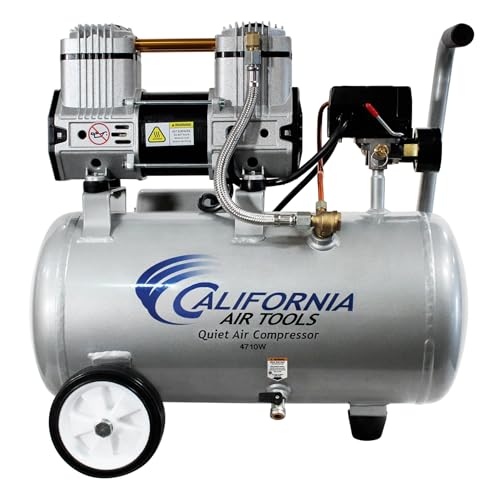 California Air Tools CAT-4710W 4.7-Gal Compressor
|
8.3/10 | Buy | |
 5L Portable Air Tank Carbon Steel Pressure Reserve
|
8.1/10 | Buy | |
| Best Premium |
 California Air Tools 20015HP 20-Gallon Quiet Air
|
8.1/10 | Buy |
 Ingersoll Rand 2475N7.5 7.5 HP 80-Gallon Two-Stage
|
8.1/10 | Buy | |
 EVIL ENERGY 12V 1-Gallon Air Tank and Compressor
|
7.8/10 | Buy | |
 California Air Tools 20020 Ultra-Quiet 2.0 HP
|
7.8/10 | Buy |
California Air Tools 2010A 2-Gallon Compressor
Operating at just 60 decibels, this compact unit delivers reliable airflow with minimal noise disruption. Its rust-free aluminum tank and oil-free dual-piston pump make it well suited for indoor trim work and noise-sensitive spaces.
Pros
- Exceptionally quiet operation at only 60 decibels
- Lightweight rust-free aluminum tank design
- Low-maintenance oil-free dual-piston system
- Quick 14-second recovery time between cycles
Cons
- Modest 2-gallon tank limits continuous heavy tool use
- 120 PSI maximum pressure is below heavy-duty standards
- Air output is insufficient for sustained high-demand air tools
California Air Tools CAT-4610S Ultra-Quiet 1.0 HP
The California Air Tools CAT-4610S delivers a remarkably quiet 60 dB sound profile with 2.20 CFM at 90 PSI from an oil-free dual-piston pump and a 4.6-gallon steel twin tank. Drawing only 8.5 amps, it is an excellent pneumatic choice for trim carpenters, woodworkers, and garage hobbyists working in noise-sensitive spaces.
Pros
- Ultra-quiet 60 dB sound level allows normal conversation while the pump runs
- Low 8.5-amp electrical draw prevents nuisance circuit breaker trips on 110V household lines
- Oil-free dual-piston pump requires no crankcase oil changes and boasts a 3000-plus hour life cycle
- Durable 4.6-gallon steel twin-tank configuration delivers steady air storage for sequential fastening
Cons
- Rated 2.20 CFM @ 90 PSI is insufficient for continuous-demand pneumatic tools like sanders or paint sprayers
- Weighs 56.2 pounds without transport wheels, requiring a solid two-handed carry between work areas
Air Compressor for Beginners
This instructional paperback guide breaks down essential pneumatic principles, explaining the relationship between PSI, CFM, tool compatibility, and receiver tank safety. It serves as an accessible reference for DIY homeowners and hobbyists setting up their first workshop compressor.
Pros
- Demystifies core pneumatic specifications like CFM, PSI, and duty cycle for first-time buyers
- Emphasizes vital maintenance habits like routine tank condensation drainage and moisture management
- Helps prevent costly mistakes when purchasing compressors and matching pneumatic tools
- Compact and lightweight 6 x 9-inch physical reference format suited for workshop bench storage
Cons
- Instructional reference guide only and contains no physical pneumatic tools, fittings, or hardware
- Experienced mechanics and industrial pneumatic technicians may find the foundational material too basic
- Slim 0.29-inch profile reflects a concise introductory overview rather than an exhaustive commercial engineering manual
California Air Tools CAT-4710W 4.7-Gal Compressor
Built for garage workshops and DIY tasks, this mobile unit features an oil-free dual-piston pump that fills its 4.7-gallon steel tank in 78 seconds. Its low 7.5-amp motor draw ensures smooth startups on standard household circuits without tripping breakers.
Pros
- Fast 78-second tank fill time from empty
- Low 7.5-amp draw prevents tripped breakers
- Low-maintenance oil-free pump operation
- Wheels and pull handle ease transport at 35 pounds
Cons
- Delivers only 2.2 CFM at 90 PSI for demanding tools
- Steel tank construction is heavier than aluminum alternatives
5L Portable Air Tank Carbon Steel Pressure Reserve
This 5-liter (1.32-gallon) carbon steel auxiliary air buffer provides up to 1.25 MPa (approx. 181 PSI) of pressure storage to stabilize line pulses and expand pneumatic reserve capacity. It is an ideal addition for technicians, hobbyists, and automation setups requiring a durable, compact horizontal surge tank.
Pros
- Solid carbon steel construction with seamless welding and a durable baked finish
- Rated for high operating pressures up to 1.25 MPa (approx. 181 PSI)
- Built-in bottom discharge port allows quick drainage of moisture buildup
- Compact 5L (1.32 gallon) form factor fits easily into tight mobile rigs or automated systems
Cons
- Compact 1.32-gallon volume provides limited air volume for continuous-demand pneumatic tools
- Requires an external air source, pump, or compressor to pressurize the vessel
- Higher price point compared to standard consumer-grade portable air tanks
California Air Tools 20015HP 20-Gallon Quiet Air
The California Air Tools 20015HP delivers 3.80 CFM at 90 PSI with a 175 PSI maximum tank pressure and an ultra-quiet 70 dB sound profile from its low-RPM dual-piston pump. It is an ideal 20-gallon rolling workshop compressor for garage hobbyists, auto restorers, and woodworkers needing clean air without high noise levels.
Pros
- Remarkably quiet 70 dB acoustic output powered by a slow-turning 1750 RPM motor
- High 175 PSI pressure ceiling provides a substantial stored air buffer in a compact vertical footprint
- Oil-free two-stage pump design offers an extended 3000-plus hour life cycle with zero oil changes
- Low 12-amp electrical draw runs reliably on standard 110V household circuits
Cons
- Delivered 3.80 CFM at 90 PSI is limited for continuous-draw air tools such as rotary sanders or sandblasting equipment
- Heavier 113-pound dry weight requires using the transport wheels rather than manual lifting for vehicle transit
Ingersoll Rand 2475N7.5 7.5 HP 80-Gallon Two-Stage
The Ingersoll Rand 2475N7.5 is an industrial-grade 7.5 HP two-stage stationary air compressor pairing an 80-gallon ASME receiver tank with a rugged cast-iron pump rated for 100% continuous duty at up to 175 psig. It provides dependable, high-capacity air storage for professional auto mechanics, commercial garages, and demanding fabrication shops.
Pros
- Durable solid cast-iron two-stage pump engineered for over 15,000 hours of heavy-duty shop service
- True 100% continuous duty rating supports non-stop production in multi-bay automotive and fabrication environments
- Spacious 80-gallon ASME-certified vertical receiver tank stores ample air volume at up to 175 psig
- Extended 2,000-hour oil service intervals when utilizing All Season Select synthetic lubricant
- Individual cylinder casting and one-piece connecting rod simplify preventative maintenance and component access
Cons
- Substantial 611-pound dry weight requires dedicated floor anchoring, mechanical lifting gear for positioning, and a permanent shop footprint
- Demands high-power dedicated electrical service and professional stationary hardwiring rather than standard outlet convenience
- Extended two-year pump warranty coverage requires the separate purchase of the official lubricant start-up kit
EVIL ENERGY 12V 1-Gallon Air Tank and Compressor
This compact 12V onboard air kit pairs a 1-gallon reinforced steel reservoir with an integrated compressor rated up to 150 PSI across five 1/4-inch NPT ports. It is well suited for truck owners, off-road enthusiasts, and DIY builders needing reliable air storage for suspension bags, air horns, and tire topping.
Pros
- Compact 1-gallon footprint fits easily into tight truck beds, trunk compartments, or undercarriage locations
- Five 1/4-inch NPT ports provide exceptional layout flexibility for custom air lines and accessories
- All-in-one kit includes compressor, tank, drain valve, air hose, and mounting brackets
- Solid steel tank construction with anti-corrosion exterior coating designed for mobile environments
Cons
- One-gallon capacity is strictly intended for intermittent air needs, not continuous-demand air tools like sanders or impact wrenches
- Airflow delivery ratings (SCFM) and decibel sound output are not explicitly specified by the manufacturer
- Requires custom 12V automotive wiring, dedicated fuse protection, and careful placement away from extreme road debris
California Air Tools 20020 Ultra-Quiet 2.0 HP
The California Air Tools 20020 provides a 20-gallon air reserve powered by a low-RPM 2.0 HP motor, delivering 5.30 CFM at 90 PSI at an ultra-quiet 70 dB sound level. Featuring an oil-free dual-piston pump and a 14-amp draw on standard 110V power, it suits home garage hobbyists and woodworkers seeking quiet, dependable pneumatic volume.
Pros
- Quiet 70 dB acoustic rating makes indoor garage and residential basement operation comfortable without extreme ear fatigue
- Strong air delivery of 5.30 CFM at 90 PSI effortlessly handles finish nailers, impact wrenches, and common pneumatic garage tools
- Long-life dual-piston oil-free pump is rated for over 3,000 hours of operation with zero crankcase oil maintenance
- Low 14-amp draw is compatible with standard 110V household power under proper dedicated circuit conditions
- Vertical 20-gallon steel tank with no-flat wheels combines substantial air storage with a compact shop footprint
Cons
- At 114 pounds, loading this vertical compressor into a pickup truck bed or moving it upstairs requires two people
- Not intended for continuous-duty high-consumption tools like uninterrupted sandblasters or production rotary sanders
- The tall 45-inch vertical profile requires deliberate handling when rolling across uneven outdoor terrain
Matching Compressor Capacity to Pneumatic Tool Demands
Selecting the correct pneumatic power source requires evaluating the mechanical relationship between air consumption and pump replenishment. Air tools do not consume tank volume directly; they consume pressurized airflow delivered at a specific operational threshold. When a pump cannot regenerate volume as fast as your tools consume it, air line pressure drops, tool torque plummets, and the motor cycles continuously without cooling down. Determining proper equipment sizing begins by isolating continuous airflow delivery from static receiver tank volume.
Delivered CFM at 90 PSI Versus Stated Tank Storage
Cubic feet per minute, or CFM, serves as the primary metric in pneumatic equipment sizing. Manufacturers commonly measure and list airflow delivery at two standard pressures: 90 PSI for heavy pneumatic tools and 40 PSI for low-pressure applications like paint spraying or fluid transfer. A compact portable unit like the California Air Tools 2010A delivers 2.20 CFM at 90 PSI and 3.10 CFM at 40 PSI from a 1.0 HP motor. These figures indicate the actual volume of atmospheric air compressed and delivered into the system per minute under working load.
Tank size alone does not determine how many tools you can run or how powerful they will feel under sustained use. A large 20-gallon tank can run dry in seconds if attached to a high-demand sander while connected to an undersized pump mechanism. The tank acts merely as a temporary storage battery that bridges the gap during brief spikes in consumption. If your tool draws 5.0 CFM continuously at 90 PSI, a compressor delivering only 2.20 CFM will steadily lose operating line pressure regardless of receiver capacity.
Intermittent Versus Continuous Tool Duty Cycles
Pneumatic applications divide sharply into intermittent firing and continuous airflow categories. Intermittent tools include framing nailers, brad nailers, manual grease guns, and tire inflators that cycle for fractions of a second between pauses. Because these tools permit recovery intervals between cycles, compact units like the California Air Tools CAT-4610S with a 4.6-gallon twin tank easily keep up with finish carpentry. The pump runs intermittently, replenishing the tank during the natural working pauses between fasteners without overheating.
Continuous tools demand an uninterrupted volume of compressed air to maintain rotational speed or atomization pressure. Dual-action orbital sanders, pneumatic needle scalers, blast cabinets, and HVLP paint sprayers consume between 6 to 15 CFM continuously during active use. Running these high-demand tools on a lightweight compressor causes line pressure to collapse within seconds. Once line pressure drops below the minimum operating threshold, paint spray guns spit uneven droplet patterns and rotary sanders stall against work surfaces.
Duty cycle ratings specify the percentage of time a compressor pump can run safely within a given operational window without thermal breakdown. Many consumer-grade oil-free compressors feature a 50 percent duty cycle, meaning the motor should only run thirty minutes out of every hour. Industrial machines such as the Ingersoll Rand 2475N7.5 provide a 100 percent continuous duty rating, permitting uninterrupted pump operation under full mechanical load. Selecting an undersized machine forces a consumer pump into continuous operation, overheating valve plates and wearing piston seals prematurely.
Single-Stage Versus Two-Stage Pressure Dynamics
Compression staging dictates the maximum operating pressure and volumetric efficiency of the pump mechanism. Single-stage compressors draw atmospheric air into a cylinder and compress it directly into the receiver tank in one stroke. These units typically generate maximum pressures between 120 and 150 PSI, which is sufficient for common woodworking and general maintenance tasks. For example, the California Air Tools CAT-4710W utilizes an oil-free single-stage dual piston setup that produces 120 PSI maximum pressure across a 4.7-gallon steel tank.
Two-stage compressors use two separate cylinders of different diameters connected by a finned intercooler tube. The primary low-pressure cylinder compresses intake air to an intermediate pressure before transferring it to the secondary high-pressure cylinder for final compression. This dual-step process allows models like the California Air Tools 20015HP to reach 175 PSI maximum working pressure while maintaining 3.80 CFM at 90 PSI. Compressing air in two separate stages generates less heat per stroke, improving thermal efficiency and component durability.
Higher maximum pressure provides a significantly larger usable air reserve within the exact same physical tank footprint. Storing air at 175 PSI instead of 120 PSI allows you to pack substantially more standard cubic feet of air into the receiver before the pump kicks on. For demanding shop environments, an industrial unit like the Ingersoll Rand 2475N7.5 pairs an 80-gallon ASME receiver with 175 psig maximum pressure and a 7.5 HP motor. This massive pressure differential ensures that high-torque impact wrenches maintain regulated pressure without noticeable line drop during heavy shop use.
Storage Receiver Capacity and Recovery Cycle Times
Tank capacity dictates how long a tool can operate purely on stored pressure before the pressure switch triggers the motor to start. When using intermittent tools, a smaller 2-gallon aluminum tank like that on the California Air Tools 2010A fills from empty in approximately 50 seconds and recovers from 90 PSI to 120 PSI in just 14 seconds. Rapid recovery times keep portable jobsite compressors compact and lightweight, making them easy to transport across active workspaces without waiting on long recharge cycles.
Larger receivers provide a vital dampening buffer against pressure fluctuations in fixed workshop environments. A 20-gallon tank, such as the vertical vessel on the California Air Tools 20020, stores enough compressed air to absorb sudden surges from pneumatic ratchets and impact guns without instantly starting the motor. This expanded buffer dampens air line pulsation, stabilizes downstream pressure regulators, and reduces the overall frequency of motor starts and stops. Frequent motor cycling generates excessive heat in electrical start windings, so fewer extended cycles preserve motor life.
Recovery time depends entirely on the ratio of pump CFM production to the total volume of the receiver tank. Connecting an undersized 2.0 CFM pump to a massive 60-gallon tank will yield extremely sluggish recovery times once the pressure drops below the cut-in switch threshold. The motor will run for extended periods just to restore thirty pounds of pressure. Balancing pump displacement with tank gallon capacity ensures that your equipment recharges briskly, keeping tools responsive throughout multi-step assembly procedures.
Electrical Demands and Household Circuit Boundaries
Electric motor sizing determines whether your compressor can run safely on existing residential electrical wiring. Standard household branch circuits in North American garages supply 120 volts on either 15-amp or 20-amp circuit breakers. Small portable units like the California Air Tools CAT-4710W draw approximately 7.5 amps, while the larger 2.0 HP California Air Tools 20020 draws 14 amps under load. Operating a 14-amp compressor on a shared 15-amp circuit leaves almost no headroom for shop lighting or auxiliary power tools, risking breaker trips.
Electric induction motors require a substantial inrush current to start moving against cold mechanical head pressure. While running amperage might remain within acceptable limits, startup amperage spikes can reach two to three times the continuous operating draw for several cycles. If an unloader valve fails to release trapped air between the pump head and the tank check valve, the motor will hum under locked-rotor conditions and immediately pop the circuit breaker. Ensuring a dedicated circuit with correct wire gauge prevents voltage drop that causes sluggish starting and motor overheating.
High-output workshop compressors exceed standard 120-volt residential wall outlet capacities and require dedicated 240-volt single-phase or three-phase power connections. An industrial machine like the Ingersoll Rand 2475N7.5 with a continuous-duty 7.5 HP motor must be hardwired into a dedicated electrical disconnect box with heavy-gauge copper wiring. Attempting to power heavy equipment with undersized conductors causes severe line voltage sag, which increases running amperage and leads to premature motor capacitor failure. Always verify breaker panel capacity and available voltage before purchasing stationary shop machinery.
Acoustic Footprint and Pump RPM in Enclosed Spaces
Noise output represents a critical operating consideration for home garages, basements, and occupied residential jobsites. Traditional oil-free pancake compressors utilize high-RPM universal motors that spin at 3,400 RPM or higher, producing noise levels exceeding 80 to 85 decibels. Working next to an 85 dBA sound source creates severe acoustic fatigue, prevents normal conversation, and damages hearing without dedicated protective equipment. In contrast, low-RPM dual-piston designs operate at approximately 1,680 RPM to dramatically reduce mechanical vibration and intake noise.
Ultra-quiet compressor engineering focuses on sound dampening through slower motor speeds and balanced twin-cylinder pump heads. The California Air Tools 2010A and CAT-4610S operate at an impressively low 60 decibels, which is quiet enough to hold a normal conversation standing directly beside the running machine. Even larger wheeled 20-gallon units like the California Air Tools 20015HP and 20020 register at 70 decibels, making them exceptionally tolerable in compact garage workshops. Lower operating RPM also reduces friction, keeping operating temperatures lower and extending pump component life beyond 3,000 operational hours.
Managing workspace sound involves evaluating pump placement, vibration isolation, and intake filtration design. Cast-iron industrial units like the Ingersoll Rand 2475N7.5 generate substantial mechanical mass that absorbs vibration, but their sheer horsepower creates deep acoustic resonance through shop floors. Installing thick rubber vibration isolator pads under compressor mounting feet prevents sound transmission through concrete slabs and structural framing. Placing large stationary compressors in dedicated utility closets or exterior enclosures further isolates mechanical noise from primary assembly areas.
Auxiliary Reserve Tanks and Specialized Mobile Setups
Adding an auxiliary air buffer provides an effective way to expand storage capacity without upgrading the main compressor pump. Standalone pressure vessels, such as the Generic 5L Portable Air Tank constructed from carbon steel and rated up to 1.25 MPa, act as intermediate reservoirs between the compressor and the point of use. Placing an auxiliary air tank at the end of a long pneumatic hose line eliminates dynamic line friction drop during rapid tool firing. This setup stabilizes working pressure at remote framing stations or paint booths without hauling heavy machinery across the workspace.
Vehicle-mounted pneumatic systems serve mobile service trucks, off-road tire inflation, and custom air suspension needs. Specialized 12-volt kits like the EVIL ENERGY Air Tank and Compressor 1 Gallon Kit provide dedicated onboard pressure up to 150 PSI through reinforced steel vessels with multiple 1/4-inch NPT ports. These compact setups draw direct current from automotive electrical systems, allowing operators to inflate tires, actuate air horns, and run light pneumatic maintenance tools in the field. Built-in drain valves and pressure switches ensure safe, regulated operation in harsh mobile operating environments.
Proper maintenance of both primary and auxiliary pressure vessels protects pneumatic equipment against moisture-induced corrosion and internal scale. Compressing atmospheric air concentrates ambient moisture, which condenses into liquid water at the bottom of the receiver tank as the air cools. Operating without draining this liquid reduces usable air volume, rusts steel tank walls from the inside out, and sends gritty moisture downstream into expensive air tools. Draining receiver tanks daily through clean petcocks or ball valves ensures consistent air quality and preserves storage vessel structural integrity.
Practical Sizing Calculations for Common Workshop Tasks
Calculating your true compressed air requirements starts by auditing every tool you plan to operate, identifying its required operating pressure, and checking its CFM demand. As an established rule of thumb, multiply the highest continuous tool consumption rating by 1.25 to 1.5 to provide an adequate safety margin. If you intend to use a paint sprayer requiring 4.0 CFM at 40 PSI, select a machine capable of producing at least 5.0 to 6.0 CFM at that pressure. This sizing buffer prevents the compressor from running continuously at maximum thermal capacity while you work.
Consider whether multiple operators will draw from the compressed air system simultaneously during busy projects. When running two framing carpenters off a single jobsite setup, their intermittent consumption stacks during rapid subfloor or sheathing installation. While a 1.0 HP compressor producing 2.20 CFM at 90 PSI satisfies a single finish carpenter, a two-man framing crew requires higher air delivery and a twin-tank buffer to prevent nail heads from standing proud. Step up to a larger single-stage or two-stage pump whenever simultaneous tool usage is expected.
Balancing CFM delivery, receiver capacity, and physical portability ensures that you invest in the right machine for your actual daily workflow. High-pressure portable options like the wheeled California Air Tools CAT-4710W bridge the gap between lightweight mobility and steady output for small business and home garage tasks. Matching verified airflow volume to your specific tools guarantees steady power delivery, eliminates project downtime, and ensures reliable pneumatic performance for years of regular service.
About the author
Bob Beacham is an experienced tools and workshop writer with deep knowledge of power equipment, mechanical systems, and practical DIY applications. His coverage of air compressors, welding equipment, saws, and workshop tools helps translate technical specifications into useful guidance for homeowners and serious DIYers.