
How to Buy the Right Air Compressor: A Practical Guide for 2026
Learn how to buy the right air compressor by matching tool CFM, tank volume, and power demands in our practical October 2026 guide.
 By Tony Carrick
Updated October 7, 2026
By Tony Carrick
Updated October 7, 2026

Stalling an air tool midway through an intensive project or repeatedly tripping a standard household circuit breaker usually indicates an undersized or mismatched pneumatic setup. Understanding how to buy the right air compressor requires looking past superficial marketing claims and focusing on the mechanical demands of your pneumatic tools. Air delivery volume, measured in cubic feet per minute at specific pressure levels, dictates whether a machine can maintain steady airflow or constantly lag behind active work. Matching compressor capacity to planned pneumatic applications prevents unexpected motor overheating, disruptive pressure drops, and premature pump fatigue.
Selecting the ideal machine also involves evaluating operational noise levels, storage tank volume, and electrical circuit compatibility. While compact, oil-free units offer zero-maintenance portability for finish carpentry or emergency vehicle tire inflation, large stationary cast-iron systems provide the continuous duty cycles required for heavy automotive air delivery. Examining realistic specifications like running amperage draw, operating decibel ratings, and tank recovery speed ensures the selected unit integrates smoothly into your home garage or dedicated workspace. Balancing immediate airflow demands with long-term pump durability helps ensure dependable pneumatic performance across diverse workshop tasks.
| Award | Product | ACR Score About ACR ScoreThe ACR Score is our own rating from 0 to 10, based on performance, design and build, ease of use, and value. It reflects independent research and is never influenced by manufacturers, retailers, or affiliate commissions. Learn more › | |
|---|---|---|---|
| Best Overall |
California Air Tools 2010A 2-Gallon Compressor
|
9.1/10 | Buy |
| Best Value |
 ALL-TOP 12V Dual-Cylinder Air Compressor
|
8.8/10 | Buy |
| Best Budget |
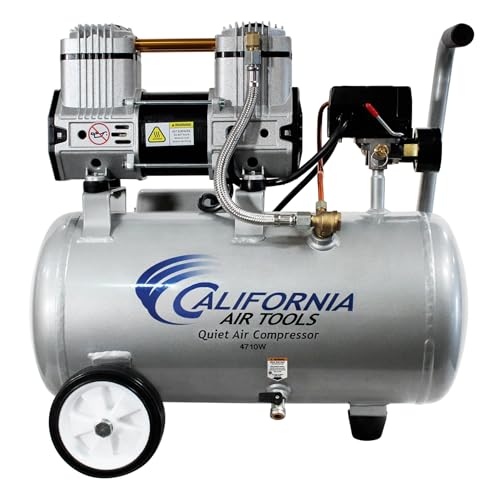 California Air Tools CAT-4710W 4.7-Gal Compressor
|
8.3/10 | Buy |
| Best Premium |
 Ingersoll Rand 2340L5-V 5 HP Air Compressor
|
8.3/10 | Buy |
 AstroAI Dual Power Portable Tire Inflator
|
8.1/10 | Buy | |
 Ingersoll Rand 2475N7.5 7.5 HP 80-Gallon Two-Stage
|
8.1/10 | Buy | |
 California Air Tools 20020 Ultra-Quiet 2.0 HP
|
7.8/10 | Buy |
California Air Tools 2010A 2-Gallon Compressor
Operating at just 60 decibels, this compact unit delivers reliable airflow with minimal noise disruption. Its rust-free aluminum tank and oil-free dual-piston pump make it well suited for indoor trim work and noise-sensitive spaces.
Pros
- Exceptionally quiet operation at only 60 decibels
- Lightweight rust-free aluminum tank design
- Low-maintenance oil-free dual-piston system
- Quick 14-second recovery time between cycles
Cons
- Modest 2-gallon tank limits continuous heavy tool use
- 120 PSI maximum pressure is below heavy-duty standards
- Air output is insufficient for sustained high-demand air tools
ALL-TOP 12V Dual-Cylinder Air Compressor
The ALL-TOP 12V Dual-Cylinder Air Compressor delivers a manufacturer-rated 12.35 CFM airflow and 150 PSI maximum pressure with an integrated digital LCD auto-stop controller. Powered via direct battery alligator clamps, this heavy-duty portable pump is built for overlanders, off-road enthusiasts, and truck owners needing rapid tire reinflation on remote trails.
Pros
- High rated airflow output of 12.35 CFM (350 L/min) significantly speeds up multi-tire trail reinflation
- Accurate digital auto-stop feature prevents over-inflation without requiring manual gauge checks
- Robust dual-cylinder motor with 221-degree Fahrenheit thermal shutdown and 120A circuit protection
- Anti-vibration metal base can be left portable or permanently bolted into an overland rig
Cons
- Substantial 26.5-pound weight makes it bulkier to stow than compact emergency inflators
- High current draw requires hooking directly to vehicle battery terminals with the engine running
- Normal 2 to 4 pause intervals during the digital inflation cycle may surprise unfamiliar users
California Air Tools CAT-4710W 4.7-Gal Compressor
Built for garage workshops and DIY tasks, this mobile unit features an oil-free dual-piston pump that fills its 4.7-gallon steel tank in 78 seconds. Its low 7.5-amp motor draw ensures smooth startups on standard household circuits without tripping breakers.
Pros
- Fast 78-second tank fill time from empty
- Low 7.5-amp draw prevents tripped breakers
- Low-maintenance oil-free pump operation
- Wheels and pull handle ease transport at 35 pounds
Cons
- Delivers only 2.2 CFM at 90 PSI for demanding tools
- Steel tank construction is heavier than aluminum alternatives
Ingersoll Rand 2340L5-V 5 HP Air Compressor
Built for demanding workshop environments, this two-stage compressor provides continuous duty operation through an all-cast-iron design. Its 60-gallon vertical configuration helps conserve valuable floor space while reliably sustaining high-pressure air applications.
Pros
- Durable all-cast-iron construction
- Rated for 100% continuous duty
- Vertical tank configuration saves floor space
- Individually cast cylinders ease maintenance
Cons
- Extremely heavy at 430 pounds
- Requires dedicated 230-volt single-phase power
- Tall 69-inch profile requires significant overhead clearance
AstroAI Dual Power Portable Tire Inflator
Designed for both home garages and roadside needs, this inflator operates on 120V AC and 12V DC power. It offers dual pressure modes with automatic shut-off, making it a dependable choice for standard vehicles and household inflatables.
Pros
- Runs on both home outlets and car sockets
- Dual modes handle tires and high-volume inflatables
- Accurate digital preset with automatic shut-off
- Lightweight and compact 2.6-pound design
- Built-in LED light aids emergency roadside repairs
Cons
- Not suitable for heavy-duty truck tires
- Continuous runtime capped at 15 minutes
Ingersoll Rand 2475N7.5 7.5 HP 80-Gallon Two-Stage
The Ingersoll Rand 2475N7.5 is an industrial-grade 7.5 HP two-stage stationary air compressor pairing an 80-gallon ASME receiver tank with a rugged cast-iron pump rated for 100% continuous duty at up to 175 psig. It provides dependable, high-capacity air storage for professional auto mechanics, commercial garages, and demanding fabrication shops.
Pros
- Durable solid cast-iron two-stage pump engineered for over 15,000 hours of heavy-duty shop service
- True 100% continuous duty rating supports non-stop production in multi-bay automotive and fabrication environments
- Spacious 80-gallon ASME-certified vertical receiver tank stores ample air volume at up to 175 psig
- Extended 2,000-hour oil service intervals when utilizing All Season Select synthetic lubricant
- Individual cylinder casting and one-piece connecting rod simplify preventative maintenance and component access
Cons
- Substantial 611-pound dry weight requires dedicated floor anchoring, mechanical lifting gear for positioning, and a permanent shop footprint
- Demands high-power dedicated electrical service and professional stationary hardwiring rather than standard outlet convenience
- Extended two-year pump warranty coverage requires the separate purchase of the official lubricant start-up kit
California Air Tools 20020 Ultra-Quiet 2.0 HP
The California Air Tools 20020 provides a 20-gallon air reserve powered by a low-RPM 2.0 HP motor, delivering 5.30 CFM at 90 PSI at an ultra-quiet 70 dB sound level. Featuring an oil-free dual-piston pump and a 14-amp draw on standard 110V power, it suits home garage hobbyists and woodworkers seeking quiet, dependable pneumatic volume.
Pros
- Quiet 70 dB acoustic rating makes indoor garage and residential basement operation comfortable without extreme ear fatigue
- Strong air delivery of 5.30 CFM at 90 PSI effortlessly handles finish nailers, impact wrenches, and common pneumatic garage tools
- Long-life dual-piston oil-free pump is rated for over 3,000 hours of operation with zero crankcase oil maintenance
- Low 14-amp draw is compatible with standard 110V household power under proper dedicated circuit conditions
- Vertical 20-gallon steel tank with no-flat wheels combines substantial air storage with a compact shop footprint
Cons
- At 114 pounds, loading this vertical compressor into a pickup truck bed or moving it upstairs requires two people
- Not intended for continuous-duty high-consumption tools like uninterrupted sandblasters or production rotary sanders
- The tall 45-inch vertical profile requires deliberate handling when rolling across uneven outdoor terrain
Technical Sizing and Equipment Selection for Air Compressors
Navigating pneumatic equipment requires understanding how individual mechanical specifications translate to real-world performance. A buyer must evaluate the relationship between air volume, pressure thresholds, electrical supply limitations, and duty cycle demands before purchasing. Investing in an incompatible unit often leads to stalled air tools, rapid motor burnout, or disruptive noise in residential spaces. Approaching this purchase with a methodical assessment of airflow consumption and power infrastructure ensures your chosen machine delivers reliable service for years to come.
Calculating Air Delivery: CFM and PSI Requirements for Pneumatic Tools
Delivered airflow volume serves as the primary metric for determining whether a compressor can successfully operate specific pneumatic tools. Manufacturers express this metric as cubic feet per minute (CFM) rated at a specified operating pressure, commonly 90 PSI or 40 PSI. Intermittent tools such as brad nailers, finish staplers, and tire chucks consume minimal air, usually requiring less than 1 to 2 CFM. Continuous tools like dual-action rotary sanders, die grinders, and HVLP paint spray guns consume far more volume, often demanding anywhere from 6 to 15 CFM to avoid stalling.
Evaluating manufacturer specifications reveals distinct performance tiers designed for specific workload profiles. For instance, the California Air Tools 2010A 1.0 HP Ultra Quiet delivers 2.20 CFM at 90 PSI and 3.10 CFM at 40 PSI, making it well-suited for light trim work and general inflation. Stepping up to larger shop equipment, the California Air Tools 20020 2.0 HP Ultra Quiet produces 5.30 CFM at 90 PSI and 6.40 CFM at 40 PSI to accommodate moderate-demand tools with greater headroom. Failing to match the CFM draw of your most demanding tool leads to constant pressure loss, forcing you to pause work while the pump rebuilds pressure.
Operating pressure, measured in pounds per square inch (PSI), represents the force of delivered air rather than volume. Most standard pneumatic tools operate efficiently between 70 and 90 PSI, requiring a steady supply without dipping below operating thresholds. Compressors with maximum pressures from 120 PSI to 175 PSI store a denser reserve of air in the receiver tank. This higher storage ceiling allows smaller tanks to hold greater usable volume before the pressure switch triggers a motor restart.
Single-Stage versus Two-Stage Compression Mechanics
Pneumatic pumps compress atmospheric air using either single-stage or two-stage mechanical configurations. In a single-stage pump, one or more pistons draw in ambient air and compress it directly to final tank pressure in a single stroke. Single-stage compressors typically top out around 120 to 150 PSI, which is sufficient for light carpentry, consumer automotive tasks, and portable jobsite tools. Because air is compressed in one step, single-stage pumps generate significant thermal energy, which can reduce efficiency during extended, uninterrupted running sessions.
Two-stage systems divide compression between two cylinders connected by a finned intercooler tube. The low-pressure cylinder compresses ambient air, routes it through the intercooler to dissipate heat, and feeds it into a high-pressure cylinder. Units like the Ingersoll Rand 2340L5-V 5 HP Type 30 Two-Stage Air and the Ingersoll Rand 2475N7.5 7.5 HP Two-Stage Air utilize this design to achieve pressures up to 175 PSI. The intercooling stage maintains lower operating temperatures, protects pump valves, and enables true continuous-duty operation in demanding industrial or professional shop environments.
Pump Architecture: Oil-Free Convenience versus Cast-Iron Longevity
Selecting between oil-free and oil-lubricated pump engineering represents a fundamental fork in pneumatic equipment purchasing. Oil-free compressors utilize self-lubricating piston rings, often composed of Teflon or advanced polymer blends, operating inside precision cylinders. These pumps require no crankcase oil changes, operate reliably in freezing weather without sluggish oil resistance, and allow transport in any orientation without leaking fluids. The California Air Tools CAT-4710W 1.0 HP Quiet features an oil-free dual-piston pump engineered for low maintenance and cleaner air delivery, making it practical for mobile contractors and indoor woodworkers.
Oil-free designs deliver air free from oil vapor, making them ideal for delicate trim work, brad nailing, or light spray finishing. Modern dual-piston oil-free pumps are typically rated for 1,000 to over 3,000 hours of operation before piston seal wear occurs. Because they rely on dry mechanical friction dissipation, these units require intermittent duty cycles to avoid overheating the compression rings. Operating within rated limits eliminates the routine chores of checking sight glasses and disposing of used pump oil.
In contrast, heavy-duty workshop compressors employ splash-lubricated or pressure-lubricated cast-iron pumps that circulate synthetic or non-detergent oil to minimize friction. The heavy cast-iron construction found on machines like the Ingersoll Rand 2475N7.5 7.5 HP Two-Stage Air is designed for over 15,000 hours of trouble-free operation under continuous duty conditions. Using specialized lubricants like All Season Select synthetic oil allows extended intervals of up to 2,000 hours between fluid changes while maintaining exceptional heat transfer. For heavy automotive restoration shops, industrial manufacturing, or continuous blast cabinets, oil-lubricated cast-iron pumps provide unmatched long-term durability and thermal stability.
Evaluating Operational Decibels and Workspace Acoustics
Operational noise is frequently underestimated when selecting an air compressor for residential or enclosed shop spaces. Traditional high-speed compressors feature universal electric motors running at 3,400 RPM, often producing harsh noise levels exceeding 80 to 90 decibels. Operating a loud machine in an enclosed garage or basement quickly causes auditory fatigue and disturbs household members. Prolonged exposure to noise levels above 85 decibels also introduces risks of hearing damage without consistent hearing protection.
Modern ultra-quiet compressors address this challenge by pairing low-RPM induction motors with balanced dual-piston pump heads. Operating at approximately 1,680 RPM, the California Air Tools 2010A 1.0 HP Ultra Quiet produces only 60 decibels of sound, allowing normal conversation right beside the running unit. Even larger capacity wheeled models, such as the California Air Tools 20020 2.0 HP Ultra Quiet, maintain a modest 70-decibel rating while delivering substantial airflow. For homeowners, indoor carpenters, and garage hobbyists working in tight suburban neighborhoods, choosing an ultra-quiet model dramatically improves daily working comfort without sacrificing necessary air output.
Electrical Circuit Compatibility, Amperage Draw, and Voltage Demands
Electrical circuit limitations must be verified before choosing an electric air compressor for a residential garage or workshop. Standard household branch circuits supply 120 volts at 15 or 20 amps, which constrains the power an electric motor can draw continuously. When an electric compressor starts under head pressure, the motor produces an inrush current spike that can trip an overloaded 15-amp breaker. Selecting a model with an appropriate operating draw avoids frequent circuit interruptions when sharing lines with other power tools.
Portable models vary considerably in their electrical demands, making circuit verification a critical purchasing step. For example, the California Air Tools CAT-4710W 1.0 HP Quiet operates on only 7.5 amps at 110 volts, allowing trouble-free startup on standard 15-amp household circuits. Conversely, the larger California Air Tools 20020 2.0 HP Ultra Quiet draws 14 amps, representing the upper boundary for 110-volt operation and functioning best on a dedicated 20-amp branch circuit. Using long, undersized extension cords causes severe voltage drop, which starves the motor of current, generates excessive heat, and triggers the built-in thermal overload protection.
High-capacity stationary workshop compressors exceed standard 120-volt household circuit capacities and require dedicated 230-volt single-phase or three-phase electrical connections. Commercial machines like the 5 HP Ingersoll Rand 2340L5-V 5 HP Type 30 Two-Stage Air require a robust 230-volt single-phase circuit to power their heavy industrial motors reliably. Upgrading to a 7.5 HP stationary platform demands even greater electrical infrastructure and professional hardwiring to handle substantial running currents and starting loads. Buyers must inspect their electrical panel capacity and available workshop wiring before investing in large-scale stationary equipment.
Storage Tank Capacity, Orientation, and Recovery Cycles
The receiver tank acts as a pressurized storage buffer, holding compressed air until an attached tool demands airflow. Tank capacity, measured in gallons, dictates how long an air tool can run before the tank pressure drops to the cut-in threshold and activates the pump. Intermittent fastening tasks require minimal storage capacity, making compact 2-gallon to 4.7-gallon tanks ideal for easy transport around a jobsite. Continuous-draw tools, by contrast, rapidly exhaust small air buffers, causing the pump to run non-stop and creating frustrating pressure drops at the tool nozzle.
Tank orientation and portability features directly influence workspace footprint and jobsite ergonomics. Vertical stationary tanks, such as the 60-gallon vessel on the Ingersoll Rand 2340L5-V 5 HP Type 30 Two-Stage Air or the 80-gallon tank on the Ingersoll Rand 2475N7.5 7.5 HP Two-Stage Air, conserve floor space by utilizing vertical height. For mobile jobs, wheeled horizontal designs like the California Air Tools CAT-4710W 1.0 HP Quiet and the California Air Tools 20020 2.0 HP Ultra Quiet allow easy transport around work areas. Lightweight aluminum tanks, such as the 2-gallon vessel on the California Air Tools 2010A 1.0 HP Ultra Quiet, keep total unit weight at 35 pounds for convenient carrying.
Understanding pump recovery time and initial fill time helps gauge operational productivity during heavy work sessions. Initial fill time measures the seconds or minutes required to charge an empty tank to maximum cut-out pressure, such as the brisk 50-second fill time on the 2-gallon model. Recovery time represents the crucial window needed to recharge the tank from the cut-in pressure back up to cut-out pressure while working. A fast recovery cycle, such as 14 seconds from 90 to 120 PSI, ensures the tool operator spends minimal time waiting for the pneumatic buffer to regenerate between tasks.
Mobile Inflation and DC Powered Emergency Air Systems
Pneumatic needs often extend beyond a traditional shop, requiring compact 12-volt direct current (DC) inflators for roadside emergencies and remote travel. Unlike workshop compressors with large storage vessels, dedicated 12V portable inflators utilize direct-drive pumps to inflate tires without an intermediate tank. Dual-power versatility provides exceptional utility, as seen in the AstroAI Tire Inflator Portable Air Compressor, which operates on both 12V DC vehicle sockets and 120V AC household outlets. This flexibility supports rapid tire top-offs at home as well as roadside inflation on the highway.
Heavy-duty off-road and overlanding vehicles with oversized all-terrain tires demand significantly higher airflow volumes than basic consumer inflators can supply. The ALL-TOP 12V Air Compressor w/LCD Control Panel delivers an impressive 12.35 CFM and up to 150 PSI using dual heavy-duty motors powered directly by vehicle battery alligator clamps. Built-in digital control panels with preset auto-stop modes allow users to dial in target tire pressures accurately, automatically shutting down the pump once inflation is complete. Integrated thermal cut-off switches and heavy-duty circuit breakers protect these high-amperage 12V pumps from electrical damage or thermal overload during demanding tire reinflation in harsh outdoor environments.
Moisture Management, Tank Maintenance, and Operational Safety
Compressing ambient air inevitably causes atmospheric humidity to condense, collecting liquid water at the bottom of the steel receiver tank. Standing water leads to internal tank rust, compromised vessel integrity, and moisture blowing through air hoses into pneumatic tools. Aluminum tanks eliminate internal corrosion concerns, but regular draining remains necessary to preserve internal storage capacity. Using an accessible quarter-turn brass drain valve encourages daily purging of accumulated moisture after finishing work.
Maintaining operational safety requires adhering to manufacturer guidelines regarding pressure limits, valve inspections, and depressurization procedures. Never attempt to adjust or bypass the factory-calibrated ASME safety relief valve, which serves as the critical mechanical fail-safe to prevent tank overpressurization. Before transporting any portable compressor, performing routine pump maintenance, or disconnecting pneumatic fittings, ensure the air tank is completely depressurized using the drain valve or relief ring. Always wear appropriate eye and hearing protection during pneumatic tool operation, and verify that all air hoses and fittings are rated to handle the maximum output pressure of your compressor.
Purchasing the right air compressor centers on matching verified mechanical specifications to your pneumatic tool demands. Sizing your system according to CFM at 90 PSI, operational noise tolerance, tank buffer volume, and electrical circuitry prevents costly equipment mismatch. Whether choosing an ultra-quiet portable unit for indoor finish carpentry, a high-output 12V inflator for vehicle tires, or a two-stage cast-iron workhorse for production tasks, technical knowledge ensures dependable performance. Take time to evaluate your most demanding pneumatic tools and select a machine engineered for your specific workspace.
About the author
Tony Carrick is an experienced product researcher and writer specializing in tools, home improvement, automotive maintenance, and consumer equipment. With extensive experience reviewing tools and tackling hands-on renovation projects, he brings a buyer-focused perspective to compressor performance, usability, and overall value.