
How Much Electricity Does an Air Compressor Use: Practical Energy Guide for 2026
Learn how much electricity does an air compressor use in October 2026, including running watts, startup surge amps, and operating costs for shop tools.
 By Bob Beacham
Updated October 8, 2026
By Bob Beacham
Updated October 8, 2026

Tripping a standard household circuit breaker during motor startup is one of the most frustrating surprises for any garage mechanic or woodworker. Knowing exactly how much electricity does an air compressor use allows you to plan your shop electrical layout, avoid costly overloads, and estimate ongoing utility expenses before plugging in heavy equipment. Most residential compressors rely on single-phase electric motors that pull significant startup current before settling into steady operation. Balancing motor horsepower against available branch circuit amperage ensures pneumatic tools run smoothly without dimming workshop lights or shutting down power panels.
Power consumption varies dramatically depending on whether you operate a compact tire inflator, a jobsite portable unit, or a large two-stage stationary tank. While smaller inflators draw minimal wattage from a standard wall outlet or vehicle socket, larger workshop units with 2.0 to 2.5 horsepower motors demand substantial electrical power under full compression load. Understanding these energy requirements is closely tied to air compressor CFM delivery factors and pump mechanisms, especially when comparing traditional lubricated units to low-maintenance oil-free air compressor designs. Evaluating your actual electrical requirements helps you choose the right pneumatic platform for your garage while keeping monthly electric bills manageable.
| Award | Product | ACR Score About ACR ScoreThe ACR Score is our own rating from 0 to 10, based on performance, design and build, ease of use, and value. It reflects independent research and is never influenced by manufacturers, retailers, or affiliate commissions. Learn more › | |
|---|---|---|---|
| Best Overall |
BairDplusL 8 Gallon Ultra Quiet Air Compressor
|
9.2/10 | Buy |
| Best Value |
 DEWALT Cordless Tire Inflator Portable Air
|
9.1/10 | Buy |
| Best Budget |
 AstroAI Dual Power 110V/12V Tire Inflator
|
8.9/10 | Buy |
| Best Premium |
 Klutch 29-Gallon Portable Air Compressor - 2.5 HP
|
8.9/10 | Buy |
 CARSUN AC/DC Portable Tire Inflator
|
8.8/10 | Buy | |
 GSPSCN 12V Portable Tire Inflator
|
8.8/10 | Buy | |
 GSPSCN Dual-Cylinder 12V Tire Inflator
|
8.8/10 | Buy | |
 KeenPower 21V 160 PSI Portable Tire Inflator
|
8.4/10 | Buy | |
 Klutch 20-Gallon Portable Air Compressor
|
8.4/10 | Buy | |
 OlarHike 12000mAh Cordless Tire Inflator
|
8.3/10 | Buy |
BairDplusL 8 Gallon Ultra Quiet Air Compressor
The BairDplusL 8-Gallon Ultra Quiet Air Compressor features a 1.5 HP oil-free motor and dual silencers to deliver a listed 8.75 CFM at 115 PSI while keeping operational noise at a modest 70 dB. It offers quick 45-65 second recovery times, making it a reliable option for DIYers and woodworkers running nailers, screwdrivers, and light spray equipment.
Pros
- Noticeably quiet 70 dB operation helps reduce auditory fatigue in enclosed garage or basement workspaces
- Quick 45 to 65 second tank recovery minimizes waiting during cyclic pneumatic tool operations
- Oil-free 1.5 HP pump design eliminates routine oil changes and avoids lubricant mist in downstream air lines
- Compact 35-pound weight and 10 x 22 x 22 inch footprint make it easy to transport and store
Cons
- Maximum operating pressure tops out at 115 PSI, which may fall short for tools requiring 125 to 150 PSI
- The product description lists both 8-gallon and 9-gallon tank capacities, creating slight sizing ambiguity
- Coupler style, regulator port sizes, and discharge fitting standards are not specified in the manufacturer documentation
DEWALT Cordless Tire Inflator Portable Air
This compact DEWALT portable tire inflator delivers up to 150 PSI with smart auto shut-off, powered by an internal rechargeable battery or an included 10-foot 12V car plug. It provides an efficient, pocket-sized solution for vehicle owners, cyclists, and DIYers wanting rapid roadside top-offs without hauling a bulky tank compressor.
Pros
- True cordless freedom with an internal rechargeable battery plus a 10-foot 12V DC vehicle plug backup
- Accurate digital pressure gauge with 5 smart presets and automatic shut-off to eliminate overinflation
- Ultra-compact handheld design weighing just 0.63 kg for easy storage in glove boxes or saddlebags
- Integrated LED work light and emergency USB power bank functionality for travel safety
- Generous accessory bundle backed by a 3-year limited warranty
Cons
- Engineered exclusively for high-pressure inflation rather than operating pneumatic air tools or nailers
- Does not include a 120V AC residential wall outlet power adapter
- Compact tankless pump requires periodic cooling breaks during heavy multi-tire inflation runs
AstroAI Dual Power 110V/12V Tire Inflator
Versatile dual-power support lets this lightweight inflator run from either a garage wall outlet or a vehicle cigarette lighter. An automatic shutoff and onboard cord storage make routine tire top-offs straightforward for any driver.
Pros
- Flexible dual AC and DC power options
- Automatic shutoff prevents over-inflation
- Compact and lightweight at 2.2 pounds
- Integrated cord and nozzle storage
Cons
- Requires a 10-minute cooldown after 15 minutes of runtime
- Must be plugged into a power source to operate
Klutch 29-Gallon Portable Air Compressor - 2.5 HP
The Klutch 29-Gallon Air Compressor pairs a 2.5 HP 120V motor with a 175 PSI maximum tank pressure and 5.1 CFM at 90 PSI, providing reliable air reserve for garage mechanics and serious DIY woodworkers. Its oil-free pump eliminates messy maintenance while large flat-free tires provide dependable mobility across busy workshop floors.
Pros
- Generous 29-gallon tank reserve coupled with high 175 PSI maximum storage pressure
- Solid airflow output delivering 5.1 CFM at 90 PSI on standard 120V power
- Maintenance-free oil-free pump design removes the hassle of oil checks and messy spills
- Durable flat-free wheels make maneuvering the 127-pound upright unit around the garage manageable
- Factory-installed brass quick-connect fitting allows easy one-handed hose connections
Cons
- Substantial 127-pound weight makes lifting the unit into a truck bed or up stairs a two-person job
- Oil-free direct pumps typically generate higher operational sound levels than slow-turning belt-drive compressors
- Continuous air-hungry tools like dual-action rotary sanders will outpace the 5.1 CFM pump delivery during extended sessions
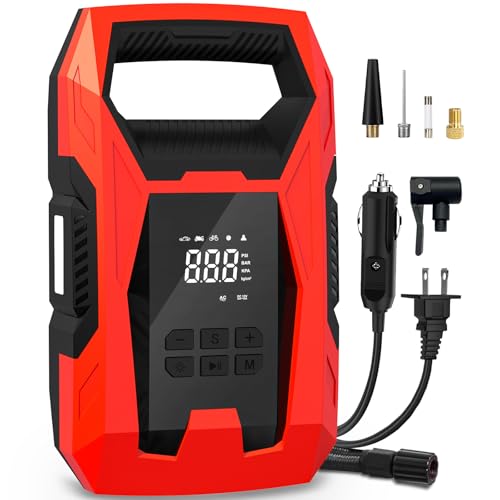
CARSUN AC/DC Portable Tire Inflator
Equipped with dual power inputs for 110V household outlets and 12V car sockets, this portable compressor delivers up to 150 PSI with auto-shutoff presets. It is a practical solution for drivers, cyclists, and households needing dependable inflation for standard vehicle tires and sports gear.
Pros
- Dual 110V AC and 12V DC power compatibility
- Automatic shutoff with memory preset function
- Clear backlit screen visible in direct sunlight
- Integrated LED light for nighttime emergencies
- Includes multiple adapters and dedicated carrying bag
Cons
- Not compatible with truck, tractor, or SUP board tires
- Requires 10-minute cooldown after 15 minutes of use
GSPSCN 12V Portable Tire Inflator
The GSPSCN 12V Heavy Duty Tire Inflator delivers a robust 70 L/min airflow with its direct-drive dual-cylinder metal pump and 150 PSI maximum pressure rating. Built for pickup trucks, SUVs, and trailer owners, it operates at a manageable 70 dB and includes battery clamps for reliable 12V direct connection.
Pros
- Fast 70 L/min air volume output powered by a dual-cylinder direct-drive metal pump mechanism
- Generous 23-foot total working reach across the 11.5-foot 12V power cord and 11.5-foot air hose
- Direct battery clamps deliver dependable 12V DC power without risking internal vehicle fuse blowouts
- Remarkably manageable 70 dB sound level compared to standard high-pitch emergency tire pumps
Cons
- Requires direct 12V car battery terminal connection, which necessitates opening the vehicle hood
- Lacks an integrated air storage tank, so it is strictly intended for direct inflation rather than air tools
- No built-in digital automatic shutoff target pressure stop, requiring manual gauge monitoring
GSPSCN Dual-Cylinder 12V Tire Inflator
Built with an all-metal dual-cylinder motor, this 12V portable compressor delivers a fast 70 L/Min airflow alongside a digital auto shut-off gauge. It is an ideal roadside tool for drivers needing rapid inflation for cars, SUVs, and light trucks without excessive vibration.
Pros
- Fast 70 L/Min dual-cylinder airflow
- Durable all-metal motor and cylinder construction
- Automatic shut-off prevents accidental over-inflation
- Includes 11.5-foot extension hose and carry bag
- Anti-slip base stabilizes pump during operation
Cons
- Relatively heavy to carry at 6.5 pounds
- Requires a wired 12V connection without cordless option
KeenPower 21V 160 PSI Portable Tire Inflator
Designed for roadside emergencies, this portable inflator delivers up to 160 PSI using either a 21V rechargeable battery or a 12V car adapter. The included battery pack doubles as a QC3.0 power bank, making it a handy emergency companion for everyday drivers.
Pros
- Operates via cordless battery or 12V car outlet
- Auto shut-off prevents accidental over-inflation
- Charges mobile devices via QC3.0 USB port
- Recharges battery fully in one hour
Cons
- Not designed to handle large truck tires
- Relatively tall form factor at over ten inches high
Klutch 20-Gallon Portable Air Compressor
Featuring a 2.0 HP 120V motor and a 20-gallon tank, the Klutch portable air compressor delivers a rated 4.2 SCFM at 90 PSI for versatile workshop air. Its oil-free pump and wheeled design make it a dependable choice for garage mechanics, woodworkers, and serious DIYers needing steady air storage.
Pros
- Generous 20-gallon air storage capacity provides a substantial buffer for intermittent shop tools
- Delivers a listed 4.2 SCFM at 90 PSI, outperforming smaller pancake compressors for workshop chores
- Oil-free pump design eliminates messy oil changes and allows clean, upright transport
- Rugged rubber wheels and built-in ergonomic handle make moving the 90-pound frame manageable
- Integrated thermal overload protection helps prevent motor burnout during demanding cycles
Cons
- Substantial 90-pound weight makes lifting into truck beds or carrying up stairs difficult without assistance
- Oil-free motor configurations generally produce noticeable operating noise compared to low-RPM lubricated units
- At 4.2 SCFM at 90 PSI, high-draw continuous air tools like sanders or grinders will require recovery pauses
OlarHike 12000mAh Cordless Tire Inflator
The OlarHike Heavy Duty Tire Inflator is a compact 3.2-pound mobile air compressor featuring a twin-cylinder motor, integrated 12,000mAh battery, and 12V DC vehicle adapter. It provides rapid roadside inflation with auto-shutoff convenience, making it a dependable emergency tool for drivers, mechanics, and off-roaders.
Pros
- Twin-cylinder pump configuration delivers faster inflation times than typical single-piston mini inflators
- True dual-power flexibility prevents downtime by running via battery or vehicle 12V DC outlet
- Compact, lightweight 3.2-pound body offers exceptional portability without eating up cargo space
- 45W USB-C Power Delivery port provides practical utility beyond tire maintenance
- Auto-stop feature eliminates pressure guessing and prevents dangerous over-inflation
Cons
- Tankless mobile design is strictly intended for inflation and cannot operate continuous-draw pneumatic air tools
- Extended continuous runtime on large truck or RV tires will cause heat buildup that requires brief cool-down intervals
- Does not include a standard 120V AC household wall plug for direct residential outlet use
Understanding Air Compressor Power Consumption, Amps, and Operating Costs
Electric motor specifications often cause confusion because manufacturers list horsepower ratings that do not cleanly translate into household electrical draw. Determining how much electricity does an air compressor use requires examining running wattage, startup inrush amperage, duty cycle percentages, and supply voltage. A portable tire inflator operating on a vehicle battery demands vastly different electrical resources than a 29-gallon stationary tank running continuous pneumatic sanders. Breaking down these operational differences allows you to size circuits correctly and calculate realistic operating costs for any pneumatic setup.
Typical Power Draw Across Compressor Sizes and Motor Ratings
Compact 12-volt DC tire pumps and portable emergency inflators represent the lowest tier of electrical consumption in pneumatic equipment. These compact units typically draw between 10 and 15 amps of direct current, translating to roughly 120 to 180 watts of electrical power during active inflation. Models designed with dual-voltage capability can also plug into standard 110-volt or 120-volt household receptacles, where their high-efficiency small motors consume less than 200 watts. Because these compact inflators run for only three to ten minutes to top off vehicle tires, their total electrical consumption remains negligible on monthly electric bills.
Mid-size portable compressors, including quiet workshop units and twin-stack contractor models, feature electric motors rated between 1.0 and 1.5 running horsepower. When connected to a standard 120-volt household supply, a 1.5-horsepower motor typically draws between 10 and 13 amps under full compression load. That running load translates to approximately 1,200 to 1,500 continuous running watts while the pump pressurizes the storage tank. Operating specialized quiet air compressor models often provides the additional benefit of low-RPM motor designs that draw steady, manageable current while minimizing acoustic fatigue in home garages.
Heavy-duty workshop compressors with large tanks, such as 20-gallon or 29-gallon models rated at 2.0 to 2.5 horsepower, push the limits of standard residential branch circuits. These robust induction motors draw approximately 14 to 15 running amps on a 120-volt line, consuming between 1,700 and 1,850 continuous watts under peak pressure. Industrial two-stage stationary compressors step up to dedicated 240-volt single-phase circuits, utilizing 3.0 to 5.0 horsepower motors that pull 15 to 25 amps at 240 volts, which equals 3,600 to 6,000 watts. Understanding these tiered ratings helps workshop owners evaluate whether their existing electrical panels can support their desired pneumatic capacity.
Running Watts Versus Inrush Starting Surge
Every electric air compressor requires significantly more power to start its motor than it does to keep spinning under steady compression. This initial demand is known as inrush current or locked rotor amperage, and it occurs during the brief fraction of a second when the motor breaks inertia. For a standard single-phase induction motor, startup inrush current can reach three to five times the continuous running amperage rating. A 2.0-horsepower motor that consumes 1,800 running watts can briefly demand 4,000 to 6,000 surge watts while overcoming internal friction and initial mechanical resistance.
High inrush current explains why standard 15-amp household circuit breakers frequently trip when a large compressor cycles on. Standard residential breakers are thermal-magnetic devices engineered to trip instantly when sudden current spikes exceed safe conductor thresholds. If a garage compressor shares a 15-amp branch circuit with overhead lighting, shop refrigerators, or battery chargers, that startup surge immediately exceeds the circuit trip curve. Upgrading to a dedicated 20-amp branch circuit wired with heavy 12-gauge copper conductor provides the necessary headroom to absorb motor startup spikes without interrupting workshop operations.
The mechanical unloader valve plays a critical role in managing electrical surge and protecting the motor during repeated cut-in cycles. When the compressor shuts off at its maximum factory cut-out pressure, the unloader valve automatically exhausts trapped air from the cylinder head and discharge pipe. This depressurization allows the motor to restart against zero head resistance the next time tank pressure drops below the cut-in threshold. If a mechanical unloader valve fails or becomes clogged with debris, the electric motor attempts to start against full tank pressure, causing an extreme current surge that instantly trips the circuit breaker or activates thermal overload protection.
Calculating True Operating Costs and Kilowatt-Hour Consumption
Calculating the exact electrical cost of running an air compressor is straightforward once you know your motor wattage and local utility rates. To determine hourly energy consumption, multiply the running wattage of the compressor by the hours of operation, then divide by 1,000 to convert the figure into kilowatt-hours. For example, a 1.5-horsepower workshop compressor drawing 1,400 watts consumes 1.4 kilowatt-hours for every full hour of continuous motor operation. Checking your monthly utility statement will reveal your specific electricity rate, which typically ranges between twelve and twenty-four cents per kilowatt-hour across the country.
Applying typical utility rates demonstrates that intermittent compressor operation is surprisingly affordable for hobbyists and DIY mechanics. If your electric utility charges sixteen cents per kilowatt-hour, running that 1,400-watt compressor continuously for one full hour costs approximately twenty-two cents. An automotive DIYer working in a home garage might operate a compressor for a cumulative total of two pump-run hours during an entire weekend project. That typical weekend workload results in less than fifty cents of electricity consumption, making compressed air one of the most cost-effective power sources in a home shop.
Duty cycles and storage tank capacity prevent the electric motor from running constantly, which keeps real electrical expenses significantly lower than worst-case calculations suggest. When powering intermittent tools such as finish nailers, impact wrenches, or tire chucks, the compressor motor only cycles on periodically to replenish stored air. A 20-gallon or 29-gallon air tank stores substantial air reserves at 150 to 175 PSI, allowing tools to draw regulated air while the pump remains completely idle. Selecting appropriately sized air compressor options for nailers ensures the pump operates within an efficient 50 percent duty cycle, keeping both heat buildup and power bills under control.
Electrical Profiles Across Modern Compressor Platforms
Traditional stationary and portable workshop compressors rely on robust 120-volt AC induction motors designed for stationary power delivery. These single-phase motors feature heavy copper windings and capacitor-start mechanisms that deliver high starting torque under load. Oil-free pump designs and dual-piston configurations in the 1.5 to 2.5 horsepower range convert that electrical power into substantial airflow, delivering between 4.0 and 8.5 CFM depending on pressure levels. Because induction motors operate at fixed rotational speeds, their electrical current draw remains predictable and stable across extended shop sessions.
Dual-power portable inflators bridge the gap between garage utility and roadside vehicle emergency inflation by accepting both AC and DC electricity. When plugged into a 12-volt vehicle cigarette lighter socket, these compact direct-drive pumps pull around 10 to 15 amps of direct current. When switched to a 110-volt or 120-volt AC wall outlet, an internal step-down transformer or rectifying circuit powers the metal pump motor at approximately 120 to 150 watts. This flexible architecture ensures homeowners can top off bicycle and vehicle tires using standard domestic current without discharging the vehicle battery during garage maintenance.
Cordless battery-powered inflators represent a modern shift in pneumatic convenience by decoupling air compression from stationary electrical outlets. These units utilize high-density lithium-ion battery packs, often operating at 12-volt, 20-volt, or 21-volt platforms, to drive compact high-pressure motors. Recharging these high-capacity battery systems requires specialized chargers that draw modest power from a wall outlet, typically consuming 45 to 65 watts during fast-charge cycles. The overall electrical cost to fully recharge a 12,000mAh battery pack is fractions of a single cent, making cordless battery operation both energy-efficient and highly mobile for field applications.
Electrical Safety, Circuit Sizing, and Extension Cord Voltage Drop
Proper branch circuit sizing is essential for operating workshop compressors safely without generating electrical fire hazards or nuisance breaker trips. Units equipped with motors rated at 1.5 horsepower or larger should ideally connect to a dedicated 20-amp, 120-volt circuit equipped with a NEMA 5-20R receptacle. A dedicated circuit ensures that the compressor does not compete with table saws, shop vacuums, or high-intensity lighting for available conductor ampacity. Electrical code recommendations and manufacturer guidelines consistently advise against operating heavy induction motors on shared multi-outlet residential circuits.
Voltage drop represents one of the most destructive electrical conditions for air compressor motors, often caused by using undersized or excessively long extension cords. When electrical current travels through a long, thin extension cord, electrical resistance causes line voltage to drop significantly below nominal 120-volt levels. When supply voltage drops, an electric induction motor compensates by drawing higher amperage to maintain required rotational torque. This elevated current draw generates severe heat inside the motor windings, causing premature capacitor failure, tripped thermal overload protectors, and eventual motor burnout.
Pneumatic equipment manufacturers universally advise workshop owners to avoid extension cords entirely whenever possible. Instead of extending the electrical cord across the shop floor, the safest and most efficient practice is plugging the compressor directly into a wall outlet and using a longer air hose. High-quality 3/8-inch internal diameter air hoses convey compressed air across fifty or one hundred feet with minimal dynamic pressure drop and zero electrical risk. Keeping the electrical supply cord short and heavy ensures the motor receives full line voltage during critical startup cycles.
Practical Methods to Minimize Compressor Electricity Consumption
Pneumatic air leaks represent the single largest source of wasted electricity in residential workshops and commercial garages alike. A tiny pinhole leak or poorly sealed quick-connect coupler bleeding air at 90 PSI forces the compressor motor to cycle repeatedly even when tools sit idle. Auditing your pneumatic lines with soapy water spray and resealing threaded fittings with PTFE thread tape or liquid pipe sealant eliminates phantom air loss. Preventing unnecessary tank pressure drops ensures the motor only consumes electricity when pneumatic tools are actively performing useful work.
Optimizing regulated line pressure to match the specific requirements of your air tools delivers immediate energy savings and reduces mechanical equipment wear. Many shop owners leave their line pressure regulators adjusted to maximum tank pressure, feeding 125 or 150 PSI to tools designed to operate at 90 PSI. Operating pneumatic equipment above rated pressure consumes significantly more compressed air per cycle, forcing the pump motor to run more frequently. Adjusting the inline pressure regulator to the minimum effective operating pressure specified by your tool manufacturer conserves stored air volume and reduces cumulative electrical runtime.
Performing regular mechanical maintenance directly improves compressor pumping efficiency and lowers ongoing electrical consumption. A dirty, restricted air intake filter forces the pump cylinders to pull air through restricted openings, extending the total time required to fill the tank from zero to cut-out pressure. Similarly, draining accumulated condensation daily through the bottom tank drain valve preserves valuable internal storage volume and prevents internal corrosion. Maintaining unobstructed intake airflow and clean tank capacity ensures the electric motor achieves maximum compression efficiency during every operating cycle.
Key Takeaways for Managing Air Compressor Power Demands
Balancing pneumatic tool requirements against your available electrical supply is the foundation of a safe, efficient workshop setup. While 12-volt and compact dual-power tire inflators sip modest amounts of electricity, full-size garage compressors rated between 1.5 and 2.5 horsepower require dedicated branch circuits and careful circuit management. By understanding inrush startup surges, calculating realistic kilowatt-hour operating expenses, and eliminating costly system air leaks, you can run powerful pneumatic tools confidently without overloading your electrical service. Maintaining proper wiring and clean mechanical components ensures your air compressor delivers dependable performance while keeping energy costs remarkably low.
About the author
Bob Beacham is an experienced tools and workshop writer with deep knowledge of power equipment, mechanical systems, and practical DIY applications. His coverage of air compressors, welding equipment, saws, and workshop tools helps translate technical specifications into useful guidance for homeowners and serious DIYers.