
How Many Watts to Run an Air Compressor: Power and Sizing Guide for 2026
Learn how many watts to run an air compressor safely in October 2026, covering running amps, starting surges, and generator sizing.
 By Bob Beacham
Updated October 7, 2026
By Bob Beacham
Updated October 7, 2026

Connecting an electric air compressor to an unfamiliar power supply often leads to sudden breaker trips or stalled motors when the pressure switch demands continuous air compression. Determining exactly how many watts to run an air compressor requires looking beyond basic nameplate horsepower to examine both sustained electrical draw and brief starting inrushes. Whether you plan to power pneumatic nailers from a portable jobsite generator or operate an automotive spray gun on a dedicated garage circuit, matching electrical capacity to motor demand protects your equipment from severe thermal strain. A standard single-phase induction motor draws substantially more current while overcoming trapped cylinder head pressure than it does once spinning freely at full operating velocity.
Most portable consumer models require between one thousand and two thousand running watts, yet initial startup surges frequently demand three to five times that baseline figure. Grasping these critical power thresholds helps prevent unexpected inverter shutdowns, blown household fuses, and sluggish pump recovery times during intensive trim carpentry or tire inflation tasks. By evaluating motor displacement, continuous amperage specifications, and mechanical unloader functionality, you can easily verify whether your workshop wiring or auxiliary power supply provides sufficient energy. Understanding these foundational electrical principles ensures smooth air delivery for framing tools and automotive maintenance without putting delicate motor windings at risk of premature failure.
| Award | Product | ACR Score About ACR ScoreThe ACR Score is our own rating from 0 to 10, based on performance, design and build, ease of use, and value. It reflects independent research and is never influenced by manufacturers, retailers, or affiliate commissions. Learn more › | |
|---|---|---|---|
| Best Overall |
Goodyear 6-Gallon 150 PSI Portable Oil-Free
|
9.2/10 | Buy |
| Best Value |
 Stealth SAQ-1234 2-Gallon Air Compressor
|
9.2/10 | Buy |
| Best Premium |
 ALL-TOP 12V Dual-Cylinder Air Compressor
|
8.8/10 | Buy |
| Best Budget |
 Metabo HPT 6-Gallon Pancake Air Compressor Review
|
8.6/10 | Buy |
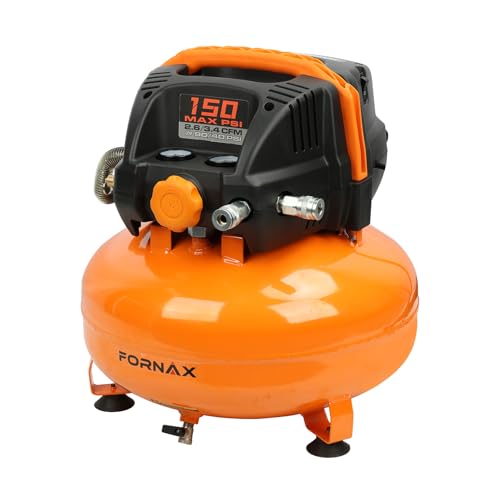 FORNAX 6-Gallon Pancake Air Compressor
|
8.4/10 | Buy | |
 DEWALT DWFP55130 2.5-Gallon 200 PSI Quiet Trim Air
|
8.4/10 | Buy | |
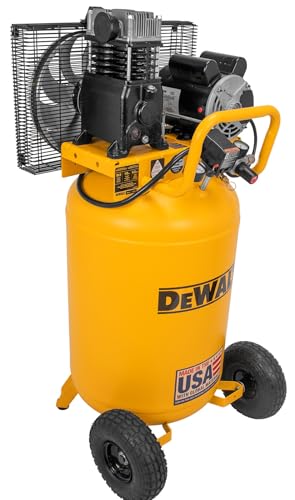 DEWALT 30-Gallon Vertical Portable Electric Air
|
8.3/10 | Buy | |
 VELPAX 8-Gallon Quiet Air Compressor
|
7.8/10 | Buy |
Goodyear 6-Gallon 150 PSI Portable Oil-Free
The Goodyear 6-gallon pancake air compressor delivers 3 SCFM at 90 PSI and 150 max PSI powered by a reliable 1 HP induction motor. At 32 pounds with an oil-free pump, it provides dependable portable air for trim carpenters, DIY home projects, and garage tire inflation.
Pros
- Produces 3 SCFM at 90 PSI, offering solid airflow for sequential finish nailing and light framing tasks
- Equipped with a durable 1 HP induction motor for dependable and consistent pressure build-up
- Oil-free pump mechanism requires zero ongoing lubrication maintenance and prevents oil contamination in air lines
- Two clearly visible analog pressure gauges make monitoring regulated line pressure straightforward
- Compact 32-pound pancake design is easy to lift, load into vehicles, and store on shop shelves
Cons
- Airflow rating of 3 SCFM is not designed to support continuous rotary air tools like orbital sanders or paint sprayers
- Comes with a single 1/4-inch quick-connect coupler rather than dual outlets for running two tools simultaneously
- Sold as a bare compressor without an included air hose, tire inflator chuck, or pneumatic nail guns
Stealth SAQ-1234 2-Gallon Air Compressor
Operating at under 60 decibels, this compact unit provides exceptionally quiet performance for garage DIY tasks, brad nailing, and tire inflation. Its oil-free motor reaches up to 125 PSI while keeping routine maintenance to a minimum.
Pros
- Quiet operation suitable for indoor workspaces
- Maintenance-free oil-free pump design
- Durable steel tank with rubber vibration dampening
- Reliable pressure recovery for intermittent nailing
Cons
- Relatively heavy to carry at nearly 42 pounds
- Small two-gallon tank limits continuous tool use
- Modest 1.8 CFM flow rate at 90 PSI
ALL-TOP 12V Dual-Cylinder Air Compressor
The ALL-TOP 12V Dual-Cylinder Air Compressor delivers a manufacturer-rated 12.35 CFM airflow and 150 PSI maximum pressure with an integrated digital LCD auto-stop controller. Powered via direct battery alligator clamps, this heavy-duty portable pump is built for overlanders, off-road enthusiasts, and truck owners needing rapid tire reinflation on remote trails.
Pros
- High rated airflow output of 12.35 CFM (350 L/min) significantly speeds up multi-tire trail reinflation
- Accurate digital auto-stop feature prevents over-inflation without requiring manual gauge checks
- Robust dual-cylinder motor with 221-degree Fahrenheit thermal shutdown and 120A circuit protection
- Anti-vibration metal base can be left portable or permanently bolted into an overland rig
Cons
- Substantial 26.5-pound weight makes it bulkier to stow than compact emergency inflators
- High current draw requires hooking directly to vehicle battery terminals with the engine running
- Normal 2 to 4 pause intervals during the digital inflation cycle may surprise unfamiliar users
Metabo HPT 6-Gallon Pancake Air Compressor Review
The Metabo HPT EC711S is a portable 6-gallon pancake air compressor delivering 2.8 CFM at 90 PSI with a 165 PSI tank ceiling and an operating sound level of 73 dB. With its quick 46-second recovery cycle and dual quick couplers, it is an excellent choice for finish carpenters, punch-list contractors, and DIYers running pneumatic nailers.
Pros
- 73 dB operational sound rating is substantially quieter than standard job-site pancake units
- 165 PSI maximum pressure provides ample air storage with a swift 46-second recovery cycle
- Two 1/4-inch universal quick couplers support multi-tool setups right out of the box
- Sturdy steel roll cage protects gauges and the manifold assembly against knocks and drops
- Oil-free 1.0 HP motor ensures low maintenance and reliable cold-weather motor startup
Cons
- At 38.5 lbs, it is slightly heavier than ultra-compact 1-to-3-gallon trim compressors
- Airflow of 2.8 CFM at 90 PSI is designed for intermittent fastening, not continuous rotary tools or paint sprayers
- Bare-tool configuration means air hoses and pneumatic fastening tools must be purchased separately
FORNAX 6-Gallon Pancake Air Compressor
The FORNAX 6-Gallon Pancake Air Compressor delivers 2.6 CFM at 90 PSI and up to 150 PSI of maximum pressure, featuring dual couplers and a lightweight 28.8-pound portable footprint. It is a practical pneumatic power source for DIY homeowners, finish carpenters, and garage hobbyists driving nailers or managing tire inflation.
Pros
- Dual quick-connect couplers allow two nailers to operate simultaneously without adding an external splitter manifold
- Generous 6-gallon air tank capacity with a 150 PSI maximum pressure ceiling provides a dependable air reserve
- Lightweight 28.8-pound profile simplifies one-handed carrying up stairs and transport into work vans
- Maintenance-free oil-free pump eliminates oil checks, oil changes, and mess around finished work surfaces
Cons
- Operating sound output rated at 95 dBA is loud and makes hearing protection necessary, especially in closed rooms
- Airflow output of 2.6 CFM at 90 PSI cannot support continuous-demand tools like sanders, grinders, or paint sprayers
- Supplied as a bare-tool compressor without an included air hose, tire inflator chuck, or pneumatic nailers
DEWALT DWFP55130 2.5-Gallon 200 PSI Quiet Trim Air
The DEWALT DWFP55130 delivers a capable 3.0 SCFM at 90 PSI with a 200 max PSI 2.5-gallon tank, running at a quiet 71.5 dBA on an efficient 12-amp motor. It is an ideal pneumatic power source for trim carpenters, punch-list contractors, and DIYers working on residential circuits.
Pros
- Delivers 3.0 SCFM at 90 PSI with a high 200 max PSI ceiling for rapid pressure recovery during sequential fastening
- Quiet 71.5 dBA sound output makes indoor trim carpentry and remodeling far less disruptive to homeowners
- Low 12-amp draw reduces breaker trips when running on shared 15-amp household circuits
- Integrated roll cage and console protect critical components while supporting horizontal or vertical operation
- Dual quick couplers allow two trim carpenters to connect and work off a single compressor
Cons
- Bare-tool configuration means you must supply your own air hoses, couplers, and pneumatic nail guns
- At 36 pounds, it is heavier to haul up flights of stairs than ultra-compact 1-gallon finish compressors
- Air output of 3.0 SCFM is built for intermittent finish fastening and will not support continuous tools like rotary sanders or sprayers
DEWALT 30-Gallon Vertical Portable Electric Air
Delivering 6.2 SCFM at 90 PSI with a high-capacity 175 PSI max pressure rating, the DEWALT DXCM303 30-Gallon Electric Air Compressor offers substantial air reserves for demanding workshop tools. Featuring rugged pneumatic wheels and a factory high-flow regulator, it is an outstanding mobile solution for garage mechanics and serious DIY woodworkers.
Pros
- Substantial 175 PSI maximum pressure provides longer run time between motor recovery cycles
- Solid airflow output of 6.2 SCFM at 90 PSI supports a wide variety of pneumatic garage tools
- High-flow regulator supplies up to 65% more usable operating pressure to connected hoses
- Heavy-duty pneumatic wheels make rolling this 196-pound upright compressor around the garage practical
Cons
- Substantial 196-pound total weight makes vehicle loading and transport between jobsites difficult without ramps or assistance
- Large vertical shop profile is designed for roll-around floor use rather than hand-carry punch-list applications
VELPAX 8-Gallon Quiet Air Compressor
Delivering 115 PSI at an approachable 68 decibels, this oil-free unit suits indoor spaces like home workshops and garages. Its 8-gallon tank and 1.75HP motor supply clean air for tire inflation, woodwork nailing, and basic pneumatic tools without excessive noise.
Pros
- Quiet 68 dB motor fits home workshops
- Oil-free design requires minimal regular maintenance
- Integrated overload protection supports safe operation
- Standard G1/4 outlet enables easy tool connections
Cons
- Maximum working pressure tops out at 115 PSI
- Lacks wheels for moving the 8-gallon tank
Technical Analysis of Air Compressor Wattage, Inrush Surge, and Power Sizing
Calculating the electrical energy needed to operate an air compressor requires a clear understanding of alternating current dynamics and motor mechanics. Air compressors rely on heavy-duty electric induction motors to drive pistons against rising air pressure. Because these machines generate mechanical resistance with every stroke, their power draw fluctuates throughout an operating cycle. Knowing the precise electrical demands of your machine prevents tripped circuit breakers, stalled pumps, and costly motor burnouts.
Running Watts Versus Starting Surge: The Electric Induction Equation
Running wattage represents the continuous electrical power an air compressor consumes once the motor reaches normal operating speed. For most portable garage and jobsite compressors, this continuous baseline falls between one thousand and two thousand watts. During steady operation, the motor maintains consistent rotational momentum while turning the pump crankshaft. This continuous draw remains relatively stable as long as internal tank pressure stays within standard working parameters.
Starting surge, commonly referred to as inrush wattage, is the brief spike in electrical power required to break the motor away from a dead stop. When an electric motor rests, it produces zero counter-electromotive force, allowing a heavy rush of current through the stator windings. Overcoming the physical inertia of the flywheel, connecting rods, and pistons demands three to five times the motor normal running wattage. This sudden demand lasts only a fraction of a second, but it represents the most critical hurdle for household circuits and portable generators.
The pressure switch cycle directly impacts how often this surge demand occurs during active shop work. When pneumatic tool use depletes stored air volume to the factory cut-in threshold, the pressure switch contacts snap shut to re-engage the motor. If the compressor restarts against high internal resistance, the motor must immediately draw peak inrush current to resume pumping. Frequent cycling under high air demand continually subjects the electrical supply to these punishing startup surges.
Calculating Wattage from Nameplate Voltage and Amperage
Determining the theoretical power draw of any compressor begins with standard electrical formulas applied to manufacturer data. The fundamental relationship states that wattage equals operating voltage multiplied by electrical current in amperes. Most standard portable compressors operate on a single-phase alternating current supply of one hundred twenty volts. Reading the manufacturer specification plate attached to the motor housing provides the certified running amperage needed for this calculation.
Portable models designed for finish carpentry demonstrate this mathematical relationship in practical shop environments. The DEWALT DWFP55130 trim compressor features a motor rated at twelve amperes on standard household voltage. Multiplying one hundred twenty volts by twelve amperes yields a baseline running demand of one thousand four hundred forty watts. Factoring in a typical three-to-one starting surge indicates that this compact unit can momentarily demand over four thousand watts when starting.
Real-world electrical calculations must also account for motor efficiency and power factor. Electric induction motors are inductive loads rather than simple resistive heating elements, meaning voltage and current waveforms do not peak simultaneously. Efficiency losses caused by internal winding resistance and mechanical friction further elevate the true electrical power required from the wall. Consequently, prudent workshop planners always add a twenty percent safety buffer above calculated baseline figures when planning electrical distribution.
Decoding Motor Horsepower Ratings and True Electrical Consumption
Horsepower ratings printed on compressor marketing shrouds frequently confuse buyers calculating electrical requirements. While one mechanical horsepower mathematically converts to seven hundred forty-six watts of electrical energy, electric motors operate well below one hundred percent efficiency. Typical consumer-grade induction motors achieve roughly seventy to eighty percent electrical efficiency under continuous compression load. As a result, a true continuous one-horsepower motor routinely consumes between one thousand and one thousand four hundred watts of grid power.
Popular portable units like the Goodyear 6 Gallon pancake and the Metabo HPT pancake compressor feature one-horsepower electric motors designed for portable trim work. While their mechanical rating suggests a modest power draw, their electrical footprint demands substantial current during peak compression cycles. These one-horsepower induction motors typically pull ten to twelve running amperes, translating to approximately one thousand two hundred to one thousand four hundred forty running watts. Attempting to run these machines on undersized power sources based solely on mechanical conversion formulas inevitably leads to equipment stalling.
Compact fractional-horsepower units offer an appealing alternative when electrical supply capacity is tightly restricted. The Stealth 2 Gallon air compressor utilizes a three-quarter horsepower motor engineered for quiet, low-demand tasks like tire inflation and light brad nailing. Its smaller induction motor operates with a continuous draw near nine hundred watts, creating a noticeably milder electrical load on branch circuits. Selecting a lower horsepower pump provides a dependable solution for older workshops with limited electrical infrastructure.
Comparing Electrical Loads Across Common Compressor Platforms
Standard six-gallon pancake compressors, including models like the FORNAX portable electric compressor, serve as the baseline workhorses for residential DIYers. Operating with high-RPM universal or compact induction motors, these compressors typically require between one thousand two hundred and one thousand five hundred running watts. Their initial startup surge routinely peaks between three thousand five hundred and four thousand five hundred watts. These power demands match the operational ceiling of standard fifteen-ampere residential circuits, leaving minimal margin for other appliances.
Quiet prosumer compressors incorporate specialized multi-piston motor assemblies to balance airflow performance against noise production. The VELPAX eight-gallon quiet compressor features a motor rated at one thousand three hundred watts, providing one and three-quarter horsepower of compression output. Designed to operate at approximately sixty-eight decibels, its low-speed motor configuration spreads mechanical loads across twin cylinders. This configuration delivers consistent air delivery for automotive repair and spray painting while maintaining a manageable continuous wattage profile on household electrical lines.
Stationary workshop units represent a significant step up in continuous volume, tank storage, and electrical consumption. The DEWALT 30-Gallon vertical portable compressor delivers six point two standard cubic feet per minute at ninety pounds per square inch to support demanding tools. Sustaining this high volume requires a substantial motor that draws continuous current near the upper safety limit of standard single-phase circuits. Operating equipment of this caliber requires a dedicated electrical circuit to prevent thermal overload during continuous air tool operation.
Direct Current Power Profiles for 12-Volt Overlanding Inflators
Mobile tire inflators and overlanding air pumps operate under an entirely different electrical architecture than alternating current garage equipment. Direct current systems run directly off twelve-volt automotive batteries, requiring massive electrical current to generate meaningful volume. The ALL-TOP 12V dual-cylinder air compressor illustrates this high-current design, delivering twelve point thirty-five cubic feet per minute for large vehicle tires. Rather than drawing low current at high voltage, these pumps demand extreme amperage at low automotive voltages.
Calculating wattage for heavy-duty twelve-volt pumps highlights the immense electrical energy demanded by off-road recovery gear. The ALL-TOP inflator features integrated circuit breaker protection capable of handling current draws up to one hundred twenty amperes. Multiplying twelve volts by one hundred twenty amperes reveals a theoretical peak power consumption of one thousand four hundred forty watts. Supplying this level of direct current power requires heavy-gauge battery clamps attached directly to vehicle terminals rather than light-duty cigarette lighter sockets.
Operating high-wattage direct current compressors safely requires specific operational precautions in remote field environments. Running the vehicle engine during inflation tasks allows the alternator to shoulder the heavy electrical load while maintaining stable system voltage. High continuous amperage generates substantial heat across cables and motor windings, making internal thermal cut-off switches essential for equipment survival. Allowing proper cool-down intervals between heavy tire inflation cycles protects both the pump assembly and the vehicle charging system.
Sizing Portable Generators and Inverters for Jobsite Reliability
Selecting an auxiliary power source for remote jobsite air compression requires matching surge capability rather than nominal continuous output. Many buyers assume a two-thousand-watt portable generator can easily run a one-thousand-four-hundred-watt pancake compressor. When the compressor attempts to start, however, the initial inrush surge instantly overloads the generator voltage regulator, triggering a stall. A generator must possess sufficient starting surge headroom to absorb the instantaneous three-to-five-thousand-watt spike without stumbling.
As a general sizing benchmark, powering a standard one-horsepower portable compressor reliably requires a generator rated for at least four thousand starting watts. A generator in the four-thousand to five-thousand-watt range provides sufficient kinetic and electrical reserve to handle sudden motor engagement under load. This capacity buffer also ensures stable output when powering auxiliary battery chargers or jobsite lighting alongside the pneumatic setup. Investing in adequate generator displacement eliminates frustrating motor stalls and protects compressor windings from severe brownouts.
Operating an air compressor through a modern battery power station or power inverter introduces unique waveform considerations. Electric induction motors require clean pure sine wave alternating current to operate efficiently without generating excessive internal heat. Modified sine wave inverters produce stepped electrical waves that degrade motor torque, prolong startup surges, and risk damaging pressure switch electronics. Furthermore, inverter surge ratings must be certified to sustain peak motor inrush for at least two to three full seconds.
Circuit Breaker Limitations and Managing Line Voltage Drop
Residential electrical circuits impose strict thermal limits that dictate which air compressors can safely operate without interruption. A standard fifteen-ampere, one-hundred-twenty-volt household branch circuit supports a theoretical maximum load of one thousand eight hundred watts. Standard electrical codes advise limiting continuous sustained loads to eighty percent of circuit capacity, which equates to one thousand four hundred forty watts. High-draw compressors operating near this threshold leave virtually zero headroom for garage lights, battery chargers, or benchtop tools.
Line voltage drop represents one of the most common causes of nuisance breaker tripping and electric motor failure on active jobsites. When electric current travels through long or undersized conductors, electrical resistance dissipates voltage before it reaches the motor terminals. As voltage drops, an electric induction motor must draw higher amperage to produce the mechanical torque needed to compress air. This elevated current draw quickly trips thermal breakers and subjects motor windings to destructive operating temperatures.
Using extended pneumatic air hoses rather than long electrical extension cords provides the most effective defense against voltage drop. Placing the compressor directly beside a dedicated twenty-ampere wall receptacle ensures the motor receives full nominal voltage during startup. Running fifty or one hundred feet of three-eighths-inch rubber air hose carries pressurized air directly to your work area without electrical loss. If an extension cord remains unavoidable, utilizing a heavy-duty twelve-gauge or ten-gauge cord minimizes resistance over short distances.
Mechanical Load Factors That Elevate Operating Wattage
The mechanical condition of your compressor directly influences how many electrical watts it consumes during daily operation. The unloader valve serves a pivotal role by venting pressurized air trapped above the pump cylinders whenever the motor shuts down. If this valve sticks closed or fails to seat properly, the motor must start against high head pressure, exponentially spiking inrush wattage. Verifying that your unloader valve emits a sharp hiss of escaping air upon motor shutdown confirms proper head depressurization.
Ambient operating temperatures also play a significant role in determining compressor startup resistance and electrical current draw. In cold winter environments, compressor lubricating oil thickens and internal piston seals stiffen, dramatically increasing mechanical drag throughout the pump assembly. Overcoming this elevated rotational friction forces the electric motor to draw maximum inrush amperage for an extended duration. Storing portable compressors in conditioned spaces or allowing them to warm before starting helps mitigate cold-weather electrical spikes.
Maximum tank pressure settings naturally dictate the upper boundaries of motor electrical consumption during each cycle. As internal tank pressure climbs toward maximum ratings such as one hundred fifty or two hundred pounds per square inch, the pump faces mounting backpressure. The electric motor must exert maximum torque during the final thirty seconds before reaching the automatic cut-out threshold. Ensuring that pressure switches cycle within manufacturer parameters prevents the motor from laboring against excessive internal resistance.
Daily Maintenance and Operational Habits for Power Efficiency
Routine pneumatic system maintenance maintains factory efficiency and prevents unnecessary increases in electric motor power consumption. Draining accumulated tank condensation on a daily basis preserves the full internal volume of your storage reservoir. When water occupies substantial tank space, the air buffer shrinks, causing the motor to cycle on and off far more frequently. Minimizing unnecessary cycle frequency directly reduces the total number of high-wattage startup surges experienced by your electrical system.
Keeping air intake filters clean ensures unrestricted airflow into the compression cylinders during every intake stroke. A clogged filter creates intake vacuum resistance, forcing the motor to expend extra energy simply drawing atmospheric air into the pump. Periodically inspecting one-way tank check valves also prevents pressurized air from leaking back into the pump head while the unit rests. Maintaining clean intake pathways and positive check valve seals ensures the motor operates at its optimal electrical efficiency curve.
Observing fundamental pneumatic safety protocols protects both the operator and the electrical infrastructure of your workshop. Always depressurize the storage tank completely using the drain valve before servicing electrical connections or performing mechanical maintenance. Periodically inspect the American Society of Mechanical Engineers safety relief valve by gently pulling the test ring to confirm free movement. Operating within manufacturer electrical guidelines ensures your pneumatic tools receive reliable air pressure without compromising safety.
Matching your air compressor to an appropriate electrical supply ultimately comes down to understanding both continuous running demands and temporary starting spikes. Portable six-gallon units generally operate comfortably within fifteen-ampere residential limits when line resistance remains low, whereas larger stationary and automotive compressors demand dedicated twenty-ampere or two-hundred-forty-volt circuits. Calculating your equipment requirements in advance prevents costly motor burnout and ensures steady, reliable pneumatic performance for every jobsite task.
About the author
Bob Beacham is an experienced tools and workshop writer with deep knowledge of power equipment, mechanical systems, and practical DIY applications. His coverage of air compressors, welding equipment, saws, and workshop tools helps translate technical specifications into useful guidance for homeowners and serious DIYers.