
How Many Watts to Run a Air Compressor: Practical Power Guide for 2026
Calculate how many watts to run a air compressor in October 2026 by evaluating running amperage, startup inrush surge, and generator compatibility.
 By Bob Beacham
Updated October 7, 2026
By Bob Beacham
Updated October 7, 2026

Electric motors on pneumatic equipment present a unique electrical demand that often catches garage mechanics and jobsite contractors by surprise. While a standard power tool draws a relatively consistent stream of current, an induction motor driving a compression pump requires a massive burst of startup energy to overcome trapped head pressure. Determining exactly how many watts to run a air compressor involves separating continuous running wattage from that brief, intense startup inrush spike. Without calculating both metrics accurately, you risk nuisance tripping on standard 15-amp household circuits or stalling a portable jobsite generator right when the pressure switch calls for air.
Compressor designs span everything from compact 12-volt off-road inflators to heavy-duty 30-gallon workshop units, meaning their electrical appetites vary considerably. For example, a small trim compressor with a low 12 amp draw motor demands far fewer running watts than a large cast-iron stationary pump, yet both still demand adequate electrical headroom to cycle reliably under full load. Understanding how continuous horsepower ratings, operational voltage, and electrical branch circuits interact ensures your air delivery remains seamless across all pneumatic tasks. Evaluating these power specifications beforehand prevents costly motor overheating and protects sensitive circuit components during demanding workshop sessions.
| Award | Product | ACR Score About ACR ScoreThe ACR Score is our own rating from 0 to 10, based on performance, design and build, ease of use, and value. It reflects independent research and is never influenced by manufacturers, retailers, or affiliate commissions. Learn more › | |
|---|---|---|---|
| Best Overall |
Stealth SAQ-1234 2-Gallon Air Compressor
|
9.2/10 | Buy |
| Best Budget |
 AstroAI Dual Power 110V/12V Tire Inflator
|
8.9/10 | Buy |
| Best Premium |
 ALL-TOP 12V Dual-Cylinder Air Compressor
|
8.8/10 | Buy |
| Best Value |
 Metabo HPT 6-Gallon Pancake Air Compressor Review
|
8.6/10 | Buy |
 FORTEM Model L 150 PSI Tire Inflator
|
8.4/10 | Buy | |
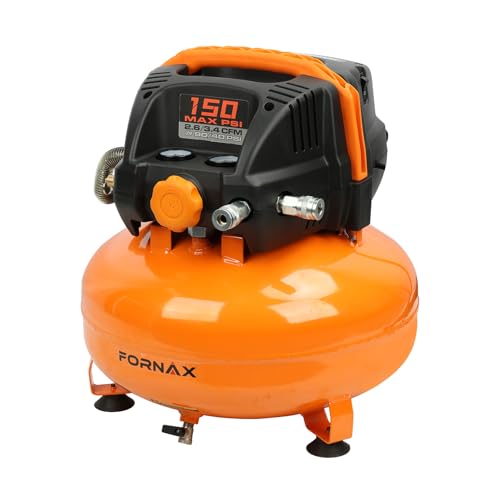 FORNAX 6-Gallon Pancake Air Compressor
|
8.4/10 | Buy | |
 DEWALT DWFP55130 2.5-Gallon 200 PSI Quiet Trim Air
|
8.4/10 | Buy | |
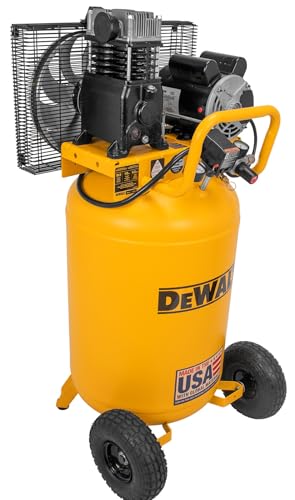 DEWALT 30-Gallon Vertical Portable Electric Air
|
8.3/10 | Buy |
Stealth SAQ-1234 2-Gallon Air Compressor
Operating at under 60 decibels, this compact unit provides exceptionally quiet performance for garage DIY tasks, brad nailing, and tire inflation. Its oil-free motor reaches up to 125 PSI while keeping routine maintenance to a minimum.
Pros
- Quiet operation suitable for indoor workspaces
- Maintenance-free oil-free pump design
- Durable steel tank with rubber vibration dampening
- Reliable pressure recovery for intermittent nailing
Cons
- Relatively heavy to carry at nearly 42 pounds
- Small two-gallon tank limits continuous tool use
- Modest 1.8 CFM flow rate at 90 PSI
AstroAI Dual Power 110V/12V Tire Inflator
Versatile dual-power support lets this lightweight inflator run from either a garage wall outlet or a vehicle cigarette lighter. An automatic shutoff and onboard cord storage make routine tire top-offs straightforward for any driver.
Pros
- Flexible dual AC and DC power options
- Automatic shutoff prevents over-inflation
- Compact and lightweight at 2.2 pounds
- Integrated cord and nozzle storage
Cons
- Requires a 10-minute cooldown after 15 minutes of runtime
- Must be plugged into a power source to operate
ALL-TOP 12V Dual-Cylinder Air Compressor
The ALL-TOP 12V Dual-Cylinder Air Compressor delivers a manufacturer-rated 12.35 CFM airflow and 150 PSI maximum pressure with an integrated digital LCD auto-stop controller. Powered via direct battery alligator clamps, this heavy-duty portable pump is built for overlanders, off-road enthusiasts, and truck owners needing rapid tire reinflation on remote trails.
Pros
- High rated airflow output of 12.35 CFM (350 L/min) significantly speeds up multi-tire trail reinflation
- Accurate digital auto-stop feature prevents over-inflation without requiring manual gauge checks
- Robust dual-cylinder motor with 221-degree Fahrenheit thermal shutdown and 120A circuit protection
- Anti-vibration metal base can be left portable or permanently bolted into an overland rig
Cons
- Substantial 26.5-pound weight makes it bulkier to stow than compact emergency inflators
- High current draw requires hooking directly to vehicle battery terminals with the engine running
- Normal 2 to 4 pause intervals during the digital inflation cycle may surprise unfamiliar users
Metabo HPT 6-Gallon Pancake Air Compressor Review
The Metabo HPT EC711S is a portable 6-gallon pancake air compressor delivering 2.8 CFM at 90 PSI with a 165 PSI tank ceiling and an operating sound level of 73 dB. With its quick 46-second recovery cycle and dual quick couplers, it is an excellent choice for finish carpenters, punch-list contractors, and DIYers running pneumatic nailers.
Pros
- 73 dB operational sound rating is substantially quieter than standard job-site pancake units
- 165 PSI maximum pressure provides ample air storage with a swift 46-second recovery cycle
- Two 1/4-inch universal quick couplers support multi-tool setups right out of the box
- Sturdy steel roll cage protects gauges and the manifold assembly against knocks and drops
- Oil-free 1.0 HP motor ensures low maintenance and reliable cold-weather motor startup
Cons
- At 38.5 lbs, it is slightly heavier than ultra-compact 1-to-3-gallon trim compressors
- Airflow of 2.8 CFM at 90 PSI is designed for intermittent fastening, not continuous rotary tools or paint sprayers
- Bare-tool configuration means air hoses and pneumatic fastening tools must be purchased separately
FORTEM Model L 150 PSI Tire Inflator
Equipped for dual-voltage use, this inflator runs on both 12V car sockets and 110V household outlets. It reaches up to 150 PSI with automatic shut-off, making it a versatile option for vehicle tires and household inflatables.
Pros
- Operates on both AC and DC power sources
- Automatic shut-off stops inflation at target pressure
- Long 14-foot power cord stores internally
- Integrated LED light aids roadside visibility
- Includes three nozzle adapters and carrying case
Cons
- Plastic body construction rather than metal housing
- Requires corded power with no internal battery option
FORNAX 6-Gallon Pancake Air Compressor
The FORNAX 6-Gallon Pancake Air Compressor delivers 2.6 CFM at 90 PSI and up to 150 PSI of maximum pressure, featuring dual couplers and a lightweight 28.8-pound portable footprint. It is a practical pneumatic power source for DIY homeowners, finish carpenters, and garage hobbyists driving nailers or managing tire inflation.
Pros
- Dual quick-connect couplers allow two nailers to operate simultaneously without adding an external splitter manifold
- Generous 6-gallon air tank capacity with a 150 PSI maximum pressure ceiling provides a dependable air reserve
- Lightweight 28.8-pound profile simplifies one-handed carrying up stairs and transport into work vans
- Maintenance-free oil-free pump eliminates oil checks, oil changes, and mess around finished work surfaces
Cons
- Operating sound output rated at 95 dBA is loud and makes hearing protection necessary, especially in closed rooms
- Airflow output of 2.6 CFM at 90 PSI cannot support continuous-demand tools like sanders, grinders, or paint sprayers
- Supplied as a bare-tool compressor without an included air hose, tire inflator chuck, or pneumatic nailers
DEWALT DWFP55130 2.5-Gallon 200 PSI Quiet Trim Air
The DEWALT DWFP55130 delivers a capable 3.0 SCFM at 90 PSI with a 200 max PSI 2.5-gallon tank, running at a quiet 71.5 dBA on an efficient 12-amp motor. It is an ideal pneumatic power source for trim carpenters, punch-list contractors, and DIYers working on residential circuits.
Pros
- Delivers 3.0 SCFM at 90 PSI with a high 200 max PSI ceiling for rapid pressure recovery during sequential fastening
- Quiet 71.5 dBA sound output makes indoor trim carpentry and remodeling far less disruptive to homeowners
- Low 12-amp draw reduces breaker trips when running on shared 15-amp household circuits
- Integrated roll cage and console protect critical components while supporting horizontal or vertical operation
- Dual quick couplers allow two trim carpenters to connect and work off a single compressor
Cons
- Bare-tool configuration means you must supply your own air hoses, couplers, and pneumatic nail guns
- At 36 pounds, it is heavier to haul up flights of stairs than ultra-compact 1-gallon finish compressors
- Air output of 3.0 SCFM is built for intermittent finish fastening and will not support continuous tools like rotary sanders or sprayers
DEWALT 30-Gallon Vertical Portable Electric Air
Delivering 6.2 SCFM at 90 PSI with a high-capacity 175 PSI max pressure rating, the DEWALT DXCM303 30-Gallon Electric Air Compressor offers substantial air reserves for demanding workshop tools. Featuring rugged pneumatic wheels and a factory high-flow regulator, it is an outstanding mobile solution for garage mechanics and serious DIY woodworkers.
Pros
- Substantial 175 PSI maximum pressure provides longer run time between motor recovery cycles
- Solid airflow output of 6.2 SCFM at 90 PSI supports a wide variety of pneumatic garage tools
- High-flow regulator supplies up to 65% more usable operating pressure to connected hoses
- Heavy-duty pneumatic wheels make rolling this 196-pound upright compressor around the garage practical
Cons
- Substantial 196-pound total weight makes vehicle loading and transport between jobsites difficult without ramps or assistance
- Large vertical shop profile is designed for roll-around floor use rather than hand-carry punch-list applications
Calculating Power Requirements and Wattage for Air Compressors
Determining the precise electrical wattage needed to operate an air compressor requires looking beyond simple nameplate labels. Most residential and portable compressors operate on standard alternating current circuits, yet their electrical power consumption shifts dramatically between resting, running, and initial startup states. An electric motor powering an air pump draws significantly more power while starting against internal mechanical resistance than it does while maintaining steady rotational speed. Understanding these distinct power stages ensures that you configure your workshop electrical circuits, select an adequately sized backup generator, and prevent unexpected breaker trips during critical projects.
The Fundamental Equation: Converting Volts, Amps, and Horsepower to Watts
The standard electrical formula for determining basic electrical power calculates wattage as the product of voltage multiplied by current in amperes. On a standard 120-volt household circuit, an air compressor drawing 10 continuous amps consumes approximately 1,200 running watts. If that same equipment operates on a dedicated 240-volt workshop line, a 10-amp current draw represents 2,400 watts of continuous electrical power. Knowing your power supply voltage and the compressor running amperage rating provides the foundation for determining baseline electrical loads.
Horsepower ratings frequently cause confusion because electric motor efficiency and alternating current power factor prevent a simple mathematical conversion. While theoretical physics defines one mechanical horsepower as 746 watts, real-world induction motors do not operate with total electrical efficiency. Due to electrical resistance, thermal losses, and inductive power factors commonly hovering around 0.80, a true 1.0 continuous horsepower motor typically consumes between 1,000 and 1,200 running watts from the wall. Exaggerated peak horsepower claims on marketing labels often obscure this reality, making nameplate amperage ratings a far more dependable guide for electrical planning.
Manufacturer specifications for portable equipment highlight how running amperage dictates real-world electrical load. For instance, the DEWALT DWFP55130 trim compressor features a motor engineered for a low 12 amp draw, which translates directly to 1,440 continuous watts on a 120-volt line. This intentional design choice keeps steady power consumption just within the threshold of standard residential branch circuits. By calculating continuous wattage directly from verified amperage ratings, equipment operators can accurately evaluate whether a given circuit possesses sufficient capacity.
Running Watts Versus Starting Inrush Surge Watts
The distinction between running watts and starting inrush surge watts represents the most critical calculation when planning compressor power. Running wattage reflects the continuous electrical energy consumed while the pump actively compresses air into the storage tank at steady operating speed. In contrast, starting wattage describes the massive instantaneous current spike required to break the electric motor free from a dead stop. This brief inrush event occurs during the initial fraction of a second when the pressure switch contacts snap shut to initiate a pumping cycle.
Induction motors driving piston pumps typically require between two and three times their continuous running wattage to overcome initial mechanical inertia. A portable compressor that consumes 1,400 running watts can easily demand between 2,800 and 4,200 surge watts for a fraction of a second during startup. If the electrical supply cannot deliver this temporary surge current, the motor will stall, hum loudly, and trip thermal or magnetic circuit breakers. Accounting for this dramatic surge multiplier is vital when operating pneumatic equipment from temporary power distribution panels or portable generators.
The unloader valve plays an indispensable mechanical role in minimizing this startup wattage spike by venting trapped air pressure off the pump cylinder head. When the compressor shuts off at its cut-out pressure threshold, the unloader valve releases head pressure with an audible hiss, allowing the motor to restart against near-zero resistance. If an unloader valve sticks closed or fails mechanically, the motor attempts to start against trapped line pressure, causing starting wattage to spike well beyond normal limits. Regular inspection of the unloader valve helps maintain normal electrical startup cycles and prevents unnecessary motor winding strain.
Power Demands Across Different Compressor Categories
Compact dual-power tire inflators represent the lowest wattage tier within pneumatic equipment, prioritizing portability over massive airflow delivery. Units such as the AstroAI Tire Inflator Portable Air Compressor and the FORTEM Tire Inflator Portable Air Compressor operate efficiently on 12-volt direct current vehicle sockets or 110-volt alternating current wall receptacles. These compact diaphragm or miniature piston inflators generally draw between 100 and 180 watts of electrical power. Their modest wattage requirements allow them to function safely from standard automotive accessory ports without risking blown vehicle fuses or heavy battery drain during routine tire topping.
Heavy-duty off-road and overland compressors occupy an entirely different electrical tier despite operating on 12-volt direct current power. The ALL-TOP 12V Air Compressor w/LCD Control Panel utilizes dual cylinders to deliver an impressive 12.35 CFM, which requires heavy-duty alligator clamps connected directly to battery terminals rather than cigarette lighter plugs. Because high airflow at low voltage requires substantial amperage, this unit incorporates an integrated circuit breaker rated up to 120 amps and thermal protection over 221 degrees Fahrenheit. At peak load, a heavy 12-volt compressor like this can demand between 500 and 1,400 watts directly from a vehicle electrical system.
Ultra-quiet finish and trim compressors balance modest power draw with low acoustic output, making them favored choices for indoor trim carpentry and residential workshops. The Stealth Air Compressor 2 Gallon utilizes a 3/4 horsepower oil-free motor designed to operate at sound levels as low as 60 decibels while delivering 1.8 CFM at 90 PSI. A 3/4 horsepower motor of this style typically draws between 6 and 8 running amps on a 120-volt circuit, representing roughly 720 to 960 running watts. Its modest power demand produces gentle startup surges, allowing it to start consistently on shared residential circuits without dimming household lighting.
Mid-sized jobsite pancake compressors represent common fixtures on residential construction sites, operating with motors between 1.0 and 1.5 horsepower. The Metabo HPT Pancake Air Compressor features a 1.0 horsepower oil-free high-efficiency motor delivering 2.8 CFM at 90 PSI, while the FORNAX Pancake Air Compressor with two couplers operates a 3550 RPM motor providing 2.6 CFM at 90 PSI. Compressors in this popular 6-gallon class generally pull between 10 and 13.5 running amps at 120 volts, translating to 1,200 to 1,620 running watts. During cold mornings or rapid cycling, their startup surge can quickly reach 3,000 to 3,800 peak watts, demanding robust electrical supply lines.
Large workshop compressors introduce substantial continuous loads that push standard 120-volt circuits to their absolute limits or mandate dedicated 240-volt wiring. The DEWALT 30-Gallon Vertical Portable Electric Air compressor delivers 6.2 SCFM at 90 PSI and 175 PSI maximum pressure to support demanding air tools like impact wrenches and sanders. A large displacement pump of this caliber requires a heavy-duty motor drawing roughly 15 amps on 120 volts, consuming approximately 1,800 continuous running watts. The startup inrush on a 30-gallon unit can exceed 4,500 to 5,000 surge watts, necessitating dedicated wiring to prevent immediate breaker tripping.
Sizing a Portable Generator for Air Compressors
Operating an air compressor from a portable generator requires sizing the generator around peak starting surge wattage rather than continuous running capacity. Many operators make the mistake of pairing a 1,500-watt pancake compressor with a generator rated for 2,000 continuous watts, only to find the engine bogs down and stalls when the pump kicks in. While the generator possesses ample continuous capacity for running operation, it lacks the instantaneous rotational inertia and electrical headroom needed for motor inrush. To run an air compressor reliably, the generator surge or starting wattage rating must match or exceed the compressor peak starting draw.
Calculating the minimum generator capacity involves multiplying the compressor running wattage by a safety factor of 2.5 to 3.0. For a jobsite compressor requiring 1,400 running watts, a portable generator should provide a minimum of 3,500 to 4,000 surge watts to guarantee dependable cut-in cycles under pressure. This headroom ensures that if the compressor restarts while pneumatic framing nailers are firing or other jobsite tools are active, the generator governor can respond without dropping voltage. Selecting a generator with automatic voltage regulation further stabilizes electrical delivery and protects compressor motor windings from damaging voltage sag.
Inverter generators offer clean electrical output with low total harmonic distortion, but their electronic overload protection circuits react extremely quickly to current spikes. Traditional open-frame construction generators possess heavy rotating flywheels that mechanically absorb brief motor starting spikes, whereas compact inverter models may immediately trigger an overload fault. If using an inverter generator, ensure its maximum surge rating provides substantial surplus capacity beyond the compressor rated inrush. Running the generator with its economy mode switch turned off helps keep engine throttle responsive, preventing hesitation when the compressor pressure switch snaps closed.
Household Circuit Limitations: 15-Amp Versus 20-Amp Breakers
Standard residential branch circuits are typically protected by 15-amp circuit breakers wired with 14-gauge copper conductors, delivering a maximum theoretical capacity of 1,800 watts at 120 volts. However, the National Electrical Code establishes an 80 percent continuous load rule for safety, limiting continuous sustained draw on a 15-amp circuit to 12 amps, or 1,440 watts. Because many portable compressors pull between 12 and 14 running amps, they operate at or slightly above this safety threshold while refilling their tanks. If the pump runs for extended periods during high-consumption tasks, thermal expansion within the breaker will eventually cause it to trip.
Shared garage circuits aggravate electrical tripping problems because garage outlets frequently share a single breaker with overhead lighting, outdoor receptacles, or secondary appliances. If an auxiliary freezer, battery charger, or work light is drawing current on the same branch circuit, starting an air compressor will instantly exceed the 15-amp breaker trip threshold. Nuisance tripping interrupts work productivity and exposes compressor motor capacitors to repeated electrical stress. Identifying an unshared circuit or running equipment on an isolated circuit breaker prevents these disruptive electrical cutouts.
Upgrading to a dedicated 20-amp branch circuit wired with 12-gauge copper wire provides 2,400 total watts and a continuous working threshold of 16 amps, or 1,920 watts. This additional headroom comfortably accommodates standard pancake, twin-stack, and vertical compressors while absorbing initial motor inrush spikes without issue. For heavy commercial compressors with motors exceeding 2.0 running horsepower, installing a dedicated 240-volt single-phase line becomes the standard recommendation. Operating on 240 volts halves the required operating amperage for an equivalent wattage, promoting cooler motor operation and significantly reduced branch circuit strain.
Managing Voltage Drop and Extension Cord Hazards
Using undersized or excessively long extension cords is one of the most common causes of electric motor failure on pneumatic equipment. An electric cord acts as a resistor in series with the compressor motor, and excessive electrical resistance causes incoming voltage to drop under heavy current draw. When line voltage drops below acceptable operating thresholds, an induction motor must pull higher amperage to produce the required mechanical torque. This compounding electrical cycle generates intense internal heat within the motor windings, frequently tripping thermal overload reset buttons and risking permanent insulation breakdown.
Selecting the appropriate American Wire Gauge rating is essential if an extension cord must be used on a jobsite or in an expansive driveway. Standard lightweight household cords rated at 16 AWG or 14 AWG are completely inadequate for air compressors and should never be used. For runs up to 25 feet, a heavy-duty 12 AWG cord is the bare minimum requirement, while distances between 25 and 50 feet demand an extra-heavy 10 AWG extension cord. Maintaining robust copper conductor gauge minimizes voltage drop, ensuring the compressor motor receives full line voltage even under maximum compression load.
Workshop veterans universally recommend extending pneumatic air hoses rather than running long electrical extension cords whenever additional reach is required. Air hoses carry compressed pneumatic air rather than electric current, meaning long hose runs introduce zero risk of electrical voltage drop or motor overheating. While longer air lines may produce a slight pneumatic friction pressure drop, this can easily be compensated for by adjusting the line pressure regulator slightly upward. Plugging the compressor directly into a grounded wall receptacle and running 50 to 100 feet of flexible air hose keeps your electrical system operating safely and efficiently.
Cold Weather Starting and Trapped Head Pressure Spikes
Cold ambient temperatures dramatically increase mechanical drag inside compressor pump cylinders, causing startup wattage spikes to climb well beyond standard factory ratings. In unheated garages or sub-freezing outdoor jobsites, pump lubricants thicken and internal rubber or PTFE piston seals stiffen considerably. The electric motor must exert significantly greater mechanical torque simply to complete its initial revolutions through this viscous resistance. On chilly mornings, this elevated mechanical drag causes the motor to draw peak inrush amperage for several seconds longer than usual, frequently tripping standard circuit breakers.
A stuck or sluggish unloader valve in cold weather further compounds the electrical starting burden by failing to dump trapped head pressure. When head pressure remains trapped above the piston crowns, the electric motor is forced to push against 100 PSI or more of resistance immediately upon energizing. Instead of spinning up freely, the motor hums loudly, draws locked-rotor amperage, and trips the breaker within two to three seconds. Regularly testing the tank check valve and unloader tube connection ensures that head pressure vents cleanly whenever the pump stops cycling.
Implementing a proper cold-weather startup procedure protects both the compressor motor and the building electrical distribution system. Before plugging the unit in on a freezing day, open the bottom tank drain valve completely to release all stored air pressure and accumulated moisture. Starting the compressor with the drain valve open allows the motor to spin up and circulate lubricant for thirty seconds under absolute zero-pressure conditions. Once the pump warms up and reaches full operating speed, closing the brass drain valve allows the tank to pressurize normally without inducing excessive electrical startup strain.
Key Wattage Benchmarks and Practical Selection Takeaway
Matching air compressor power requirements to your electrical infrastructure boils down to understanding your specific pneumatic tool demands and duty cycle expectations. Intermittent tools like brad nailers, tire chucks, and blow guns work comfortably with compact compressors drawing 700 to 1,400 running watts. Continuous air-demand tools like orbital sanders, die grinders, and HVLP paint sprayers require larger pumps delivering higher CFM, demanding 1,800 running watts or dedicated 240-volt power. Verifying that your available circuit capacity or portable generator can comfortably handle both running wattage and peak startup inrush prevents unexpected job interruptions and protects your equipment investments.
Always check the manufacturer data plate for running amperage, inspect the condition of safety valves, and ensure the unloader mechanism vents properly after every run cycle. Depressurize storage tanks before servicing fittings, and purge condensation daily through the bottom drain valve to maintain internal tank integrity and overall operating safety. Taking the time to calculate running and surge watts accurately ensures your pneumatic equipment operates reliably across every workshop task and jobsite application.
About the author
Bob Beacham is an experienced tools and workshop writer with deep knowledge of power equipment, mechanical systems, and practical DIY applications. His coverage of air compressors, welding equipment, saws, and workshop tools helps translate technical specifications into useful guidance for homeowners and serious DIYers.