
How Many Watts Air Compressor: Practical Guide for 2026
Understand how many watts air compressor units consume during startup and continuous operation with electrical guidelines for October 2026.
 By Bob Beacham
Updated October 8, 2026
By Bob Beacham
Updated October 8, 2026

Tripping a household circuit breaker or stalling a portable generator during tool startup often comes down to unexpected electrical demand. Electric motors drive pneumatic pumps under severe pressure resistance, which means their real power draw changes dramatically between resting and full load. Determining how many watts air compressor systems require is essential when setting up a garage workshop or running equipment on jobsite power. A typical household 120V outlet provides limited capacity, making it critical to understand running power and startup surge before plugging in heavy air tools.
Standard portable units generally consume between 1,000 and 1,800 running watts, but their initial startup surge can spike to nearly double or triple that figure. Motors rated between 3/4 horsepower and 2.0 horsepower push electrical limits on common 15-amp and 20-amp circuits as tank pressure climbs toward maximum levels. Reviewing detailed resources like our air compressor power output guide helps clarify how motor capacity relates to delivered pneumatic volume. Matching electrical supply to continuous pump demands prevents annoying breaker trips and protects motor windings from premature heat failure.
| Award | Product | ACR Score About ACR ScoreThe ACR Score is our own rating from 0 to 10, based on performance, design and build, ease of use, and value. It reflects independent research and is never influenced by manufacturers, retailers, or affiliate commissions. Learn more › | |
|---|---|---|---|
| Best Overall |
BairDplusL 8 Gallon Ultra Quiet Air Compressor
|
9.2/10 | Buy |
| Best Value |
 Baococo 10-Gallon 2HP Quiet Air Compressor
|
9.2/10 | Buy |
 Stealth SAQ-1234 2-Gallon Air Compressor
|
9.2/10 | Buy | |
| Best Budget |
 Baococo 8 Gallon Portable Air Compressor
|
8.6/10 | Buy |
 Metabo HPT 6-Gallon Pancake Air Compressor Review
|
8.6/10 | Buy | |
| Best Premium |
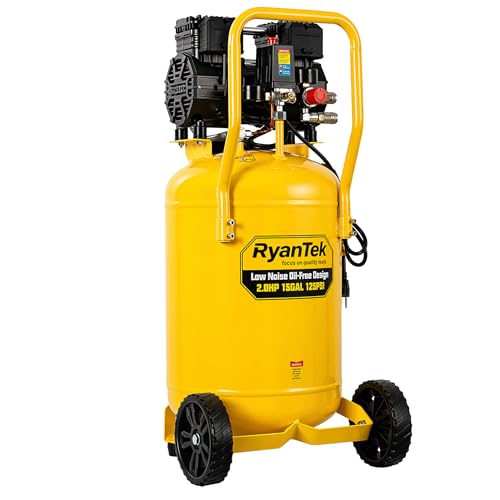 RyanTek 15-Gallon 2HP Air Compressor
|
8.6/10 | Buy |
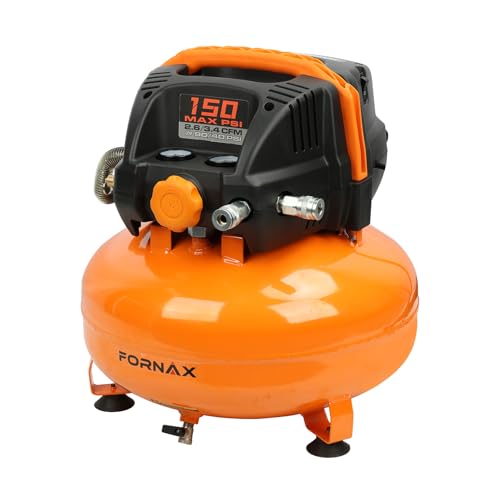 FORNAX 6-Gallon Pancake Air Compressor
|
8.4/10 | Buy | |
 DEWALT DWFP55130 2.5-Gallon 200 PSI Quiet Trim Air
|
8.4/10 | Buy | |
 Klutch 20-Gallon Portable Air Compressor
|
8.4/10 | Buy | |
 CARSUN Dual Power AC/DC Portable Tire Inflator
|
8.3/10 | Buy |
BairDplusL 8 Gallon Ultra Quiet Air Compressor
The BairDplusL 8-Gallon Ultra Quiet Air Compressor features a 1.5 HP oil-free motor and dual silencers to deliver a listed 8.75 CFM at 115 PSI while keeping operational noise at a modest 70 dB. It offers quick 45-65 second recovery times, making it a reliable option for DIYers and woodworkers running nailers, screwdrivers, and light spray equipment.
Pros
- Noticeably quiet 70 dB operation helps reduce auditory fatigue in enclosed garage or basement workspaces
- Quick 45 to 65 second tank recovery minimizes waiting during cyclic pneumatic tool operations
- Oil-free 1.5 HP pump design eliminates routine oil changes and avoids lubricant mist in downstream air lines
- Compact 35-pound weight and 10 x 22 x 22 inch footprint make it easy to transport and store
Cons
- Maximum operating pressure tops out at 115 PSI, which may fall short for tools requiring 125 to 150 PSI
- The product description lists both 8-gallon and 9-gallon tank capacities, creating slight sizing ambiguity
- Coupler style, regulator port sizes, and discharge fitting standards are not specified in the manufacturer documentation
Baococo 10-Gallon 2HP Quiet Air Compressor
Equipped with a 2HP copper-wound motor and a 10-gallon steel tank, this Baococo compressor runs at a modest 70 decibels. Its oil-free operation, rapid refill cycle, and wheeled base make it well suited for home garages and light workshop duties.
Pros
- Quiet 70dB operation suits indoor workspaces
- Fast 40-second tank pressure recovery
- Oil-free pump eliminates routine oil changes
- Dual couplers support multi-tool setups
- Wheels and handle provide smooth mobility
Cons
- 115 PSI maximum pressure limits heavy-duty pneumatic tools
- Ten-gallon tank requires noticeable floor storage space
Stealth SAQ-1234 2-Gallon Air Compressor
Operating at under 60 decibels, this compact unit provides exceptionally quiet performance for garage DIY tasks, brad nailing, and tire inflation. Its oil-free motor reaches up to 125 PSI while keeping routine maintenance to a minimum.
Pros
- Quiet operation suitable for indoor workspaces
- Maintenance-free oil-free pump design
- Durable steel tank with rubber vibration dampening
- Reliable pressure recovery for intermittent nailing
Cons
- Relatively heavy to carry at nearly 42 pounds
- Small two-gallon tank limits continuous tool use
- Modest 1.8 CFM flow rate at 90 PSI
Baococo 8 Gallon Portable Air Compressor
The Baococo 8-gallon portable air compressor pairs a 2HP electric motor with a 150 PSI receiver tank, delivering 2.8 SCFM at 90 PSI. It provides a solid, accessible air source for garage DIYers tackling tire inflation, car detailing, and pneumatic finish nailing.
Pros
- Useful 8-gallon tank capacity cushions air demand better than smaller pancake style compressors
- 150 PSI peak tank pressure accommodates common automotive tire inflators and pneumatic nailers
- Standard 120V 60Hz power compatibility allows easy plug-and-play use in residential garages
- Sufficient airflow rating of 2.8 SCFM at 90 PSI for light woodworking, trim carpentry, and cleaning tasks
Cons
- Continuous high-CFM pneumatic tools like rotary sanders and heavy-duty 1/2-inch impact wrenches will quickly deplete tank reserves
- Contradictory product listing notes an oil-free tank in the title while mentioning regular oil checks in the description, requiring users to inspect pump details before first start
- Does not include an air hose, quick-connect fittings, or downstream regulator accessories in the box
Metabo HPT 6-Gallon Pancake Air Compressor Review
The Metabo HPT EC711S is a portable 6-gallon pancake air compressor delivering 2.8 CFM at 90 PSI with a 165 PSI tank ceiling and an operating sound level of 73 dB. With its quick 46-second recovery cycle and dual quick couplers, it is an excellent choice for finish carpenters, punch-list contractors, and DIYers running pneumatic nailers.
Pros
- 73 dB operational sound rating is substantially quieter than standard job-site pancake units
- 165 PSI maximum pressure provides ample air storage with a swift 46-second recovery cycle
- Two 1/4-inch universal quick couplers support multi-tool setups right out of the box
- Sturdy steel roll cage protects gauges and the manifold assembly against knocks and drops
- Oil-free 1.0 HP motor ensures low maintenance and reliable cold-weather motor startup
Cons
- At 38.5 lbs, it is slightly heavier than ultra-compact 1-to-3-gallon trim compressors
- Airflow of 2.8 CFM at 90 PSI is designed for intermittent fastening, not continuous rotary tools or paint sprayers
- Bare-tool configuration means air hoses and pneumatic fastening tools must be purchased separately
RyanTek 15-Gallon 2HP Air Compressor
Built for garage workshops and indoor tasks, this vertical compressor combines a quiet 66 dBA dual-cylinder motor with a spacious 15-gallon tank. It supplies a dependable 4.5 CFM at 90 PSI for continuous nailing, spraying, and inflation while conserving floor space.
Pros
- Quiet 66 dBA operation suitable for indoor spaces
- Generous 4.5 CFM output at 90 PSI
- Compact vertical tank saves workshop floor space
- Maintenance-free oil-free pump design
- Integrated wheels make rolling transport straightforward
Cons
- Heavy at 68.3 pounds to lift manually
- Maximum pressure caps at 125 PSI
FORNAX 6-Gallon Pancake Air Compressor
The FORNAX 6-Gallon Pancake Air Compressor delivers 2.6 CFM at 90 PSI and up to 150 PSI of maximum pressure, featuring dual couplers and a lightweight 28.8-pound portable footprint. It is a practical pneumatic power source for DIY homeowners, finish carpenters, and garage hobbyists driving nailers or managing tire inflation.
Pros
- Dual quick-connect couplers allow two nailers to operate simultaneously without adding an external splitter manifold
- Generous 6-gallon air tank capacity with a 150 PSI maximum pressure ceiling provides a dependable air reserve
- Lightweight 28.8-pound profile simplifies one-handed carrying up stairs and transport into work vans
- Maintenance-free oil-free pump eliminates oil checks, oil changes, and mess around finished work surfaces
Cons
- Operating sound output rated at 95 dBA is loud and makes hearing protection necessary, especially in closed rooms
- Airflow output of 2.6 CFM at 90 PSI cannot support continuous-demand tools like sanders, grinders, or paint sprayers
- Supplied as a bare-tool compressor without an included air hose, tire inflator chuck, or pneumatic nailers
DEWALT DWFP55130 2.5-Gallon 200 PSI Quiet Trim Air
The DEWALT DWFP55130 delivers a capable 3.0 SCFM at 90 PSI with a 200 max PSI 2.5-gallon tank, running at a quiet 71.5 dBA on an efficient 12-amp motor. It is an ideal pneumatic power source for trim carpenters, punch-list contractors, and DIYers working on residential circuits.
Pros
- Delivers 3.0 SCFM at 90 PSI with a high 200 max PSI ceiling for rapid pressure recovery during sequential fastening
- Quiet 71.5 dBA sound output makes indoor trim carpentry and remodeling far less disruptive to homeowners
- Low 12-amp draw reduces breaker trips when running on shared 15-amp household circuits
- Integrated roll cage and console protect critical components while supporting horizontal or vertical operation
- Dual quick couplers allow two trim carpenters to connect and work off a single compressor
Cons
- Bare-tool configuration means you must supply your own air hoses, couplers, and pneumatic nail guns
- At 36 pounds, it is heavier to haul up flights of stairs than ultra-compact 1-gallon finish compressors
- Air output of 3.0 SCFM is built for intermittent finish fastening and will not support continuous tools like rotary sanders or sprayers
Klutch 20-Gallon Portable Air Compressor
Featuring a 2.0 HP 120V motor and a 20-gallon tank, the Klutch portable air compressor delivers a rated 4.2 SCFM at 90 PSI for versatile workshop air. Its oil-free pump and wheeled design make it a dependable choice for garage mechanics, woodworkers, and serious DIYers needing steady air storage.
Pros
- Generous 20-gallon air storage capacity provides a substantial buffer for intermittent shop tools
- Delivers a listed 4.2 SCFM at 90 PSI, outperforming smaller pancake compressors for workshop chores
- Oil-free pump design eliminates messy oil changes and allows clean, upright transport
- Rugged rubber wheels and built-in ergonomic handle make moving the 90-pound frame manageable
- Integrated thermal overload protection helps prevent motor burnout during demanding cycles
Cons
- Substantial 90-pound weight makes lifting into truck beds or carrying up stairs difficult without assistance
- Oil-free motor configurations generally produce noticeable operating noise compared to low-RPM lubricated units
- At 4.2 SCFM at 90 PSI, high-draw continuous air tools like sanders or grinders will require recovery pauses
CARSUN Dual Power AC/DC Portable Tire Inflator
The CARSUN Dual Power Tire Inflator delivers up to 150 PSI of high-pressure air running from either a 110V household outlet or a 12V vehicle socket. With digital pressure presets, automatic shutoff, and a lightweight 2.1-pound frame, it is an ideal maintenance pump for passenger vehicles, bicycles, and household inflatables.
Pros
- Versatile dual-voltage operation works seamlessly in the home garage or on the road without requiring an external converter
- Accurate auto-shutoff mechanism protects tires from accidental over-pressurization during routine top-offs
- Compact 2.1-pound build packs away easily in car trunks, under vehicle seats, or on garage shelving
- Clear digital display allows fast switching across four standard pressure measurement units
Cons
- Requires a mandatory 10-minute cooldown period after every 15 minutes of continuous operation
- Manufacturer explicitly states it does not support heavy truck tires, tractor tires, or stand-up paddleboards (SUP)
- Tankless inflator design cannot run standard workshop pneumatic air tools like brad nailers or paint sprayers
Understanding Air Compressor Wattage, Electrical Draw, and Power Requirements
Determining electrical demand for pneumatic equipment requires separating continuous running consumption from momentary startup current. Most consumer and jobsite electric air compressors run on standard 110V to 120V household alternating current. While small tire inflators draw under 150 watts, standard workshop compressors rated between 1.0 HP and 2.0 HP typically require 1,200 to 1,800 running watts and up to 3,000 starting watts. Understanding these electrical boundaries ensures reliable tool operation without damaging motors, tripping breakers, or overloading portable power generators.
Running Watts Versus Starting Surge in Pneumatic Motors
Electric motors on air compressors face heavy mechanical resistance the moment they switch on against unpressurized or partially pressurized pump cylinders. This physical load produces an inrush of electrical current known as starting surge or locked-rotor amperage. While a compressor might settle into drawing 12 to 15 amps during normal operation, the startup surge can demand 25 to 40 amps for a fraction of a second. That initial spike equates to roughly 2,500 to 4,500 starting watts on a standard 120V line before the motor reaches its full operating speed.
Once the motor spins at full operating speed, power consumption levels off to its continuous running wattage rating. Running watts reflect the steady electrical draw needed to compress ambient air and overcome friction in the pump cylinders. As air pressure inside the tank approaches the factory cut-out threshold, mechanical resistance climbs, pulling slightly higher amperage than at empty tank startup. If you want to dive deeper into long-term electrical utility impacts, our compressor electricity consumption overview explains everyday operational expenses.
Mechanical components like the unloader valve play a crucial role in managing this startup electrical spike. When the compressor shuts off at its maximum pressure setting, the unloader valve purges trapped high-pressure air from the pump head. This automatic release allows the motor to restart without fighting backpressure against the piston rings. If an unloader valve sticks or fails, trapped head pressure forces the motor to draw extreme inrush wattage, which quickly trips the circuit breaker or activates thermal overload protection.
Calculating Wattage from Motor Horsepower and Listed Amperage
Calculating the true electrical wattage of an air compressor begins with basic electrical formulas rather than promotional horsepower badges. In theoretical physics, one horsepower equals 746 watts, but real-world induction motors are not perfectly efficient. Most small single-phase electric motors operate at roughly 60 to 75 percent electrical efficiency due to heat, friction, and magnetic losses. Consequently, a true 1.0 horsepower electric motor typically consumes between 1,000 and 1,200 watts of electrical energy from the wall.
A more reliable method for calculating running watts is using Ohm’s Law by multiplying operating voltage by running amperage. For instance, a compressor rated at 120V with a listed motor draw of 12 amps pulls 1,440 running watts under normal working loads. The DEWALT DWFP55130 trim compressor specifically features a low 12-amp motor draw designed to prevent breaker tripping on standard residential lines. That 1,440-watt threshold fits comfortably within a standard 15-amp household circuit while leaving a small margin for electrical variance.
Larger 2.0 horsepower motors, such as those found on 8-gallon, 10-gallon, and 15-gallon units, frequently pull 14 to 15 running amps on a 120V circuit. Multiplying 120 volts by 15 amps yields 1,800 running watts, which pushes a standard 15-amp circuit to its maximum rated capacity. Continuous electrical loads on branch circuits should ideally not exceed 80 percent of the circuit breaker rating according to standard electrical guidelines. For heavy 2.0 HP compressors, operating on a dedicated 20-amp branch circuit provides necessary headroom to prevent nuisance tripping during prolonged pumping cycles.
Sizing Portable Generators and Inverters for Jobsite Compressors
Operating pneumatic power equipment on job sites without utility power requires careful generator sizing to handle initial surge demands. Many contractors make the mistake of matching a generator solely to the running wattage listed on the compressor data plate. A small 2,000-watt inverter generator might easily supply the 1,400 running watts of a pancake compressor, but it will stall immediately when hit with a 3,000-watt startup surge. Selecting a generator requires sizing for peak surge capacity rather than continuous running output alone.
To safely run a 1.0 HP to 1.5 HP portable compressor, a generator should supply at least 3,500 to 4,000 starting watts and 2,500 running watts. For heavier 2.0 HP models like the Klutch 20-gallon or RyanTek 15-gallon compressors, a generator with 5,000 starting watts provides the overhead required for reliable motor cycling. Without sufficient surge wattage, the generator voltage sags drastically during compressor startup, which overheats motor windings and triggers low-voltage protective shutdowns. Maintaining adequate surge headroom also prevents the generator from hunting or stalling when other small tools share the power plant.
When relying on battery-powered power stations or solar inverters, pure sine wave output is necessary to prevent induction motor damage. Modified sine wave inverters produce uneven electrical waveforms that generate excessive heat in electric compressor motors. Inverters must also feature high surge multiplier ratings capable of sustaining motor inrush current for several seconds. Checking the continuous inverter rating and peak surge duration ensures smooth pump startup in remote work environments.
Electrical Demand Across Tank Sizes and Air Volume Outputs
Tank volume and delivered cubic feet per minute directly influence how long the electric motor runs and how much cumulative power it consumes. A compact 2-gallon unit like the Stealth SAQ-1234 uses a modest 3/4 HP motor with lower running wattage suitable for intermittent brad nailing and tire inflation. Because the tank is small, the motor cycles on and off frequently, but each cycle only lasts a short duration. Small buffer tanks keep individual power draws brief, though total cycles increase under continuous tool operation.
Mid-sized 6-gallon pancake compressors, such as the Metabo HPT EC711S or the FORNAX portable unit, balance transportable weight with moderate air storage. These models deliver around 2.6 to 2.8 CFM at 90 PSI while pulling between 10 and 13 amps on standard household current. Reviewing our comprehensive garage air compressor guide helps identify how tank volume balances with motor duty cycles. A 6-gallon reservoir provides enough reserve air to drive framing nailers without forcing the motor into continuous uninterrupted operation.
Larger upright units, including 15-gallon and 20-gallon workshop compressors, utilize powerful 2.0 HP motors delivering 4.2 to 4.5 CFM at 90 PSI. These substantial tanks require longer continuous pump cycles during initial tank fill from zero pressure, lasting several minutes at maximum electrical draw. While larger air reserves reduce the frequency of motor startups, the extended run times place high thermal demands on motor insulation. Reliable thermal overload switches protect these motors by cutting power if sustained pumping creates excessive internal winding temperatures.
Avoiding Voltage Drop from Undersized Extension Cords
Plugging an air compressor into a long, thin extension cord is the most frequent cause of startup failure and tripped breakers. Electric motors draw substantial current during startup, and undersized electrical wire creates significant electrical resistance over distance. When resistance increases along a power cord, line voltage drops below the threshold required for the motor to produce full starting torque. A compressor receiving only 105 volts instead of 120 volts will struggle to turn over, hum loudly, and trip the circuit breaker.
Light-duty 16-gauge and 14-gauge extension cords should never be used with workshop air compressors drawing more than 10 amps. If an extension cord is unavoidable, user manuals recommend heavy-duty 12-gauge or even 10-gauge cords limited to 25 or 50 feet in total length. Heavy wire conductors minimize voltage drop, ensuring the electric motor receives adequate voltage during high-torque startup against tank head pressure. Maintaining full supply voltage prevents excessive heat buildup that breaks down motor insulation over time.
A far better practice on jobsites and in garages is keeping the compressor plugged directly into the wall outlet and extending reach with air hoses. Compressed air traveling through a 50-foot or 100-foot rubber or polyurethane air hose does not suffer the electrical risks of extension cord voltage drop. While long air lines may experience minor pneumatic pressure drop, increasing regulated tool pressure easily compensates for hose friction. Using longer pneumatic hoses protects electrical components, lowers fire risks, and keeps the compressor running smoothly.
Wattage Differences in 12V DC Inflators Versus 120V AC Compressors
Portable inflators designed for vehicle emergencies operate on entirely different electrical principles than workshop air compressors. Units like the CARSUN AC/DC tire inflator draw power from either a 12V vehicle cigarette lighter socket or a 110V wall outlet. When plugged into a vehicle DC outlet, these compact inflators generally draw 10 to 15 amps of direct current, representing roughly 120 to 180 total watts. This low wattage draw makes them safe for standard automotive auxiliary circuits without risk of blowing vehicle fuses.
Direct-drive tire inflators achieve high pressure up to 150 PSI by using small-bore pistons and miniature electric motors, but they move very low air volume. Unlike workshop compressors with high-flow pumps delivering multiple CFM, miniature inflators focus strictly on slow tire top-offs and sporting gear. Their modest wattage requirement means they lack storage tanks and cannot operate pneumatic fasteners, sprayers, or air ratchets. They also require mandatory cool-down periods after ten to fifteen minutes of operation to prevent small plastic or metal parts from overheating.
Comparing these portable 120-watt inflators to 1,500-watt workshop compressors highlights the distinction between simple inflation and continuous pneumatic tool power. A workshop compressor uses an induction motor and substantial cast-iron or aluminum cylinders to deliver rapid air replenishment into a steel storage vessel. That higher wattage consumption directly translates into high volume airflow capable of cycling nailers and running pneumatic tools. Recognizing your intended tasks ensures you do not expect workshop performance from a low-wattage emergency inflator.
Maintenance Habits That Lower Motor Strain and Electrical Consumption
Routine mechanical maintenance directly impacts how hard an electric motor must work and how much electrical wattage it draws during operation. Ambient air contains moisture that condenses into liquid water inside the steel storage tank as compressed air cools. When water accumulates inside the reservoir, it robs valuable air storage volume and forces the pump to cycle more frequently. Purging condensation through the bottom tank drain valve after every work session restores full tank volume and reduces unnecessary motor starts.
Restricted air intake filters force the compressor pump to pull against vacuum resistance, increasing mechanical drag on motor bearings. Inspecting and cleaning square or round intake filter elements ensures unrestricted atmospheric airflow into the compression cylinders. When intake filters become clogged with workshop sawdust or automotive overspray, the motor draws higher amperage to displace less air. Keeping intake pathways clear maintains efficient compression cycles and prevents sluggish fill times that strain electrical circuits.
Checking check valves and tube fittings for air leaks also prevents the compressor from cycling continuously to maintain pressure. A slow leak at a quick-connect coupler or pressure switch fitting causes the pump to kick on repeatedly even when pneumatic tools sit idle. Eliminating air leaks and maintaining clean check valves ensures that every watt of electricity drawn goes directly into useful pneumatic output. Practicing consistent maintenance protects motor components, lowers operating costs, and keeps your compressor running reliably for years.
About the author
Bob Beacham is an experienced tools and workshop writer with deep knowledge of power equipment, mechanical systems, and practical DIY applications. His coverage of air compressors, welding equipment, saws, and workshop tools helps translate technical specifications into useful guidance for homeowners and serious DIYers.