
How Industrial Air Compressors Work: Practical Guide for 2026
Learn how industrial air compressors work, pump cycles, and storage systems to power heavy pneumatic workshop equipment efficiently in October 2026.
 By Tom Scalisi
Updated October 8, 2026
By Tom Scalisi
Updated October 8, 2026

Pneumatic machinery powers heavy manufacturing lines, auto repair facilities, and large fabrication shops by converting mechanical energy into pressurized air. Understanding how industrial air compressors work requires examining how electrical motors or gas engines drive pumps to compress atmospheric air into dense, usable energy stored inside high-pressure receivers. Unlike small residential inflators that struggle under continuous tool draw, commercial systems rely on precision pump stages, heavy flywheel cooling, and engineered pressure vessels to maintain steady volume across multi-tool shifts. Evaluating how these machines draw, compress, cool, and store air helps operators prevent pressure drops and maintain plant productivity.
Compression systems must balance volume, pressure, and thermal load, which is why operators pay close attention to measuring delivered airflow and CFM ratings across different working pressures. Whether a facility operates stationary vertical receivers like the 60-gallon and 80-gallon platforms from VEVOR or deploys portable gas units from Ingersoll Rand and Albott for remote jobsites, the core thermodynamic cycle remains identical. Grasping the distinction between positive displacement stages, heat dissipation mechanisms, and air treatment filtration ensures that tools receive dry, stable pneumatic energy while extending pump operating life.
| Award | Product | ACR Score About ACR ScoreThe ACR Score is our own rating from 0 to 10, based on performance, design and build, ease of use, and value. It reflects independent research and is never influenced by manufacturers, retailers, or affiliate commissions. Learn more › | |
|---|---|---|---|
| Best Overall |
VEVOR 80-Gallon Heavy-Duty Air Compressor
|
8.9/10 | Buy |
| Best Premium |
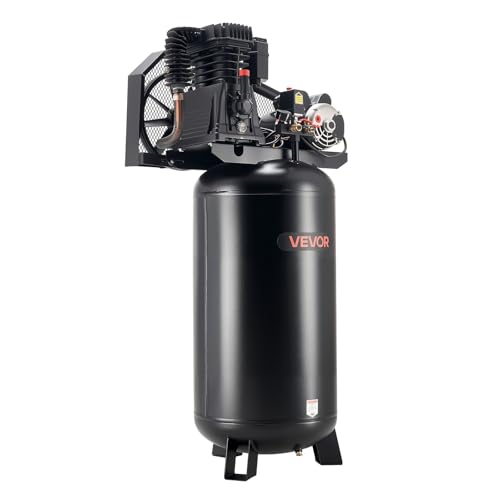 VEVOR 60-Gallon Heavy-Duty Air Compressor
|
8.9/10 | Buy |
| Best Budget |
 DEWALT D55146 4.5-Gallon 225-PSI Wheeled
|
8.8/10 | Buy |
 Metabo HPT 6-Gallon Pancake Air Compressor Review
|
8.6/10 | Buy | |
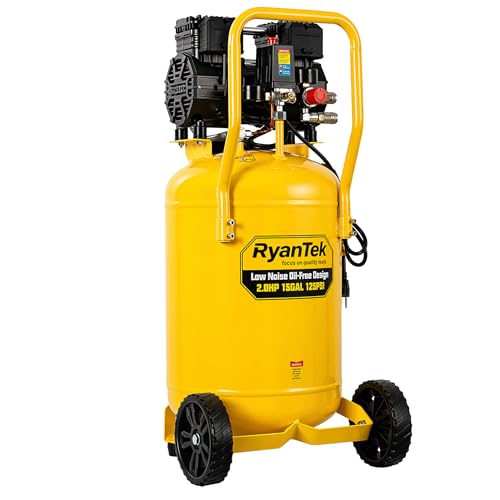 RyanTek 15-Gallon 2HP Air Compressor
|
8.6/10 | Buy | |
 VEVOR 13.2-Gallon 7HP Gas Air Compressor
|
8.6/10 | Buy | |
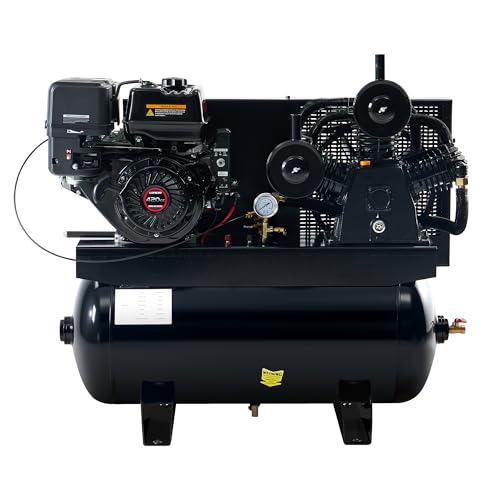 Albott 13HP Gas Air Compressor
|
8.6/10 | Buy | |
| Best Value |
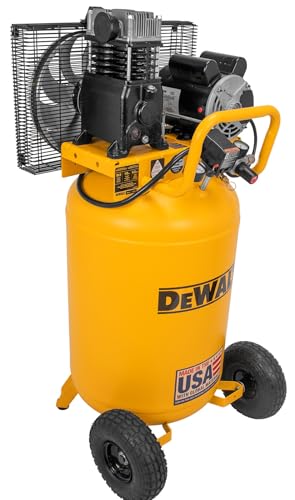 DEWALT 30-Gallon Vertical Portable Electric Air
|
8.3/10 | Buy |
 Ingersoll Rand SS3J5.5GH-WB 5.5 HP Compressor
|
8.3/10 | Buy | |
 VEVOR 80-Gallon Stationary Air Compressor
|
8.1/10 | Buy |
VEVOR 80-Gallon Heavy-Duty Air Compressor
The VEVOR 80-Gallon Heavy-Duty Air Compressor combines a 5 HP motor and belt-driven oil-lubricated pump to deliver 10 SCFM at 90 PSI with a 175 PSI maximum working pressure. Built for large garages and industrial workshops, it provides massive air storage for demanding automotive and fabrication setups.
Pros
- Massive 80-gallon tank stores ample pneumatic reserves up to 175 PSI
- Smooth belt-driven oil-lubricated pump with an integrated oil sight glass
- Factory dual air outlets allow running two pneumatic tools simultaneously
- Heavy-duty 3.5mm thick carbon steel tank with protective powder-coated finish
- Delivers 10 SCFM at 90 PSI to handle demanding automotive and shop equipment
Cons
- Ships without an electrical plug, requiring dedicated 230V hardwiring or plug installation
- Heavy 264-pound stationary unit requires equipment or multiple people to move and set in place
- Continuous high-demand applications like full-production sandblasting may exceed the 10 SCFM delivery
VEVOR 60-Gallon Heavy-Duty Air Compressor
The VEVOR 60-Gallon Air Compressor delivers a rated 12 SCFM at 90 PSI with a 5 HP motor and a maximum pressure of 145 PSI, utilizing a belt-driven oil-lubricated pump on a vertical carbon steel tank. Powered by a 230V single-phase electrical connection, it provides serious air volume for auto mechanics, fabricators, and home workshop owners running air-demanding tools.
Pros
- Strong air delivery of 12 SCFM at 90 PSI handles demanding workshop pneumatic equipment without rapid pressure drop
- Large 60-gallon tank capacity creates an expansive pressurized reservoir for sustained tool use
- Belt-driven, oil-lubricated pump design offers smoother operation and longevity compared to direct-drive universal pumps
- Integrated oil sight mirror simplifies routine fluid checks to keep maintenance straightforward
- Dual air outlets enable two air hoses to operate without adding external splitters
Cons
- Substantial dry weight of nearly 236 pounds makes initial positioning and shop placement a multi-person task
- Requires a 230V single-phase power supply and arrives without an attached electrical plug, requiring hardwiring or custom plug installation
- Maximum pressure tops out at 145 PSI, which is lower than industrial two-stage systems that reach 175 PSI
DEWALT D55146 4.5-Gallon 225-PSI Wheeled
The DEWALT D55146 is a rugged 4.5-gallon portable compressor featuring an oil-free pump and 225-PSI maximum storage pressure for extended air reserve. Built with 10-inch non-flat tires and a protective metal console, it delivers dependable mobility and performance for trim carpenters, remodelers, and garage hobbyists.
Pros
- 225 PSI maximum tank storage provides significantly more usable compressed air than standard lower-pressure portable tanks
- 10-inch non-flat tires make rolling across jobsite debris, thresholds, and gravel paths smooth and dependable
- Protective metal console shields working pressure gauges and air controls against accidental jobsite impacts
- Oil-free pump allows clean transport in truck beds or car trunks without worrying about spilled crankcase oil
Cons
- Substantial 88-pound weight requires noticeable effort when lifting into high truck tailgates or carrying up staircases
- Oil-free pump operation naturally produces elevated sound levels inside small enclosed garages or occupied rooms
- Larger physical footprint takes up more floor space than compact pancake-style compressors
Metabo HPT 6-Gallon Pancake Air Compressor Review
The Metabo HPT EC711S is a portable 6-gallon pancake air compressor delivering 2.8 CFM at 90 PSI with a 165 PSI tank ceiling and an operating sound level of 73 dB. With its quick 46-second recovery cycle and dual quick couplers, it is an excellent choice for finish carpenters, punch-list contractors, and DIYers running pneumatic nailers.
Pros
- 73 dB operational sound rating is substantially quieter than standard job-site pancake units
- 165 PSI maximum pressure provides ample air storage with a swift 46-second recovery cycle
- Two 1/4-inch universal quick couplers support multi-tool setups right out of the box
- Sturdy steel roll cage protects gauges and the manifold assembly against knocks and drops
- Oil-free 1.0 HP motor ensures low maintenance and reliable cold-weather motor startup
Cons
- At 38.5 lbs, it is slightly heavier than ultra-compact 1-to-3-gallon trim compressors
- Airflow of 2.8 CFM at 90 PSI is designed for intermittent fastening, not continuous rotary tools or paint sprayers
- Bare-tool configuration means air hoses and pneumatic fastening tools must be purchased separately
RyanTek 15-Gallon 2HP Air Compressor
Built for garage workshops and indoor tasks, this vertical compressor combines a quiet 66 dBA dual-cylinder motor with a spacious 15-gallon tank. It supplies a dependable 4.5 CFM at 90 PSI for continuous nailing, spraying, and inflation while conserving floor space.
Pros
- Quiet 66 dBA operation suitable for indoor spaces
- Generous 4.5 CFM output at 90 PSI
- Compact vertical tank saves workshop floor space
- Maintenance-free oil-free pump design
- Integrated wheels make rolling transport straightforward
Cons
- Heavy at 68.3 pounds to lift manually
- Maximum pressure caps at 125 PSI
VEVOR 13.2-Gallon 7HP Gas Air Compressor
Built for job sites lacking electrical hookups, this gas-powered VEVOR unit pairs a 7HP engine with dual outlets to run two pneumatic tools simultaneously. The 9 CFM delivery rate at 115 PSI ensures fast recovery times for outdoor construction and workshop tasks.
Pros
- Dual outlets operate two pneumatic tools at once
- Strong 9 CFM airflow provides rapid air delivery
- Automatic low-oil shutoff prevents pump damage
- Sturdy cast iron cylinders and frame construction
Cons
- Heavy unit weighing over 131 pounds
- Maximum pressure limited to 115 PSI
- Gas-powered design requires regular engine maintenance
Albott 13HP Gas Air Compressor
The Albott 13HP Gas Air Compressor combines a 30-gallon ASME-certified tank with a 3-cylinder cast iron pump delivering 18 CFM at 90 PSI and up to 180 PSI maximum pressure. It is designed for service truck operators, mobile mechanics, and remote jobsite crews needing high-volume pneumatic airflow without electrical grid access.
Pros
- Delivers a listed 18 CFM at 90 PSI to easily operate high-demand pneumatic tools like heavy impact wrenches and spray guns off the grid
- Rugged 3-cylinder cast iron pump and frame reduce deformation and wear under demanding work conditions
- Substantial 30-gallon ASME-certified horizontal tank provides a reliable air buffer and reduces engine cycle frequency
- Total independence from 120V electrical outlets, eliminating blown household breakers and extension cord voltage drops
Cons
- Substantial dry weight of 344 pounds requires mechanical lifting equipment or permanent truck bed mounting rather than hand carrying
- Internal combustion engine produces exhaust fumes and high sound levels, restricting operation strictly to well-ventilated outdoor areas
- Requires dual routine maintenance schedules for both the gas engine and the oil-lubricated 3-cylinder compressor pump
DEWALT 30-Gallon Vertical Portable Electric Air
Delivering 6.2 SCFM at 90 PSI with a high-capacity 175 PSI max pressure rating, the DEWALT DXCM303 30-Gallon Electric Air Compressor offers substantial air reserves for demanding workshop tools. Featuring rugged pneumatic wheels and a factory high-flow regulator, it is an outstanding mobile solution for garage mechanics and serious DIY woodworkers.
Pros
- Substantial 175 PSI maximum pressure provides longer run time between motor recovery cycles
- Solid airflow output of 6.2 SCFM at 90 PSI supports a wide variety of pneumatic garage tools
- High-flow regulator supplies up to 65% more usable operating pressure to connected hoses
- Heavy-duty pneumatic wheels make rolling this 196-pound upright compressor around the garage practical
Cons
- Substantial 196-pound total weight makes vehicle loading and transport between jobsites difficult without ramps or assistance
- Large vertical shop profile is designed for roll-around floor use rather than hand-carry punch-list applications
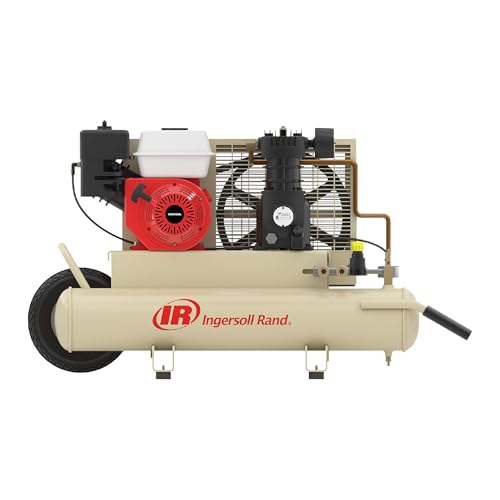
Ingersoll Rand SS3J5.5GH-WB 5.5 HP Compressor
Built for rugged jobsites lacking electrical hookups, this wheelbarrow-style compressor pairs a 5.5 HP Honda engine with durable cast-iron construction. It delivers continuous 135 psi operation and supports two pneumatic tools simultaneously.
Pros
- Durable cast iron pump construction
- Reliable 5.5 HP gas-powered Honda engine
- Rated for 100% continuous duty operation
- Dual quick disconnects for multi-tool use
Cons
- Heavy 226-pound weight makes vehicle loading difficult
- Modest 0.825-gallon fuel tank requires frequent refilling
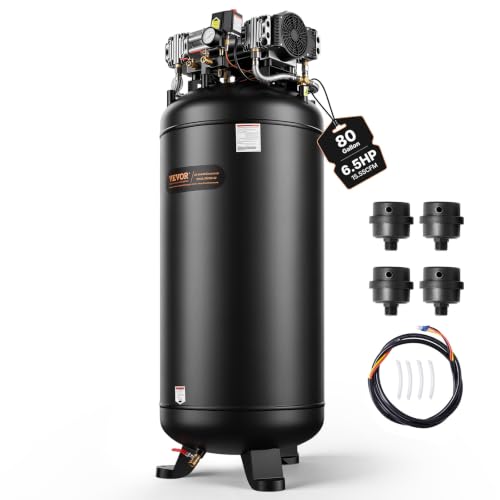
VEVOR 80-Gallon Stationary Air Compressor
The VEVOR 80-Gallon Stationary Air Compressor delivers an impressive 15.5 SCFM at 90 PSI with a maintenance-free 6.5 HP oil-free motor and 145 PSI maximum pressure. Operating on 220V single-phase power with an 86 dB sound profile, it provides dependable, high-volume air storage for serious woodworkers, commercial auto shops, and industrial facilities.
Pros
- High airflow rating of 15.5 SCFM at 90 PSI supports continuous and intermittent pneumatic tools alike
- Oil-free pump architecture eliminates messy oil changes and oil mist in downstream air lines
- Generous 80-gallon tank capacity creates an extensive pressurized air reserve for high-volume tasks
- Space-saving vertical tank footprint fits cleanly against shop walls and in dedicated utility corners
Cons
- The 86 dB sound output is relatively loud for tight, enclosed residential garages without hearing protection
- Heavy 264.6-pound stationary design requires dedicated equipment placement and appropriate transport planning
- Requires a 220V single-phase electrical connection, making it incompatible with standard 120V household outlets
The Mechanics, Thermodynamics, and Systems Behind Industrial Air Compression
Industrial air compressors serve as the primary utility backbone across manufacturing plants, automotive collision centers, and commercial construction projects. These machines convert mechanical input power into stored pneumatic energy by forcing ambient atmospheric air into an increasingly confined chamber. Rather than creating new energy, the compressor concentrates air molecules to elevate potential pressure within a sealed receiver vessel. Understanding the mechanical components and thermodynamic principles behind this cycle reveals how commercial facilities sustain continuous pneumatic power across demanding production schedules.
The Fundamental Physics of Air Compression and Heat Generation
The compression cycle relies on foundational thermodynamic laws governing gas behavior under variable pressure and volume. When ambient air enters an intake filter at standard atmospheric pressure, its gas molecules remain loosely dispersed throughout the chamber. As mechanical pump components decrease the physical volume of that intake space, the molecular density increases in direct proportion to the volume reduction. This physical displacement creates potential pneumatic pressure that downstream tools convert into mechanical work.
Compressing gas inevitably produces significant thermal energy as kinetic friction accelerates among crowded air molecules. The heat of compression elevates the discharge temperature of the air stream rapidly as operating pressure climbs toward the cut-out threshold. If this excess heat remains unmanaged, it can thin pump lubricants, accelerate carbon deposits on valves, and degrade internal sealing rings. High-output industrial pumps utilize integrated cooling fins, cast-iron cylinder heads, and deep-fan flywheels to dissipate this thermal load into the surrounding workspace.
Atmospheric humidity enters the compressor intake alongside ambient nitrogen and oxygen molecules during every stroke cycle. Hot compressed air holds substantial amounts of evaporated water vapor as it discharges from the pump head under pressure. Once that air stream cools inside delivery lines or receiver vessels, the water vapor condenses into liquid form. Managing both thermal rejection and resulting moisture condensation represents a central engineering priority across every commercial pneumatic installation.
Reciprocating Piston Pump Mechanics and Valve Operation
Reciprocating piston pumps represent one of the most widespread mechanical configurations used in commercial workshops and repair bays. These assemblies rely on a rotating crankshaft that drives one or more pistons upward and downward inside precision-machined cylinders. Heavy-duty belt-driven pumps, such as those found on stationary cast-iron workshop platforms, ensure smooth and stable stroke cycles under continuous load. As the piston travels downward on its intake stroke, it creates a partial vacuum within the cylinder bore that draws in atmospheric air through the intake filter.
Flexible reed valves or spring-loaded disc valves govern the directional movement of air entering and exiting the cylinder head. During the downward intake stroke, atmospheric pressure pushes the intake valve open while system pressure keeps the discharge valve firmly seated against its port. Once the piston reaches bottom dead center and reverses direction, rising cylinder pressure seals the intake valve shut to prevent reverse leakage. The trapped air is then compressed into a fraction of its original volume as the piston moves upward toward top dead center.
When internal cylinder pressure exceeds the pressure stored inside the discharge line, the exhaust valve flexes open to release the compressed charge. Multi-cylinder configurations distribute compression pulses across separate cylinders to increase airflow stability and balance mechanical loads on the motor. Heavy cast-iron cylinder construction resists mechanical bore deformation under severe duty cycles while minimizing thermal expansion. Precision piston rings maintain a tight mechanical seal against cylinder walls, preventing pressurized blow-by from entering the lower oil crankcase.
Single-Stage versus Two-Stage Compression Architectures
The distinction between single-stage and two-stage compression lies in how many times the air charge is compressed before entering the receiver tank. In a single-stage system, atmospheric air is compressed directly to its final working pressure within a single piston stroke. Single-stage machines typically operate up to approximately 135 to 150 PSI, making them well-suited for general pneumatic fastening, inflation, and moderate utility tasks. Attempting to push single-stage pumps past these thresholds causes excessive thermal buildup and accelerated valve wear due to extreme compression ratios.
Two-stage industrial compressors divide the compression process across two distinct cylinder sizes to achieve higher operating pressures efficiently. Atmospheric air first enters a large low-pressure cylinder where it is compressed to an intermediate level, often between 40 and 60 PSI. This intermediate air charge then travels through an external finned intercooler tube where ambient airflow cools the air before it enters the second stage. Lowering the air temperature between stages increases air density, which dramatically improves the volumetric efficiency of the second compression step.
The second stage utilizes a smaller high-pressure cylinder that compresses the pre-chilled air up to final pressures between 175 and 200 PSI. High maximum working pressures, such as 175 PSI, provide a substantially larger usable air buffer compared to standard utility compressors. This expanded pressure reserve allows high-draw pneumatic machinery to operate longer before the electric motor or engine must cycle back on. Dual-stage pumps also maintain lower operating temperatures across continuous duty cycles because each cylinder handles only a portion of the total pressure lift.
Motor Drive Systems, Power Transmission, and Duty Cycles
Industrial air compressors require powerful prime movers to turn heavy pump crankshafts against rising head pressure. Most permanent workshop installations rely on heavy-duty electric induction motors wired to dedicated 230-volt single-phase or three-phase circuits. While compact jobsite units use direct-drive connections, heavy industrial platforms generally utilize belt-driven pulleys. Belt-drive systems allow the pump to turn at lower revolutions per minute than the electric motor, reducing operational friction, heat, and mechanical vibration.
Gas-driven compressors replace electric motors with internal combustion engines for remote jobsite operation where utility power remains unavailable. Reliable engine-driven platforms deliver true continuous pneumatic power on active roadwork and construction sites. Many gas-powered units feature cast-iron pump heads engineered for continuous duty operation, meaning they can run under steady load without overheating. Operators running service trucks or mobile equipment rely on these engine-driven units to maintain pneumatic pressure wherever work takes them.
Understanding true continuous running horsepower versus exaggerated peak marketing labels prevents costly motor burnout and breaker tripping. A commercial motor draws sustained electrical current to produce its rated torque, whereas consumer units often advertise peak surge horsepower that cannot be maintained. High-output electric compressors draw significant current to generate high volumetric delivery at standard working pressures. Matching the motor electrical supply to proper wire gauge and breaker capacity ensures reliable starts even during cold shop conditions.
Air Receivers, Storage Dynamics, and Flow Dampening
The air receiver tank acts as an indispensable energy accumulator within any industrial pneumatic network. Piston pumps generate pulsating waves of pressurized air that would cause erratic tool operation if plumbed directly to downstream equipment. By collecting discharge air in a rigid pressure vessel, the receiver dampens pressure pulses into a calm, steady airstream. Large receiver capacities create massive reservoirs that absorb sudden spikes in pneumatic tool consumption without immediate line pressure drops.
Tank volume also dictates the operational cycle time of the compressor motor, helping protect internal electrical windings from thermal stress. When air storage is limited, frequent motor starts and stops generate severe electrical inrush current that accelerates motor degradation. A larger air reservoir allows the pump to run through longer, more efficient cycles and rest during extended cut-out intervals. Vertical stationary tanks maximize air storage capacity while occupying minimal floor space in crowded machine shops and commercial garages.
Industrial air tanks must withstand immense mechanical stress and are typically manufactured from heavy-gauge carbon steel with welded seams. Certified receivers comply with rigorous pressure vessel standards to ensure safe operation under continuous cycling loads. Powder-coated exterior finishes and corrosion-resistant coatings help the steel shell resist ambient moisture and industrial workshop chemicals. Maintaining proper tank wall integrity requires routine inspections to verify that internal moisture has not compromised structural pressure containment.
Moisture Accumulation, Cooling Systems, and Air Treatment
Ambient air contains moisture that condenses rapidly as compressed air cools within the storage tank and distribution piping. Because water is essentially non-compressible, accumulated moisture robs the tank of usable air volume over extended operating periods. More critically, entrained moisture traveling downstream washes away lubricating oils inside pneumatic tools, accelerates valve rust, and ruins fine spray finishes. Industrial systems therefore incorporate multi-stage cooling and moisture separation strategies to purify the compressed air stream before delivery.
Finned discharge tubes between the pump head and the tank initiate early heat rejection into the ambient room air. As the compressed air drops in temperature inside the receiver, gravity causes condensed water droplets to settle along the bottom curved floor of the tank. Installing an accessible tank drain valve allows operators to purge this corrosive liquid daily before rust pits the lower steel shell. Quarter-turn brass ball valves provide far superior reliability compared to fragile threaded thumb petcocks that often seize shut from mineral buildup.
High-demand facilities often supplement tank drainage with dedicated refrigerated air dryers, coalescing filters, and particulate separators. Refrigerated dryers chill incoming air to drop its dew point, wringing out moisture before the air enters shop distribution lines. Coalescing filters subsequently trap aerosolized pump oil droplets and microscopic scale particles that could otherwise contaminate paint sprayers or automated valves. Proper moisture management keeps pneumatic equipment operating smoothly while preventing catastrophic water hammer inside rigid pipe networks.
Pressure Switch Calibration and Essential Safety Valves
The electrical pressure switch controls the automated cycling of the compressor motor based on internal tank pressure thresholds. When air consumption drops tank pressure down to the predetermined cut-in setpoint, internal switch contacts snap closed to energize the motor. The pump then runs continuously until stored air reaches the cut-out threshold, at which point the switch contacts open and cut power. This differential setting, typically spanning 30 to 40 PSI, prevents the motor from cycling on and off rapidly during normal workshop use.
An integrated unloader valve works in tandem with the pressure switch to bleed trapped head pressure every time the motor shuts down. When the motor cuts off, the unloader valve actuates to release high-pressure air trapped in the discharge tube between the pump and tank. This instantaneous pressure release allows the motor to restart smoothly against zero backpressure during the subsequent cut-in cycle. If the unloader valve fails or leaks, the motor may hum and trip circuit breakers as it struggles against trapped cylinder pressure.
A one-way brass check valve installed at the tank inlet prevents stored tank pressure from flowing backward into the unloader line. In addition, an ASME safety relief valve provides fail-safe mechanical overpressure protection if the electrical pressure switch fails to cut power. If internal tank pressure exceeds rated safety limits, the spring-loaded relief valve pops open to vent excess air directly into the atmosphere. Operators must regularly inspect the relief valve pull-ring to ensure the internal seat moves freely and has not seized from corrosion.
Matching Industrial Compressor Output to Tool Demand
Selecting and configuring an industrial compressor requires careful calculation of continuous air consumption across all planned pneumatic tools. Many operators mistakenly focus strictly on tank storage volume while ignoring continuous cubic feet per minute delivery ratings. While small portable compressors handle intermittent nail guns effortlessly, continuous production tools demand sustained airflow. Reviewing our comprehensive guide on matching compressor capacity to air tools helps operators avoid severe pressure drops during heavy shifts.
Continuous pneumatic tools such as rotary sanders, die grinders, and HVLP paint sprayers consume immense volumes of air without pause. A high-speed sander can easily demand substantial CFM at 90 PSI to maintain full operating torque and spindle speed. If the compressor pump generates less air volume than the tool consumes, the reservoir depletes rapidly and causes dynamic pressure drops. When equipping an automotive or fabrication shop, consulting our resource on sizing compressors for demanding workshop tools ensures pump output exceeds total tool consumption.
High-output stationary units and commercial platforms provide the sustained volume required for multi-operator workflows. Incorporating a dedicated high-flow air regulator prevents line restriction, ensuring tools receive unrestricted airflow even under fluctuating tool trigger pulls. Maintaining adequate pump capacity alongside a 25 to 30 percent safety margin protects the motor from running continuously at maximum thermal capacity. Sizing equipment properly ensures steady pneumatic power while extending the operational lifespan of the entire industrial compression system.
Understanding how industrial air compressors work allows plant managers, technicians, and workshop owners to optimize pneumatic system performance and prevent costly downtime. By balancing pump displacement, cooling efficiency, pressure switch calibration, and air treatment filtration, facilities ensure their tools operate at peak efficiency. Regular maintenance, including daily moisture purging, oil level monitoring via sight glasses, and checking belt tension, safeguards this mechanical investment over decades of service. Sizing the system accurately to continuous tool demands transforms raw atmospheric air into one of the most reliable and versatile power sources in modern industry.
About the author
Tom Scalisi brings more than two decades of experience in construction, building maintenance, contracting, and hands-on tool use. His practical understanding of power tools, automotive work, repairs, and jobsite equipment helps readers evaluate compressors based on real workloads rather than specifications alone.