
How Does an Oilless Air Compressor Work: Practical Guide for 2026
Understand how does an oilless air compressor work through piston mechanics, PTFE seals, and quiet operation in this October 2026 guide.
 By Bob Beacham
Updated October 7, 2026
By Bob Beacham
Updated October 7, 2026

Workshop owners and mobile contractors often struggle with heavy, oil-filled machines that risk staining workpieces or refusing to start during sub-freezing mornings. Understanding how does an oilless air compressor work reveals why modern portable equipment has shifted away from traditional splash-lubricated pumps toward dry-running technology. Instead of circulating liquid motor oil through a crankcase, an oil-free system relies on specialized low-friction materials to compress ambient air without cylinder scoring. This design eliminates routine fluid checks while delivering completely oil-free air to sensitive pneumatic nailers, paint spray guns, and tire valves.
Pneumatic performance depends directly on how effectively the internal piston moves air through the cylinder head into the pressure receiver. Evaluating these systems requires examining scfm and cfm air delivery ratings alongside motor speed to ensure your tools receive consistent working pressure. Modern oil-less compressors also feature dual-piston pump heads that rotate at lower speeds, dramatically reducing workshop decibel levels compared to older, screaming universal motors. Knowing the mechanical principles behind dry compression makes it much easier to select the right tool for finish carpentry, tire inflation, or garage maintenance.
| Award | Product | ACR Score About ACR ScoreThe ACR Score is our own rating from 0 to 10, based on performance, design and build, ease of use, and value. It reflects independent research and is never influenced by manufacturers, retailers, or affiliate commissions. Learn more › | |
|---|---|---|---|
| Best Overall |
Baococo 4-Gallon 0.5 HP Air Compressor
|
9.2/10 | Buy |
| Best Budget |
 Limodot 1-Gallon Quiet Air Compressor
|
9.1/10 | Buy |
| Best Premium |
 California Air Tools 2010A 2-Gallon Compressor
|
9.1/10 | Buy |
 MZB MZB-1100H-50 13.2-Gallon Air Compressor
|
8.8/10 | Buy | |
| Best Value |
 Baococo 8 Gallon Portable Air Compressor
|
8.6/10 | Buy |
 VEVOR 1-Gallon 1HP Portable Air Compressor
|
8.3/10 | Buy | |
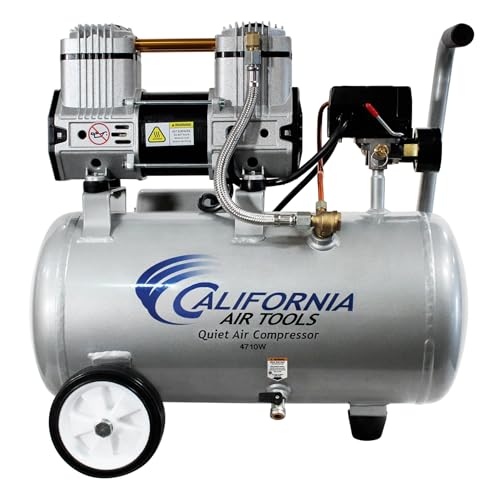 California Air Tools CAT-4710W 4.7-Gal Compressor
|
8.3/10 | Buy | |
 Goodyear 10-Gallon 150 PSI Air Compressor
|
8.3/10 | Buy | |
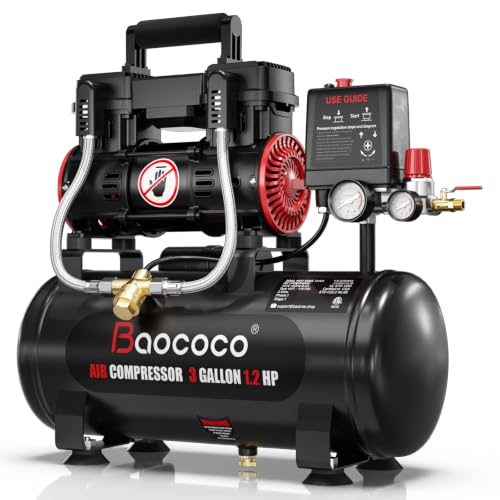 Baococo 3-Gallon Ultra Quiet Air Compressor
|
7.8/10 | Buy | |
 VELPAX 8-Gallon Quiet Air Compressor
|
7.8/10 | Buy |
Baococo 4-Gallon 0.5 HP Air Compressor
Built for light household maintenance and quick inflation tasks, this compact 4-gallon unit pairs a quiet 0.5 HP motor with an automatic overpressure safety shut-off. Its modest air delivery handles small nailers and tire filling without creating excessive workshop noise.
Pros
- Quiet operation suitable for residential spaces
- Automatic overpressure shut-off enhances operational safety
- Compact footprint stores easily in tight spaces
- Stable base minimizes movement during use
Cons
- Low airflow output limits heavy pneumatic tool use
- Maximum pressure capped at 110 PSI
- Modest 0.5 HP motor lacks heavy-duty capability
Limodot 1-Gallon Quiet Air Compressor
Engineered for low noise output at 68 decibels, this 1-horsepower Limodot compressor delivers quick recovery times and an oil-free motor for light pneumatic tools. Its compact form factor and bundled 11-piece accessory kit make it a practical option for trim carpentry and home workshop projects.
Pros
- Quiet 68 dB operation suitable for indoor jobs
- Rapid 15-second pressure recovery time
- Oil-free design requires minimal routine maintenance
- Generous accessory bundle included out of the box
- Reliable cold-weather starting capability
Cons
- Small 1-gallon capacity restricts continuous heavy use
- Relatively heavy at nearly 30 pounds
California Air Tools 2010A 2-Gallon Compressor
Operating at just 60 decibels, this compact unit delivers reliable airflow with minimal noise disruption. Its rust-free aluminum tank and oil-free dual-piston pump make it well suited for indoor trim work and noise-sensitive spaces.
Pros
- Exceptionally quiet operation at only 60 decibels
- Lightweight rust-free aluminum tank design
- Low-maintenance oil-free dual-piston system
- Quick 14-second recovery time between cycles
Cons
- Modest 2-gallon tank limits continuous heavy tool use
- 120 PSI maximum pressure is below heavy-duty standards
- Air output is insufficient for sustained high-demand air tools
MZB MZB-1100H-50 13.2-Gallon Air Compressor
Designed for indoor workshops and residential garages, this compressor keeps operating noise down to a manageable 70 decibels. Its 13.2-gallon steel tank and wheeled frame suit DIY woodworkers, painters, and mechanics needing reliable airflow without regular pump maintenance.
Pros
- Quiet 70dB sound level ideal for indoor spaces
- Maintenance-free oil-free pump design
- Large 13.2-gallon durable steel tank
- Wheels and handle make transport manageable
Cons
- Hefty 72-pound weight makes vehicle loading difficult
- 115 PSI maximum pressure is modest for heavy-duty pneumatic tools
Baococo 8 Gallon Portable Air Compressor
The Baococo 8-gallon portable air compressor pairs a 2HP electric motor with a 150 PSI receiver tank, delivering 2.8 SCFM at 90 PSI. It provides a solid, accessible air source for garage DIYers tackling tire inflation, car detailing, and pneumatic finish nailing.
Pros
- Useful 8-gallon tank capacity cushions air demand better than smaller pancake style compressors
- 150 PSI peak tank pressure accommodates common automotive tire inflators and pneumatic nailers
- Standard 120V 60Hz power compatibility allows easy plug-and-play use in residential garages
- Sufficient airflow rating of 2.8 SCFM at 90 PSI for light woodworking, trim carpentry, and cleaning tasks
Cons
- Continuous high-CFM pneumatic tools like rotary sanders and heavy-duty 1/2-inch impact wrenches will quickly deplete tank reserves
- Contradictory product listing notes an oil-free tank in the title while mentioning regular oil checks in the description, requiring users to inspect pump details before first start
- Does not include an air hose, quick-connect fittings, or downstream regulator accessories in the box
VEVOR 1-Gallon 1HP Portable Air Compressor
Built for quick tire top-offs and light pneumatic tasks, this compact unit pairs an oil-free 1HP motor with heavy-duty structural steel construction. Integrated thermal protection and a multi-layer intake silencer make it a reliable companion for home workshops.
Pros
- Maintenance-free oil-free motor design
- Sturdy triple-layer coated steel tank
- Automatic safety shut-off for overheating and pressure
- Compact footprint stores easily in tight spaces
Cons
- Small 1-gallon capacity depletes quickly during continuous work
- Relatively heavy at over 30 pounds for its size
- Low 1.5 CFM output limits use with demanding tools
California Air Tools CAT-4710W 4.7-Gal Compressor
Built for garage workshops and DIY tasks, this mobile unit features an oil-free dual-piston pump that fills its 4.7-gallon steel tank in 78 seconds. Its low 7.5-amp motor draw ensures smooth startups on standard household circuits without tripping breakers.
Pros
- Fast 78-second tank fill time from empty
- Low 7.5-amp draw prevents tripped breakers
- Low-maintenance oil-free pump operation
- Wheels and pull handle ease transport at 35 pounds
Cons
- Delivers only 2.2 CFM at 90 PSI for demanding tools
- Steel tank construction is heavier than aluminum alternatives
Goodyear 10-Gallon 150 PSI Air Compressor
Built for home garages and workshop DIY tasks, this vertical 10-gallon compressor provides up to 150 PSI without the upkeep of oil-lubricated pumps. Its wheeled vertical build saves floor space while delivering dependable airflow for inflation and light pneumatic tools.
Pros
- Maintenance-free oil-free pump operation
- Generates 4.0 SCFM at 90 PSI
- Built-in 8-inch wheels aid workshop mobility
- Clear dual gauges for simple monitoring
Cons
- Heavier unit at 68 pounds to lift
- Limited to light-duty air tools
Baococo 3-Gallon Ultra Quiet Air Compressor
The Baococo 3-Gallon Ultra Quiet Air Compressor delivers up to 115 PSI at approximately 70dB, powered by a 1.2HP copper motor and an oil-free pump. With a 20-second recovery cycle, dual quick couplers, and integrated transport wheels, it is a practical, budget-friendly choice for indoor trim work, DIY repairs, and garage tire maintenance.
Pros
- Operates at roughly 70dB, allowing conversation and indoor use without deafening noise
- Rapid 20-second tank recovery cycle helps keep intermittent nailing projects moving
- Dual quick-connect couplers allow quick tool changes or running two air lines at once
- Built-in wheels and sturdy carry handle make rolling or lifting across the workspace easy
- Oil-free pump eliminates messy crankcase checks and prevents oil leaks during vehicle transport
Cons
- Maximum tank pressure tops out at 115 PSI, lower than 135 to 175 PSI contractor-grade units
- Manufacturer does not publish continuous CFM at 90 PSI, making it unsuited for continuous air tools like sanders or grinders
- Compact 3-gallon air reserve requires frequent motor cycling under rapid pneumatic demand
VELPAX 8-Gallon Quiet Air Compressor
Delivering 115 PSI at an approachable 68 decibels, this oil-free unit suits indoor spaces like home workshops and garages. Its 8-gallon tank and 1.75HP motor supply clean air for tire inflation, woodwork nailing, and basic pneumatic tools without excessive noise.
Pros
- Quiet 68 dB motor fits home workshops
- Oil-free design requires minimal regular maintenance
- Integrated overload protection supports safe operation
- Standard G1/4 outlet enables easy tool connections
Cons
- Maximum working pressure tops out at 115 PSI
- Lacks wheels for moving the 8-gallon tank
The Engineering and Operation Behind Oil-Free Air Compressors
Oil-free air compressors generate pressurized air through a mechanical reciprocating motion that isolates the compression chamber from liquid lubricants entirely. Rather than relying on an oil bath to seal clearances and dissipate thermal friction, these machines utilize self-lubricating synthetic compounds, precision-machined aluminum sleeves, and pre-greased sealed bearings. This mechanical separation guarantees that the compressed air discharge remains free from hydrocarbon aerosols, providing a dependable air source for trim carpentry, automotive inflation, and finish spraying.
The Mechanical Reciprocating Cycle: Intake to Discharge
The core compression process begins when an electric motor spins an eccentric crankshaft attached to a connecting rod and piston assembly. As the piston travels downward on its intake stroke, a pressure differential develops inside the cylinder bore, dropping the internal chamber below atmospheric pressure. This partial vacuum pulls ambient air through an external intake filter and forces open a flexible, thin steel intake reed valve. Atmospheric air rushes into the expanding cylinder volume until the piston bottoms out at the lowest point of its stroke.
Once the crankshaft swings past bottom dead center, the piston reverses direction and begins its upward stroke, initiating the compression phase. The immediate rise in chamber pressure forces the intake reed valve tightly flat against its valve plate, sealing off the intake port to prevent reverse airflow. As the trapped air volume decreases within the sealed cylinder, the molecules compress, causing both air pressure and air temperature to rise rapidly. When internal cylinder pressure exceeds the static pressure in the delivery tube, the exhaust reed valve flexes open, allowing the hot, high-pressure air to exit the head.
The pressurized discharge air then travels through a cooling tube toward the one-way check valve installed at the top of the storage tank. This mechanical cycle repeats hundreds or thousands of times every minute depending on the operating rotational speed of the motor. Because the intake and exhaust reed valves function solely based on physical pressure differentials rather than complex mechanical camshafts, the reciprocating design remains remarkably efficient and reliable under repeated cycling.
Self-Lubricating Materials: Operating Without Liquid Oil
Traditional reciprocating compressors require a sump filled with non-detergent oil to lubricate the cylinder walls, wrist pins, and crankshaft journals. In an oil-less system, engineers eliminate the liquid oil sump by using polytetrafluoroethylene, commonly known as PTFE or Teflon, along with specialized carbon composite blends. The piston features a flexible PTFE cup seal or ring that expands gently against the cylinder wall as air pressure builds above it. This continuous contact creates an airtight boundary while generating minimal frictional resistance during rapid cycling.
The cylinder bore itself is typically machined from high-strength aluminum alloy and treated with a hard-anodized or ceramic coating. This ultra-smooth, hardened surface resists abrasive wear while allowing the self-lubricating PTFE material to slide freely without galling or binding. Over time, microscopic amounts of PTFE transfer to the cylinder wall, creating a low-friction interface that operates completely dry. Understanding these compressor pump oil requirements in contrast to dry designs helps explain why oil-free units can be stored or operated in any orientation without oil leaks.
Below the piston head, the crankshaft bearings and wrist pins utilize permanently sealed, high-temperature ball bearings packed with synthetic grease from the factory. Rubber seals prevent this internal grease from escaping into the compression chamber or drying out under elevated operating temperatures. This sealed architecture protects the mechanical bearings from environmental dust and debris, eliminating the need for periodic crankcase draining, dipstick checks, or oil filter replacements throughout the operational life of the pump.
Dual-Piston Low-RPM Systems versus High-Speed Pumps
Modern oil-free air compressors generally fall into two distinct engineering architectures: high-speed universal motor units and low-speed dual-piston induction units. Older traditional oil-free designs utilize a single small piston driven by a universal motor spinning at speeds exceeding 3,000 to 4,000 revolutions per minute. While these high-speed pumps generate respectable air volume in a compact footprint, the rapid piston travel produces extreme friction, elevated thermal stress, and piercing operational noise levels that frequently exceed 80 decibels.
Modern quiet compressors, exemplified by dual-piston configurations, operate on a fundamentally different design philosophy. These systems feature two opposed or parallel cylinders driven by a slow-turning four-pole induction motor operating at roughly 1,680 to 1,750 revolutions per minute. By utilizing two larger pistons moving at half the rotational speed of traditional units, the pump produces equal air displacement while generating significantly less friction and thermal buildup. This slower stroke cadence drops operational noise dramatically into the 60 to 70 decibel range, making indoor operation practical.
Managing operating temperatures is critical for dry-running systems because they lack circulating oil to carry heat away from friction points. Dual-piston low-speed pumps feature oversized, finned aluminum cylinder heads and high-flow cooling fans mounted directly onto the motor shaft. The cooling fan directs continuous airflow across the cylinder fins, actively drawing heat away from the PTFE piston cups and reed valve plates. This active cooling extends the life expectancy of the synthetic seals and prevents thermal breakdown under routine workloads.
Pressure Regulation, Check Valves, and the Unloader System
Pressurized air exiting the pump head cannot flow uncontrolled into the environment; it must be stored and regulated to ensure safe, stable pneumatic tool operation. An electromechanical pressure switch monitors tank pressure continuously, acting as the primary brain of the compressor system. The switch is calibrated with specific cut-in and cut-out thresholds, typically shutting off the electric motor once internal pressure reaches 115 to 150 PSI and restarting the motor when pressure drops down to roughly 85 to 90 PSI during tool usage.
Crucial to this cycling sequence is the mechanical unloader valve and the in-tank one-way check valve. When the motor reaches the cut-out threshold and powers down, the one-way check valve seals shut, locking stored air securely inside the steel or aluminum tank. Simultaneously, the pressure switch actuates the unloader valve, releasing the trapped, high-pressure air sitting in the line between the pump head and the tank. That characteristic burst of hissing air heard upon motor shutdown confirms that trapped head pressure has been safely vented to the atmosphere.
Venting the pump head is essential because an electric motor cannot easily overcome 120 PSI of trapped static resistance when starting from a dead stop. Without a properly functioning unloader valve, the motor would experience severe inrush current spikes upon restart, humming under load and immediately tripping standard 15-amp household circuit breakers. Additionally, an ASME-certified safety relief valve provides fail-safe mechanical overpressure protection, springing open automatically if the electrical pressure switch fails to cut power before the tank reaches its maximum design threshold.
Moisture Physics and the Necessity of Tank Condensation Drainage
A common misconception among equipment owners is that an oil-free air compressor produces moisture-free air. While it is true that the air discharge contains zero lubricating oil aerosols, the laws of atmospheric physics still cause significant water accumulation inside the storage vessel. Ambient air naturally contains moisture in the form of water vapor, especially during humid summer months or in unconditioned garage workshops. When the compressor draws in cubic feet of atmospheric air and packs it into a confined tank volume, that moisture concentrates proportionally.
As hot, compressed air enters the cooler steel or aluminum storage tank, the air temperature drops rapidly, reaching its dew point. This rapid cooling forces invisible water vapor to condense into liquid water droplets that settle directly along the bottom of the pressure vessel. If left unaddressed, standing water reduces usable tank volume, introduces rust scales into downstream pneumatic lines, and accelerates corrosion of the tank walls. Understanding proper procedures for draining moisture from the air tank helps preserve equipment safety and extends the physical lifespan of the receiver.
Modern portable compressors feature drain valves positioned at the lowest physical point of the tank, ranging from basic threaded needle petcocks to accessible quarter-turn brass ball valves. Purging this collected condensation after every work session expels moisture before rust can pit the interior steel lining. Keeping the storage tank dry also ensures that pneumatic tools receive clean airflow, preventing internal cylinder corrosion inside framing nailers, impact wrenches, and pneumatic ratchets.
Matching Oil-Free Air Output to Pneumatic Tool Demands
Matching an oil-free compressor to specific workshop tasks requires understanding the fundamental difference between intermittent and continuous pneumatic air consumption. Intermittent air tools, such as finish nailers, brad nailers, and tire inflators, consume air in brief, isolated bursts, typically requiring less than one cubic foot per minute under normal pacing. A compact oil-free compressor with a 1-gallon to 4-gallon tank handles these intermittent tasks easily because the storage reservoir buffers the short burst while the pump catches up during the user’s natural work pauses.
Continuous-draw pneumatic tools present an entirely different mechanical challenge for oil-free pumps. Equipment such as dual-action orbital sanders, high-volume low-pressure paint spray guns, and abrasive blasters consume a continuous stream of air ranging from 6 to 15 CFM at 90 PSI. Because most portable oil-less compressors deliver between 1.5 and 4.0 CFM at 90 PSI, a continuous tool will deplete the tank reserve in seconds. Once the tank pressure drops below the working threshold, the tool stalls, forcing the operator to stop and wait for the pump to recover.
Operating an undersized oil-free compressor against continuous air tools also forces the motor to run continuously without cycling off. Most consumer and prosumer oil-free units are engineered with a 50% to 70% duty cycle, meaning they require adequate resting periods to cool their dry-running cylinder assemblies. Exceeding this duty cycle through continuous sanding or heavy spraying leads to excessive thermal expansion, softening the PTFE piston seals and accelerating mechanical wear on the reed valves.
Practical Advantages and Environmental Operating Limits
The primary advantage of an oil-free air compressor is its complete freedom from messy fluid maintenance and orientation restrictions. Operators can transport an oil-free unit flat in the trunk of a car, on its side in a service van, or carry it up a steep ladder without any danger of crankcase oil spilling across fabrics or into the cylinder head. This makes oil-less designs the undisputed standard for mobile finish carpenters, trim installers, and mobile roadside tire technicians who require grab-and-go convenience.
Cold-weather reliability represents another major practical benefit of dry pump technology. Oil-lubricated compressors often struggle to start in unheated garages during freezing winter conditions because low temperatures thicken conventional non-detergent pump oil into a viscous sludge. This increased mechanical drag places heavy strain on the electric motor, often causing startup humming and tripped breakers. Because oil-free compressors utilize synthetic PTFE seals and greased bearings that do not thicken in sub-zero environments, the electric motor spins up effortlessly even in frigid jobsite conditions.
The primary trade-off of dry compression is total operational lifespan compared to heavy industrial cast-iron pumps. While an industrial oil-lubricated pump can run for thousands of hours with regular oil changes, an oil-free pump eventually wears down its synthetic PTFE piston cups after hundreds or thousands of duty hours. For commercial auto body shops or high-production framing operations running multiple crews all day, heavy splash-lubricated systems remain superior. However, for residential workshops, finish trim carpentry, and light automotive maintenance, modern oil-free compressors deliver unmatched convenience, clean air, and reliable performance.
Understanding how self-lubricating PTFE seals, low-speed dual-piston assemblies, and automated pressure valves work together enables equipment owners to operate and maintain their oil-free systems with complete confidence. Routine attention to moisture drainage and respecting rated duty cycles ensures that your dry-running air compressor delivers clean, reliable pneumatic power for years of workshop projects.
About the author
Bob Beacham is an experienced tools and workshop writer with deep knowledge of power equipment, mechanical systems, and practical DIY applications. His coverage of air compressors, welding equipment, saws, and workshop tools helps translate technical specifications into useful guidance for homeowners and serious DIYers.