
How Does a High Pressure Air Compressor Work: Practical Guide for 2026
Learn how does a high pressure air compressor work with this practical pneumatic mechanics breakdown, valve guide, and equipment overview for October 2026.
 By Tony Carrick
Updated October 8, 2026
By Tony Carrick
Updated October 8, 2026

Atmospheric air sits at roughly 14.7 pounds per square inch at sea level, but running heavy-duty pneumatic systems requires concentrating that atmospheric volume into a much smaller, dense space. Mechanical compression drives this physical transformation by forcing ambient molecules into rigid containment vessels where stored energy can perform mechanical work. Understanding how does a high pressure air compressor work reveals how mechanical energy from electric motors or combustion engines converts into pneumatic force capable of powering industrial tools or filling high-pressure cylinders. A basic grasp of compression mechanics also helps when evaluating a single-stage air compressor guide against multi-stage systems.
Different pneumatic operations require radically different pressure ranges, from standard shop tools running around 90 PSI to specialized pre-charged pneumatic systems reaching thousands of PSI. While the physical scale changes, every compressor depends on controlled intake strokes, reduction chambers, non-return check valves, and regulated discharge channels to maintain safe operating levels. Selecting the right mechanical setup depends heavily on your air tool requirements and whether continuous airflow or static pressure capacity matters most for your daily workload. When planning a workshop setup, reviewing an air compressor sizing for pneumatic tools walkthrough ensures your air delivery matches tool consumption.
| Award | Product | ACR Score About ACR ScoreThe ACR Score is our own rating from 0 to 10, based on performance, design and build, ease of use, and value. It reflects independent research and is never influenced by manufacturers, retailers, or affiliate commissions. Learn more › | |
|---|---|---|---|
| Best Overall |
Goodyear 6-Gallon 150 PSI Portable Oil-Free
|
9.2/10 | Buy |
| Best Budget |
 DEWALT Cordless Tire Inflator Portable Air
|
9.1/10 | Buy |
 OlarHike Portable Tire Inflator Air Compressor
|
8.8/10 | Buy | |
 GSPSCN 12V Portable Tire Inflator
|
8.8/10 | Buy | |
| Best Value |
 Metabo HPT 6-Gallon Pancake Air Compressor Review
|
8.6/10 | Buy |
 VEVOR 2HP Oil-Free Air Compressor Motor
|
8.4/10 | Buy | |
| Best Premium |
 Klutch 20-Gallon Portable Air Compressor
|
8.4/10 | Buy |
 UUP 150 PSI Dual Cylinder Air Compressor
|
8.3/10 | Buy | |
 VEVOR 15-Gallon 2HP Air Compressor
|
8.3/10 | Buy | |
 Greteefor 5800 PSI Portable PCP Air Compressor
|
8.3/10 | Buy |
Goodyear 6-Gallon 150 PSI Portable Oil-Free
The Goodyear 6-gallon pancake air compressor delivers 3 SCFM at 90 PSI and 150 max PSI powered by a reliable 1 HP induction motor. At 32 pounds with an oil-free pump, it provides dependable portable air for trim carpenters, DIY home projects, and garage tire inflation.
Pros
- Produces 3 SCFM at 90 PSI, offering solid airflow for sequential finish nailing and light framing tasks
- Equipped with a durable 1 HP induction motor for dependable and consistent pressure build-up
- Oil-free pump mechanism requires zero ongoing lubrication maintenance and prevents oil contamination in air lines
- Two clearly visible analog pressure gauges make monitoring regulated line pressure straightforward
- Compact 32-pound pancake design is easy to lift, load into vehicles, and store on shop shelves
Cons
- Airflow rating of 3 SCFM is not designed to support continuous rotary air tools like orbital sanders or paint sprayers
- Comes with a single 1/4-inch quick-connect coupler rather than dual outlets for running two tools simultaneously
- Sold as a bare compressor without an included air hose, tire inflator chuck, or pneumatic nail guns
DEWALT Cordless Tire Inflator Portable Air
This compact DEWALT portable tire inflator delivers up to 150 PSI with smart auto shut-off, powered by an internal rechargeable battery or an included 10-foot 12V car plug. It provides an efficient, pocket-sized solution for vehicle owners, cyclists, and DIYers wanting rapid roadside top-offs without hauling a bulky tank compressor.
Pros
- True cordless freedom with an internal rechargeable battery plus a 10-foot 12V DC vehicle plug backup
- Accurate digital pressure gauge with 5 smart presets and automatic shut-off to eliminate overinflation
- Ultra-compact handheld design weighing just 0.63 kg for easy storage in glove boxes or saddlebags
- Integrated LED work light and emergency USB power bank functionality for travel safety
- Generous accessory bundle backed by a 3-year limited warranty
Cons
- Engineered exclusively for high-pressure inflation rather than operating pneumatic air tools or nailers
- Does not include a 120V AC residential wall outlet power adapter
- Compact tankless pump requires periodic cooling breaks during heavy multi-tire inflation runs
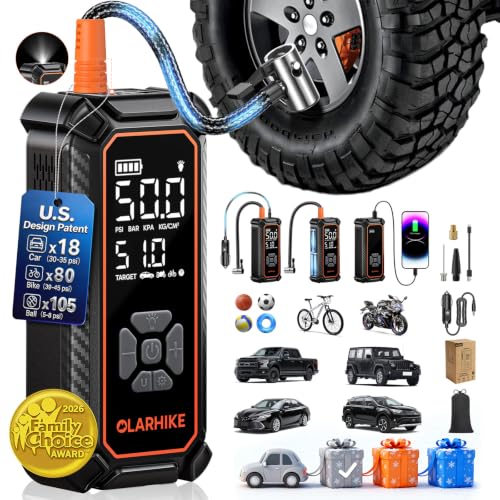
OlarHike Portable Tire Inflator Air Compressor
The OlarHike Portable Tire Inflator combines dual-power versatility via a 12V DC vehicle plug or built-in rechargeable battery with an automatic shut-off digital display. It provides dependable roadside tire top-offs and inflation for passenger cars, crossovers, motorcycles, and bicycles.
Pros
- Dual-power design allows cordless field operation or continuous power through any standard vehicle 12V DC port
- Automatic shut-off technology stops the motor precisely at preset pressure to prevent over-inflation
- Integrated 6000mAh battery reserve doubles as an emergency phone charger and includes an LED work light
- Pocket-sized footprint weighs well under two pounds for convenient transport in center consoles or backpacks
Cons
- Maximum vehicle pressure rating of 51 PSI is not suitable for heavy-duty commercial trucks, RVs, or high-pressure trailer tires
- Compact tankless inflator mechanism cannot power workshop pneumatic tools such as nail guns or air ratchets
- Recharging requires a standard 5V 2A or 5V 3A adapter and is not compatible with high-wattage fast chargers
GSPSCN 12V Portable Tire Inflator
The GSPSCN 12V Heavy Duty Tire Inflator delivers a robust 70 L/min airflow with its direct-drive dual-cylinder metal pump and 150 PSI maximum pressure rating. Built for pickup trucks, SUVs, and trailer owners, it operates at a manageable 70 dB and includes battery clamps for reliable 12V direct connection.
Pros
- Fast 70 L/min air volume output powered by a dual-cylinder direct-drive metal pump mechanism
- Generous 23-foot total working reach across the 11.5-foot 12V power cord and 11.5-foot air hose
- Direct battery clamps deliver dependable 12V DC power without risking internal vehicle fuse blowouts
- Remarkably manageable 70 dB sound level compared to standard high-pitch emergency tire pumps
Cons
- Requires direct 12V car battery terminal connection, which necessitates opening the vehicle hood
- Lacks an integrated air storage tank, so it is strictly intended for direct inflation rather than air tools
- No built-in digital automatic shutoff target pressure stop, requiring manual gauge monitoring
Metabo HPT 6-Gallon Pancake Air Compressor Review
The Metabo HPT EC711S is a portable 6-gallon pancake air compressor delivering 2.8 CFM at 90 PSI with a 165 PSI tank ceiling and an operating sound level of 73 dB. With its quick 46-second recovery cycle and dual quick couplers, it is an excellent choice for finish carpenters, punch-list contractors, and DIYers running pneumatic nailers.
Pros
- 73 dB operational sound rating is substantially quieter than standard job-site pancake units
- 165 PSI maximum pressure provides ample air storage with a swift 46-second recovery cycle
- Two 1/4-inch universal quick couplers support multi-tool setups right out of the box
- Sturdy steel roll cage protects gauges and the manifold assembly against knocks and drops
- Oil-free 1.0 HP motor ensures low maintenance and reliable cold-weather motor startup
Cons
- At 38.5 lbs, it is slightly heavier than ultra-compact 1-to-3-gallon trim compressors
- Airflow of 2.8 CFM at 90 PSI is designed for intermittent fastening, not continuous rotary tools or paint sprayers
- Bare-tool configuration means air hoses and pneumatic fastening tools must be purchased separately
VEVOR 2HP Oil-Free Air Compressor Motor
Delivering 5.2 CFM at 90 PSI with a 1680 RPM motor, this oil-free VEVOR pump head provides clean, low-maintenance air output for garage shops and pneumatic tools. Its cold-rolled steel build and dedicated cooling fans make it a dependable drop-in motor for woodworking, spray painting, and automotive repairs.
Pros
- Low-maintenance oil-free operation
- Generates 5.2 CFM at 90 PSI
- Sturdy steel and aluminum construction
- Effective cooling via built-in fans and heat sinks
Cons
- Heavier unit at over 36 pounds to install
- Single-stage design limits peak pressure to 145 PSI
- At 78 dB, operating volume is still noticeable indoors
Klutch 20-Gallon Portable Air Compressor
Featuring a 2.0 HP 120V motor and a 20-gallon tank, the Klutch portable air compressor delivers a rated 4.2 SCFM at 90 PSI for versatile workshop air. Its oil-free pump and wheeled design make it a dependable choice for garage mechanics, woodworkers, and serious DIYers needing steady air storage.
Pros
- Generous 20-gallon air storage capacity provides a substantial buffer for intermittent shop tools
- Delivers a listed 4.2 SCFM at 90 PSI, outperforming smaller pancake compressors for workshop chores
- Oil-free pump design eliminates messy oil changes and allows clean, upright transport
- Rugged rubber wheels and built-in ergonomic handle make moving the 90-pound frame manageable
- Integrated thermal overload protection helps prevent motor burnout during demanding cycles
Cons
- Substantial 90-pound weight makes lifting into truck beds or carrying up stairs difficult without assistance
- Oil-free motor configurations generally produce noticeable operating noise compared to low-RPM lubricated units
- At 4.2 SCFM at 90 PSI, high-draw continuous air tools like sanders or grinders will require recovery pauses
UUP 150 PSI Dual Cylinder Air Compressor
Built with dual cylinders and a 70L/min flow rate, this portable 12V inflator delivers fast tire fills for trucks, SUVs, and outdoor inflatables. Its integrated LED light and included battery clamps make roadside top-offs straightforward.
Pros
- High 70L/min airflow for rapid inflation
- Capable of reaching up to 150 PSI
- Built-in emergency LED work light
- Includes comprehensive adapter kit and storage bag
Cons
- Weighs over 6.6 pounds
- Requires direct car battery connection with clamps
VEVOR 15-Gallon 2HP Air Compressor
Equipped with a 2HP oil-free motor delivering 5.3 CFM at 90 PSI, this 15-gallon unit provides ample air flow for auto repair and workshop air tools. Integrated silencers maintain a manageable 78 dB sound level, while the multi-layer steel tank ensures structural durability.
Pros
- Solid 5.3 CFM air delivery at 90 PSI
- Relatively quiet 78 dB operation with integrated mufflers
- Low-maintenance oil-free pump mechanism
- Heavy-duty three-layer steel tank construction
- Integrated thermal overload and pressure protection
Cons
- Heavy build weighing over 81 pounds
- Maximum pressure capped at 125 PSI
- Substantial footprint requires dedicated storage space
Greteefor 5800 PSI Portable PCP Air Compressor
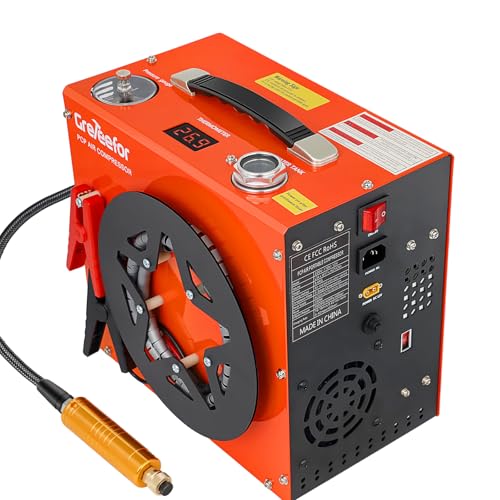
Delivering up to 5800 PSI with combined water and air cooling, this portable compressor serves airgun and paintball enthusiasts across home setups and remote shooting ranges. Integrated dual-voltage power and auto-stop gauges provide dependable control for cylinders up to 1.2 liters.
Pros
- High 5800 PSI maximum pressure capacity
- Dual cooling supports longer continuous operation
- Flexible 12V DC and 110V AC power options
- Automatic shut-off and thermal safety controls
Cons
- Recommended only for small tanks up to 1.2 liters
- Weighs 20 pounds, adding heft during transport
- Requires careful manual valve bleeding after each fill
The Engineering Principles of High Pressure Air Compression
Generating pressurized air relies on fundamental principles of fluid dynamics where mechanical power forces atmospheric gas into an increasingly restricted volume. When the available physical space shrinks, gas molecules collide more frequently against the container walls, producing an increase in internal force measured as pressure. Exploring the internal mechanical process clarifies how modern workshop compressors, portable tire pumps, and specialized high-pressure air systems generate usable pneumatic power.
Atmospheric Intake and Mechanical Displacement
Every pneumatic cycle begins by pulling ambient air through a filtration assembly into the compression chamber. Atmospheric air contains microscopic particulates and ambient moisture that must pass through an intake filter before contacting internal cylinders. The intake stroke occurs when the piston moves downward or away from the cylinder head, creating a localized pressure drop inside the chamber. This partial vacuum allows atmospheric pressure to push open the intake reed valve, filling the cylinder with ambient air before the compression stroke begins.
Mechanical displacement occurs as an electric motor or engine drives a crankshaft and connecting rod assembly. In direct-drive setups, such as dual-cylinder portable pumps from brands like GSPSCN or UUP, two pistons operate simultaneously to double the intake volume without requiring high rotating speeds. As the piston reverses direction and travels toward top dead center, the intake valve snaps shut against its seat under rising internal pressure. Trapped within the sealed cylinder, the air volume decreases steadily while the internal air density climbs.
Single-Stage Versus Multi-Stage Compression Mechanics
Single-stage air compressors execute the entire pressure rise within a single stroke of one or more cylinders. In standard workshop units like the Goodyear pancake compressor or the Metabo HPT 6-gallon model, air compresses from atmospheric pressure directly to its maximum rating of 150 to 165 PSI. While single-stage designs provide excellent efficiency for light framing, tire inflation, and trim carpentry, single-stage compression encounters physical limits when pressure demands exceed roughly 175 PSI. As compression ratios rise within a single cylinder, internal heat increases dramatically while volumetric efficiency drops.
Multi-stage compressors overcome these physical limits by dividing the compression workload across two or more sequentially linked cylinders. The first-stage cylinder features a larger diameter that compresses ambient air to an intermediate pressure level before discharging it into a transfer tube. That intermediate air then travels into a secondary cylinder with a smaller bore, where a second piston compresses the dense gas to its final working pressure. This staged approach allows industrial units and high-pressure setups to achieve higher pressures while minimizing mechanical strain on individual components.
Extreme high-pressure systems, such as the Greteefor PCP compressor designed for pre-charged pneumatic air rifles and cylinders, take staging and displacement to specialized extremes. These units compress air up to 5800 PSI (40 MPa) using multi-stage pump heads powered by compact electric motors. Because compressing air to thousands of pounds per square inch produces massive thermal energy, specialized high-pressure equipment incorporates active cooling systems and reinforced stainless-steel braided lines. Managing such extreme pressure levels requires tight tolerances and specialized sealing materials that far exceed standard garage compressor requirements.
Thermal Management and Heat Dissipation During Compression
Compressing a gas inevitably generates thermal energy due to the thermodynamic work performed on the molecules. When gas molecules are forced into close proximity, the kinetic energy of the system spikes, causing temperatures inside the cylinder to climb rapidly. Without adequate cooling, excessive heat can degrade valve seals, break down lubrication, and cause thermal shutdown in electric drive motors. Managing this heat represents one of the primary engineering challenges in high-pressure compressor design.
Air-cooled compressors rely on deep cooling fins cast directly into the aluminum or cast-iron cylinder head and pump body. Large cooling fan blades attached to the motor shaft direct a steady stream of ambient air across these fins to dissipate heat into the surrounding environment. In ultra-high-pressure applications like PCP pumps, air cooling alone is often insufficient for extended runtimes. Units like the Greteefor high-pressure pump utilize hybrid systems combining forced airflow with water cooling jackets to maintain safe operating temperatures below critical thresholds during continuous filling cycles.
Proper thermal regulation protects the pump components from premature mechanical fatigue. High operating temperatures can warp delicate reed valves and degrade the low-friction coatings used on oil-free piston rings. When thermal limits are exceeded, electric motors equipped with thermal overload protection switches will automatically cut power to prevent winding damage. Allowing adequate cool-down periods between duty cycles preserves internal tolerances and ensures consistent volumetric air output over years of operation.
Flow Control: Check Valves, Unloader Valves, and Pressure Switches
Pressurized air exiting the pump head must flow into the storage reservoir without leaking backward when the motor stops. A one-way check valve installed at the tank inlet port permits air to enter the tank during compression strokes while sealing tightly against internal tank pressure. If this check valve fails to seal completely, pressurized air leaks backward into the pump head, creating severe starting resistance for the electric motor during subsequent startup cycles.
The unloader valve works in tandem with the check valve to release residual air trapped in the discharge line between the pump head and the tank. When the motor shuts off, the unloader valve opens briefly, emitting a sharp hiss as it vents trapped head pressure to the atmosphere. Removing this trapped pressure ensures the motor can start against zero head resistance during the next cycle. Without a functioning unloader valve, the motor faces immense resistance and will likely draw excessive inrush current, tripping household circuit breakers upon startup.
Electromechanical pressure switches automate the cycling of the entire compressor system. The switch monitors internal tank pressure through an internal diaphragm connected to electrical contacts. When tank pressure drops below the cut-in threshold, typically around 90 to 120 PSI depending on the model, the switch closes electrical contacts to engage the motor. Once the tank reaches its maximum cut-out pressure, such as 125 PSI on a VEVOR 15-gallon unit or 165 PSI on a Metabo HPT model, the diaphragm forces the contacts open, safely interrupting power to the motor.
Storage Buffering, Regulators, and Pneumatic Energy Delivery
An air tank serves as a vital storage buffer that separates intermittent pump production from fluctuating tool consumption. In stationary and shop models like the Klutch 20-gallon or VEVOR 15-gallon compressors, the large steel reservoir stores a substantial volume of potential pneumatic energy. This buffer allows users to run air-hungry tools without forcing the electric motor to run constantly. Smaller pancake tanks, such as 6-gallon models, prioritize portability over storage volume, making them better suited for intermittent fastening tasks rather than continuous air delivery.
Delivering stored air safely to pneumatic tools requires an adjustable pressure regulator. While the storage tank might hold air at 150 PSI, most pneumatic tools operate best between 70 and 90 PSI. The regulator uses an internal spring and diaphragm mechanism to reduce tank pressure down to the desired line pressure displayed on the working pressure gauge. Dual-gauge manifolds allow operators to monitor total tank reserve on one gauge while checking regulated tool pressure on the other.
Internal moisture condensation is an unavoidable byproduct of compressing ambient humidity. As hot, pressurized air cools inside the steel storage vessel, water vapor condenses into liquid water that pools at the bottom of the tank. If left unmanaged, this pooled moisture causes internal corrosion and discharges water droplets through downstream air hoses into spray guns and pneumatic tools. Implementing the proper procedure to drain an air compressor after every work session purges accumulated liquid and prevents structural rust damage to the pressure vessel.
Oil-Free Versus Oil-Lubricated Compression Pumps
The internal lubrication design strongly influences pump lifespan, maintenance needs, and air purity. Modern consumer and portable jobsite compressors, including units from Goodyear, DEWALT, and Metabo HPT, frequently use oil-free pump mechanisms. These designs replace liquid lubricant with self-lubricating PTFE (polytetrafluoroethylene) piston rings sliding against precision-machined aluminum or steel cylinder sleeves. Oil-free pumps eliminate the risk of oil mist contaminating air lines, making them popular for trim carpentry and clean garage tasks.
Industrial workshops and heavy-duty automotive repair shops often prefer oil-lubricated cast-iron pump assemblies for continuous workloads. Oil-lubricated pumps feature an oil reservoir in the crankcase where splash pins or dipsticks distribute lubricant across crankshaft bearings, connecting rods, and cylinder walls during rotation. The lubricating oil forms a protective film that reduces friction, transfers heat away from internal friction points, and seals micro-gaps around piston rings. Following a detailed lubricating compressor pump oil guide ensures the pump uses proper non-detergent oil that will not foam or leave carbon deposits on valve plates.
Choosing between oil-free and oil-lubricated pumps involves weighing convenience against duty-cycle durability. Oil-free pumps require zero oil checks and start easily in sub-freezing temperatures without sluggish oil drag. However, oil-free piston rings experience higher wear rates under continuous commercial use compared to oil-lubricated cast-iron cylinders. For occasional DIY tasks, tire inflation, or portable jobsite trim work, oil-free designs offer reliable performance with virtually zero routine pump maintenance.
Operational Safety, Relief Valves, and Pressure Vessel Integrity
Storing air under high pressure represents a substantial amount of potential energy that requires rigorous safety safeguards. Every certified air tank features an ASME-compliant safety relief valve installed directly onto the tank manifold. This spring-loaded valve is calibrated to pop open automatically if the primary pressure switch fails to shut off the motor and tank pressure exceeds safe design limits. Manually pulling the safety relief valve ring periodically verifies that the internal spring and seat move freely without seizing.
Electric motor protection is equally critical to prevent electrical fire hazards and motor burnout. Heavy starting loads, low line voltage from undersized extension cords, or continuous operation can cause motor windings to overheat. Most modern compressor motors incorporate a thermal overload protector that trips automatically when internal temperatures exceed safe thresholds. If a compressor trips its thermal reset switch, allowing the unit to cool thoroughly before pressing the reset button prevents permanent winding degradation.
Safe operating protocols require releasing all stored pressure before transporting, servicing, or storing pneumatic equipment. Never attempt to disconnect fittings, service unloader lines, or remove tank plugs while the system contains residual pressure. For ultra-high-pressure PCP equipment operating at thousands of PSI, opening the bleed valve slowly after closing the cylinder valve is essential to depressurize the whip line safely. Practicing methodical pressure release ensures long-term operational safety and prevents accidental component failure.
Practical Verification and Compressor Diagnostics
Assessing the mechanical health of an air compressor involves monitoring its cycle times and operating behavior. A healthy compressor should fill its storage tank within manufacturer baseline times without stalling or emitting abnormal metallic knocking sounds. If a compressor takes substantially longer to recover pressure between tool cycles, worn piston seals or leaking reed valves may be allowing air to bypass the compression chamber. Inspecting intake air filters for dust accumulation is the first diagnostic step, as restricted airflow severely reduces pump delivery.
External air leaks also degrade compressor efficiency and force the pump to cycle unnecessarily. Inspecting tank weld bungs, regulator fittings, and quick-connect couplers with a soapy water solution reveals escaping air through bubbling bubbles. If the unloader valve hisses continuously after the motor has shut off, the tank check valve is likely stuck open, allowing stored air to escape backward through the unloader port. Cleaning or replacing a fouled check valve restores proper system sealing and eliminates continuous pressure loss.
Understanding compression mechanics empowers equipment owners to select, maintain, and troubleshoot pneumatic systems effectively. Whether dealing with a compact 12V inflator, a 6-gallon portable jobsite unit, a 20-gallon workshop workhorse, or a 5800 PSI multi-stage PCP pump, the underlying physical principles remain constant. Matching compression capacity, cooling capability, and air storage to your specific pneumatic tools ensures dependable power delivery and extended equipment service life across all workshop projects.
About the author
Tony Carrick is an experienced product researcher and writer specializing in tools, home improvement, automotive maintenance, and consumer equipment. With extensive experience reviewing tools and tackling hands-on renovation projects, he brings a buyer-focused perspective to compressor performance, usability, and overall value.