
How Are Portable Air Compressors Powered
How are portable air compressors powered? Compare battery, vehicle, and outlet options for practical tire inflation in November 2026.
 By Tom Scalisi
Updated November 22, 2026


A compressor that runs from a vehicle outlet may suit roadside tire top-ups, while a rechargeable model can work without a cord nearby. The answer to how are portable air compressors powered depends on the unit: common portable tire inflators use a built-in rechargeable battery, a 12V DC vehicle outlet, a household AC outlet, or a combination of these sources. Larger portable shop compressors can use a household outlet, cordless tool batteries, or, in some designs, a gas engine, but those are different types of equipment from the compact inflators featured here.
Power source affects where you can inflate, how you prepare before a trip, and whether you need to keep a battery charged. The product information here includes cordless, 12V DC, USB-rechargeable, and AC/DC dual-power options. It does not provide comparable battery runtimes or air delivery figures for every model, so check the intended task and manufacturer instructions rather than treating maximum PSI as a measure of speed or capacity. For a vehicle-mounted alternative, see our guide to on-board compressor setups.
Top Products
| Award | Product | ACR Score About ACR ScoreThe ACR Score is our own rating from 0 to 10, based on performance, design and build, ease of use, and value. It reflects independent research and is never influenced by manufacturers, retailers, or affiliate commissions. Learn more › | |
|---|---|---|---|
| Best Overall |
WELLBALLER 20V Cordless Tire Inflator 150 PSI
|
9.1/10 | Buy |
| Best Value |
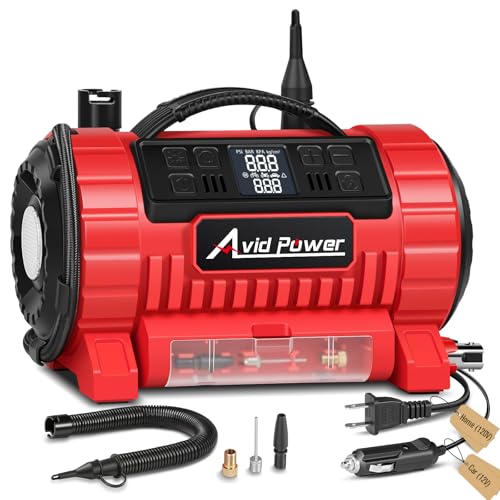 AVID POWER 110V/12V Portable Tire Inflator |
9.1/10 | Buy |
| Best Premium |
 DEWALT Cordless Tire Inflator Portable Air |
9.1/10 | Buy |
 KANWITY 160 PSI Portable Tire Inflator |
8.9/10 | Buy | |
| Best Budget |
 Inzeetor 150 PSI Portable Tire Inflator 12V DC |
8.6/10 | Buy |
 AVID POWER 20V Cordless Tire Inflator |
8.6/10 | Buy | |
 AstroAI AIRUN H 12V DC Portable Air Compressor |
8.4/10 | Buy | |
 CARSUN Dual Power AC/DC Portable Tire Inflator |
8.3/10 | Buy | |
 Airmoto 120 PSI Portable Tire Inflator |
8.3/10 | Buy | |
 Coranex 21V 160 PSI Tire Inflator |
8.1/10 | Buy |
WELLBALLER 20V Cordless Tire Inflator 150 PSI
WELLBALLER equips this handheld inflator with a 25mm cylinder delivering 30L/min airflow up to 150 PSI. Fast USB-C recharging and intelligent auto shut-off make it a dependable companion for car tires, bicycles, and emergency roadside top-offs.
Pros
- Fast 30L/min airflow reaches up to 150 PSI
- Rapid one-hour USB-C fast charging
- Automatic shut-off prevents accidental over-inflation
- Multi-mode LED light aids nighttime roadside use
Cons
- 2000mAh battery capacity limits extended heavy use
- Lacks a 12V car socket power backup
AVID POWER 110V/12V Portable Tire Inflator
Running on both household AC and vehicle DC power, this versatile inflator tackles car tires, sports equipment, and large camping mattresses with equal ease. Its dedicated high-volume deflation mode and automatic shutoff make it an adaptable tool for garage maintenance and roadside emergencies.
Pros
- Dual-power support for garage and roadside use
- Fast inflation with reliable auto-shutoff functionality
- High-volume hose supports rapid mattress deflation
- Bright emergency LED assists nighttime repairs
Cons
- Lacks an internal battery for cordless operation
- Bulkier footprint requires dedicated trunk storage space
DEWALT Cordless Tire Inflator Portable Air
This compact DEWALT portable tire inflator delivers up to 150 PSI with smart auto shut-off, powered by an internal rechargeable battery or an included 10-foot 12V car plug. It provides an efficient, pocket-sized solution for vehicle owners, cyclists, and DIYers wanting rapid roadside top-offs without hauling a bulky tank compressor.
Pros
- True cordless freedom with an internal rechargeable battery plus a 10-foot 12V DC vehicle plug backup
- Accurate digital pressure gauge with 5 smart presets and automatic shut-off to eliminate overinflation
- Ultra-compact handheld design weighing just 0.63 kg for easy storage in glove boxes or saddlebags
- Integrated LED work light and emergency USB power bank functionality for travel safety
- Generous accessory bundle backed by a 3-year limited warranty
Cons
- Engineered exclusively for high-pressure inflation rather than operating pneumatic air tools or nailers
- Does not include a 120V AC residential wall outlet power adapter
- Compact tankless pump requires periodic cooling breaks during heavy multi-tire inflation runs
KANWITY 160 PSI Portable Tire Inflator
Delivering up to 160 PSI using either an internal 8000 mAh battery or 12V car power, this compact compressor is built for quick roadside tire top-offs. Its multi-mode digital interface, integrated emergency light, and mobile charging capability make it a practical tool for glove-box storage.
Pros
- Dual battery and 12V DC car power options
- Fast 30L/min inflation with auto shut-off
- Accurate digital gauge with four pressure units
- Includes emergency light and USB power bank
Cons
- Lacks support for standard household AC wall outlets
- Relatively heavy for a handheld tool at nearly 1.9 pounds
Inzeetor 150 PSI Portable Tire Inflator 12V DC
The Inzeetor 150 PSI Portable Tire Inflator is a lightweight 12V DC air compressor featuring digital auto shut-off and a durable zinc-alloy motor. Designed for rapid vehicle tire top-offs and sports gear, it offers dependable roadside utility for drivers and garage DIYers.
Pros
- Automatic digital shut-off eliminates manual monitoring and over-inflation risks
- Zinc-alloy motor allows continuous top-offs across four passenger tires without mandatory cooling breaks
- Weighs less than two pounds, making it effortless to stash in a trunk emergency kit
- Low-vibration chassis prevents the compressor from skittering across pavement during operation
- Comes equipped with versatile Presta and sports ball adapters alongside the standard Schrader chuck
Cons
- Requires a 12V DC vehicle cigarette lighter outlet and does not include a 120V AC wall plug
- The 1.97-foot air hose means the unit must sit on the ground or be held near the valve stem
- Engineered strictly for tire and recreation inflation rather than driving pneumatic workshop tools
AVID POWER 20V Cordless Tire Inflator
Designed for roadside emergencies and everyday top-ups, this versatile compressor runs on either a 20V rechargeable battery or a 12V car outlet. Its auto shut-off function and all-metal cylinder deliver reliable, controlled inflation for passenger vehicles, bikes, and sports gear.
Pros
- Flexible dual-power operation prevents dead-battery delays
- Accurate auto shut-off stops overinflation
- Durable all-metal cylinder construction
- Built-in LED work light aids nighttime use
- Comfortable rubberized grip and clear digital screen
Cons
- Not suitable for truck or trailer tires
- Cannot inflate high-volume items like paddleboards
- Requires cooling breaks after 10 to 15 minutes
AstroAI AIRUN H 12V DC Portable Air Compressor
The AstroAI AIRUN H is a compact 12V DC tire inflator delivering up to 35 L/min airflow with automatic shut-off and digital pressure presets. It is an ideal portable emergency compressor for drivers, commuters, and garage hobbyists seeking fast tire top-offs.
Pros
- Automatic shut-off stops pumping reliably once target PSI is reached
- High-airflow 120W motor provides rapid top-offs for daily driver tires
- Long 9.84-foot power cord reaches all passenger vehicle wheels with ease
- Bright built-in LED flashlight and backlit display assist during night repairs
- Lightweight 2.2-pound form factor stores neatly in glove boxes and trunks
Cons
- Requires a 12V DC vehicle outlet and does not include a 120V AC household plug
- Mandates a 10-minute cool-down interval after 15 minutes of continuous operation
- Not intended for high-volume inflatables like large pool floats or air mattresses
CARSUN Dual Power AC/DC Portable Tire Inflator
The CARSUN Dual Power Tire Inflator delivers up to 150 PSI of high-pressure air running from either a 110V household outlet or a 12V vehicle socket. With digital pressure presets, automatic shutoff, and a lightweight 2.1-pound frame, it is an ideal maintenance pump for passenger vehicles, bicycles, and household inflatables.
Pros
- Versatile dual-voltage operation works seamlessly in the home garage or on the road without requiring an external converter
- Accurate auto-shutoff mechanism protects tires from accidental over-pressurization during routine top-offs
- Compact 2.1-pound build packs away easily in car trunks, under vehicle seats, or on garage shelving
- Clear digital display allows fast switching across four standard pressure measurement units
Cons
- Requires a mandatory 10-minute cooldown period after every 15 minutes of continuous operation
- Manufacturer explicitly states it does not support heavy truck tires, tractor tires, or stand-up paddleboards (SUP)
- Tankless inflator design cannot run standard workshop pneumatic air tools like brad nailers or paint sprayers
Airmoto 120 PSI Portable Tire Inflator
Weighing just 1.2 pounds, this compact cordless compressor delivers up to 120 PSI with automatic shutoff for routine top-offs on cars, bikes, and sports gear. Its pocket-sized form factor stores neatly in a glove box, serving as a convenient roadside backup.
Pros
- Extremely compact and lightweight design
- Auto shut-off prevents accidental over-inflation
- Clear digital LCD display with real-time pressure reading
- Integrated LED light aids night roadside repairs
- Internal hose storage keeps accessories organized
Cons
- Not suitable for heavy-load tires or large inflatables
- Cold temperatures and large tires drain battery quickly
- Requires frequent recharging before heavy usage
Coranex 21V 160 PSI Tire Inflator
Equipped with both a removable 21V battery pack and a 12V car adapter, this portable compressor delivers up to 160 PSI for routine tire upkeep. Real-time pressure monitoring, automatic shut-off, and an included hard case make it a practical emergency kit for drivers.
Pros
- Flexible dual power options for garage and roadside use
- Automatic shut-off prevents over-inflation
- High maximum pressure output up to 160 PSI
- Clear digital screen with live pressure tracking
- Comes with a protective hard storage case
Cons
- Bulkier than compact pocket-sized inflators
- Requires proprietary charger for the 21V battery pack
How Power Sources Work in Portable Air Compressors
Portable air compressors get power from an electrical source or, for some larger equipment, a fuel-powered engine. The compact tire inflators covered here are electric: they draw energy from a rechargeable battery, a vehicle’s 12V accessory outlet, a household AC outlet, or more than one of those sources. That energy runs a motor, which drives the pump that compresses air. A model’s power connection tells you where it can operate, but it does not by itself establish how quickly it will inflate a particular tire.
The product descriptions identify several different arrangements. Some units have an onboard battery for cordless operation, while others plug into a car’s 12V outlet or a wall outlet. Dual-power models offer a choice between AC at home and DC in a vehicle, and some combine a rechargeable battery with a 12V backup cord. These are useful distinctions for planning a trip or home use, but they do not mean all models can run from every source.
Rechargeable batteries provide cord-free operation
A battery-powered inflator carries its energy source with it, so you can position it near a tire without routing a cable to a wall or vehicle outlet. The WELLBALLER listing describes a 20V battery and USB-C PD charging, while the Coranex listing specifies a removable 21V battery and an included 12V car power cord. Airmoto lists a built-in rechargeable battery, and the DEWALT inflator description combines a rechargeable battery with a USB charging connection and a 12V vehicle plug.
These product details help identify the charging and backup arrangements, but battery voltage alone is not a reliable way to compare runtime. Capacity, tire size, starting pressure, target pressure, temperature, and the inflator’s operating limits all affect how much work a charge can support. The Airmoto listing specifically notes that cold conditions can reduce battery efficiency and recommends fully charging before use. A sensible owner checks charge status before a trip and follows the manual’s directions for charging, storage, and cooling.
Cordless operation is convenient, but it creates a preparation task: the battery must be charged and available when needed. A removable pack can be convenient if the product supports a spare or replacement battery, but the listing alone does not establish how many tires a charge will handle. Do not assume a battery-powered inflator is suitable for repeated large-volume work or heavy-duty tires just because its maximum pressure appears high. Confirm the manufacturer’s stated use limits for the specific tire and inflation task.
Vehicle 12V power uses the car’s electrical system
A 12V DC inflator connects to a vehicle accessory outlet, often called a cigarette-lighter socket. The AstroAI AIRUN H and the inzeetor model are listed with vehicle cords, and the AVID POWER cordless model includes a 12V DC adapter as an alternative to its battery. A corded connection can be useful when the internal battery is depleted, provided the vehicle outlet and inflator are compatible and the cord reaches the tire without strain.
Check the instructions for the required outlet, fuse, and vehicle operating conditions before connecting an inflator. Product descriptions may specify a fuse or cord length, but that does not establish compatibility with every vehicle or accessory outlet. Keep the cord clear of moving parts, hot components, and trip hazards. If an outlet’s rating or condition is uncertain, consult the vehicle manual rather than bypassing a fuse or changing the electrical connection.
A 12V accessory plug is not interchangeable with a direct battery-clamp connection. The products covered here describe accessory-plug connections, not high-output clamp leads, so do not infer that they can be connected directly to a vehicle battery. This distinction matters for larger off-road and RV tire systems, which may use different equipment and electrical connections. Use an inflator only as directed for its specified power input.
AC power suits a household outlet
An AC-powered inflator plugs into a household outlet, allowing use at home without relying on the vehicle or a charged battery. The AVID POWER dual-power listing specifies 110V AC and 12V DC, while the CARSUN description lists a 110V/120V wall connection alongside a 12V vehicle plug. This arrangement can reduce the need to choose between garage convenience and roadside portability, although the AC cord still ties the unit to an outlet while operating.
Read the model’s electrical instructions to confirm the outlet requirements and intended operating environment. The existence of an AC plug does not mean an inflator is a full-size shop compressor or suitable for every pneumatic tool. These products are presented primarily for tires and smaller inflatables, and several listings explicitly exclude large-volume items or heavy-duty tires. Use an appropriately rated compressor for air tools or jobs that require sustained airflow.
Some dual-power products include separate AC and DC cords, while others rely on a battery and a vehicle connection rather than household AC. Check what is actually included before purchase, and identify the source you expect to use most often. A corded unit is a poor match for a location without a suitable outlet unless it also has a supported alternative power mode. Likewise, a battery unit is not ready for cordless use if its pack is flat and no compatible backup is available.
Power Source Is Not the Same as Inflation Capability
Power describes how the motor receives energy; pressure and airflow describe what the pump can deliver. A maximum PSI figure is a pressure ceiling, not a promise that the inflator will rapidly fill every tire or run continuously. The listings include maximum-pressure figures for several models, but they do not supply standardized airflow data for all products. That missing information makes it unwise to rank the inflators by pressure alone.
For vehicle tires, follow the pressure recommendation for the vehicle and tire rather than inflating to the maximum printed on an inflator. Set a target using the vehicle’s specified cold tire pressure and verify it with a reliable gauge where appropriate. Preset modes and automatic shutoff can help simplify operation, but the target still needs to be correct. Check the inflator manual to understand how it measures pressure and how to use its display.
Match the inflator to the job, not just its voltage
A compact tire inflator is intended for pressure top-ups and similar tasks, not automatically for high-volume equipment. Several listings name cars, motorcycles, bicycles, and sports balls as intended uses. The AVID POWER AC/DC description adds small inflatables and a separate high-volume hose, while also distinguishing those tasks from tire inflation. Airmoto and AstroAI warn against using their products for large items such as air mattresses or paddleboards.
That difference reflects the distinction between pressure and volume. A ball or tire needs air delivered to a target pressure, while a large inflatable may need a substantial volume of air at relatively low pressure. A product that can reach a high pressure may still be unsuitable for quickly filling a large item. Read the listed use cases and exclusions closely instead of extrapolating from a PSI number.
These handheld inflators should not be treated as substitutes for a tank-style compressor used to power pneumatic tools. Nailers, sanders, and sprayers have air-consumption requirements that are not addressed by the supplied descriptions for these tire inflators. A buyer looking to run air tools should compare the tool’s required airflow with the compressor’s delivered SCFM at the relevant pressure, plus tank size and duty-cycle limits. The product details here do not provide those shop-compressor specifications.
Choosing Between Battery, 12V, and AC Operation
Start with where inflation is likely to happen. A driver who wants a compact emergency option may value an onboard battery or a vehicle cord, while someone who will mostly use an inflator in a garage may appreciate AC power. A dual-power arrangement can cover more locations, but only if the included connections match the intended use. The most useful option is the one you can reliably power when the tire needs attention.
For cordless use, check whether the battery is built in or removable, how it charges, and whether the package includes the charger and cable. The Coranex listing describes a removable battery, charger, and vehicle cord; other listings describe built-in rechargeable packs or USB charging. Those differences influence storage and charging habits. They do not establish a guaranteed runtime, so avoid assuming a stated voltage translates into a particular number of tires per charge.
For vehicle use, verify that the outlet type matches the inflator and that the cord can reach the tires in the intended parking position. The AstroAI listing describes a 12V plug, a fuse, and a cord length, while the AVID POWER cordless description also lists a 12V adapter. Those are product-specific details, not a general standard for every inflator. Keep any cable away from traffic and avoid using damaged cords or connectors.
For home use, confirm the AC voltage listed for the product and use a suitable outlet. The CARSUN description identifies AC and DC cords, and the AVID POWER listing names both 110V AC and 12V DC. If a product offers only battery and 12V modes, do not assume it can plug directly into a household outlet. A compatible charging adapter may charge a battery, but charging a battery is not the same as powering the compressor during inflation.
Using the Listed Power Options Carefully
Before inflating, inspect the power cable, connector, hose, and valve adapter for visible damage, then select the power method the manufacturer permits. Attach the correct valve connection and set the target pressure using the vehicle’s recommendation, not a guess. Keep the inflator stable and monitor the operation, even when an automatic shutoff feature is available. Auto shutoff is a useful control, but it does not remove the need to set the right target or follow the manual.
Some products offer preset modes for cars, motorcycles, bicycles, or balls, while others allow a custom target. Confirm the selected mode and pressure unit before starting because displays may use PSI, BAR, kPa, or another listed unit. If the reading or connection seems wrong, stop and check the setup instead of continuing to add air. Never exceed the tire’s applicable pressure limit.
Inflators can heat during operation, and several product descriptions specify cooling breaks or thermal protections. Follow the particular model’s duty and rest instructions rather than applying another product’s limits. Do not cover vents or use the unit beyond the listed task. If it shuts down, becomes unusually hot, or behaves abnormally, disconnect it safely and consult its manual before resuming.
For battery models, recharge using the supplied or specified equipment and store the unit according to its instructions. For 12V models, disconnect the plug after use and keep the cable organized. For AC/DC units, store both cords so the correct one is easy to identify later. These simple habits help ensure the power option you selected remains available, without implying a particular battery life or product lifespan.
What the Product Options Indicate
The AVID POWER Portable Tire Inflator Air Compressor is a clear example of a dual-source choice because its listing specifies both household AC and vehicle 12V DC power. That makes it a potential fit for someone who expects to inflate at home and on the road, subject to the stated uses and connections. The CARSUN AC/DC model also lists wall and vehicle power, plus adapters for several smaller inflation tasks. Neither description establishes suitability for truck, tractor, or other excluded tire categories.
For cordless flexibility with a backup, the listings for the 20V WELLBALLER and 21V Coranex describe battery operation and USB-C or vehicle-cord details respectively. The AVID POWER cordless model pairs a 20V battery with a 12V car adapter. Such combinations can help reduce dependence on one power source, but shoppers should verify exactly which battery, charger, and cord come in the package. Compatibility with a separate tool-brand battery platform should not be assumed unless the product specifically states it.
The DEWALT and Airmoto descriptions emphasize compact rechargeable operation and include charging details, while the AstroAI AIRUN H and inzeetor listings describe 12V vehicle-powered operation. Their power arrangements serve different preferences: a charged internal battery offers a cord-free setup, and a vehicle cord draws power from the car’s accessory outlet. Product descriptions also list features such as digital pressure displays, lights, and automatic shutoff, but these features do not replace checking the power source or the pressure target.
For a broader look at how compressor designs relate to work requirements, our article on compressor airflow for sustained air use discusses a different class of equipment. That distinction is useful because a handheld tire pump and a tank-style compressor solve different problems. A buyer should not select a tire inflator for continuous pneumatic-tool use based on convenience or a high maximum PSI rating. Match the equipment category to the required airflow, pressure, and operating duration.
In practical terms, choose a supported power source that matches where you’ll work, then confirm the model’s included cables, charging method, and intended inflation tasks. Battery, vehicle, and household power each provide a different kind of convenience, but none alone proves that an inflator can handle every tire or inflatable. Follow the product and vehicle instructions, and treat pressure limits and cooling guidance as essential parts of the decision.
About the author
Tom Scalisi brings more than two decades of experience in construction, building maintenance, contracting, and hands-on tool use. His practical understanding of power tools, automotive work, repairs, and jobsite equipment helps readers evaluate compressors based on real workloads rather than specifications alone.