
How an Air Compressor Works: A Practical Guide for 2026
Learn how an air compressor works, from atmospheric intake to regulated pneumatic tool power, in this October 2026 practical equipment guide.
 By Tom Scalisi
Updated October 8, 2026
By Tom Scalisi
Updated October 8, 2026

Pneumatic power equipment relies on stored mechanical pressure rather than direct electric drivetrains to drive fasteners, rotate impact sockets, and spray protective coatings. Understanding how an air compressor works reveals how everyday atmospheric air transforms into concentrated potential energy capable of running demanding workshop equipment. The mechanical cycle appears straightforward on the surface, but it depends on a synchronized interaction between intake filters, precision valves, drive assemblies, and automatic pressure controls.
Every stage of this mechanical compression process directly influences tool performance, recovery cycle speed, and electrical circuit stability. Modern compressors like compact trim units and high-pressure pancake tanks pack substantial airflow into portable frames by pairing oil-free pumps with automatic pressure switches. Examining airflow paths, valve functions, and receiver tank physics helps operators avoid sudden line pressure drops while extending the lifespan of their pneumatic tools. Proper system knowledge also simplifies routine maintenance routines, from draining condensation reservoirs to selecting the right hose diameter for specific pneumatic jobs.
| Award | Product | ACR Score About ACR ScoreThe ACR Score is our own rating from 0 to 10, based on performance, design and build, ease of use, and value. It reflects independent research and is never influenced by manufacturers, retailers, or affiliate commissions. Learn more › | |
|---|---|---|---|
| Best Overall |
RexLeLXB Cordless Air Compressor for Dewalt 20V
|
9.2/10 | Buy |
| Best Budget |
 WYNNsky 20-Piece 1/4-Inch Air Tool Kit
|
9.1/10 | Buy |
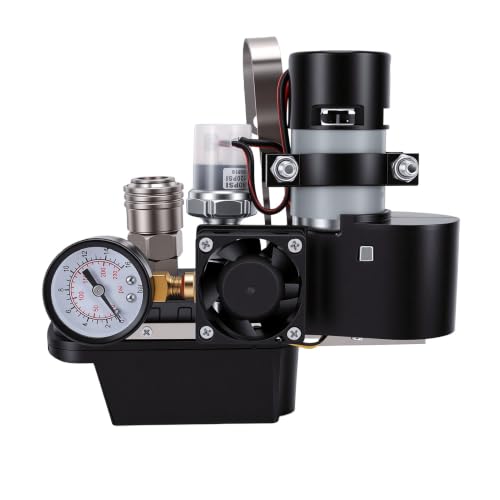
 QWORK Air Compressor Pressure Switch Manifold
|
8.6/10 | Buy | |
| Best Premium |
 Metabo HPT 6-Gallon Pancake Air Compressor Review
|
8.6/10 | Buy |
| Best Value |
 banapoy Cordless Nail Gun Air Compressor
|
8.4/10 | Buy |
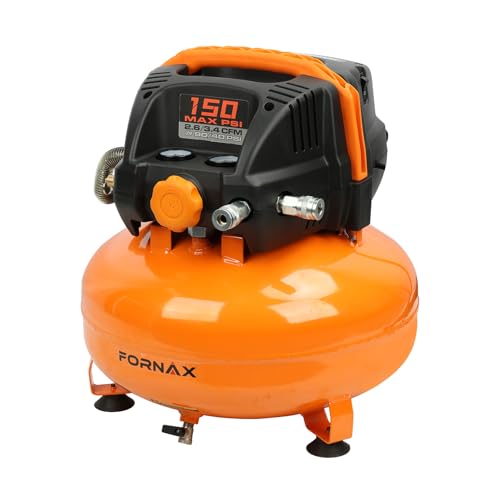 FORNAX 6-Gallon Pancake Air Compressor
|
8.4/10 | Buy | |
 DEWALT DWFP55130 2.5-Gallon 200 PSI Quiet Trim Air
|
8.4/10 | Buy | |
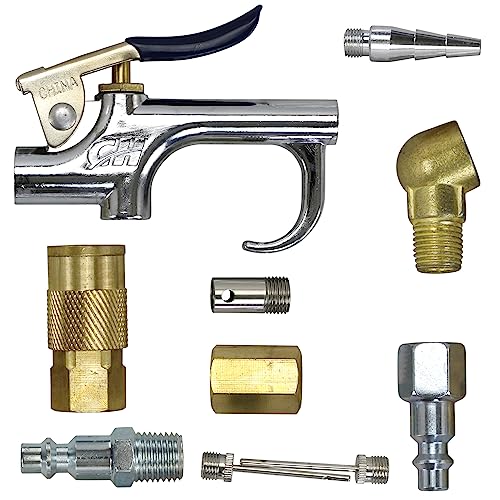 Harrier Hardware 11-Piece Air Compressor Starter
|
8.3/10 | Buy | |
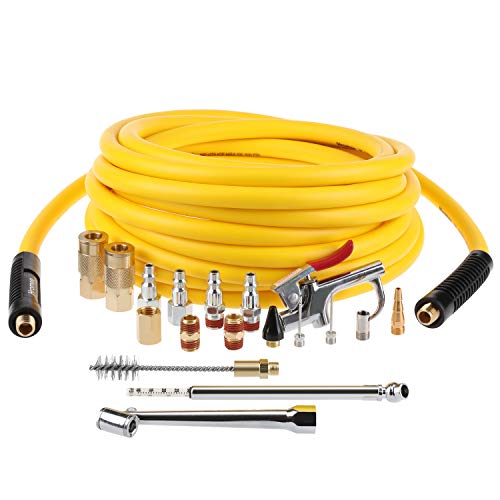 Hromee 19-Piece 25-Foot Air Compressor Kit
|
8.3/10 | Buy | |
 Metabo HPT EC914S 6-Gallon 200 PSI Pancake Air
|
8.3/10 | Buy |
RexLeLXB Cordless Air Compressor for Dewalt 20V
Powered by Dewalt 20V lithium-ion batteries, this ultra-portable 0.26-gallon cordless compressor features an oil-free pump operating at an unobtrusive 65 dB noise level. It is a practical, grab-and-go option for trim carpenters, DIYers, and mobile techs needing fast inflation or light fastening without extension cords.
Pros
- Cordless operation compatible with widely owned Dewalt 20V lithium-ion battery packs
- Quiet 65 dB operating noise level is ideal for occupied residences and indoor repair work
- Oil-free pump design requires zero crankcase oil changes and prevents messy jobsite spills
- Ultra-compact 0.26-gallon tank and lightweight build offer exceptional grab-and-go mobility
Cons
- Small 0.26-gallon tank capacity is unsuited for continuous air tools like sanders or impact wrenches
- Sold as a bare tool only, requiring separate purchase of compatible Dewalt 20V batteries and a charger
- Manufacturer does not publish explicit continuous SCFM ratings or maximum PSI thresholds
WYNNsky 20-Piece 1/4-Inch Air Tool Kit
This starter package bundles a 15-foot recoil hose, blow gun, and essential fittings into a compact carrying case. It provides the core accessories needed for basic tire inflation, surface dusting, and standard pneumatic tool hookups.
Pros
- Broad 20-piece assortment of standard pneumatic fittings
- Blow gun includes five swappable nozzle attachments
- Self-coiling hose design stores away neatly
- Dedicated case keeps all small adapters organized
Cons
- 120 PSI working limit excludes high-pressure pneumatic tools
- 15-foot hose length limits overall work radius
QWORK Air Compressor Pressure Switch Manifold
The QWORK Air Compressor Pressure Switch Manifold provides an integrated pressure switch, regulator, and dual gauges with a factory 90 to 120 PSI cycling range. It suits DIYers and shop owners looking to rebuild a compressor manifold, though American users must note its G1/4 BSP thread sizing requires adapters for standard NPT equipment.
Pros
- Factory-set 90 to 120 PSI cut-in and cut-out cycling provides stable air supply regulation
- Convenient pre-assembled manifold block integrates dual monitoring gauges and a pressure regulator
- Solid pressure tolerance capable of handling equipment setups up to 175 PSI maximum
- Reinforced ABS cover protects electrical switch contacts from shop dust and debris
Cons
- Features G1/4 BSP threaded ports, meaning standard 1/4-inch NPT American fittings will not thread directly without adapters
- Fittings are constructed from iron rather than solid brass, requiring careful sealing against moisture corrosion
- Adjustment instructions are minimal, requiring users to carefully verify cut-in and cut-out settings before operation
Metabo HPT 6-Gallon Pancake Air Compressor Review
The Metabo HPT EC711S is a portable 6-gallon pancake air compressor delivering 2.8 CFM at 90 PSI with a 165 PSI tank ceiling and an operating sound level of 73 dB. With its quick 46-second recovery cycle and dual quick couplers, it is an excellent choice for finish carpenters, punch-list contractors, and DIYers running pneumatic nailers.
Pros
- 73 dB operational sound rating is substantially quieter than standard job-site pancake units
- 165 PSI maximum pressure provides ample air storage with a swift 46-second recovery cycle
- Two 1/4-inch universal quick couplers support multi-tool setups right out of the box
- Sturdy steel roll cage protects gauges and the manifold assembly against knocks and drops
- Oil-free 1.0 HP motor ensures low maintenance and reliable cold-weather motor startup
Cons
- At 38.5 lbs, it is slightly heavier than ultra-compact 1-to-3-gallon trim compressors
- Airflow of 2.8 CFM at 90 PSI is designed for intermittent fastening, not continuous rotary tools or paint sprayers
- Bare-tool configuration means air hoses and pneumatic fastening tools must be purchased separately
banapoy Cordless Nail Gun Air Compressor
Designed for trim carpentry and cabinet assembly, this portable compressor runs pneumatic nailers without cumbersome tanks or long hoses. It provides a mobile air source for light-duty fasteners, though it requires users to supply their own battery and nail gun.
Pros
- Eliminates heavy air tanks and cumbersome air hoses
- Standard 1/4-inch nozzle fits common pneumatic nailers
- Consistent air output suited for fine finish woodworking
- Compact and highly portable for tight job-site spaces
Cons
- Battery and nail gun are sold separately
- Restricted to light-duty nailing and stapling
- Incompatible with high-demand tools like sprayers or inflators
FORNAX 6-Gallon Pancake Air Compressor
The FORNAX 6-Gallon Pancake Air Compressor delivers 2.6 CFM at 90 PSI and up to 150 PSI of maximum pressure, featuring dual couplers and a lightweight 28.8-pound portable footprint. It is a practical pneumatic power source for DIY homeowners, finish carpenters, and garage hobbyists driving nailers or managing tire inflation.
Pros
- Dual quick-connect couplers allow two nailers to operate simultaneously without adding an external splitter manifold
- Generous 6-gallon air tank capacity with a 150 PSI maximum pressure ceiling provides a dependable air reserve
- Lightweight 28.8-pound profile simplifies one-handed carrying up stairs and transport into work vans
- Maintenance-free oil-free pump eliminates oil checks, oil changes, and mess around finished work surfaces
Cons
- Operating sound output rated at 95 dBA is loud and makes hearing protection necessary, especially in closed rooms
- Airflow output of 2.6 CFM at 90 PSI cannot support continuous-demand tools like sanders, grinders, or paint sprayers
- Supplied as a bare-tool compressor without an included air hose, tire inflator chuck, or pneumatic nailers
DEWALT DWFP55130 2.5-Gallon 200 PSI Quiet Trim Air
The DEWALT DWFP55130 delivers a capable 3.0 SCFM at 90 PSI with a 200 max PSI 2.5-gallon tank, running at a quiet 71.5 dBA on an efficient 12-amp motor. It is an ideal pneumatic power source for trim carpenters, punch-list contractors, and DIYers working on residential circuits.
Pros
- Delivers 3.0 SCFM at 90 PSI with a high 200 max PSI ceiling for rapid pressure recovery during sequential fastening
- Quiet 71.5 dBA sound output makes indoor trim carpentry and remodeling far less disruptive to homeowners
- Low 12-amp draw reduces breaker trips when running on shared 15-amp household circuits
- Integrated roll cage and console protect critical components while supporting horizontal or vertical operation
- Dual quick couplers allow two trim carpenters to connect and work off a single compressor
Cons
- Bare-tool configuration means you must supply your own air hoses, couplers, and pneumatic nail guns
- At 36 pounds, it is heavier to haul up flights of stairs than ultra-compact 1-gallon finish compressors
- Air output of 3.0 SCFM is built for intermittent finish fastening and will not support continuous tools like rotary sanders or sprayers
Harrier Hardware 11-Piece Air Compressor Starter
The Harrier Hardware 11-piece air compressor accessory kit provides essential pneumatic connections including a blow gun, tire chuck, and standard 1/4-inch NPT fittings. It is a practical starter set for garage DIYers and homeowners looking to handle basic inflation and shop cleanup tasks.
Pros
- Comprehensive 11-piece starter bundle covers basic inflation and workbench cleanup needs.
- Standard 1/4-inch NPT fitting compatibility connects easily with common workshop air hoses.
- Dedicated plastic storage container prevents losing small needles, inflator tips, and fittings.
- Cost-effective entry option for homeowners setting up a newly purchased air compressor.
Cons
- Supplies only one coupler and plug set, requiring extra fittings for multi-tool setups.
- Thread sealant or PTFE tape is not pre-applied and must be added to ensure leak-free connections.
- Designed for light DIY and garage duties rather than high-demand industrial production.
Hromee 19-Piece 25-Foot Air Compressor Kit
This starter bundle equips home workshops with essential inflation, cleaning, and connection attachments centered around a flexible 25-foot hybrid air hose. It offers rust-resistant brass fittings and versatile nozzles suited for everyday pneumatic tasks and basic tire maintenance.
Pros
- Flexible hybrid hose resists kinking and coils easily
- Durable brass couplers resist rust better than steel
- Includes specialized wire brush for bore cleaning
- Rubber tip nozzle protects delicate surfaces from scratches
Cons
- 25-foot hose length limits reach in larger workspaces
- Pencil tire gauge caps at 50 PSI maximum
Metabo HPT EC914S 6-Gallon 200 PSI Pancake Air
The Metabo HPT EC914S delivers an impressive 200 PSI maximum pressure and 4 CFM at 90 PSI from a 6-gallon tank, giving trim carpenters and remodelers the air volume needed to drive multiple nailers simultaneously. At roughly 41 pounds, it successfully combines high-pressure air storage with practical job-site portability.
Pros
- High 200 PSI tank ceiling stores substantially more usable air than conventional 150 PSI pancake models
- Generous 4 CFM at 90 PSI airflow rating supports multi-tool operation and reduces nailer drive hesitation
- Manageable 41-pound carry weight offers better portability than heavier twin-stack compressor configurations
- Engineered by Metabo HPT to support both lightweight trim nailers and larger framing or roofing guns
Cons
- At 41 pounds, it is noticeably heavier to carry than minimalist 1-to-3 gallon trim-only compressors
- Tank volume and CFM output remain inadequate for continuous high-demand air tools like HVLP sprayers or sanders
- Ships as a bare-tool compressor without included air hoses, pneumatic fittings, or nail guns
The Mechanics and Physics of Pneumatic Air Compression
Pneumatic systems operate on a clear physical foundation: surrounding ambient air can be captured, mechanically reduced in volume, and stored under pressure to yield reliable kinetic energy on demand. An air compressor does not create new energy, but instead converts electrical current or battery power into pressurized pneumatic force. Tracing the mechanical path that air follows from the surrounding atmosphere into a storage tank clarifies why different pump designs excel at specific workshop tasks. Examining these internal mechanics also shows how pressure switches, safety valves, and storage tanks work together to deliver consistent line pressure.
The Thermodynamic Principles of Air Compression
The fundamental behavior of pressurized air traces back to basic gas laws, where decreasing the volume of a gas naturally increases its internal pressure. When an electric motor drives a piston inside a cylinder, it forces air molecules into a fraction of their original atmospheric space. This molecular crowding causes the molecules to collide rapidly, creating outward force against the cylinder walls and storage vessel. As the piston completes its stroke, the confined gas stores potential energy ready to drive pneumatic equipment. This physical relationship between volume and pressure forms the foundational principle behind all reciprocating compressor designs.
Compression also produces substantial thermal energy as a natural byproduct of rapid molecular compaction. The air exiting a compression chamber becomes hot, which temporarily elevates line pressure before the air cools down inside the storage vessel. As that compressed air cools to room temperature inside the tank, its internal pressure stabilizes while moisture separates from the gas and collects on the tank floor. Understanding this heat exchange explains why receiver tanks must handle both thermal shifts and liquid condensation.
Atmospheric Intake and Filtration Mechanics
The compression process starts at the intake port, where surrounding air enters the pump assembly. Ambient workshop air carries invisible contaminants like wood dust, airborne grit, and ambient humidity that can damage precision metal components. Quality air compressors place a replaceable foam or paper intake filter over the suction port to catch abrasive particles before they touch the cylinder. Without adequate filtration, airborne grit quickly scores cylinder walls and degrades valve plate seals. Intake housings often feature sound dampening chambers that reduce air suction noise during active intake strokes.
A clogged intake filter starves the pump of necessary air volume, which forces the motor to run longer to reach target tank pressure. Clean airflow through the filter ensures that the cylinder fills completely during the suction stroke without creating excessive vacuum resistance. Protecting the pump from airborne debris preserves the micro-finish on cylinder sleeves and prevents premature valve plate wear. Routine filter inspections ensure that the pump maintains its factory CFM delivery across extended projects.
Reciprocating Piston Motion and Cylinder Dynamics
Most portable and workshop compressors utilize a reciprocating piston mechanism driven by an electric motor and rotating crankshaft. As the crankshaft pulls the piston downward, internal cylinder volume expands and creates a localized vacuum. This pressure differential between the atmosphere and the cylinder pulls the intake valve open, allowing fresh air to fill the bore. The downward travel of the piston determines the total displacement volume of the pump on each revolution.
Once the piston passes bottom dead center, the connecting rod drives it upward toward the cylinder head. This upward stroke traps the air, rapidly decreasing chamber volume and escalating internal pressure. Piston seals made from specialized fluoropolymer compounds or cast iron rings prevent pressurized air from slipping past the piston skirt into the crankcase. Tight piston tolerances ensure that virtually all trapped air transfers directly into the discharge port without blow-by leakage. As pressure builds above the piston crown, the air is forced toward the cylinder head at peak compression.
Reed Valves and Directional Airflow Management
Directional airflow inside the pump head depends entirely on flexible spring-steel components called reed valves or flapper valves. The intake reed valve covers the intake port and flexes inward only when the descending piston creates cylinder vacuum. When the piston reverses direction and begins compressing the air, internal cylinder pressure forces the intake reed tightly against its machined seat to prevent backflow. This simple flexing action operates thousands of times per minute without mechanical linkages.
The discharge reed valve operates in opposite synchronization against the exhaust port of the valve plate. It remains sealed shut during the intake stroke to keep previously compressed air from rushing backward into the vacuum. Once upward piston pressure exceeds the pressure in the discharge line, the discharge reed flexes open, releasing high-pressure air into the pump head manifold. Valve fatigue or carbon accumulation can prevent these reeds from seating flat, leading to slow recovery times.
The In-Tank Check Valve and Backflow Prevention
Compressed air leaving the pump head travels down a copper or aluminum discharge tube directly toward the receiver tank. At the point where this line enters the tank, a dedicated one-way check valve controls entry. This spring-loaded brass valve allows pressurized air to enter the vessel easily during the pump compression stroke. The internal poppet shifts backward under pump pressure, granting clear passage into the main storage chamber. A heavy-duty internal spring ensures that the poppet reacts instantly whenever cylinder pressure fluctuates.
When the compressor motor turns off, internal spring tension and stored tank pressure force the check valve poppet firmly shut. This mechanical seal traps all stored pneumatic energy securely inside the tank reservoir. Without a functioning check valve, high-pressure tank air would immediately bleed backward through the pump head and escape through the intake filter. A leaking check valve often manifests as continuous air escaping through the unloader valve when the unit sits idle.
Receiver Tanks and Energy Storage Buffering
The steel or aluminum receiver tank functions as a mechanical energy reservoir, much like an electrical storage battery. Storing air under pressure allows operators to draw sudden bursts of airflow that exceed the instantaneous delivery output of the pump motor. Compressors with 6-gallon pancake tanks or 2.5-gallon trim tanks store significant air volume by maintaining high pressure thresholds up to 165 or 200 PSI. The structural tank walls feature certified welds designed to withstand continuous pressure cycling safely.
Higher storage pressure allows a compact tank to hold more mass of usable air than a lower-pressure tank of identical size. As pneumatic tools consume air, the tank pressure slowly declines until it triggers the cut-in switch. This buffer volume cushions the electric motor from starting and stopping every single time an operator squeezes a tool trigger. Without an air receiver, tools would experience severe pressure pulsations matching the individual strokes of the piston.
Pressure Switches and the Automated Cycling Loop
An electromechanical pressure switch monitors internal tank pressure to govern the motor operating cycle automatically. A flexible rubber diaphragm inside the switch housing remains exposed to tank pressure, pressing against calibrated mechanical springs. Controllers like the QWORK pressure switch assembly use standard pressure differentials to automate the equipment cycle between 90 and 120 PSI. This automated cycling guarantees that operators always have adequate line pressure without manual monitoring.
When tank pressure drops to the preset cut-in limit during tool operation, internal switch contacts snap shut to energize the motor. The pump then runs continuously until internal tank pressure rises enough to overcome the spring tension and reach the cut-out threshold. Reaching cut-out causes the electrical contacts to separate cleanly, cutting power to the motor until line consumption requires another cycle. Maintaining correct switch calibration protects the pump from overworking and prevents sudden tool pressure drops. This automated cycling allows workers to focus entirely on their pneumatic tasks rather than monitoring pressure gauges.
Unloader Valves and Cold Motor Startup Protection
Starting an electric motor against trapped head pressure requires massive electrical inrush current that often trips standard 15-amp household breakers. The unloader valve solves this electrical challenge by venting trapped air from the discharge tube whenever the motor stops. This small valve links mechanically to the pressure switch and opens the instant the electrical contacts separate. By venting head pressure, the unloader ensures that the motor encounters zero resistance upon its next startup. Without this pressure release, the motor would have to overcome high head resistance the instant electrical current engages.
The distinct hissing sound heard when a compressor shuts off signals the unloader valve releasing residual line pressure to the atmosphere. Because the tank check valve holds the stored air inside the vessel, only the short line between the pump head and check valve empties. When the motor restarts later, the piston spins freely without backpressure on the piston crown, reducing starting amperage spikes. A faulty unloader that fails to open leaves head pressure trapped, causing the motor to hum and stall.
Pressure Regulators and Tool Line Delivery
Pneumatic tools require precise, regulated air pressure rather than full raw tank pressure to operate safely and effectively. The pressure regulator uses an adjustable spring-loaded diaphragm to meter air passing from the tank into the tool hose. Operators turn the regulator knob to adjust working pressure while monitoring the regulated output gauge. Keeping tool pressure dialed to the exact manufacturer specification prevents internal seal damage and optimizes overall air consumption.
Air compressor manifolds often integrate dual quick-connect couplers, as seen on models from DEWALT and FORNAX. These dual outlets allow carpenters and mechanics to connect multiple nailers or accessories to a single air source without swapping hoses. Standard 1/4-inch NPT couplers found in kits from WYNNsky, Harrier Hardware, and Hromee deliver secure connections with minimal airflow resistance. High-quality brass or plated steel fittings prevent accidental disconnects and minimize line leakage during active tool use.
Oil-Free Versus Oil-Lubricated Pump Engineering
Air compressors utilize either oil-free or oil-lubricated pump assemblies depending on their intended operating environment. Oil-free designs, including models from Metabo HPT, DEWALT, and FORNAX, employ self-lubricating PTFE cylinder sleeves and permanently sealed bearings. These pumps require zero crankcase oil checks, start dependably in sub-freezing weather, and eliminate oil mist from sensitive painting lines. They also operate reliably on uneven ground or tilted roof decks where oil-lubricated pumps would suffer oil starvation.
Traditional oil-lubricated pumps feature cast-iron cylinders, splash-lubricated crankcases, and replaceable oil sumps. While oil-lubricated pumps demand regular oil inspections and routine fluid changes, they run cooler and support higher continuous duty cycles in stationary shop installations. Newer cordless platforms, such as RexLeLXB and banapoy models, rely on compact oil-free pumps to maximize portable battery efficiency. Selecting between pump styles depends on whether an operator values zero-maintenance jobsite portability or heavy stationary runtime.
Moisture Management, Air Delivery, and Safe Operation
Atmospheric air contains invisible moisture vapor that separates into liquid water during the compression cycle. As hot compressed air enters the cooler steel receiver tank, the water vapor condenses rapidly and pools on the tank floor. Leaving this liquid inside the vessel leads to internal metal corrosion and sends dirty water droplets through air hoses into pneumatic tools. Opening the bottom drain valve after each work session purges this standing water and protects the tank interior.
Balancing airflow volume with tool consumption is equally vital for uninterrupted performance. Tools operate on specific ratings of cubic feet per minute (CFM) at 90 PSI, where intermittent nailers need low CFM while continuous sanders require sustained volume. Operators should also inspect the ASME safety relief valve regularly to confirm over-pressure protection. Using longer 3/8-inch hoses rather than undersized extension cords further protects electric motors from damaging voltage drops. Pairing proper CFM capacity with dedicated moisture purging ensures that pneumatic equipment operates safely and reliably across years of workshop service.
About the author
Tom Scalisi brings more than two decades of experience in construction, building maintenance, contracting, and hands-on tool use. His practical understanding of power tools, automotive work, repairs, and jobsite equipment helps readers evaluate compressors based on real workloads rather than specifications alone.