
How Air Compressors Work: Complete Mechanics Guide for 2026
Learn how air compressors work, from intake compression to tank storage and tool airflow, in this practical equipment guide for October 2026.
 By Kenny Koehler
Updated October 8, 2026
By Kenny Koehler
Updated October 8, 2026

Compressed air powers everything from framing nailers on construction sites to paint sprayers in automotive workshops, yet the underlying transformation begins with basic ambient atmosphere. Understanding how air compressors work reveals why dynamic variables like cubic feet per minute, tank capacity, and operating pressure dictate actual tool performance. Every compression cycle draws outside air through an intake filter, forces gas molecules into a restricted volume, and transfers pressurized energy into a storage receiver. Without an efficient mechanical pump and dependable seals, pneumatic tools quickly starve for pressure during demanding workshop tasks.
Different applications require tailored mechanical designs, ranging from compact 12V digital inflators for roadside tire maintenance to heavy-duty dual-piston workshop units. Modern oil-free dual-cylinder configurations deliver clean, maintenance-free airflow while reducing operating sound levels down to around 66 to 71.5 dBA. Meanwhile, high-pressure 200 PSI tank reserves allow smaller units to store greater usable air volume without requiring massive physical footprints. Knowing how each component functions helps users diagnose pressure drops, prevent internal tank corrosion, and select the correct equipment for specific pneumatic workloads.
| Award | Product | ACR Score About ACR ScoreThe ACR Score is our own rating from 0 to 10, based on performance, design and build, ease of use, and value. It reflects independent research and is never influenced by manufacturers, retailers, or affiliate commissions. Learn more › | |
|---|---|---|---|
| Best Overall |
DEWALT Cordless Tire Inflator Portable Air
|
9.1/10 | Buy |
| Best Budget |
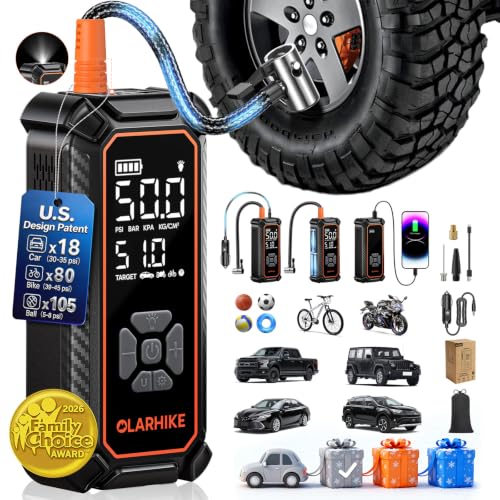 OlarHike Portable Tire Inflator Air Compressor
|
8.8/10 | Buy |
| Best Premium |
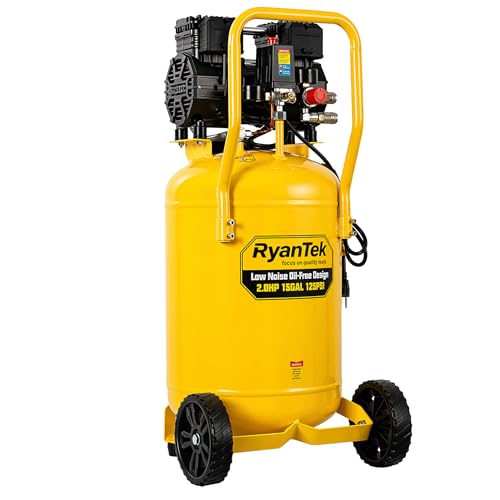 RyanTek 15-Gallon 2HP Air Compressor
|
8.6/10 | Buy |
 AstroAI AIRUN H 12V DC Portable Air Compressor
|
8.4/10 | Buy | |
| Best Value |
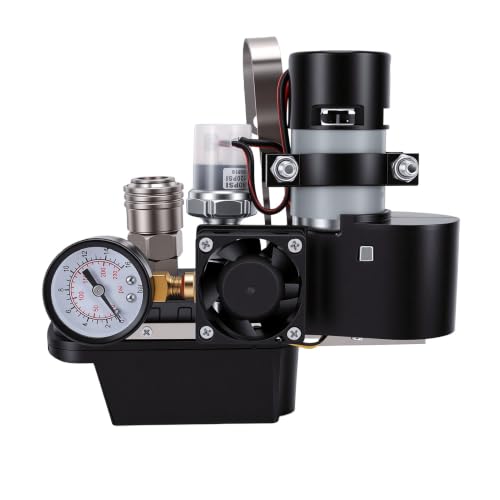 banapoy Cordless Nail Gun Air Compressor
|
8.4/10 | Buy |
 DEWALT DWFP55130 2.5-Gallon 200 PSI Quiet Trim Air
|
8.4/10 | Buy | |
 Metabo HPT EC914S 6-Gallon 200 PSI Pancake Air
|
8.3/10 | Buy | |
 Fogera 1-Gallon Cordless Air Compressor
|
8.3/10 | Buy | |
 LIVOWALNY 20V 160 PSI Cordless Tire Inflator
|
8.1/10 | Buy | |
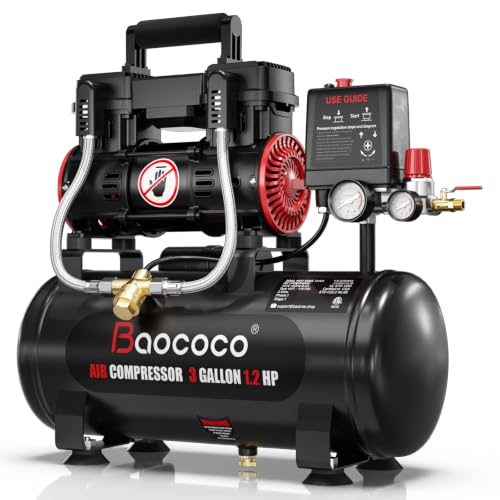 Baococo 3-Gallon Ultra Quiet Air Compressor
|
7.8/10 | Buy |
DEWALT Cordless Tire Inflator Portable Air
This compact DEWALT portable tire inflator delivers up to 150 PSI with smart auto shut-off, powered by an internal rechargeable battery or an included 10-foot 12V car plug. It provides an efficient, pocket-sized solution for vehicle owners, cyclists, and DIYers wanting rapid roadside top-offs without hauling a bulky tank compressor.
Pros
- True cordless freedom with an internal rechargeable battery plus a 10-foot 12V DC vehicle plug backup
- Accurate digital pressure gauge with 5 smart presets and automatic shut-off to eliminate overinflation
- Ultra-compact handheld design weighing just 0.63 kg for easy storage in glove boxes or saddlebags
- Integrated LED work light and emergency USB power bank functionality for travel safety
- Generous accessory bundle backed by a 3-year limited warranty
Cons
- Engineered exclusively for high-pressure inflation rather than operating pneumatic air tools or nailers
- Does not include a 120V AC residential wall outlet power adapter
- Compact tankless pump requires periodic cooling breaks during heavy multi-tire inflation runs
OlarHike Portable Tire Inflator Air Compressor
The OlarHike Portable Tire Inflator combines dual-power versatility via a 12V DC vehicle plug or built-in rechargeable battery with an automatic shut-off digital display. It provides dependable roadside tire top-offs and inflation for passenger cars, crossovers, motorcycles, and bicycles.
Pros
- Dual-power design allows cordless field operation or continuous power through any standard vehicle 12V DC port
- Automatic shut-off technology stops the motor precisely at preset pressure to prevent over-inflation
- Integrated 6000mAh battery reserve doubles as an emergency phone charger and includes an LED work light
- Pocket-sized footprint weighs well under two pounds for convenient transport in center consoles or backpacks
Cons
- Maximum vehicle pressure rating of 51 PSI is not suitable for heavy-duty commercial trucks, RVs, or high-pressure trailer tires
- Compact tankless inflator mechanism cannot power workshop pneumatic tools such as nail guns or air ratchets
- Recharging requires a standard 5V 2A or 5V 3A adapter and is not compatible with high-wattage fast chargers
RyanTek 15-Gallon 2HP Air Compressor
Built for garage workshops and indoor tasks, this vertical compressor combines a quiet 66 dBA dual-cylinder motor with a spacious 15-gallon tank. It supplies a dependable 4.5 CFM at 90 PSI for continuous nailing, spraying, and inflation while conserving floor space.
Pros
- Quiet 66 dBA operation suitable for indoor spaces
- Generous 4.5 CFM output at 90 PSI
- Compact vertical tank saves workshop floor space
- Maintenance-free oil-free pump design
- Integrated wheels make rolling transport straightforward
Cons
- Heavy at 68.3 pounds to lift manually
- Maximum pressure caps at 125 PSI
AstroAI AIRUN H 12V DC Portable Air Compressor
The AstroAI AIRUN H is a compact 12V DC tire inflator delivering up to 35 L/min airflow with automatic shut-off and digital pressure presets. It is an ideal portable emergency compressor for drivers, commuters, and garage hobbyists seeking fast tire top-offs.
Pros
- Automatic shut-off stops pumping reliably once target PSI is reached
- High-airflow 120W motor provides rapid top-offs for daily driver tires
- Long 9.84-foot power cord reaches all passenger vehicle wheels with ease
- Bright built-in LED flashlight and backlit display assist during night repairs
- Lightweight 2.2-pound form factor stores neatly in glove boxes and trunks
Cons
- Requires a 12V DC vehicle outlet and does not include a 120V AC household plug
- Mandates a 10-minute cool-down interval after 15 minutes of continuous operation
- Not intended for high-volume inflatables like large pool floats or air mattresses
banapoy Cordless Nail Gun Air Compressor
Designed for trim carpentry and cabinet assembly, this portable compressor runs pneumatic nailers without cumbersome tanks or long hoses. It provides a mobile air source for light-duty fasteners, though it requires users to supply their own battery and nail gun.
Pros
- Eliminates heavy air tanks and cumbersome air hoses
- Standard 1/4-inch nozzle fits common pneumatic nailers
- Consistent air output suited for fine finish woodworking
- Compact and highly portable for tight job-site spaces
Cons
- Battery and nail gun are sold separately
- Restricted to light-duty nailing and stapling
- Incompatible with high-demand tools like sprayers or inflators
DEWALT DWFP55130 2.5-Gallon 200 PSI Quiet Trim Air
The DEWALT DWFP55130 delivers a capable 3.0 SCFM at 90 PSI with a 200 max PSI 2.5-gallon tank, running at a quiet 71.5 dBA on an efficient 12-amp motor. It is an ideal pneumatic power source for trim carpenters, punch-list contractors, and DIYers working on residential circuits.
Pros
- Delivers 3.0 SCFM at 90 PSI with a high 200 max PSI ceiling for rapid pressure recovery during sequential fastening
- Quiet 71.5 dBA sound output makes indoor trim carpentry and remodeling far less disruptive to homeowners
- Low 12-amp draw reduces breaker trips when running on shared 15-amp household circuits
- Integrated roll cage and console protect critical components while supporting horizontal or vertical operation
- Dual quick couplers allow two trim carpenters to connect and work off a single compressor
Cons
- Bare-tool configuration means you must supply your own air hoses, couplers, and pneumatic nail guns
- At 36 pounds, it is heavier to haul up flights of stairs than ultra-compact 1-gallon finish compressors
- Air output of 3.0 SCFM is built for intermittent finish fastening and will not support continuous tools like rotary sanders or sprayers
Metabo HPT EC914S 6-Gallon 200 PSI Pancake Air
The Metabo HPT EC914S delivers an impressive 200 PSI maximum pressure and 4 CFM at 90 PSI from a 6-gallon tank, giving trim carpenters and remodelers the air volume needed to drive multiple nailers simultaneously. At roughly 41 pounds, it successfully combines high-pressure air storage with practical job-site portability.
Pros
- High 200 PSI tank ceiling stores substantially more usable air than conventional 150 PSI pancake models
- Generous 4 CFM at 90 PSI airflow rating supports multi-tool operation and reduces nailer drive hesitation
- Manageable 41-pound carry weight offers better portability than heavier twin-stack compressor configurations
- Engineered by Metabo HPT to support both lightweight trim nailers and larger framing or roofing guns
Cons
- At 41 pounds, it is noticeably heavier to carry than minimalist 1-to-3 gallon trim-only compressors
- Tank volume and CFM output remain inadequate for continuous high-demand air tools like HVLP sprayers or sanders
- Ships as a bare-tool compressor without included air hoses, pneumatic fittings, or nail guns
Fogera 1-Gallon Cordless Air Compressor
Powered by DeWalt 20V Max batteries, this 11-pound portable unit supplies up to 120 PSI for trim nailing and roadside inflation. An oil-free pump paired with a brushless motor minimizes maintenance while keeping mobile tasks hassle-free.
Pros
- Runs on standard DeWalt 20V Max batteries
- Lightweight 11-pound build is easy to carry
- Brushless motor with maintenance-free oil-free pump
- Reaches up to 120 PSI output
- Comes with hose and multiple inflation attachments
Cons
- Battery and charger are not included
- Small 1-gallon tank limits continuous heavy-duty use
- Tied strictly to DeWalt 20V battery platform
LIVOWALNY 20V 160 PSI Cordless Tire Inflator
Built for owners of DeWalt 20V batteries, this portable inflator delivers up to 160 PSI with a fast 30L/min flow rate. An automatic shut-off system and dual-display digital gauge make it a dependable choice for emergency car tire top-ups and sports gear.
Pros
- Fast inflation speed reaching up to 160 PSI
- Accurate auto shut-off prevents accidental over-inflation
- Durable all-metal cylinder and gear construction
- Clear dual-reading digital screen with four pressure units
- Built-in emergency LED light with SOS mode
Cons
- Bare tool only, battery and charger not included
- Not suitable for large truck tires
- Continuous runtime capped at 20 minutes
Baococo 3-Gallon Ultra Quiet Air Compressor
The Baococo 3-Gallon Ultra Quiet Air Compressor delivers up to 115 PSI at approximately 70dB, powered by a 1.2HP copper motor and an oil-free pump. With a 20-second recovery cycle, dual quick couplers, and integrated transport wheels, it is a practical, budget-friendly choice for indoor trim work, DIY repairs, and garage tire maintenance.
Pros
- Operates at roughly 70dB, allowing conversation and indoor use without deafening noise
- Rapid 20-second tank recovery cycle helps keep intermittent nailing projects moving
- Dual quick-connect couplers allow quick tool changes or running two air lines at once
- Built-in wheels and sturdy carry handle make rolling or lifting across the workspace easy
- Oil-free pump eliminates messy crankcase checks and prevents oil leaks during vehicle transport
Cons
- Maximum tank pressure tops out at 115 PSI, lower than 135 to 175 PSI contractor-grade units
- Manufacturer does not publish continuous CFM at 90 PSI, making it unsuited for continuous air tools like sanders or grinders
- Compact 3-gallon air reserve requires frequent motor cycling under rapid pneumatic demand
The Mechanical Principles and Practical Systems Behind Air Compression
Grasping the internal mechanics of pneumatic equipment helps operators maximize tool efficiency and prevent unexpected hardware failures. Atmospheric air holds substantial potential energy when compressed into a rigid vessel, but transforming that ambient gas into controlled mechanical power requires a synchronized mechanical cycle. Every component, from the intake filter to the regulator manifold, plays a direct role in maintaining airflow and pressure stability. Examining these physical processes clarifies how atmospheric displacement supports everything from finish nailers to continuous workshop air tools.
The Core Physics: Atmospheric Intake and Volume Reduction
At the center of any pneumatic machine lies Boyle’s law, which states that gas pressure increases as volume decreases under constant temperature. When an intake stroke begins, ambient air enters the compressor cylinder at normal atmospheric pressure, measuring about 14.7 PSI at sea level. The air passes through an intake filter designed to trap dust, sawdust, and abrasive workshop particulate. Restricting particulate entry prevents premature scoring on cylinder walls and maintains dependable compression seals over time.
As the pump reverses stroke, the volume within the chamber decreases, forcing air molecules together and driving pressure upward. This mechanical reduction generates thermal energy as kinetic friction between air molecules intensifies during compression. The heated air pushes open flexible exhaust valves once cylinder pressure exceeds downstream line pressure. This thermal conversion explains why compressor pump heads become distinctly warm after just a few minutes of continuous operation.
Anatomy of the Pump: Pistons, Cylinders, and Valve Action
Reciprocating compressors rely on a crankshaft assembly that converts rotary motor motion into linear piston strokes. Inside the cylinder bore, a piston travels downward to create a partial vacuum within the chamber. This pressure differential causes thin flexible reed valves on the intake plate to open, letting filtered air fill the bore. When the piston reaches bottom dead center and begins its upward stroke, the intake valve snaps closed under spring tension.
The upward piston travel traps the ingested air and forces it against the cylinder head, multiplying pressure rapidly. Once trapped air pressure exceeds the line resistance inside the discharge tube, the exhaust valve lifts open to release the pressurized charge. This cycle repeats thousands of times per minute, with high-speed pumps running around 3,400 RPM and quiet motors running around 1,750 RPM. Precision tolerances between the piston seal and cylinder sleeve prevent air from leaking into the crankcase.
Single-Stage Versus Two-Stage Compression Mechanics
Compression systems are categorized primarily by the number of stages used to elevate intake air to final tank storage pressure. A single-stage compressor compresses atmospheric air directly to its maximum working pressure in a single piston stroke before routing it into the receiver. Most portable units, including pancake models and quiet workshop compressors reaching 115 to 200 PSI, utilize single-stage architecture. These pumps provide an outstanding balance of portability, airflow output, and mechanical simplicity for general workshop tasks.
Two-stage compressors divide the compression workload between two separate cylinders connected by a finned intercooler tube. The larger low-pressure cylinder first compresses intake air to an intermediate pressure, typically around 50 to 90 PSI, before sending it across cooling fins. The smaller high-pressure cylinder then compresses that cooled, denser air charge up to industrial pressures reaching 175 PSI. Intercooling reduces heat buildup between stages, improving volumetric efficiency and supporting sustained, heavy-duty pneumatic demands.
Oil-Free Dual-Piston Systems Versus Splash-Lubricated Pumps
Piston lubrication heavily influences operational sound levels, maintenance routines, and air discharge purity. Traditional commercial compressors utilize splash lubrication, where a connecting rod dipper splashes oil from an internal crankcase onto cylinder walls and wrist pins. These oil-lubricated pumps feature durable cast-iron cylinders designed for high duty cycles, but they require periodic oil changes and level inspections. They also release trace oil vapor into the air stream, necessitating downstream filtration for fine finishing applications.
Modern quiet consumer and jobsite compressors frequently incorporate oil-free dual-piston technology, utilizing self-lubricating Teflon piston sleeves that eliminate liquid oil entirely. Twin-cylinder pumps operating in an opposed layout balance mechanical vibration, allowing motors to run smoothly at lower rotational speeds. Dual-cylinder oil-free systems can operate at sound ratings as low as 66 to 71.5 dBA, creating a comfortable acoustic environment in enclosed residential garages. Because there is no crankcase oil, operators can transport these units on their sides without oil leaks.
The Pressure Receiver Tank: Energy Storage and CFM Buffering
Direct pump output fluctuates with every piston stroke, making a storage receiver tank indispensable for delivering steady airflow. The tank acts as a pneumatic battery, storing compressed potential energy so tools draw from a stable reserve rather than relying solely on continuous pump production. When an air tool fires, it consumes air volume measured in cubic feet per minute, briefly exceeding what a compact pump produces in real time. The storage vessel buffers these sudden demand spikes, preventing pressure drops that cause nailers to misfire.
Tank capacity and maximum pressure ratings establish how much usable pneumatic work can be performed before the motor must restart. A 6-gallon tank operating at 200 PSI stores substantially more usable air mass than a matching tank limited to 125 PSI, because higher storage pressures pack more air into the same footprint. Delivering 4.0 CFM at 90 PSI allows a high-pressure pancake compressor to support multiple finish nailers with fast recovery times. Larger 15-gallon vertical tanks offering 4.5 CFM at 90 PSI reduce motor cycling during medium-draw applications.
Pressure Switches, Unloader Valves, and Automatic Cycling
Compressor operation is governed by an electromechanical pressure switch that continuously monitors internal tank air pressure against calibrated mechanical springs. When storage pressure reaches the preset cut-out limit, such as 125 or 200 PSI, internal contacts snap open to disconnect electrical power from the motor. As tools consume stored air and tank pressure falls to the cut-in threshold, usually 20 to 30 PSI below cut-out, the switch closes to restart the pump. This automated cycling loop maintains working pressure without requiring manual adjustments during busy work sessions.
When the motor shuts off at cut-out pressure, an unloader valve actuates to release high-pressure air trapped in the pump cylinder head and discharge line. You often hear a brief sharp hiss of escaping air when the motor cuts out, confirming that head pressure has vented successfully. Relieving this trapped head pressure allows the electric motor to spin up freely during the next start cycle, preventing startup stalls that trip circuit breakers. A one-way check valve at the tank inlet prevents stored tank air from escaping through the open unloader port.
Air Regulation, Manifold Delivery, and Usable Dynamic Pressure
Air stored at maximum tank pressure cannot be piped directly into pneumatic tools without risking internal seal failure or erratic tool performance. An adjustable pressure regulator installed on the outlet manifold steps down raw tank pressure to the specific operating PSI required by attached air tools. Inside the regulator, an adjustable knob compresses an internal spring against a flexible diaphragm that controls a needle orifice. By balancing downstream pressure against spring tension, the regulator delivers a steady working stream, whether setting 90 PSI for nailing or 30 PSI for stapling.
Dual-gauge manifolds allow operators to monitor both total tank storage pressure and regulated tool output pressure simultaneously at a glance. Quick-connect couplers on the manifold permit rapid hose attachment while sealing automatically when disconnected. High-pressure setups utilizing dual couplers enable two operators to run separate nailers concurrently from a single compressor manifold. Operators must account for dynamic pressure drop, which occurs when friction inside narrow or long hoses causes working pressure at the tool to fall below static regulator gauge readings.
Moisture Condensation and the Critical Role of Tank Drains
Atmospheric air naturally carries water vapor, and compressing that air concentrates humidity inside the pump head and receiver tank. When hot compressed air cools against the steel walls of the storage tank, water vapor condenses into liquid droplets that settle at the bottom of the vessel. If left unmanaged, accumulated water accelerates internal tank corrosion, reduces available storage volume, and travels downstream into pneumatic tools where it washes away lubricating oils. Moisture entering paint spray guns or air sanders can ruin delicate surface finishes and cause tool damage.
To eliminate standing water, manufacturers install drain valves at the lowest physical point of the receiver tank. Basic units often utilize threaded needle petcocks that can become stiff and difficult to turn over time. More ergonomic modern designs incorporate accessible horizontal quarter-turn brass ball valves that simplify regular purging. Draining the receiver tank at the end of every working day ensures that accumulated moisture vents completely while the tank retains residual pressure, safeguarding tank structural integrity over time.
Handheld Inflators Versus Tank-Based Compressors
Not all pneumatic tasks require a bulky receiver tank, giving rise to direct-drive mini inflators engineered specifically for vehicle tires and recreation equipment. Compact 12V and battery-powered inflators utilize miniature high-speed motors and small single-cylinder pumps without any secondary air storage vessel. Instead of buffering air in a tank, these units push continuous airflow directly through the inflation hose at pressures up to 150 or 160 PSI. Digital pressure sensors monitor line resistance in real time, displaying target PSI on backlit screens and automatically cutting power at target tire pressures.
While compact inflators excel at topping off vehicle tires quickly, their mechanical architecture differs significantly from workshop air systems. Without a storage tank, direct-drive inflators produce very low CFM volume, making them entirely unsuitable for pneumatic tools like impact wrenches or nailers. Mini inflators also generate considerable thermal heat across their miniature cylinder walls, requiring built-in cooling fans and automatic thermal shut-off protection after fifteen minutes of continuous use. Understanding this distinction ensures buyers do not attempt to run pneumatic workshop tools using dedicated roadside tire inflators.
Motor Electrical Demands and Circuit Breaker Compatibility
Electric compressor motors require substantial electrical power to overcome compression resistance, particularly when initiating a cold start. Traditional induction motors pull a heavy inrush startup current that can momentarily surge to three or four times their continuous running amperage draw. If a compressor is plugged into a shared 15-amp household circuit or an undersized extension cord, this inrush spike can instantly trip circuit breakers. Modern trim compressors address this issue by utilizing low 12-amp draw motors engineered to start smoothly even under challenging jobsite electrical conditions.
Cordless battery platforms offer an innovative alternative by decoupling pneumatic power from traditional wall outlets and extension cords entirely. Brushless motors powered by 20V lithium-ion batteries provide grab-and-go agility for lightweight 1-gallon jobsite compressors and finish nailing rigs. Brushless motor controllers digitally regulate power delivery and heat dissipation, maintaining steady 2,600 RPM pump speed while protecting cells from thermal overload. For mobile technicians and finish carpenters working on sites without active utility power, cordless compressor designs eliminate trip hazards and voltage drop issues.
Practical Verification and Routine System Checks
Keeping an air compressor running reliably requires operators to perform basic system checks and verify safety mechanisms before every major project. The safety relief valve on the manifold should be tested periodically by gently pulling the brass ring while the tank holds partial pressure. This manual test verifies that the spring-loaded relief valve opens freely, ensuring it will vent automatically if the primary pressure switch ever fails to cut power at maximum rated PSI. Never operate any pressure vessel if the relief valve ring appears seized, damaged, or altered.
Operators should also inspect intake air filters regularly to ensure clean airflow and prevent dirt ingestion from abrasive workshop environments. Finned metal cylinder heads and motor cooling vents must remain clear of sawdust and debris to permit efficient heat dissipation during long cycles. Checking hose connections with soapy water reveals minor fitting leaks around couplers and threaded joints that force the pump to cycle unnecessarily when tools sit idle. Routine attention to moisture drainage, leak prevention, and pressure stability ensures that pneumatic systems deliver consistent power and safe operation.
From the physics of Boyle’s law to the precision timing of unloader valves and storage receivers, air compression transforms ordinary atmosphere into reliable mechanical energy. Recognizing how each mechanical component interacts allows operators to size tools correctly, manage electrical demands, and protect equipment from moisture wear. Whether relying on a 200 PSI pancake tank for jobsite carpentry or an ultra-quiet dual-piston unit for an attached garage, proper pneumatic fundamentals keep every air tool operating at peak efficiency.
About the author
Kenny Koehler is a power-tool specialist with more than a decade of hands-on evaluation experience and a science-based approach to product testing. His expertise in repeatable testing, tool performance, impact wrenches, and professional equipment brings a practical, data-focused perspective to compressor and pneumatic-tool comparisons.