
Do I Need an Air Compressor for a Nail Gun: Practical Guide for 2026
Do I Need An Air Compressor For A Nail Gun? Learn how air pressure, tank size, and cordless options impact your carpentry work for October 2026.
 By Tom Scalisi
Updated October 7, 2026
By Tom Scalisi
Updated October 7, 2026

Fastening trim, assembling cabinets, or securing subflooring often raises questions about the necessary power source to drive collated fasteners cleanly into hardwood and framing lumber. Many woodworkers and finish carpenters wonder whether traditional pneumatic setups remain essential when modern cordless battery tools are widely available across job sites. Answering the question do i need an air compressor for a nail gun depends directly on the specific fastener design, your daily production volume, and the operational demands of your workshop or jobsite. While pneumatic nailers require a dedicated source of pressurized air, cordless battery-powered and electric nail guns operate completely independently of hoses and pressure tanks.
Pneumatic tools continue to dominate high-volume framing, finish carpentry, and upholstery tasks because they deliver rapid cycle rates with lightweight tool bodies that reduce user fatigue throughout long workdays. Compact pancake and trim compressors store pressurized air to drive fasteners instantly, whereas standalone battery nailers rely on internal flywheels or sealed gas springs that add noticeable tool weight. Understanding the mechanical differences between pneumatic systems, dedicated air supplies, and self-contained battery fasteners helps you choose the right setup for your specific building projects. Evaluating CFM air delivery ratings, maximum tank operating pressures, and hose management ensures you never experience fastener stalling or incomplete drive depths.
| Award | Product | ACR Score About ACR ScoreThe ACR Score is our own rating from 0 to 10, based on performance, design and build, ease of use, and value. It reflects independent research and is never influenced by manufacturers, retailers, or affiliate commissions. Learn more › | |
|---|---|---|---|
| Best Overall |
POPULO 2-in-1 Pneumatic Brad Nailer and Crown
|
9.2/10 | Buy |
| Best Premium |
 BOSTITCH BTFP02012 6-Gallon Pancake Air Compressor
|
9.2/10 | Buy |
| Best Value |
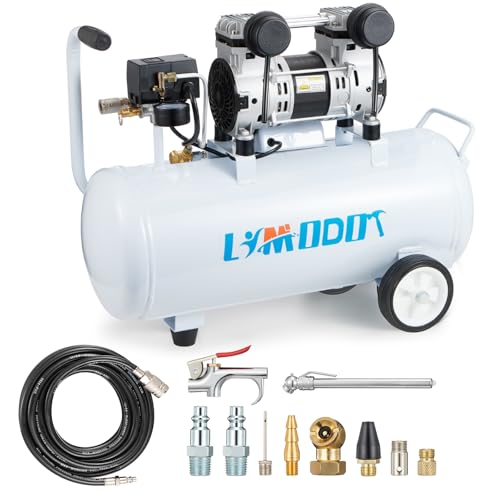 Limodot 8-Gallon Quiet Air Compressor
|
9.1/10 | Buy |
| Best Budget |
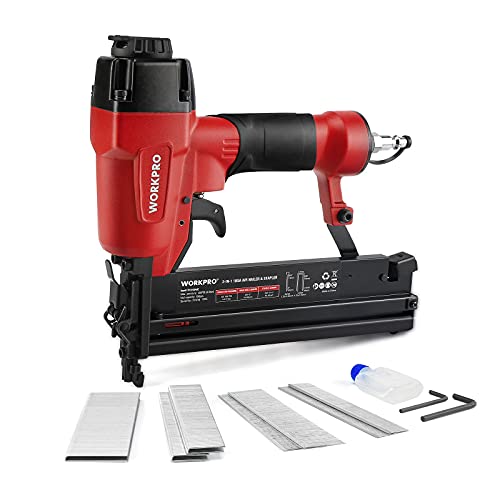 WORKPRO 2-in-1 Pneumatic Brad Nailer and Crown
|
8.9/10 | Buy |
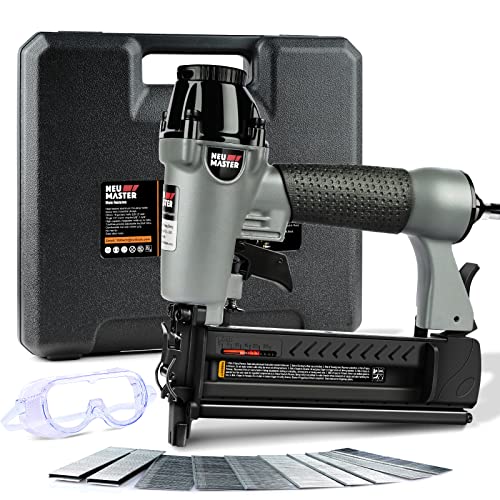 NEU Master 2-in-1 Pneumatic Brad Nailer and Staple
|
8.8/10 | Buy | |
 DEWALT DWFP55130 2.5-Gallon 200 PSI Quiet Trim Air
|
8.4/10 | Buy | |
 Daikcaiyb Cordless Tank-Free Air Compressor
|
7.8/10 | Buy |
POPULO 2-in-1 Pneumatic Brad Nailer and Crown
The POPULO 2-in-1 Pneumatic Brad Nailer and Crown Stapler operates between 60 and 110 PSI, driving both 18-gauge brads and 1/4-inch narrow crown staples from a single tool. It is an affordable, practical addition for DIY homeowners and woodworkers looking to tackle trim and cabinetry using their home workshop air compressor.
Pros
- Versatile 2-in-1 magazine fires both 18-gauge brad nails and 1/4-inch narrow crown staples
- Works reliably with standard portable air compressors delivering 60 to 110 PSI
- Tool-free jam clearance and quick-turn depth adjustment wheel streamline setup
- Lightweight aluminum body and ergonomic rubber grip help minimize hand strain
- Includes 1,600 fasteners out of the box for instant project readiness
Cons
- Requires a dedicated air compressor and pneumatic hose to function (not cordless or electric)
- Combination driver blade leaves a slightly wider indentation when driving brad nails compared to dedicated single-purpose finish nailers
- Does not feature a dry-fire lockout mechanism to prevent firing on an empty magazine
BOSTITCH BTFP02012 6-Gallon Pancake Air Compressor
Delivering 2.6 SCFM at 90 PSI from a 6-gallon 150 max PSI tank, the Bostitch BTFP02012 provides reliable pneumatic output in a 29-pound portable design. It is an ideal match for DIY homeowners, finish carpenters, and punch-list contractors needing low-maintenance air power for trim nailers and inflation tasks.
Pros
- Delivers a steady 2.6 SCFM at 90 PSI with a 150 max PSI ceiling for sequential finish fastening
- Portable 29-pound build and balanced center handle simplify jobsite mobility and vehicle loading
- Dual universal couplers allow two users to run separate nailers without aftermarket splitters
- High-efficiency motor starts smoothly in cold conditions and on properly rated extension cords
Cons
- Airflow output of 2.6 SCFM is not suited for continuous high-demand tools like sanders or spray guns
- Operational sound level of 78.5 dBA is louder than ultra-quiet low-RPM dual-piston models
- Ships as a bare tool without an air hose, blow gun, or pneumatic finish nailers included
Limodot 8-Gallon Quiet Air Compressor
Limodot pairs an 8-gallon capacity with a quiet 68-decibel motor, keeping noise disruption low during indoor trim or workshop jobs. Delivering 2.8 CFM at 90 PSI alongside a quick 30-second recovery time, it provides steady airflow for DIY pneumatic tools without messy oil maintenance.
Pros
- Low 68 dB output prevents loud workshop disruption
- Fast 30-second pressure recovery keeps projects moving
- Oil-free pump eliminates messy oil changes
- Comprehensive 11-piece accessory kit included out of the box
- Integrated wheels make moving the 8-gallon tank easy
Cons
- 2.8 CFM output limits high-demand continuous tools
- Included PVC hose is stiffer than rubber alternatives
WORKPRO 2-in-1 Pneumatic Brad Nailer and Crown
The WORKPRO 2-in-1 Pneumatic Brad Nailer and Stapler is an economical 18-gauge fastening tool operating between 60 and 100 PSI with a standard 1/4-inch NPT air inlet. It provides dual-fastener flexibility, tool-free jam clearing, and an adjustable depth wheel, making it a dependable choice for DIY homeowners and woodworkers using compact portable air compressors.
Pros
- Dual-magazine design shoots both 18-gauge brad nails and narrow crown staples without switching tools.
- Modest 60 to 100 PSI air requirement runs smoothly on virtually any compact DIY pancake or hot-dog compressor.
- Tool-free jam clearance latch and rotating depth wheel simplify fastener adjustments on the fly.
- Includes 700 starter fasteners and dedicated pneumatic tool oil for immediate project setup.
Cons
- Requires regular manual oiling before each work session to lubricate the internal driver mechanism.
- Does not include an air compressor, air hose, or quick-connect brass couplers, which must be sourced separately.
- Tethered pneumatic hose setup limits mobility compared to heavier cordless battery-powered nail guns.
NEU Master 2-in-1 Pneumatic Brad Nailer and Staple
This dual-action pneumatic finish tool drives 18-gauge brad nails up to 2 inches and 1/4-inch crown staples across a standard 60-120 PSI compressor range. Paired with a standard 1/4-inch NPT air line, it offers DIY homeowners and hobbyist woodworkers an adaptable fastening setup for interior trim, cabinetry, and light upholstery.
Pros
- Versatile 2-in-1 magazine fires both 18GA brad nails and 1/4-inch narrow crown staples without tool swaps
- Operates reliably within a broad 60 to 120 PSI pressure window on basic home garage compressors
- Tool-free quick-clear nose mechanism simplifies jam recovery without extra wrenches
- Complete kit packaging includes a hard storage case, safety glasses, and 1,000 starter fasteners
- Standard 1/4-inch NPT fitting hooks directly to common shop air compressor hoses
Cons
- Requires a separate air compressor, air hose, and quick-connect couplers to operate
- Sequential trip trigger lacks a contact-actuated bump-fire mode for rapid-fire production nailing
- Staple magazine accepts only 1/4-inch narrow crown fasteners and will not accommodate wide-crown upholstery staples
DEWALT DWFP55130 2.5-Gallon 200 PSI Quiet Trim Air
The DEWALT DWFP55130 delivers a capable 3.0 SCFM at 90 PSI with a 200 max PSI 2.5-gallon tank, running at a quiet 71.5 dBA on an efficient 12-amp motor. It is an ideal pneumatic power source for trim carpenters, punch-list contractors, and DIYers working on residential circuits.
Pros
- Delivers 3.0 SCFM at 90 PSI with a high 200 max PSI ceiling for rapid pressure recovery during sequential fastening
- Quiet 71.5 dBA sound output makes indoor trim carpentry and remodeling far less disruptive to homeowners
- Low 12-amp draw reduces breaker trips when running on shared 15-amp household circuits
- Integrated roll cage and console protect critical components while supporting horizontal or vertical operation
- Dual quick couplers allow two trim carpenters to connect and work off a single compressor
Cons
- Bare-tool configuration means you must supply your own air hoses, couplers, and pneumatic nail guns
- At 36 pounds, it is heavier to haul up flights of stairs than ultra-compact 1-gallon finish compressors
- Air output of 3.0 SCFM is built for intermittent finish fastening and will not support continuous tools like rotary sanders or sprayers
Daikcaiyb Cordless Tank-Free Air Compressor
This cordless tank-free mini air compressor pump connects directly to Miwoqi 18V batteries to power pneumatic nail guns without dragging heavy tanks or electrical cords across the jobsite. It is a practical, ultra-mobile air solution for finish carpenters and trim woodworkers tackling punch-list installs.
Pros
- Tank-free cordless design eliminates the heavy bulk and awkward carry profile of traditional pancake compressors
- Allows tradespeople and DIYers to use their existing pneumatic nailers without buying expensive battery-dedicated nail guns
- Zero risk of tripping sensitive 15-amp household circuit breakers on cold mornings because it runs on 18V battery power
- Spill-free, compact layout makes it easy to pack into a work vehicle or carry up a flight of stairs for fast punch-list repairs
Cons
- Strictly limited to pneumatic nail guns and cannot operate tire chucks, blow guns, impact wrenches, or paint sprayers
- Sold as a bare tool, requiring compatible Miwoqi 18V batteries and a charger to be purchased separately
- Lacks an air reserve tank buffer, which prevents its use with continuous-draw air equipment
Understanding Air Compressor Requirements for Nail Guns
Determining whether you need an air compressor begins with identifying the specific category of nail gun you plan to operate. If your tool is an air-powered pneumatic model, an air compressor is strictly required because the fastener drive piston relies entirely on compressed air to function. Standalone battery-powered cordless nailers and corded electric models do not require an air compressor because they rely on mechanical flywheels or sealed nitrogen cylinders. Reviewing the tool mechanism and power source ensures you select compatible equipment for your woodworking, trim carpentry, or framing jobs.
Pneumatic Versus Cordless Nail Guns: Mechanical Differences
Pneumatic nailers use pressurized air directed into an internal cylinder to drive a driver blade against the fastener head. Tools like the POPULO 2-in-1 Pneumatic Brad Nailer & Crown and the WORKPRO 2-in-1 Pneumatic Brad Nailer/Staple Gun operate specifically within designated air pressure ranges between 60 PSI and 110 PSI. Because pneumatic nailers do not house heavy electric motors or bulky lithium-ion battery packs, their handheld aluminum bodies remain remarkably lightweight and well-balanced. This lightweight profile reduces wrist fatigue during repetitive tasks such as installing baseboards, window casings, or decorative crown molding.
Cordless battery nailers rely on onboard lithium-ion battery packs to spin an internal flywheel or compress a sealed nitrogen air spring. While cordless nail guns eliminate the tripping hazard and setup inconvenience of air hoses, the added weight of the battery pack and electric motor can make prolonged overhead work tiring. Versatile pneumatic tools such as the NEU Master Nail Gun, 2 in 1 Pneumatic Brad also provide dual functionality by firing both 18-gauge brad nails and 1/4-inch narrow crown staples from a single compact chassis. For craftspeople operating in dedicated workshop environments or stationary assembly stations, pneumatic tools offer exceptional mechanical simplicity and lower initial tool cost.
Operating Pressure and Air Volume Sizing for Fasteners
Operating a pneumatic nailer successfully requires matching the tool operating pressure and air delivery volume to your compressor output. Most 18-gauge brad nailers and narrow crown staplers require between 60 PSI and 100 PSI to countersink fasteners cleanly beneath the wood surface. Framing nailers and heavy coil roofing nailers demand higher continuous working pressures, often operating between 90 PSI and 120 PSI to drive thick shank nails into dense framing lumber. Operating a nailer below its minimum rated pressure leads to proud fasteners that stick above the workpiece, while exceeding the maximum pressure risks damaging the internal bumper and seals.
Pneumatic nail guns consume air intermittently rather than continuously, which sets them apart from rotary air tools like sanders and die grinders. Each time you pull the trigger, the nailer consumes a small burst of compressed air measured in standard cubic feet per cycle, which generally averages between 0.03 and 0.08 cubic feet per shot. Because the tool fires in discrete bursts, you do not need an industrial-sized air compressor delivering high continuous cubic feet per minute (CFM) ratings. Even compact portable compressors can easily keep up with the firing pace of a single finish carpenter working on detailed trim installations.
Tank Reserve Capacity and CFM Delivery Comparison
Air tank capacity acts as a pressurized buffer between the compressor pump and your pneumatic tool. Small tanks ranging from 1 to 3 gallons are lightweight and easy to transport, making them ideal for punch-list trim jobs and light cabinetry assembly. However, smaller tanks cycle the electric motor on and off more frequently because the limited air reserve depletes quickly after several dozen consecutive shots. A frequent motor cycle rate increases wear on the pressure switch and motor start capacitors, while also generating frequent jobsite noise interruptions.
Medium-sized tanks ranging from 6 to 8 gallons provide an optimal balance of portable convenience and air reserve stability. The BOSTITCH Pancake Air Compressor, Oil-Free features a 6-gallon tank and a 150 PSI maximum pressure rating, delivering 2.6 SCFM at 90 PSI to support sustained nailing cycles. Meanwhile, larger 8-gallon wheeled compressors like the Quiet Oil-Free Air Compressor, 68 dB deliver 2.8 CFM at 90 PSI and feature rapid 30-second recovery times that easily support roofing and framing nailers. The larger air reservoir provides sufficient buffer capacity so the electric pump cycles less often, allowing you to complete long runs of trim before the pump restarts.
Noise Levels and Motor Types for Indoor Carpentry
Operating an air compressor inside an occupied home or enclosed residential garage can be jarring if the unit produces high decibel levels. Traditional pancake compressors often utilize high-speed universal motors operating at roughly 3,400 RPM, generating operational noise ratings between 78 dBA and 85 dBA. This piercing noise level can cause ear fatigue, disturb homeowners during interior trim renovations, and make communication difficult across the workspace. Choosing a compressor with a lower decibel rating significantly improves comfort during long indoor finish woodworking sessions.
Modern quiet compressors utilize dual-piston oil-free pumps driven by low-speed four-pole induction motors operating at lower operational speeds. The Quiet Oil-Free Air Compressor, 68 dB produces an ultra-quiet 68 dB sound profile that allows for normal conversation while the pump recharges the 8-gallon tank. Similarly, the DEWALT Air Compressor for Trim, 200-PSI Max operates at 71.5 dBA with a low 12-amp motor draw designed to prevent tripping standard 15-amp household circuit breakers. Low-noise compressors combined with low electrical amp draws make indoor trim work cleaner, quieter, and far less disruptive for residential carpentry projects.
Tank-Free and Battery Compressor Options for Mobility
Contractors working on quick repair jobs or punch-list trim repairs often dread transporting a heavy compressor and rolling out 50 feet of air hose. Recent advancements in mobile pneumatic power have introduced tank-free cordless compressor designs tailored specifically for light nailing tasks. The Cordless Portable Air Compressor Pump operates on compatible 18-volt battery platforms, completely eliminating the need for a stationary air tank or electrical extension cords. This compact design supplies direct air pressure to standard pneumatic nail guns, offering mobile freedom without purchasing separate cordless nailers.
Tank-free mini air supplies bridge the gap between traditional stationary compressors and expensive dedicated cordless tools. By connecting directly to an existing pneumatic brad nailer or crown stapler, these battery-driven pumps supply stable operating pressure for baseboard and cabinet trim. However, tank-free units are engineered specifically for intermittent low-volume fasteners and cannot support high-demand air tools like paint sprayers or impact wrenches. Matching your equipment mobility to your jobsite demands prevents unnecessary physical strain and speeds up setup routines across multiple rooms.
Air Line Setup, Couplers, and Pressure Calibration
Connecting your nail gun to an air compressor requires a proper air line setup using standard 1/4-inch NPT quick-connect couplers and industrial fittings. Ensure that all threaded fittings on your manifold and tool inlets are wrapped with PTFE thread seal tape to prevent persistent air leaks that cause the compressor to cycle unnecessarily. Inspect your air hose for cracks, kinks, or worn crimps before pressurizing the line to prevent sudden hose bursts under load. Using lightweight 1/4-inch polyurethane air hoses reduces hand drag compared to heavy rubber hoses, making trim work much easier to maneuver.
Calibrating the pressure regulator is a critical step that directly controls fastener drive depth and protects delicate trim materials. Compressors like the BOSTITCH Pancake Air Compressor, Oil-Free and DEWALT Air Compressor for Trim, 200-PSI Max feature dual quick-connect couplers and clear regulated line gauges. Rotate the regulator adjustment knob until the regulated gauge matches the specific pressure recommended for your fastener length and wood species. Always test-fire a nail into a scrap piece of matching hardwood or softwood before firing fasteners into finished molding to verify proper countersinking depth.
Daily Maintenance, Moisture Purging, and Jam Prevention
Maintaining your pneumatic nail gun and compressor system requires distinct care routines to ensure operational reliability and prevent mechanical failure. Many pneumatic nailers, including the WORKPRO 2-in-1 Pneumatic Brad Nailer/Staple Gun and NEU Master Nail Gun, 2 in 1 Pneumatic Brad, require regular pneumatic tool oil added directly into the air inlet fitting before use. Adding two to three drops of specialized non-detergent air tool oil before each work session lubricates the internal O-rings and prevents cylinder scoring. Never use automotive motor oil or penetrating sprays, as harsh additives can dissolve internal rubber seals and cause catastrophic air leaks.
Compressor tank maintenance centers around managing internal moisture buildup that naturally condenses during air compression cycles. Atmospheric air contains ambient humidity, which condenses into liquid water inside the steel pressure vessel as compressed air cools. Failing to drain this accumulated water leads to internal tank corrosion, reduces usable air volume, and sends rusty moisture through your air hose into your nailer. At the end of every work session, depressurize the system and open the bottom tank drain valve completely to expel all trapped water and moisture.
Troubleshooting Incomplete Drives and Pressure Fluctuations
When a pneumatic nailer fails to drive fasteners flush with the workpiece surface, the issue usually stems from incorrect pressure calibration or dynamic line pressure drop. Begin troubleshooting by checking the regulated air gauge on your compressor to verify that operating pressure has not fallen below the tool minimum threshold. If the gauge displays proper static pressure but the nailer still underdrives fasteners during rapid firing, an undersized or excessively long air hose may be restricting airflow volume. Switching to a larger diameter hose or increasing the regulated pressure slightly can restore full driving power.
Mechanical tool adjustments on the nailer itself also influence drive depth independently of air pressure settings. Most modern finish nailers feature an integrated depth adjustment wheel located near the safety nose contact bracket. Rotating this depth control wheel extends or retracts the nose contact, allowing you to fine-tune nail countersinking without altering compressor line pressure. In addition, inspect your quick-connect couplers for worn O-rings, as persistent air bleeds can rob the tool of peak driving energy on high-cycle framing jobs.
Selecting the Ideal Fastening System for Your Workshop
Deciding whether to invest in an air compressor and pneumatic nailer setup depends primarily on your workspace layout, tool budget, and typical project volume. Woodworkers and trim carpenters who spend hours assembling cabinets, picture frames, and furniture in a workshop benefit greatly from the lightweight ergonomics and low cost of pneumatic tools. Paired with an ultra-quiet pancake or 8-gallon induction compressor, a pneumatic nailer delivers rapid, fatigue-free firing with unmatched long-term durability. The mechanical simplicity of pneumatic tools means they rarely suffer from the electronic board failures common in complex cordless power tools.
Ultimately, you do not need an air compressor if you choose to purchase dedicated, self-contained cordless electric nail guns. But if you choose a pneumatic nailer, an air compressor is an indispensable requirement that dictates your tool driving performance, speed, and reliability. Purchasing a dependable compressor provides broad workshop utility that extends well beyond nailing, powering blow guns, tire inflators, and specialized air tools. Assessing your expected workload, tool weight preferences, and workshop space will guide you toward the ideal fastening configuration for your upcoming building projects.
About the author
Tom Scalisi brings more than two decades of experience in construction, building maintenance, contracting, and hands-on tool use. His practical understanding of power tools, automotive work, repairs, and jobsite equipment helps readers evaluate compressors based on real workloads rather than specifications alone.