
Can You Add a Second Tank to an Air Compressor: Practical Guide for 2026
Can you add a second tank to an air compressor? Learn how auxiliary tanks affect CFM, recovery times, and safety for October 2026.
 By Bob Beacham
Updated October 7, 2026
By Bob Beacham
Updated October 7, 2026
Pneumatic tools often stall or suffer noticeable loss of operating torque when an undersized air compressor runs out of usable reserve volume during heavy garage or workshop projects. Home mechanics, woodworkers, and automotive hobbyists confronting sudden pressure drops frequently ask whether they can plumb an extra storage vessel into their existing setup. When evaluating whether can you add a second tank to an air compressor, the answer is a definitive yes, provided the installation adheres to standard pneumatic plumbing practices. Connecting a secondary receiver expands the buffer of stored compressed air, helping maintain consistent pressure across rapid, intermittent tool cycles without stalling your equipment.
Expanding total tank capacity does not alter the fundamental air production capacity of the compressor motor and pump. While an auxiliary reservoir provides extra gallons of stored air buffer, the compressor pump still delivers its original output rated in CFM at 90 PSI. Adding secondary storage changes operational cycle dynamics, doubles initial tank fill times, and requires dedicated pressure relief and moisture management hardware. Understanding the mechanical relationship between stored air volume, pump recovery times, and electrical motor duty cycles helps you configure a dual-tank system that safely meets your pneumatic tool requirements.
| Award | Product | ACR Score About ACR ScoreThe ACR Score is our own rating from 0 to 10, based on performance, design and build, ease of use, and value. It reflects independent research and is never influenced by manufacturers, retailers, or affiliate commissions. Learn more › | |
|---|---|---|---|
| Best Overall |
SUNROAD 2-Pack Extended Air Compressor Tank Drain
|
9.1/10 | Buy |
| Best Premium |
 QWORK 2-Pack Air Compressor Extended Tank Drain
|
9.1/10 | Buy |
| Best Budget |
 Hromee 5-Piece 1/4-Inch Drain Valve Kit
|
8.9/10 | Buy |
 Hromee Automatic Air Compressor Tank Drain Valve
|
8.6/10 | Buy | |
 SUNROAD 10-Inch Compressor Tank Drain Kit
|
8.3/10 | Buy | |
 Stark USA 10-Gallon Horizontal Air Compressor
|
8.1/10 | Buy | |
 QWORK 10-Inch Tank Drain Valve Kit
|
7.8/10 | Buy | |
| Best Value |
 Ei Air Compressor Tank Manifold Valve
|
7.8/10 | Buy |
SUNROAD 2-Pack Extended Air Compressor Tank Drain
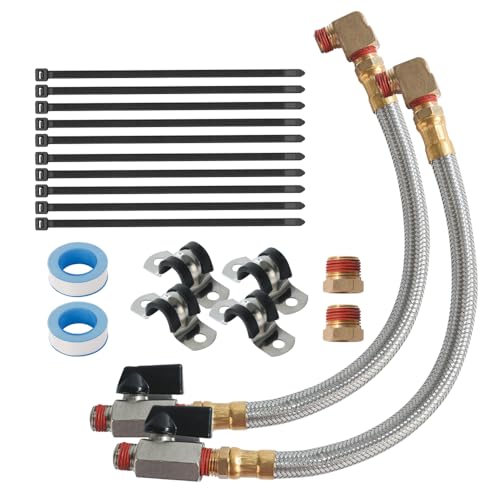
The SUNROAD 2-Pack Extended Tank Drain Valve Kit relocates awkward tank drain ports using a 10-inch braided steel hose rated to 175 PSI and a smooth quarter-turn brass ball valve rated to 300 PSI. It provides DIYers, garage mechanics, and woodworkers with a clean, ergonomic way to purge tank condensation and help protect air receiver vessels from internal rust.
Pros
- Eliminates having to reach or crawl beneath bulky air tanks to turn stiff factory drain screws
- Rugged 10-inch braided steel hose handles up to 175 PSI working pressure and 200 degrees Fahrenheit
- Smooth quarter-turn chrome-plated brass ball valve provides reliable shutoff without leaking air
- Supplied with 3/8-inch adapter bushings, thread seal tape, and vibration-damping mounting clamps
Cons
- Hose working pressure is capped at 175 PSI, making it unsuitable for high-pressure industrial systems operating above that threshold
- Initial installation into tight bottom bungs on low-clearance tanks may require tipping the compressor
- Thread connections require careful wrapping with the included Teflon tape to ensure an airtight seal
QWORK 2-Pack Air Compressor Extended Tank Drain
The QWORK 2-Pack Extended Tank Drain Valve Assembly Kit relocates hard-to-reach petcock drains using a 10-inch braided steel hose rated for 175 PSI working pressure. It provides DIYers, mechanics, and shop owners with a durable brass upgrade that simplifies regular moisture draining to prevent internal tank corrosion.
Pros
- Durable braided steel hose and brass construction resist workshop wear, rust, and corrosion
- 10-inch extended length eliminates crawling under tanks or scraping knuckles on low-clearance petcocks
- High working pressure rating of 175 PSI with a 475 PSI blasting threshold ensures safe pneumatic containment
- Complete two-pack kit includes 1/4-inch to 3/8-inch brass adapters and thread seal tape for quick installation
Cons
- Requires checking your specific compressor tank port size to verify 1/4-inch or 3/8-inch NPT compatibility
- Does not include an integrated shut-off ball valve, requiring you to attach an existing valve or fitting to the hose end
Hromee 5-Piece 1/4-Inch Drain Valve Kit
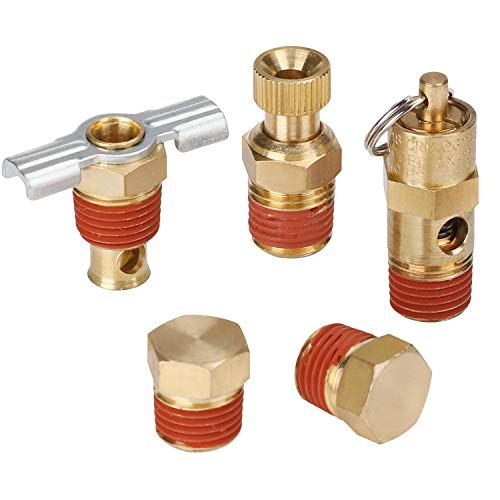
This brass fitting assortment provides essential replacement valves and plugs for routine compressor tank maintenance. It pairs winged and knurled drain petcocks with a 140 PSI safety relief valve for dependable pneumatic management.
Pros
- Solid brass body provides corrosion and heat resistance
- Two petcock styles offer flexible moisture draining options
- Integrated safety valve handles up to 55 SCFM flow
- Stainless steel relief components resist rust over time
Cons
- Requires separate thread sealant for proper sealing
- Safety valve maximum pressure is capped at 140 PSI
- Winged drain handle has a 12-pound torque limit
Hromee Automatic Air Compressor Tank Drain Valve
The Hromee Automatic Air Compressor Tank Drain Valve Kit automates moisture removal from pneumatic receiver tanks and filters using an adjustable electronic timer and durable braided steel hose. It is an ideal preventative upgrade for garage hobbyists, woodworkers, and shop owners looking to protect their air equipment from internal rust without manual draining.
Pros
- Fully adjustable cycle and duration timers match purge frequency to workshop humidity levels
- Extensive adapter collection fits common 1/4-inch, 3/8-inch, and 1/2-inch NPT tank drain ports
- Braided steel lead hose provides generous clearance to route moisture away from hard-to-reach petcocks
- Pre-wired 6-foot grounded 110V-120V plug eliminates the need for electrical hardwiring
- IP65 enclosure provides dependable protection against dust and workshop moisture
Cons
- Requires an accessible 110V-120V electrical outlet positioned near the compressor location
- Minimum operating ambient temperature of 32°F makes it unsuitable for unheated sub-freezing shops
- Audible pressurized purge bursts may startle users inside small, quiet residential garages
SUNROAD 10-Inch Compressor Tank Drain Kit
Draining moisture prevents compressor tank rust, and this SUNROAD kit simplifies routine maintenance with a flexible braided steel line and an accessible quarter-turn shutoff. It provides a practical upgrade for standard 1/4-inch and 3/8-inch drain ports operating under 175 PSI.
Pros
- Durable braided steel hose prevents kinks
- Corrosion-resistant chrome-plated brass valve
- Complete installation kit with clamps and tape
- Rubber-coated handle allows easy quarter-turn operation
Cons
- 10-inch hose may be short for large tanks
- Working pressure is limited to 175 PSI
- Requires manual operation after every compressor use
Stark USA 10-Gallon Horizontal Air Compressor
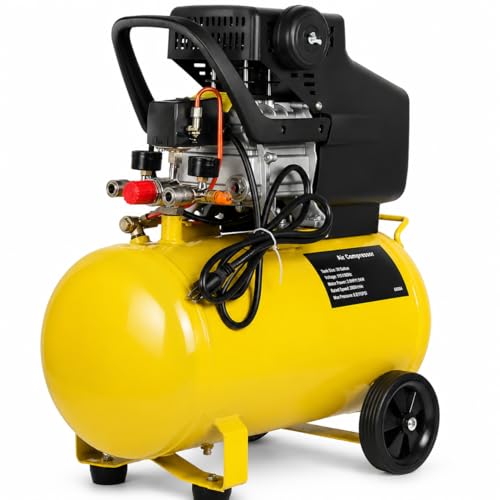
Equipped with a 10-gallon structural steel horizontal tank and an ultra-quiet 62 dB motor rating, the Stark USA air compressor delivers a listed 8.37 CFM up to 125 PSI. It provides a generous air reserve and dual quick-connect versatility for home garage mechanics, woodworkers, and DIY hobbyists.
Pros
- Subdued 62 dB noise rating dramatically reduces acoustic fatigue compared to traditional jobsite compressors
- Ten-gallon tank capacity provides a steady reserve to buffer air pressure during intermittent tool operation
- Factory-installed dual quick-connect couplers support multi-tool setups right out of the box
- Heavy-duty welded structural steel tank ensures rugged workshop durability
Cons
- At 61.05 pounds, moving the compressor requires substantial physical effort
- Maximum pressure is limited to 125 PSI, which is lower than the 150 to 175 PSI thresholds found on high-pressure jobsite units
- Manufacturer specifications do not provide dedicated SCFM delivery breakdowns specifically measured at 40 PSI or 90 PSI
QWORK 10-Inch Tank Drain Valve Kit
This braided steel extension kit simplifies tank draining by relocating hard-to-reach compressor valves. Rated up to 175 PSI and packaged with an adapter, it offers a reliable setup for standard workshop compressors.
Pros
- Corrosion-resistant braided steel construction
- Pre-applied sealant speeds up installation
- Includes adapter for 3/8-inch ports
- Handles up to 175 PSI reliably
Cons
- Fixed 10-inch length restricts mounting flexibility
- Not rated for high-pressure industrial systems
Ei Air Compressor Tank Manifold Valve
This USA-made Ei tank manifold valve is an all-in-one replacement fitting equipped with a 1/2-inch Male NPT inlet, an integrated shut-off ball valve, a 1/4-inch gauge port, and a 130 PSI safety relief valve. Designed for compressors rated up to 3 HP, it offers a dependable, streamlined solution for garage mechanics and DIY hobbyists repairing damaged tank ports or assembling custom pneumatic setups.
Pros
- Consolidates a ball valve, gauge port, and safety relief into one compact manifold fitting
- Built-in 130 PSI safety pop-off valve delivers built-in overpressure protection
- Made in the USA hardware ensures clean NPT threading and solid metal construction
- Direct replacement for damaged, stripped, or leaking manifold valves on small shop compressors
Cons
- Fixed 130 PSI safety relief rating makes it unsuitable for higher-pressure 150 to 175 PSI systems
- Manufacturer specifies use on compressors 3 HP and smaller, ruling out heavy commercial shop units
- Provides a single 1/4-inch discharge port, requiring extra pipe tees if running multiple air lines directly from the tank
Expanding Pneumatic Air Storage: Mechanics, Plumbing, and Practical Safety
The Mechanical Reality of Adding a Secondary Air Tank
Adding an auxiliary air tank to an existing compressor system is a recognized mechanical practice for increasing available air reserves. An auxiliary tank operates as a passive pressure vessel connected directly to the primary compressor plumbing. When the electric motor starts, the pump delivers compressed air into both tanks until the entire system reaches the factory cut-out pressure threshold. Because the pressure switch installed on the main compressor monitors overall line pressure, it automatically governs cycling for both vessels as a single unified storage system.
The core objective of an auxiliary storage setup is to prevent sudden line pressure drops during demanding shop tasks. Having extra gallon capacity provides a larger reservoir of pressurized air that absorbs brief surges in tool consumption. Fast-acting pneumatic tools like high-torque impact wrenches draw heavily from this stored reserve without causing an instant dip in working pressure. This expanded buffer stabilizes regulated line pressure, allowing air tools to sustain consistent torque and driving power during intermittent operation.
Stored Volume Versus Pump Displacement and Delivered CFM
A frequent misunderstanding among garage mechanics is that adding an auxiliary tank increases the continuous airflow output of the machine. An air compressor pump generates air based entirely on its mechanical displacement, measured in cubic feet per minute (CFM) at specific pressures like 90 PSI. An air pump delivering 4 CFM at 90 PSI will continue to produce exactly 4 CFM at 90 PSI regardless of tank size. Connecting a secondary ten-gallon reservoir increases stored volume, but it does not change the speed at which the pump compresses incoming atmospheric air.
Because delivery volume remains constant, expanding tank capacity changes the runtime profile rather than continuous operating capacity. A tool consuming 8 CFM will rapidly drain a 4 CFM compressor equipped with a small factory tank, resulting in immediate pressure loss. Adding an auxiliary tank allows that high-draw tool to operate smoothly for an initial burst by consuming the stored air buffer. Once that accumulated pressure reserve is depleted, however, the tool will still stall, and the operator must wait significantly longer for the small pump to replenish both vessels.
Calculating the air demand profile of your tools is essential before installing extra storage vessels. Intermittent tools like framing nailers, grease guns, and tire chucks benefit tremendously from expanded air storage because they consume air in quick pulses. Conversely, continuous air tools like rotary sanders, die grinders, and paint spray guns require constant CFM delivery from the pump mechanism itself. Relying on an auxiliary tank to power continuous tools on an undersized compressor only delays pressure drops while putting excessive run strain on the motor.
Tank-to-Tank Versus Downstream Surge Tank Plumbing
There are two distinct plumbing configurations for connecting a secondary reservoir into a workshop air delivery system. The first method connects the secondary tank directly to the primary tank before the air pressure regulator, creating an expanded high-pressure reserve. In this pre-regulator setup, both tanks store air at full maximum operating pressure, typically between 125 and 150 PSI. Storing air at maximum pressure maximizes the total volume of standard cubic feet held in reserve before the system drops to the motor cut-in point.
The second plumbing method positions the auxiliary tank downstream of the primary regulator, placing the secondary vessel close to the tool work area. This downstream arrangement functions as a localized surge tank, compensating for dynamic friction losses across long hose runs. Long runs of standard pneumatic hose often suffer substantial pressure drops when tools draw sudden high-volume bursts. Placing an auxiliary tank near the workstation keeps regulated air immediately available, eliminating line starvation without requiring heavy high-pressure piping across the garage.
Selecting durable pipe fittings is crucial to ensure adequate airflow and leak-free operation between connected vessels. Connecting lines should use substantial diameter hose or pipe, such as 3/8-inch or 1/2-inch lines, rather than restrictive 1/4-inch whip hoses. Using a specialized manifold, such as the Ei air compressor tank manifold featuring a 1/2-inch NPT inlet, provides organized port routing for auxiliary connections. Installing an accessible quarter-turn brass ball valve between tanks allows you to isolate the auxiliary vessel quickly when performing smaller tasks that require rapid single-tank fill times.
Essential Pressure Relief and Safety Hardware Requirements
Compressed air storage tanks hold substantial energy under pressure, making proper safety devices essential for every added vessel. An auxiliary air tank must never depend entirely on the safety valve mounted on the primary compressor unit. If an isolating valve between the two tanks is closed accidentally, pressure could build unevenly without activating the primary relief mechanism. Every independent pressure vessel in the pneumatic circuit must be equipped with its own dedicated ASME safety relief valve calibrated to the tank maximum working pressure.
Safety valves protect the pneumatic system by venting excess air automatically if internal tank pressure exceeds pre-set thresholds. Fitting kits like the Hromee five-piece tank port kit include 140 PSI safety valves engineered with solid brass bodies and stainless steel pull rings to relieve over-pressurization quickly. Component assemblies like the Ei manifold valve also feature built-in 130 PSI relief valves designed to protect compressors rated at 3 horsepower and smaller. Always check the manufacturer stamped data plate on any auxiliary vessel to confirm its working pressure rating matches or exceeds your system cut-out setting.
Never connect an auxiliary air tank that exhibits severe exterior rust pitting, structural damage, or an unknown pressure rating. Connecting an unrated or lower-pressure tank to a compressor capable of building 150 PSI creates a dangerous risk of catastrophic vessel rupture. All port adapters and brass hex plugs must feature clean NPT threads sealed with thread sealant tape to ensure airtight integrity. Manually testing the pull ring on every installed safety valve before initial pressurization ensures the internal spring mechanism moves freely without sticking.
Compressor Duty Cycle Limits and Motor Thermal Protection
Doubling the storage volume of an air system significantly increases the operational workload placed on the compressor pump and electric motor. When a compressor charges its original factory tank, the pump runs for a specific duration before reaching cut-out pressure. Adding an auxiliary vessel doubles the total volume, requiring the pump to run twice as long during initial pressurization and subsequent recovery cycles. A machine that normally recharges in two minutes will run for four minutes or more when replenishing an expanded dual-tank configuration.
Consumer and jobsite air compressors frequently utilize lightweight oil-free pumps rated for a 50 percent duty cycle limit. Operating at a 50 percent duty cycle means the pump should run no more than thirty minutes out of every hour to prevent excessive heat buildup. Forcing a small oil-free unit to run continuously against high head pressure to fill large auxiliary tanks can overheat piston seals and cause premature valve failure. Conversely, robust units built with cast-iron components, such as the Stark USA 10-gallon horizontal air compressor delivering 8.37 CFM with a 3.5 horsepower motor, handle extended run cycles with far superior thermal heat dissipation.
Electric compressor motors also experience considerable electrical stress and startup inrush current when cycling under heavy loads. Extended run times cause motor windings to heat up, which can activate the internal thermal overload reset switch on shared 15-amp circuits. Ensuring adequate airflow around the compressor motor and avoiding light-gauge extension cords helps prevent voltage drops that exacerbate motor overheating. Monitoring pump temperature during extended multi-tank recovery periods ensures your equipment operates within safe thermal boundaries.
Managing Moisture Condensation Across Multiple Vessels
The process of compressing atmospheric air naturally concentrates ambient humidity, resulting in substantial water condensation inside storage vessels. As warm compressed air exits the pump, it cools against the steel walls of the storage tanks, dropping moisture straight to the tank bottom. Because adding an auxiliary tank increases the overall cooling surface area of your air system, the secondary vessel will collect significant condensation. If liquid water is allowed to accumulate, it accelerates internal tank corrosion, reduces usable storage volume, and ruins pneumatic tools.
Standard factory drain petcocks are typically recessed under the tank curve, making daily manual draining inconvenient and messy. Upgrading both vessels with extended drain assemblies promotes regular moisture maintenance. Drain kits like the SUNROAD extended tank drain valve kit and the QWORK extended drain valve kit provide 10-inch flexible braided steel drain hoses rated for 175 PSI working pressure. These kits relocate the drain line to an accessible mounting position, ending in a chrome-plated brass quarter-turn ball valve that simplifies daily water purging.
For dedicated workshop installations where manual draining might be overlooked, an automated electronic drain offers dependable moisture removal. Devices like the Hromee automatic air compressor tank drain valve kit feature programmable timers offering drain cycles from 30 seconds to 45 minutes with short purge bursts. Designed with IP65 water-resistant housing and standard 110-volt power cords, these electronic valves discharge condensate automatically without dropping line pressure. Draining both the primary and auxiliary tanks after every operating session protects your investment from internal corrosion.
Evaluating Tool Compatibility for Expanded Air Systems
Understanding tool consumption characteristics helps you determine whether adding an auxiliary tank will resolve your specific workshop airflow bottlenecks. Heavy automotive impact wrenches consume large quantities of compressed air, but they typically fire in brief bursts of several seconds. An auxiliary storage vessel provides the reserve volume necessary to break stubborn lug nuts loose without suffering immediate pressure drop. Once the fastener is removed, the tool rests while the compressor pump quietly replenishes the stored volume in both vessels.
Pneumatic framing nailers and construction staplers also benefit substantially from the expanded storage buffer provided by an auxiliary tank. When multiple nailers operate simultaneously on a construction site, small factory tanks experience severe pressure drops that cause incomplete fastener drives. Adding an auxiliary air receiver cushions the system against simultaneous firings, ensuring full driving energy across all connected lines. Using manifold splitters with dual quick-connect couplers allows multiple crew members to share the expanded air buffer smoothly.
Continuous-demand pneumatic tools present an entirely different operational challenge that extra tanks cannot overcome. Tools such as orbital sanders, high-speed die grinders, and HVLP paint sprayers consume continuous air volume that quickly empties even large storage tanks. Once the accumulated buffer is exhausted, the tool stalls, forcing the user to stop working while the pump struggles to rebuild pressure. For continuous tools, upgrading to a larger compressor pump with higher delivered CFM at 90 PSI is the only effective solution.
Step-by-Step Guidelines for Installing an Auxiliary Tank
Installing an auxiliary tank safely requires methodical preparation and careful adherence to pneumatic plumbing standards. Disconnect the primary air compressor from its electrical outlet and open all drain valves to release every pound of stored pressure. Never attempt to loosen, remove, or modify threaded pipe fittings while pressure remains trapped in either vessel. Once the pressure gauges read zero, inspect the port threads on both tanks to confirm matching NPT sizing or select appropriate brass adapters.
Proper thread preparation is critical to ensure airtight connections that prevent the compressor from cycling unexpectedly during idle periods. Wrap several layers of quality PTFE thread sealant tape clockwise around all male NPT threads before threading them into ports. Install an isolating brass ball valve at the primary compressor outlet, followed by braided steel hose or rigid piping rated for full system pressure. If your auxiliary tank has limited bungs, install a manifold assembly to provide ports for incoming air, an ASME safety relief valve, and regulated tool outlets.
Confirm that both vessels have dedicated safety relief valves installed and that all bottom drain assemblies are closed tightly. Plug the compressor into a suitable circuit, start the motor, and allow the combined dual-tank system to build pressure until reaching the automatic cut-out threshold. Listen attentively around all newly installed fittings, manifold connections, and hoses to detect any audible air leaks as the pressure rises.
To verify absolute joint tightness, brush or spray a soapy water solution across every threaded connection and valve stem while the tanks remain at full pressure. If active bubbles emerge around any joint, shut down the system and vent all compressed air before tightening the fitting or reapplying thread tape. Once all fittings remain completely bubble-free and the system maintains full pressure overnight without cycling, your auxiliary air tank installation is safe and ready for workshop use.
Practical Takeaways for Workshop Air Expansion
Adding a second air tank provides an accessible method for expanding the reserve air capacity of your workshop pneumatic system. By understanding the distinction between stored volume buffer and continuous pump CFM output, you can match your setup to intermittent high-demand tools effectively. Installing dedicated ASME safety relief valves, high-pressure braided connecting lines, and accessible quarter-turn drain valves ensures your dual-tank system operates reliably without compromising workshop safety.
Always respect the duty cycle limits of your compressor pump during extended projects to prevent motor overheating and premature component wear. If your future projects demand continuous air tools like sanders or spray equipment, invest in a higher-capacity compressor pump rather than relying strictly on expanded storage. For intermittent fastener driving, automotive tire maintenance, and multi-tool construction tasks, an auxiliary air receiver delivers the steady reserve pressure needed to keep your pneumatic tools performing efficiently.
About the author
Bob Beacham is an experienced tools and workshop writer with deep knowledge of power equipment, mechanical systems, and practical DIY applications. His coverage of air compressors, welding equipment, saws, and workshop tools helps translate technical specifications into useful guidance for homeowners and serious DIYers.