
Are All Air Compressor Hoses Universal? What You Need to Know for 2026
Are all air compressor hoses universal? Learn how thread standards, coupler plugs, and hose diameters match pneumatic tools for October 2026.
 By Clint DeBoer
Updated October 7, 2026
By Clint DeBoer
Updated October 7, 2026

Connecting a pneumatic tool to a garage workshop line often seems straightforward until an unexpected hiss of escaping air reveals an incompatible fitting. Many pneumatic tool owners wonder whether are all air compressor hoses universal when setting up their first workshop manifold or replacing an aged line. In reality, pneumatic lines vary significantly in thread dimensions, internal diameters, coupling profiles, and maximum working pressure ratings. Understanding these mechanical variations helps prevent costly CFM restriction and annoying pressure drops across your air delivery system.
A setup designed for a light-duty finish nailer will rarely match the airflow requirements of a continuous automotive impact wrench or paint sprayer. Standard workshop lines frequently rely on 1/4-inch NPT threaded fittings, yet the quick-disconnect couplers attached to those threads come in several non-interchangeable industrial and automotive profiles. Matching your compressor output, hose diameter, and connector plugs ensures safe operation and dependable pressure delivery across every pneumatic task. Taking time to evaluate these hardware differences saves you from mid-project stalls and frustrating trips to the hardware store.
| Award | Product | ACR Score About ACR ScoreThe ACR Score is our own rating from 0 to 10, based on performance, design and build, ease of use, and value. It reflects independent research and is never influenced by manufacturers, retailers, or affiliate commissions. Learn more › | |
|---|---|---|---|
| Best Overall |
SARDVISA 22-Piece Kit with 25-Ft PU Hose
|
9.2/10 | Buy |
| Best Value |
 YOTOO 1/4-Inch x 25-Foot Polyurethane Recoil Air
|
9.2/10 | Buy |
 RainBello 25-Ft 1/4-Inch Polyurethane Air Hose
|
8.3/10 | Buy | |
| Best Premium |
 Furesn 1/4-Inch x 25-Ft Hybrid Air Compressor Hose
|
8.3/10 | Buy |
 WYNNsky 14-Piece 1/4-Inch Air Fitting Kit
|
8.3/10 | Buy | |
| Best Budget |
 FYCQER 25-Foot Coiled Air Hose (1/4 Inch)
|
8.1/10 | Buy |
 Sixzoo 20-Inch Tire Inflator Hose Adapter
|
8.0/10 | Buy |
SARDVISA 22-Piece Kit with 25-Ft PU Hose
This 22-piece accessory bundle equips home garages and workshops with standard 1/4-inch NPT fittings, dual chucks, and a metal blow gun. Its standout component is a 25-foot coiled PU hose featuring detachable ends that allow easy trimming and repair if damaged.
Pros
- Repairable PU hose design saves replacement costs
- Comprehensive 22-piece selection for inflation and cleaning
- Sturdy metal blow gun supports high air capacity
- Universal 1/4-inch NPT fittings ensure wide compatibility
Cons
- Recommended working pressure is capped at 120 PSI
- Coiled spring hose can limit practical working reach
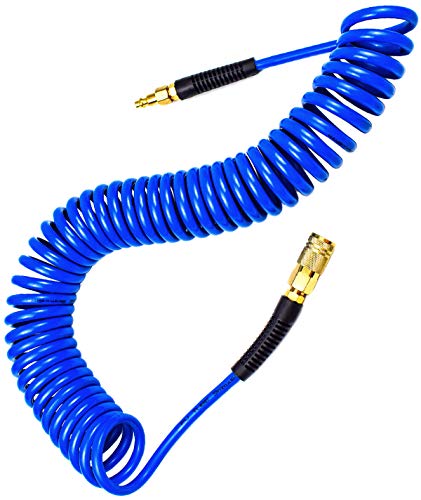
YOTOO 1/4-Inch x 25-Foot Polyurethane Recoil Air
The YOTOO 1/4-inch by 25-foot polyurethane recoil air hose provides a lightweight, tangle-resistant pneumatic connection rated for up to 150 PSI. Equipped with pre-installed 1/4-inch industrial quick-connect fittings and flexible operation down to -40 degrees Fahrenheit, it is a convenient, space-saving accessory for garage hobbyists, trim carpenters, and workbench setups.
Pros
- Self-retracting coil design eliminates manual hose winding and prevents messy shop floor clutter
- Comes ready to work with factory-installed 1/4-inch industrial quick-connect coupler and plug
- Retains pliability in freezing conditions down to -40 degrees Fahrenheit
- Durable bend restrictors protect high-wear junction points from premature cracking or kinking
- Lightweight polyurethane build significantly minimizes hand and wrist fatigue during detailed tool work
Cons
- 1/4-inch inner diameter restricts airflow volume required for continuous high-demand tools like dual-action sanders or spray guns
- Coil tension increases when stretched near the full 25-foot reach, which can pull back against lightweight pneumatic tools
- Not intended for severe rough-framing jobsite abuse where heavy-duty reinforced rubber hoses are typically preferred
RainBello 25-Ft 1/4-Inch Polyurethane Air Hose
The RainBello 25-foot 1/4-inch reinforced polyurethane air hose delivers high flexibility and a 300 PSI working pressure rating for garage workshops and trim jobs. Equipped with factory brass swivel fittings and quick-connect hardware, it provides a reliable, kink-resistant connection for DIYers and finish carpenters.
Pros
- Braided polyurethane outer jacket resists scuffing, kinking, and twisting
- Factory-installed 1/4-inch brass swivel fittings and quick-connect couplers save setup time
- Substantial 300 PSI working pressure rating handles common pneumatic tasks
- Remains pliable in sub-freezing temperatures down to -40°F
Cons
- A 1/4-inch internal diameter restricts airflow volume for continuous high-CFM tools like dual-action sanders
- The 25-foot length may limit reach across larger multi-bay automotive garages without an additional extension
Furesn 1/4-Inch x 25-Ft Hybrid Air Compressor Hose
The Furesn 1/4-inch by 25-foot hybrid air compressor hose blends rubber and PVC to provide a lightweight, kink-resistant line rated for 300 PSI working pressure in temps from -40°F to 150°F. Equipped with solid brass fittings and bend restrictors, it offers dependable utility for DIYers, finish carpenters, and garage mechanics.
Pros
- Hybrid rubber-PVC material remains lightweight at just over 2 pounds while resisting cold-weather stiffening down to -40°F
- Substantial 300 PSI working pressure and 1,200 PSI burst rating handle common pneumatic tool demands safely
- Solid brass 1/4-inch NPT fittings and integrated bend restrictors protect high-stress hose termination points
- Reinforced woven core provides dependable resistance against garage chemicals, snagging, and rough shop floor abrasion
Cons
- The 1/4-inch inner diameter restricts airflow volume for high-CFM continuous tools like dual-action sanders or heavy impact wrenches compared to 3/8-inch lines
- A 25-foot reach may require pairing with an additional extension hose or reel for larger garage bays and multi-room jobsites
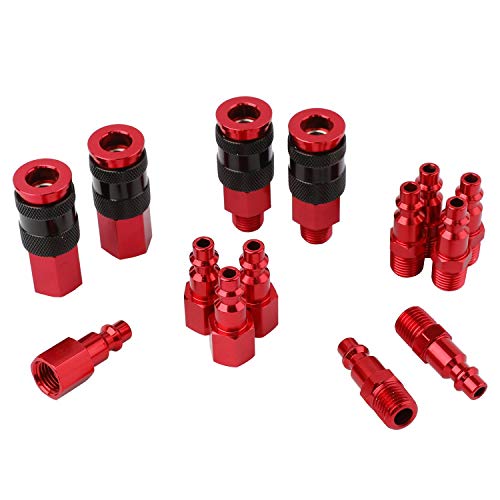
WYNNsky 14-Piece 1/4-Inch Air Fitting Kit
Equipped with automatic push-to-connect couplers, this 14-piece accessory set allows workshops to run multiple tool lines across standard I/M, ARO, and T interchanges. Its lightweight aluminum construction provides a ready-to-use assortment of standard 1/4-inch NPT plugs and couplers.
Pros
- Compatible with three common plug standards
- Quick push-connect design needs no sleeve pulling
- Six-ball locking system provides secure grip
- Includes 14 matching 1/4-inch NPT fittings
Cons
- Aluminum is softer than solid brass fittings
- Restricted to 1/4-inch body size air lines
FYCQER 25-Foot Coiled Air Hose (1/4 Inch)
Built from flexible polyurethane, this self-storing coiled hose extends your reach up to 25 feet without tangling. Its 300 PSI rating and pre-sealed brass fittings make it a dependable pick for light garage work and tire inflation.
Pros
- Pre-sealed brass fittings ensure secure, leak-resistant connections
- Compact coil profile snaps back quickly for easy storage
- Rated up to 300 PSI for high-pressure tools
- Wide operating temperature range prevents cold-weather kinking
Cons
- Coil tension may pull back when stretched near 25 feet
- 1/4-inch inner diameter limits high-CFM air tools
- 25-foot length may feel short for larger workshop layouts
Sixzoo 20-Inch Tire Inflator Hose Adapter
Adding 20 inches of reach, this Sixzoo replacement hose upgrades portable tire inflators with a hands-free locking chuck and an integrated thumb release for quick pressure adjustments. It serves as a practical accessory for drivers and cyclists navigating hard-to-reach valve stems.
Pros
- Thumb button enables fast deflation and pressure adjustments
- Solid brass locking chuck allows hands-free inflation
- Durable woven fabric resists high pressure and cracking
- Includes Presta and M6/M8 adapters for versatility
Cons
- Requires standard fine-thread Schrader inflator port
- Added 20-inch length takes up extra storage space
The Complete Guide to Air Compressor Hose Compatibility
Anyone setting up a pneumatic system quickly realizes that air hoses are not universal one-size-fits-all components. While many consumer hoses share similar exterior appearances, their internal diameters, end thread standards, and quick-disconnect couplers differ substantially. Sizing the wrong line or pairing mismatched fittings causes air leaks, dangerous blow-offs, and severe tool power loss. Reviewing how each part of an air line functions ensures your pneumatic tools receive steady airflow without unnecessary strain on your compressor pump.
The Short Answer: Why Air Hoses Are Not Truly Universal
The straightforward answer to whether pneumatic lines are universal is no. An air compressor hose assembly consists of three separate mechanical components: the flexible tubing itself, the threaded end fittings, and the quick-disconnect couplers or plugs attached to those ends. While 1/4-inch dimensions represent the most widespread consumer baseline, variation exists across every single component. Assuming that any replacement hose will automatically click onto your existing tools often leads to immediate leaks or connection failure.
Compatibility depends on matching both the threaded connection and the quick-coupling profile to your specific equipment. A hose fitted with an Automotive Type T plug will not seat into a standard Industrial Type M coupler, even if both components feature 1/4-inch threaded bases. Furthermore, the inner diameter of the hose directly dictates the cubic feet per minute (CFM) of air that can reach your tool. Sizing these elements correctly prevents motor strain and keeps regulated line pressure stable.
Thread Standards: Understanding 1/4-Inch NPT and Conical Sealing
Most air compressors and pneumatic accessories sold in North America use National Pipe Taper (NPT) threads. For example, kit packages like the SARDVISA 22-Packs Air Compressor Kit with 25-Ft PU hose feature standard American 1/4-inch NPT conical threads on all accessories. Unlike straight machine threads that require an internal O-ring or gasket to seal, NPT fittings rely on tapered threads that wedge tightly together as you turn them with a wrench. This tapered geometry creates a mechanical wedge that seals against escaping pressurized air.
Even with tapered NPT geometry, microscopic gaps between the metal threads can permit persistent air leaks if left bare. Applying two to three wraps of Teflon thread sealant tape or liquid pneumatic thread paste is necessary to ensure an airtight seal. Some modern assemblies, such as the FYCQER Air Hose 1/4 NPT x 25 Feet coiled hose, include pre-applied thread sealant directly on the brass fittings to streamline installation. Straight threads like NPS or British BSPT threads require dedicated conversion adapters before they can pair safely with NPT compressor manifolds.
Quick-Connect Plug Styles: Industrial, Automotive, and ARO Profiles
The biggest source of confusion regarding hose universality stems from quick-connect couplers and male plugs. Manufacturers produce several distinct interchange patterns, with Industrial (Type I/M), Automotive (Type T), and ARO (Type A or 210) being the most prevalent. The Industrial Type I/M profile is the standard found on most retail portable compressors and lightweight finish nailers. It features a recognizable short nose and a wide retention groove designed to lock securely behind the coupler bearings.
Automotive Type T plugs feature a longer cylindrical nose and a narrower collar, whereas ARO plugs have a distinct stepped profile. If you attempt to force an Automotive plug into an Industrial coupler, the locking sleeve will usually refuse to slide forward and latch. Even if you manage to force a mismatched plug into place, pressurized air will blow past the internal seal or violently eject the hose under load. Checking the stamp on your existing plugs or matching profiles visually is essential before purchasing replacement fittings.
Universal Couplers: Bridging the Gap Between Competing Interchanges
Workshops that operate multiple pneumatic tools often accumulate a mixture of Industrial, Automotive, and ARO plugs over time. Replacing every plug on dozens of air tools is both tedious and unnecessary when universal couplers are available. A multi-fit solution like the WYNNsky 1/4” Air Compressor Hose Fittings set uses universal couplers engineered to accept I/M, ARO, and T type interchanges interchangeably. These couplers utilize an internal locking arrangement with six precision steel balls to hold differing plug profiles firmly against the internal sealing ring.
Universal couplers provide exceptional convenience in busy garage environments where friends or coworkers bring their own pneumatic tools. A push-on style sleeve allows users to snap a plug into the coupler automatically without pulling back the collar manually. While universal couplers solve connection mismatch headaches, they still adhere to standard 1/4-inch NPT threads at the base. This design preserves thread compatibility while eliminating the frustration of hunting for matching quick-connect profiles.
Inner Diameter Dynamics: 1/4-Inch vs. 3/8-Inch Air Delivery
Beyond end fittings, the internal diameter of the hose body plays a critical role in pneumatic tool performance. A 1/4-inch inner diameter hose, such as the YOTOO Polyurethane Recoil Air Hose, provides adequate airflow for intermittent tools like brad nailers, tire inflators, and blow guns. Because these tools consume air in short bursts, the slight frictional restriction of a 1/4-inch line does not cause noticeable performance drops. The lighter weight and superior flexibility of 1/4-inch tubing also reduce wrist fatigue during extended assembly work.
Continuous-demand air tools like rotary sanders, dual-action polishers, and high-torque impact wrenches draw high CFM ratings that can starve through a narrow 1/4-inch line. Forcing high volumes of air through a 25-foot or 50-foot narrow hose causes significant friction, resulting in substantial dynamic pressure drop at the tool inlet. In continuous operation, an impact gun might drop from 90 PSI static pressure down to 65 PSI operating pressure during heavy lug removal. Stepping up to a 3/8-inch inner diameter hose reduces line resistance and delivers the air volume needed for heavy shop tools.
Hose Material Selection: Polyurethane, Hybrid Blends, and Recoil Coils
Hose construction material dictates flexibility, weight, kinking resistance, and temperature durability. Traditional rubber hoses offer excellent durability and lay flat easily, but their substantial weight makes them clumsy for overhead trim work or mobile repairs. Polyurethane hoses, featured in products like the RainBello 25FT 1/4 Inch Air Hose Reinforced model, offer an exceptional balance of lightweight portability and extreme abrasion resistance. Polyurethane resists cuts and grease, making it well-suited for demanding garage and workshop floors.
Hybrid hoses have become increasingly popular by blending the flexibility of rubber with the light weight of PVC. The Furesn Air Hose 1/4 in x 25 ft utilizes a woven middle layer sandwiched between hybrid inner and outer layers to resist kinking and punctures. Hybrid materials remain pliable in cold working environments, operating reliably from -40°F up to 150°F without stiffening into unmanageable coils. This thermal stability prevents line coiling when working outdoors in unheated garages during winter months.
Self-coiling recoil hoses provide unmatched organizational benefits in compact workspaces and assembly benches. A coiled polyurethane hose snaps back automatically into a tight footprint when released, preventing tripping hazards and keeping hoses off dirty shop floors. Both the YOTOO and FYCQER coiled lines offer 25-foot operating reach while compressing down to a fraction of that size during storage. Recoil hoses excel for benchtop detailing, tire inflation, and blow-off stations where long trailing hoses would create clutter.
Working Pressure and Burst Ratings: Matching PSI to Tool Demand
Operating pressure thresholds represent another crucial compatibility factor that buyers often overlook. Light-duty nylon recoil hoses may carry maximum working limits around 120 PSI, which is insufficient for two-stage compressors or high-pressure tank outputs. In contrast, heavy-duty options like the RainBello reinforced hose and Furesn hybrid hose are rated for up to 300 PSI working pressure. Furesn lists a bursting pressure rating of up to 1200 PSI, providing an immense safety buffer against pressure spikes.
Most portable home compressors operate within an 85 to 150 PSI range, governed by an automatic pressure switch cut-out mechanism. The SARDVISA PU air hose lists a maximum working pressure up to 200 PSI, though the manufacturer recommends operating below 120 PSI for extended longevity. Matching the hose working pressure to your compressor maximum output ensures the casing will not bubble, delaminate, or burst unexpectedly. Always verify that your line rating exceeds your regulator maximum setting by a comfortable margin.
Field Repairability and Swivel Ends: Solving Jobsite Wear
Air hoses endure constant dragging over rough concrete, sharp metal edges, and heavy shop equipment, which can lead to localized pinholes. Traditional hoses feature factory-crimped brass ferrules that require cutting the hose and finding specialized crimping tools to repair. The SARDVISA 22-Packs Air Compressor Kit addresses this issue with a repairable PU hose featuring detachable 1/4-inch MNPT plugs. If the hose sustains damage near an end, you simply unscrew the plug, trim the damaged section cleanly, and reinstall the compression interface.
Kinking near the end fittings is another primary cause of premature pneumatic line failure. Installing integrated bend restrictors, as found on the YOTOO and Furesn lines, distributes mechanical strain away from the brass barb. Furthermore, swivel end fittings prevent the hose from twisting into knots as you maneuver an air tool around a vehicle chassis. Swivel brass connections, like those on the RainBello reinforced line, maintain unrestricted air flow while significantly reducing wrist fatigue during detailed tasks.
Specialty Adapters: Navigating Schrader Valves and Inflator Hoses
Certain pneumatic tasks require dedicated adapter lines rather than standard quick-connect workshop hoses. Vehicle tire inflation represents a common scenario where universal hose assumptions break down completely. Tires use standard fine-thread Schrader valves (0.305-inch x 32 TPI), which cannot accept standard 1/4-inch NPT pneumatic plugs without an intermediate chuck. The Sixzoo 20 Inch Tire Inflator Hose Adapter solves this interface problem by bridging the gap between portable air inflators and vehicle valve stems.
Specialized inflator lines incorporate dedicated features such as thumb-operated quick air release buttons to bleed excess pressure safely. The Sixzoo replacement hose features a solid brass locking chuck with internal rubber sealing rings to prevent air loss during vehicle maintenance. It also includes Schrader-to-Presta valve adapters and M6/M8 thread adapters for bicycles, sports equipment, and inflatable mattresses. Recognizing when a task requires a dedicated valve adapter prevents forcing ill-fitting shop connectors onto delicate inflation stems.
Building a Reliable, Leak-Free Workshop Air Connection
Assembling a leak-free pneumatic delivery system requires careful component matching and clean assembly practices. Start by ensuring all male NPT threads are clean and wrapped with Teflon tape in the direction of the thread spiral. Thread the brass fittings into the coupler or tool inlet by hand first to avoid cross-threading, then tighten them securely with two wrenches. One wrench should brace the tool or hose fitting while the second tightens the hex collar, preventing rotational strain on the hose body.
Once pressurized, inspect your connections for silent pressure bleeding by applying a soapy water solution to all threaded joints and quick-connect interfaces. Escaping air will create expanding bubbles, identifying connections that require additional tightening or fresh thread sealant. Daily maintenance also requires draining condensation from your compressor tank bottom drain valve, as moisture traveling through air lines accelerates internal corrosion in brass couplers and air tools. Keeping your lines dry and properly connected guarantees maximum tool power and system efficiency.
Practical Takeaways for Sizing Your Pneumatic Lines
Choosing the right air compressor hose comes down to matching thread types, coupler profiles, and internal tubing diameters to your specific workload. While 1/4-inch NPT fittings serve as the common standard, verifying that your quick-connect couplers match your tool plugs eliminates connection headaches. High-demand tools require larger 3/8-inch lines, whereas lightweight polyurethane or recoil hoses excel for bench work and intermittent fastening. Prioritizing correct fittings and durable materials ensures dependable, safe, and leak-free performance on every workshop project.
About the author
Clint DeBoer is an experienced tool-industry specialist with decades of involvement in technical media, hands-on product evaluation, and testing methodology. His focus on performance, practical usability, and data-driven comparisons makes his expertise highly relevant to professional air compressors, pneumatic tools, and workshop equipment.