
Is a Portable Air Compressor Good? A Practical Guide
Is a portable air compressor good for your tools, tires, and workspace? Compare real-world limits and useful features for November 2026.
 By Tony Carrick
Updated November 22, 2026


A compact compressor can save a trip to a service station or keep a nailer close at hand, but portability alone doesn’t make every model suitable for every job. The useful answer to is a portable air compressor good depends on whether its delivered airflow, tank reserve, power source, and duty limits fit the work you actually plan to do.
Small tire inflators and battery-powered pumps are convenient for topping off tires and inflating sports gear, while tank-style electric compressors can also support some pneumatic tools. Neither category should be assumed to run a high-air-demand tool continuously. Check the manufacturer’s airflow and operating instructions before buying, and compare the tool’s requirements with the compressor’s stated output rather than relying on maximum PSI alone.
The products below range from compact vehicle inflators to tank compressors, including models with digital gauges, automatic shutoff, and different power options. For a broader view of workshop use, see our air compressor options for furniture work. The right portable setup is the one that solves the frequent task without being asked to deliver more air or runtime than its specifications support.
Product Shortcode
| Award | Product | ACR Score About ACR ScoreThe ACR Score is our own rating from 0 to 10, based on performance, design and build, ease of use, and value. It reflects independent research and is never influenced by manufacturers, retailers, or affiliate commissions. Learn more › | |
|---|---|---|---|
| Best Overall |
CRAFTSMAN 12V Portable Tire Inflator with
|
9.2/10 | Buy |
| Best Budget |
 AstroAI H2 Pro Cordless Tire Inflator 150 PSI |
9.2/10 | Buy |
| Best Premium |
 VEVOR 13-Gallon 2HP Quiet Air Compressor |
9.2/10 | Buy |
| Best Value |
 DEWALT Cordless Tire Inflator Portable Air |
9.1/10 | Buy |
 CRAFTSMAN 2-Gallon Portable Air Compressor |
9.1/10 | Buy | |
 KANWITY 160 PSI Portable Tire Inflator |
8.9/10 | Buy | |
 ECOMAX 6-Gallon 150 PSI Portable Pancake Air |
8.8/10 | Buy | |
 AstroAI AIRUN H 12V DC Portable Air Compressor |
8.4/10 | Buy | |
 VIAIR 88P 12V Portable Air Compressor |
8.4/10 | Buy | |
 Airmoto 120 PSI Portable Tire Inflator |
8.3/10 | Buy |
CRAFTSMAN 12V Portable Tire Inflator with
The CRAFTSMAN 12V Portable Tire Inflator is an ultra-compact 1.9-pound roadside unit delivering up to 150 PSI with digital auto shut-off and built-in cord storage. Powered via a standard 12V car accessory plug, it offers fast tire top-offs and dependable emergency inflation without crowding trunk space.
Pros
- Weighs only 1.9 pounds for effortless glove box, under-seat, or trunk storage during road trips
- Digital auto shut-off prevents accidental over-inflation without requiring constant manual gauge monitoring
- Bright three-mode LED light provides critical illumination during nighttime roadside emergencies
- Comes fully equipped with multi-valve adapters, a replacement fuse, and a tailored carry pouch
Cons
- Requires a 12V DC vehicle accessory socket and does not include a 120V AC household outlet adapter
- Compact tankless pump is built strictly for tire inflation and cannot drive pneumatic nailers or air tools
- The 2.17-foot air hose length means the compressor must sit on the ground adjacent to the wheel valve stem
AstroAI H2 Pro Cordless Tire Inflator 150 PSI
The AstroAI H2 Pro is a versatile dual-power portable tire inflator delivering up to 150 PSI via an internal rechargeable lithium battery or 12V DC vehicle plug. Featuring digital auto shut-off, accurate dual pressure displays, and onboard accessory storage, it is an ideal roadside emergency and garage solution for vehicle owners and cyclists.
Pros
- Dual power supply provides cordless convenience with a 12V DC vehicle fallback for roadside emergencies.
- Automatic shut-off and dual digital display prevent overinflation and eliminate manual pressure monitoring.
- ToughUltra internal components improve mechanical durability compared to standard plastic gear assemblies.
- Integrated nozzle storage compartment keeps bicycle adapters and ball needles organized inside the unit.
Cons
- Tankless high-pressure inflator design is not compatible with pneumatic workshop air tools like nailers or impact wrenches.
- Cordless runtime is limited to approximately 18 minutes before requiring a recharge or switching to the 12V DC vehicle cord.
- Direct-drive high-pressure pump requires cool-down pauses during continuous multi-tire inflation tasks.
VEVOR 13-Gallon 2HP Quiet Air Compressor
Delivering 4.6 SCFM at 90 PSI with a quiet 66-decibel sound profile, this 13-gallon compressor suits home garages and workshops needing steady air supply without disruptive motor noise. Its oil-free 2HP motor fills the tank in under three minutes, while large rubber wheels help maneuver its substantial 71-pound frame.
Pros
- Quiet 66-decibel noise level during operation
- Oil-free motor design eliminates routine maintenance
- Fast air buildup in under three minutes
- Sturdy 7-inch rubber wheels assist transport
Cons
- Heavy 71-pound weight makes vehicle loading difficult
- Maximum 125 PSI ceiling limits high-pressure tools
DEWALT Cordless Tire Inflator Portable Air
This compact DEWALT portable tire inflator delivers up to 150 PSI with smart auto shut-off, powered by an internal rechargeable battery or an included 10-foot 12V car plug. It provides an efficient, pocket-sized solution for vehicle owners, cyclists, and DIYers wanting rapid roadside top-offs without hauling a bulky tank compressor.
Pros
- True cordless freedom with an internal rechargeable battery plus a 10-foot 12V DC vehicle plug backup
- Accurate digital pressure gauge with 5 smart presets and automatic shut-off to eliminate overinflation
- Ultra-compact handheld design weighing just 0.63 kg for easy storage in glove boxes or saddlebags
- Integrated LED work light and emergency USB power bank functionality for travel safety
- Generous accessory bundle backed by a 3-year limited warranty
Cons
- Engineered exclusively for high-pressure inflation rather than operating pneumatic air tools or nailers
- Does not include a 120V AC residential wall outlet power adapter
- Compact tankless pump requires periodic cooling breaks during heavy multi-tire inflation runs
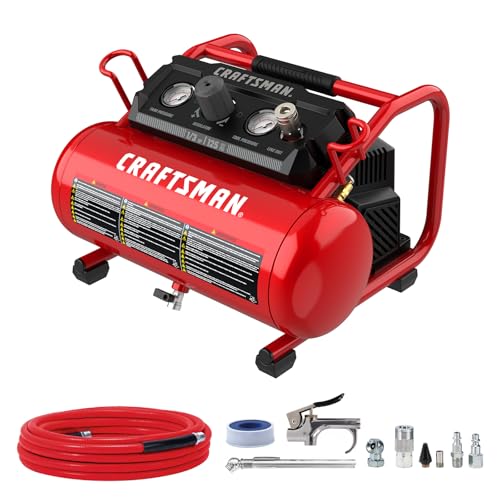
CRAFTSMAN 2-Gallon Portable Air Compressor
This CRAFTSMAN 2-gallon portable compressor package pairs a max 125 PSI oil-free pump with a versatile 10-piece pneumatic accessory kit using standard 1/4-inch NPT fittings. It is a practical, lightweight solution for DIYers and homeowners tackling tire inflation, air dusting, and light fastening.
Pros
- Complete out-of-the-box pneumatic package with air hose, blow gun, tire chuck, and 1/4-inch NPT quick-connect hardware
- Lightweight 19-pound carry weight makes moving between the garage, driveway, and workbench effortless
- Oil-free pump eliminates crankcase oil checks and prevents oil aerosol contamination in downstream air lines
- Dual quick couplings allow quick hookups without needing additional brass splitters
Cons
- Small 2-gallon receiver tank and 1/3 HP motor are limited to light-duty pneumatic tasks rather than continuous air-hungry tools
- The included starter air hose and accessories are entry-level components that high-volume shops may eventually want to upgrade
- Fittings utilize standard 1/4-inch auto profile plugs which require matching couplers if your shop uses alternate pneumatic profiles
KANWITY 160 PSI Portable Tire Inflator
Delivering up to 160 PSI using either an internal 8000 mAh battery or 12V car power, this compact compressor is built for quick roadside tire top-offs. Its multi-mode digital interface, integrated emergency light, and mobile charging capability make it a practical tool for glove-box storage.
Pros
- Dual battery and 12V DC car power options
- Fast 30L/min inflation with auto shut-off
- Accurate digital gauge with four pressure units
- Includes emergency light and USB power bank
Cons
- Lacks support for standard household AC wall outlets
- Relatively heavy for a handheld tool at nearly 1.9 pounds
ECOMAX 6-Gallon 150 PSI Portable Pancake Air
The ECOMAX 6-Gallon 150 PSI Pancake Air Compressor delivers portable, low-maintenance pneumatic power with its 1.5 HP oil-free pump, dual quick-connect couplers, and bundled 10-piece accessory kit. Featuring cold-weather starting support and a flip-up handle, it is an accessible choice for DIYers, trim carpenters, and garage tire maintenance.
Pros
- Comes with a 10-piece accessory kit including an air hose, tire chuck, and blow gun ready out of the box
- Dual quick-connect couplers enable two operators to run pneumatic lines simultaneously
- Oil-free pump design requires zero motor oil maintenance and prevents oil discharge into air lines
- Low-voltage and cold-weather startup capability helps ensure reliable motor turnover in chilly garages
- Flip-up carrying handle and built-in cord bracket simplify transport and tidy storage
Cons
- PVC air hose included in the kit can become stiff and difficult to manage in freezing temperatures
- Not intended for continuous high-demand air tools such as rotary sanders or automotive paint sprayers
- Standard universal motor noise level makes hearing protection advisable during indoor use
AstroAI AIRUN H 12V DC Portable Air Compressor
The AstroAI AIRUN H is a compact 12V DC tire inflator delivering up to 35 L/min airflow with automatic shut-off and digital pressure presets. It is an ideal portable emergency compressor for drivers, commuters, and garage hobbyists seeking fast tire top-offs.
Pros
- Automatic shut-off stops pumping reliably once target PSI is reached
- High-airflow 120W motor provides rapid top-offs for daily driver tires
- Long 9.84-foot power cord reaches all passenger vehicle wheels with ease
- Bright built-in LED flashlight and backlit display assist during night repairs
- Lightweight 2.2-pound form factor stores neatly in glove boxes and trunks
Cons
- Requires a 12V DC vehicle outlet and does not include a 120V AC household plug
- Mandates a 10-minute cool-down interval after 15 minutes of continuous operation
- Not intended for high-volume inflatables like large pool floats or air mattresses
VIAIR 88P 12V Portable Air Compressor
Designed for passenger cars and light trucks with tires up to 33 inches, the VIAIR 88P delivers dependable 120 PSI output directly from a vehicle battery. Its generous 26-foot total reach, built-in gauge, and integrated work light make it a practical emergency companion for road trips and camping.
Pros
- Solid 1.47 CFM flow rate provides brisk inflation
- Generous 26-foot reach easily accesses all four tires
- Built-in LED work light aids dark roadside repairs
- Compact body weighs under five pounds for convenient storage
Cons
- Requires direct battery connection instead of standard 12V outlet
- Limited to a 25-minute duty cycle before cooling
- Not designed for tires larger than 33 inches
Airmoto 120 PSI Portable Tire Inflator
Weighing just 1.2 pounds, this compact cordless compressor delivers up to 120 PSI with automatic shutoff for routine top-offs on cars, bikes, and sports gear. Its pocket-sized form factor stores neatly in a glove box, serving as a convenient roadside backup.
Pros
- Extremely compact and lightweight design
- Auto shut-off prevents accidental over-inflation
- Clear digital LCD display with real-time pressure reading
- Integrated LED light aids night roadside repairs
- Internal hose storage keeps accessories organized
Cons
- Not suitable for heavy-load tires or large inflatables
- Cold temperatures and large tires drain battery quickly
- Requires frequent recharging before heavy usage
Is a Portable Air Compressor Good for Your Needs?
Yes, a portable air compressor can be a good choice when its power source, airflow, and operating limits match the task. For tire maintenance and small inflatables, compact inflators are easy to store and bring to the vehicle. A tank-style model can serve a wider range of home and workshop tasks, but portability does not make it a substitute for a larger compressor when a tool needs sustained high airflow.
The products listed here illustrate why the label “portable” covers several different machines. Some connect to a vehicle’s 12-volt outlet or battery, some have rechargeable batteries, and others are electric tank compressors with capacities from two to thirteen gallons. Those differences affect where a compressor can be used, how much air it stores, and which tasks are realistic. Start with the job, then consider the machine’s specifications.
First separate tire inflators from tank compressors
A compact tire inflator is designed primarily to add air to tires and smaller inflatables. The CRAFTSMAN 12V tire inflator, for example, lists a 150 PSI maximum, a digital gauge, automatic shutoff, and a 12-volt vehicle plug. The AstroAI AIRUN H is another vehicle-powered option, with a stated 120 PSI maximum and a cord that reaches around a vehicle. Such maximum-pressure figures describe a limit, not the amount of air delivered per minute or a promise to operate pneumatic tools.
Rechargeable models trade a vehicle cord for battery convenience, but their supplied details still matter. AstroAI’s H2 Pro lists both a rechargeable battery and 12-volt DC power, while the DEWALT inflator is described as battery-powered and corded with a 12-volt connection. Airmoto is a compact rechargeable inflator. These options may suit roadside top-offs or occasional household inflation, but battery charge, temperature, tire size, and the maker’s operating guidance influence use. They are not equivalent to an electric compressor with a storage tank.
Tank compressors store compressed air for use through a hose and fittings. The CRAFTSMAN two-gallon compressor is listed at 125 PSI maximum, and the ECOMAX pancake model has a six-gallon tank and 150 PSI maximum. The VEVOR has a 13-gallon tank, a stated 125 PSI maximum, and a listed 4.6 SCFM at 90 PSI. These are materially different formats and capacities. A larger tank stores a greater volume of air, but it does not by itself establish the pump’s sustained airflow or tool compatibility.
Match airflow to the tool, not just the pressure number
PSI and airflow answer different questions. PSI describes pressure, while SCFM describes a standardized volume of delivered air per minute. A tool may require a certain pressure and airflow together, so compare its stated requirements with the compressor’s delivery rating at the relevant pressure. A compressor’s maximum PSI alone cannot tell you whether it can keep a tool operating without pauses.
Intermittent tools such as brad nailers typically consume air in brief bursts, allowing a tank to provide a short reserve between pump cycles. That does not mean every small compressor can support every nailer or a rapid firing pace. Read the tool’s air-consumption specification and the compressor’s delivered-air data, then consider whether the pump can replenish the air being used. Product descriptions that do not state SCFM at the required pressure leave an important part of the comparison unknown.
Continuous-use tools present a different challenge. Sanders, grinders, and many spray applications can demand air for longer periods, making pump output and duty limits more important than the tank’s initial reserve. A small tank may empty quickly under sustained demand, after which the pump has to catch up. Do not assume that a model advertised for painting or workshop use can run any particular spray gun continuously; verify the specific tool’s airflow requirement against the compressor’s published delivery and follow both manufacturers’ instructions.
The VEVOR listing provides a useful example of a specification that helps with this check: 4.6 SCFM at 90 PSI. That number can be compared with a tool’s stated requirement at the same pressure, though actual suitability still depends on the tool, fittings, hose, and intended duty. The ECOMAX listing says it delivers three cubic inches of air at 90 PSI, but that is not a standard SCFM figure and should not be treated as one. If a listing omits a comparable delivered-air rating, avoid filling the gap with assumptions.
A larger tank can smooth short bursts and reduce how quickly stored air is depleted, but it cannot make an undersized pump deliver more air over time. Conversely, a pump with adequate delivery may still need to cycle as demand fluctuates. For abrasive or sustained shop applications, use the tool’s airflow data and the compressor manufacturer’s guidance to assess the match. Our compressor choices for abrasive work provide related context for air-hungry equipment.
Choose power and portability around where you work
A 12-volt inflator is convenient away from a wall outlet, but check how it connects and what operating limits apply. The VIAIR 88P, for example, is specified for direct battery-clamp operation and lists a 25-minute duty cycle at 30 PSI. That stated limit is more useful than assuming a compact unit can run indefinitely. It is listed for vehicle and other inflation tasks, but the right choice still depends on tire size and the manufacturer’s instructions.
Rechargeable inflators avoid a power cord during use, which can make them easy to keep in a vehicle. AstroAI’s H2 Pro also lists a 12-volt DC option, giving buyers a corded fallback when the battery is depleted. However, do not assume the listed battery runtime or charging performance will apply equally in every condition. The product descriptions note that factors such as temperature and the inflation task can affect battery performance. Keep the unit charged as directed if you expect to rely on it during travel.
Tank compressors require access to an appropriate electrical supply and are less compact than handheld inflators. The two-gallon CRAFTSMAN is listed at 19 pounds, while the ECOMAX six-gallon pancake compressor is listed at 34.17 pounds and includes a carrying handle. The VEVOR 13-gallon model has wheels, which may help move it between locations but does not make it a handheld unit. Think about lifting, stairs, vehicle storage, and where the compressor will sit during operation before choosing a tank size.
Electrical details deserve attention with plug-in tank models. The supplied descriptions do not state startup amperage or guarantee compatibility with a particular household circuit, so do not infer that from tank size or horsepower alone. Use the manufacturer’s electrical requirements and a suitable, properly grounded outlet. If an extension cord is permitted, follow the compressor maker’s guidance for cord length and wire gauge; a long or undersized cord can cause voltage drop and motor trouble. Never bypass grounding or protective devices.
Consider noise, maintenance, and included controls
Noise can matter in a garage, shared workspace, or occupied home, but the available products provide limited comparable sound data. The VEVOR is described as operating at 66 dB, while the other product listings do not provide a matching measured sound rating. Treat that figure as a manufacturer-listed specification, not as proof that every operation or location will seem quiet. If noise is a deciding factor, compare sound information measured under comparable conditions and consider hearing protection where the manufacturer’s guidance calls for it.
Oil-free pump designs can reduce routine lubrication work, and several tank compressors here are listed as oil-free. The CRAFTSMAN two-gallon model is described as having an oil-free pump, as are the ECOMAX and VEVOR units. That may be appealing for general home use and transport, but “oil-free” does not mean maintenance-free in every respect. Follow the manual for intake care, tank drainage, operating limits, and storage. Do not infer pump lifespan from the lubrication type alone.
Controls and accessories can make a compressor more convenient without changing its underlying air capacity. Digital inflators with preset pressure and automatic shutoff can simplify routine tire top-offs, while a tank compressor’s gauges and quick couplers support hose-based tasks. The two-gallon CRAFTSMAN listing includes an accessory kit, and ECOMAX lists a hose and inflation accessories. Check that included fittings match the equipment you intend to connect, and verify thread and coupling requirements rather than assuming all accessories are interchangeable.
Automatic shutoff on a tire inflator is useful for reaching a selected target, but it is not a substitute for checking the vehicle or equipment manufacturer’s pressure specification. Set the target based on the proper recommended pressure, not the maximum printed on the tire sidewall or the inflator. Inspect the gauge and valve connection if a reading seems inconsistent. For a tank compressor, use its regulator and pressure instructions as specified, and do not exceed the machine’s rated maximum pressure.
Use a portable compressor within its limits
Compressed-air equipment needs routine attention even when its pump is oil-free. Tank compressors collect moisture as air is compressed, so drain condensation according to the manual and in the manner the manufacturer specifies. Moisture left in a tank can contribute to corrosion over time. Before maintenance or transport, follow the maker’s depressurization instructions and disconnect the power source. Do not attempt to repair a damaged or corroded pressure vessel yourself.
Use hoses and fittings rated for the intended pressure, secure connections, and keep hands clear of pressurized air discharge. Wear eye protection when connecting or using pneumatic equipment, and use hearing protection where noise exposure warrants it. Inspect the hose, coupling, and power cord for damage before operation. If the compressor behaves unusually, leaks, overheats, or fails to shut off as expected, stop using it and consult the manual or a qualified service provider rather than altering pressure controls or safety devices.
For roadside use, secure the vehicle, connect the inflator as directed, and monitor the pressure rather than leaving the equipment unattended. Respect the inflator’s stated duty cycle and allow any required cooling time before another operating period. The VIAIR listing’s duty-cycle information is specific to that product and condition, not a general rule for other inflators. For rechargeable units, a charged battery and a safe storage location matter as much as the headline maximum-pressure number.
For workshop use, assess whether the job is occasional inflation, intermittent fastening, or sustained air consumption. A compact tire pump is not the right substitute for a tank compressor just because both are called air compressors. A tank model is not automatically right for a continuous-demand tool just because it has a high maximum PSI. Match delivered airflow, pressure, duty guidance, and power availability to the task, and choose extra capacity only when the specifications support the work.
In practical terms, a portable compressor is a good purchase when it solves a clearly defined need without forcing the equipment beyond its stated limits. For vehicle readiness, compare connection type, automatic shutoff, pressure display, duty cycle, and storage. For pneumatic tools, prioritize comparable airflow data and the tool’s pressure requirements, then consider tank reserve and recovery. If those figures are missing, ask the manufacturer or choose a model with clearer specifications before relying on it for demanding work.
About the author
Tony Carrick is an experienced product researcher and writer specializing in tools, home improvement, automotive maintenance, and consumer equipment. With extensive experience reviewing tools and tackling hands-on renovation projects, he brings a buyer-focused perspective to compressor performance, usability, and overall value.