
Can an ARB Portable Air Compressor Be Mounted?
Can an ARB portable air compressor be mounted? Learn the difference between portable and onboard setups, safe placement, and fit checks for November 2026.
 By Kenny Koehler
Updated November 22, 2026


A compressor that slides around in a vehicle can become a nuisance on rough roads, but permanently fastening a portable unit raises questions about airflow, heat, wiring, and access. Can an ARB portable air compressor be mounted depends on the specific model and whether its design includes vehicle-mounting hardware. ARB sells both portable compressors in protective cases and onboard compressors intended for installation, so the word portable alone does not establish that a unit can be bolted into a vehicle. Identify the exact model first, then follow its installation information rather than adapting a case or bracket by guesswork.
The distinction matters for overlanders, RV owners, and drivers who want a dependable place for tire inflation equipment without compromising service access or safety. A portable case can be restrained for transport, but that is not the same as converting a portable kit into a permanent onboard system. The product information supplied for the ARB CKMP12V2 describes a weather-resistant carry case, while the CKMA12 and CKMTA12 are described as onboard models. If your priority is a fixed installation, compare the intended mounting format, wiring arrangement, hose access, and available space before buying.
For broader context on vehicle-powered equipment, see this guide to portable compressors for vehicle and AC power. The models and product information below can help clarify which setup may suit your needs, but they do not replace the model-specific installation manual. Mounting hardware, electrical requirements, and permissible orientations can differ between versions. Treat the manufacturer’s instructions as the authority for a final installation decision.
Top Products
| Award | Product | ACR Score About ACR ScoreThe ACR Score is our own rating from 0 to 10, based on performance, design and build, ease of use, and value. It reflects independent research and is never influenced by manufacturers, retailers, or affiliate commissions. Learn more › | |
|---|---|---|---|
| Best Overall |
ALL-TOP Dual Cylinder 12V Air Compressor
|
9.2/10 | Buy |
| Best Value |
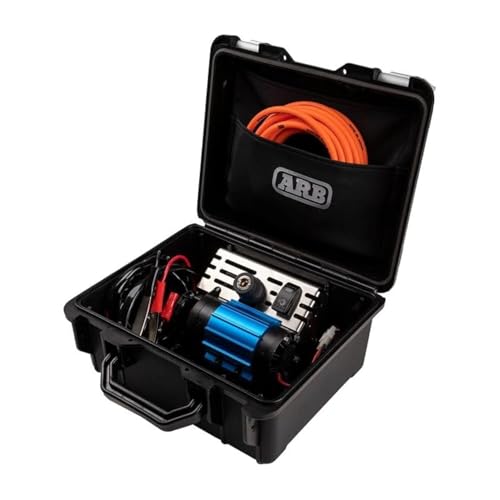 ARB CKMP12V2 12V Portable Air Compressor |
8.6/10 | Buy |
| Best Budget |
 ARB CKMA12 12V On-Board Air Compressor |
8.4/10 | Buy |
 ARB CKMTA12 12V Twin Air Compressor |
8.4/10 | Buy | |
 CRAFTSMAN 1.5 HP Wall-Mount Air Compressor |
8.3/10 | Buy | |
| Best Premium |
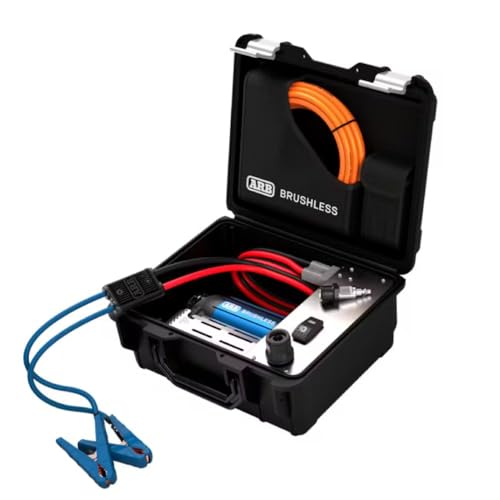 ARB CKBLP12 Brushless Portable Air Compressor |
8.3/10 | Buy |
 ARB CKMP12 12V Portable Air Compressor |
8.0/10 | Buy | |
 ARB CKMTP12 12V Twin Air Compressor |
8.0/10 | Buy | |
 ARB CKBLTP12 12V Twin Brushless Compressor |
7.8/10 | Buy |
ALL-TOP Dual Cylinder 12V Air Compressor
Built for rapid tire inflation on large trucks and off-road rigs, this dual-cylinder pump pushes an impressive 12.35 CFM flow rate up to 150 PSI. The rugged metal frame, integrated thermal safeguards, and extended 26-foot hose provide reliable utility for heavy-duty vehicle recovery.
Pros
- High 12.35 CFM output swiftly inflates large tires
- Dual aluminum cylinder construction helps dissipate heat
- Generous 26-foot hose reaches all corners of large vehicles
- Equipped with automatic thermal and over-current safety switches
Cons
- Heftier 24-pound build demands extra carrying effort
- Third-party gauges require built-in over-pressure protection
ARB CKMP12V2 12V Portable Air Compressor
Built for trail and beach recovery, this rugged 12V inflator is housed in a durable weatherproof case with internal thermal protection. It delivers reliable tire airing through a 23-foot heat-resistant hose and heavy-duty internals.
Pros
- Rugged weatherproof case protects components
- Long 23-foot hose reaches all tires easily
- Thermal protection prevents motor overheating
- Stainless steel heat shield enhances operator safety
- Hard-anodized bore ensures long-term durability
Cons
- 50 percent duty cycle limits continuous operation
- Relatively heavy at over 15 pounds
ARB CKMA12 12V On-Board Air Compressor
Designed for off-road setups, the ARB CKMA12 delivers reliable 12-volt air power for pneumatic differential lockers and tire inflation. Its sealed, moisture-resistant build and hard-anodized cylinder bore focus on long-term durability in tough environments.
Pros
- Sealed against moisture and dust contamination
- Hard-anodized cylinder bore reduces friction
- Integrated heavy-duty maxi-fuse circuit protection
- Engineered for quiet operation and long lifespan
Cons
- Requires permanent on-board vehicle installation
- Substantial unit weight at 7.7 pounds
ARB CKMTA12 12V Twin Air Compressor
Built for heavy-duty vehicle integration, this dual-motor system delivers a class-leading 6.16 CFM airflow rate capable of running pneumatic tools and rapid tire inflation. Sealed components, redundant thermal and electrical protection, and an included wiring harness suit it well for harsh off-road environments.
Pros
- Class-leading 6.16 CFM airflow rate
- Fully water-sealed motor design
- Built-in thermal and circuit redundancy protection
- Pre-wired harness simplifies vehicle installation
Cons
- Requires separate manifold kit to mount air lockers
- Nearly 20-inch length demands significant mounting space
CRAFTSMAN 1.5 HP Wall-Mount Air Compressor
Designed for garage workshops, this space-saving wall-mounted unit features a 30-foot retractable hose and an oil-free 1.5 HP motor for convenient tire inflation and light pneumatic tasks. Its compact 0.5-gallon tank recovers in roughly 20 seconds, providing a clean and organized setup for routine household maintenance.
Pros
- Convenient wall-mount design with 30-foot hose reel
- Low-maintenance oil-free motor runs in cold weather
- Quick 20-second tank recovery cycle
- Comes with versatile 8-piece starter accessory kit
Cons
- Small 0.5-gallon tank limits continuous heavy air tools
- Fixed wall mount reduces portability across job sites
ARB CKBLP12 Brushless Portable Air Compressor
Built for 4x4 tire inflation, this unit pairs a high-output brushless motor with active fan cooling for sustained trailside performance. Integrated electronic controls adjust to ambient temperature swings and protect against electrical surges without needing external relays.
Pros
- Significantly higher output than legacy brushed compressors
- Active fan cooling prevents motor overheating
- Integrated safeguards protect against voltage drops and stalls
- Elimination of external relays simplifies vehicle setup
Cons
- Heavier build at approximately 17 pounds
- Bulkier dimensions take up notable cargo space
ARB CKMP12 12V Portable Air Compressor
Built for rugged off-road utility, this sealed 12-volt compressor delivers dependable high-volume airflow with built-in thermal protection. Supplied with a 19-foot hose and durable carry case, it provides a comprehensive setup for demanding tire inflation tasks.
Pros
- High 2.65 CFM no-load airflow rate
- Durable dust and moisture-resistant sealed motor
- Built-in thermal overload and over-pressure protection
- Includes a long 19-foot hose and carry case
Cons
- Heavy total weight at nearly 15 pounds
- Large case dimensions occupy noticeable cargo space
- Requires direct connection to vehicle battery clamps
ARB CKMTP12 12V Twin Air Compressor
Engineered for demanding off-road tasks, this twin-motor compressor delivers class-leading airflow up to 6.16 CFM alongside an integrated aluminum tank for powering air tools. Housed in a rugged waterproof case, it provides a comprehensive mobile air solution despite its substantial carry weight.
Pros
- Exceptional airflow output reaching up to 6.16 CFM
- Built-in tank pressure supports most standard air tools
- Full 100 percent duty cycle at room temperature
- Rugged waterproof carry case keeps components organized
- Supplied with a durable 20-foot air hose
Cons
- Heavy total weight at 33 pounds
- Bulky case requires considerable storage space
ARB CKBLTP12 12V Twin Brushless Compressor
Built for demanding off-road tire inflation, this twin-motor unit pairs brushless technology with active cooling for continuous 100% duty cycle operation. It delivers high air volume up to 9.18 CFM alongside IP67 water resistance, making it a rugged choice for serious trail rigs.
Pros
- Continuous 100% duty cycle without thermal shutdown
- High airflow reaching 9.18 CFM at 0 PSI
- IP67 water-resistant construction withstands harsh outdoor conditions
- Active electronic cooling fans protect twin motors
- Includes 20-foot air hose and inflation chuck
Cons
- High 90-amp maximum draw demands substantial electrical capacity
- Total package weight approaches 30 pounds
- Large physical footprint requires ample mounting or storage space
Mounting an ARB Portable Compressor: What to Check
Yes, an ARB compressor can be mounted in a vehicle when the specific model is designed for that installation or its manufacturer documentation explicitly permits it. That answer does not mean every portable ARB kit should be permanently fastened to a body panel, cargo floor, or engine bay. A portable model may be intended to remain in its case and connect to a vehicle battery when needed, whereas an onboard model is designed around a fixed installation. Match the mounting plan to the model’s intended configuration, not merely to the fact that the compressor runs on vehicle power.
Product names and descriptions can create confusion because portable and onboard versions may share a model family or similar performance claims. The CKMP12V2 is described as a compact 12-volt portable compressor supplied in an impact-resistant, weatherproof polypropylene case. The CKMA12 is explicitly listed as an onboard compressor, and the CKMTA12 is an onboard twin compressor with a wiring loom. Those descriptions support a practical distinction: a carrying case points toward portable use, while an onboard designation and installation components point toward vehicle installation.
Portable case, restrained storage, or fixed installation
A portable compressor can still have a designated storage position inside a vehicle without being permanently installed as an onboard system. A restraint or compartment may keep a case from shifting during transport, but the restraint should not obstruct the case, vents, connectors, controls, or the manufacturer’s specified operating position. Do not assume that drilling through a case, adding improvised brackets, or enclosing the compressor preserves its intended protection. If the manual does not describe a mounting method, ask ARB or an authorized service source whether a fixed attachment is acceptable for that exact model.
Permanent installation changes how the compressor is exposed to vibration, dust, moisture, temperature, and service access. The CKMP12V2’s case is described as weatherproof and impact resistant, but that description does not establish that the compressor can be removed from the case and mounted bare in an engine compartment. Nor does a portable case automatically become a certified vehicle enclosure when fixed in place. Preserve the supplied configuration unless the instructions specifically approve another arrangement.
ARB’s CKBLP12 Brushless Air Compressor product information lists quick-release mounts for its onboard unit, indicating that a fixed base and removable compressor arrangement are part of that model’s described design. The CKBLTP12 product information also describes quick-release mounts for an onboard unit. That feature should not be generalized to older or different ARB compressors, and it does not explain every vehicle’s mounting requirements. Confirm the precise model, included hardware, and installation documentation before treating quick-release mounting as interchangeable across the range.
Choose the model format before planning the location
Start by reading the complete model designation on the compressor, packaging, or purchase record. The ARB CKMP12 portable kit description lists a 19-foot air hose, battery clamps, an inflation kit, and a carry case, while its product information also refers to a vehicle-mounted configuration with a wiring loom and mounting hardware. Because descriptions can cover more than one configuration, confirm which exact kit you own instead of assuming every CKMP12 package contains the same installation parts. The ARB CKMA12 and CKMTA12 listings identify onboard versions more directly.
For a fixed installation, check whether the model documentation specifies a mounting bracket, approved orientation, wiring loom, fuse protection, and clearance requirements. The supplied information for the CKMTA12 lists a full wiring loom and notes that an Air Locker Manifold Kit is required to mount solenoids for Air Locker use. That is a specific accessory note, not a universal requirement for ordinary tire inflation. Avoid transferring mounting instructions or accessories from one model to another without confirming compatibility with the manufacturer.
Space planning should account for the complete operating setup, not just the compressor’s footprint. The operator needs access to the power connection, hose outlet, controls, and any pressure switch or service points described in the manual. A hose that cannot reach the tires or a connector buried behind cargo can make a technically secure installation impractical. Measure the proposed location and compare it with the model’s documented dimensions and clearances; dimensions are not included for every product in the supplied information, so consult the actual product documentation.
Secure the compressor without compromising its case or cooling
A vehicle mounting surface should be stable enough for the installation method specified by the manufacturer and positioned so normal vehicle movement cannot pull on electrical leads or hoses. Do not use the air hose as a handle, restraint, or substitute for a mounting bracket. Keep hot surfaces and moving parts away from wiring and cargo, and do not block any cooling path identified in the instructions. If a location requires removing protective covers or changing the supplied assembly, stop and obtain model-specific guidance before proceeding.
Heat management matters because compressor motors and pump components warm during operation. The portable CKMP12V2 description identifies a stainless-steel heat shield over hot-touch areas, and the brushless onboard product descriptions identify active cooling fans. These details show why a buyer should not seal a compressor inside a small, unventilated compartment or assume that a case may be altered without consequences. Follow the manufacturer’s clearance and cooling requirements, and leave the compressor accessible for inspection.
Vehicle vibration is another reason to use only suitable mounting points and hardware. The supplied product descriptions do not specify universal bolt sizes, torque values, or approved body locations, so those details must come from the installation manual or vehicle guidance. Avoid drilling near fuel lines, brake lines, wiring harnesses, airbags, or structural components unless a qualified installer has confirmed the location is safe. A secure-looking improvised mount can create damage that is difficult to see after trim or panels are replaced.
Power wiring and air connections are part of the installation
A mounted 12-volt compressor needs an electrical supply arranged according to its model instructions. The CKMTA12 listing includes a wiring loom and dual heavy-duty Maxi-Fuses, and the CKMA12 listing mentions a heavy-duty Maxi-Fuse for in-line circuit protection. Those product details do not provide a complete wiring procedure or authorize substituting a different fuse, cable, or connection. Use the supplied or specified wiring components and have the installation checked by a qualified automotive electrician if the instructions or vehicle wiring are unclear.
Keep wiring away from sharp edges, hot surfaces, moving components, and locations where cargo can crush or snag it. Never bypass circuit protection or connect a compressor in a way that defeats the vehicle’s electrical safeguards. Disconnect power as directed before servicing, and avoid working on live wiring. The product information supplied here does not state a single amperage figure that applies to every model, so do not size wiring from a generic estimate.
Air delivery needs equal attention. A fixed compressor is only useful if its hose and fittings can reach the tires or tools without kinking, rubbing against hot components, or interfering with vehicle movement. The CKMP12V2 portable kit includes a 23-foot high-temperature hose rated to 150 PSI, but that specification belongs to that listed kit and should not be attributed to other models. Check the exact hose rating, fitting type, and pressure limits for your compressor and accessories before connecting them.
ARB onboard compressors may also be associated with Air Locker systems, tire inflation, or other pneumatic accessories, but the product listing determines what is included and what additional parts are required. The CKMTA12 listing identifies tire inflation and Air Locker applications and specifies a manifold kit for mounting solenoids. Do not assume that a tire-inflation connection supplies all controls or fittings for an Air Locker installation. For tool use, compare the tool’s required pressure and air consumption with the compressor’s documented delivery rather than relying on maximum PSI alone.
Buyers evaluating a fixed system for pneumatic tools may find this overview of matching compressor airflow to air tools useful. Tool demand is commonly expressed as air volume at a working pressure, while maximum PSI describes a pressure limit rather than sustained airflow. The product data supplied for several ARB models gives some flow figures, but not every listing provides comparable delivery information at the same pressure. Avoid claiming a tool will run continuously unless its demand and the compressor’s rated output and duty cycle support that conclusion.
Portable use may be the better answer for occasional tire work
A portable kit can be the simpler choice when the compressor is used occasionally, shared between vehicles, or stored in a removable case. The CKMP12V2 is described as a portable unit with a carry case and supplied inflation accessories, and the CKMP12 portable kit listing describes battery clamps and a case. Keeping a portable configuration intact can preserve its intended transport and connection arrangement. It also avoids committing cargo space and vehicle wiring to a permanent installation.
Portable does not mean the compressor should be left loose in a cargo area. Restrain the case using an appropriate vehicle storage method, protect hoses and electrical leads from sharp or crushing contact, and follow the product instructions for operating position and ventilation. If the unit must be used outside its case, check whether the manual permits that configuration. A weather-resistant case is useful protection, but it should not be interpreted as permission to expose the compressor to every environment or mounting arrangement.
Fixed installation is more compelling when the compressor is used regularly and a permanent location improves access. An onboard model can reduce the need to unpack equipment each time, but installation adds work and makes the vehicle’s wiring, available space, and service access part of the decision. A portable kit may be easier to move, while an onboard unit may be more convenient for a dedicated vehicle. Neither format is automatically the better choice for every driver or every tire-inflation routine.
Price should not be the only distinction in a purchase decision, and exact prices can change. Compare the actual kit contents, mounting provisions, hose, wiring components, cooling design, and intended use. The product listings identify some of these details but do not provide complete installation specifications for every model. Ask the seller or manufacturer to confirm what is included for the exact SKU before buying additional mounting hardware.
Check operating limits, pressure, and maintenance access
Mounting does not change the compressor’s pressure rating, duty limits, or operating instructions. The CKMP12V2 hose is listed as rated to 150 PSI, and other product descriptions mention over-pressure protection or pressure switches, but those details should not be treated as permission to exceed the compressor, hose, fitting, or tire manufacturer’s limits. Set tire pressure according to the vehicle or tire guidance, not the compressor’s maximum pressure. Never alter a factory pressure switch or bypass a safety device to make an installation fit a preferred use.
Leave enough access to inspect fittings, wiring, hoses, and the compressor body. A permanently covered unit is harder to check for loose connections, damage, contamination, or signs of overheating. Follow the product manual for any cleaning or service, disconnect power as directed, and depressurize the system before maintenance or transport when the manufacturer calls for it. Do not open or modify a pressure-containing component unless the instructions authorize the work.
Moisture management is relevant whenever a compressor has a receiver or air tank, but do not assume that every product in this group uses the same tank arrangement. The ARB CKMTP12 product listing describes an integrated aluminum air tank, while other supplied product descriptions do not specify a tank. If your model has a drain, use the manufacturer’s procedure and keep the drain accessible; if its instructions do not describe a user-serviceable drain, do not add one or modify the vessel. Tank corrosion or damage is a reason to stop using the equipment and seek manufacturer guidance, not to patch or weld a pressure vessel.
For users selecting a compressor that includes a tank, this guide to portable compressor tank configurations offers useful context on the role of stored air. A tank can buffer short bursts, but it does not by itself establish that the pump can meet continuous tool demand. Likewise, an integrated tank does not prove a product is suitable for a particular onboard layout. Confirm the tank’s location, drain access, operating limits, and mounting instructions for the exact compressor.
When to stop and get model-specific installation advice
Pause the installation if the model label is missing, the instructions do not describe the proposed mounting arrangement, or the supplied hardware does not match the intended location. The same applies if the compressor must be disassembled, its protective case altered, its cooling openings blocked, or its wiring modified to make it fit. These changes can affect safety, performance, and warranty coverage, and the available product descriptions do not establish that they are approved. Contact ARB or the seller with the complete model and kit information before proceeding.
A professional installer can also help when vehicle-specific routing is uncertain, particularly near electrical systems, fuel components, brakes, airbags, or structural areas. This is not a claim that every onboard compressor requires professional installation; it is a sensible option when the vehicle layout or wiring instructions exceed the owner’s experience. Ask the installer to preserve the manufacturer’s fuse protection, cooling clearances, and service access. Keep the manual and any installation documentation with the vehicle for future maintenance.
Before using a completed installation, inspect the setup against the manufacturer’s checklist rather than relying on a visual impression alone. Confirm that the compressor is secured by the approved method, wiring and hoses are routed safely, connectors are accessible, and any included protective components remain in place. Operate the unit only within its specified pressure and duty limits, and stop if you notice unusual heat, damage, or electrical trouble. The safest mounting plan is the one documented for the exact ARB model, not a universal bracket or improvised conversion.
In short, an ARB compressor can be mounted when its model is intended for onboard installation or the manufacturer explicitly approves the proposed arrangement. A portable case may be secured for storage, but that alone does not make the compressor an onboard model. Verify the model number, mounting hardware, wiring, cooling, hose routing, and service access before committing to a fixed location. If those details are unclear, keep the portable unit in its intended configuration and ask ARB for model-specific guidance.
About the author
Kenny Koehler is a power-tool specialist with more than a decade of hands-on evaluation experience and a science-based approach to product testing. His expertise in repeatable testing, tool performance, impact wrenches, and professional equipment brings a practical, data-focused perspective to compressor and pneumatic-tool comparisons.